by Tom Gurney
Tom Gurney BSc (Hons) is an art history expert with over 20 years experience
Published on June 19, 2020 / Updated on October 2, 2026
Email: tomgurney1@gmail.com / Phone: +44 7429 011000
The girl at the keyboard turns towards an open music book. Another stands close behind her, reaching towards the page. A green curtain, flowers and a compact upright piano enclose their shared attention. Renoir made several paintings of this arrangement in 1892. This page concerns the Two Young Girls at the Piano in the Metropolitan Museum of Art's Robert Lehman Collection, accession 1975.1.201. It measures 111.8 × 86.4 cm. Those identifiers matter because the better-known state-purchased painting in the Musée d'Orsay is a different canvas. Met object record [1]; Musée d'Orsay, RF 755. [2]
The Met connects the series to an invitation from the French government in late 1891 or early 1892. Renoir was asked to make a picture for the Musée du Luxembourg, which collected living artists. Conscious that this public work would be closely judged, he refined the scene through several canvases. The Met describes the Lehman version and another that once belonged to Gustave Caillebotte as especially accomplished. That judgement does not turn either into the state-owned painting. Met object interpretation. [1]
At a glance
- ArtistPierre-Auguste Renoir
- Current owner titleTwo Young Girls at the Piano
- Date1892
- MediumOil on canvas
- Dimensions111.8 × 86.4 cm
- CollectionMetropolitan Museum of Art, New York, 1975.1.201, Robert Lehman Collection
- Related public purchaseOrsay’s Jeunes filles au piano, RF 755, 116 × 90 cm; a separate 1892 oil
- Further related canvasMusée de l'Orangerie, RF 1960 16, about 1892; described as an oil sketch
Watch: Pierre-Auguste Renoir
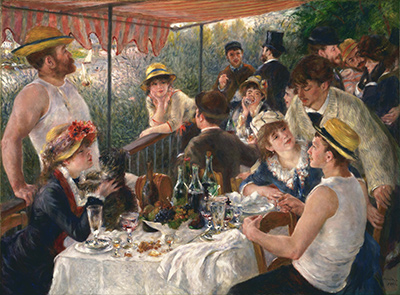
Explore a Montmartre dance, a gathering beside the Seine and the drawings behind Renoir’s paintings.
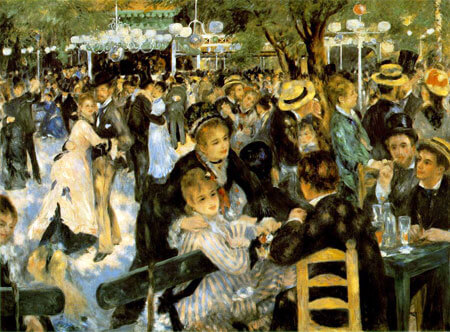
Renoir, Bal du moulin de la Galette
Dr. Beth Harris and Dr. Steven Zucker discuss Renoir’s 1876 Montmartre dance scene, its light and its crowds.
Watch on YouTubeThe page between the two girls
The sitter at the keyboard wears a pale dress and has light hair tied back. Her right hand reaches the keys while the left touches the edge of the music. The girl in pink leans over her shoulder, one hand on the chair and the other extended towards the score. Their actions make a small circuit: fingers, keys, page, pointing hand and paired faces. The sheet music joins them, although its marks need not be read as a score for a named piece.
Renoir gives the piano firm dark edges. Around it, hair, sleeves, ribbon, flowers and curtain move in softer lines. The seated girl's long dress runs from the keyboard towards the bottom of the canvas, binding her to the instrument. The standing figure closes the space behind her. The painting feels intimate because nearly every large shape directs attention back to the shared task. The Orangerie's account of a related version describes precisely this tension between a piano's geometry and the curved movements of the girls. It is a helpful comparison, while the details of this Lehman canvas must still be read from its own image. Met image [1]; Orangerie version essay. [3]
At the upper right, flowers in a vase balance the dark curtain and the two heads. At the lower edge, a visible corner of another object or fabric prevents the room from appearing empty. Renoir includes enough interior detail to suggest a comfortable household but little that locates a particular address. The Orangerie proposes that its related picture may have been made at Renoir's home, where he had given Aline a piano in 1890. That possibility should not be transferred to the Lehman canvas as a proven place of execution. Orangerie essay. [3]
One subject, several canvases
The Met says Renoir developed this composition through a series of five canvases. The Musée d'Orsay describes its own state-purchased picture plus three other finished versions, an oil sketch and a pastel. The Orangerie gives a broader “at least six other versions” count. These summaries use different boundaries between a finished painting, a sketch and another kind of study. A reader need not settle a new total to identify this object: Met 1975.1.201 is the Lehman oil, Orsay RF 755 is the state acquisition, and Orangerie RF 1960 16 is another related oil. Met record [1]; Orsay record [2]; Orangerie record. [3]
The series was an act of revision rather than simple reproduction. Renoir kept the pairing of a seated player and a standing companion while testing proportions, handling and finish. The girls' proximity, the open score and the upright piano survive from one painting to another; colour relationships and surrounding details can shift. To compare them well, keep each museum's accession, size and reproduction together. A detail seen in one canvas cannot automatically be described as a feature of all the others.
The French state's involvement explains why the subject acquired public importance in 1892. Orsay's account says friends including Stéphane Mallarmé and Roger Marx had been concerned that the state had not bought a Renoir, and the administration approached him about a picture for the Luxembourg. The Orsay canvas became that public acquisition. The Met canvas is an accomplished version of the same project held in a different collection. Orsay object essay and provenance. [2]
Music and domestic education
A piano in a nineteenth-century interior carried associations of education and cultivated leisure. A Met publication on keyboard instruments notes that musical ability was expected of many girls in households aspiring to culture. That context helps explain why a scene of two young players could feel familiar to Renoir's audience. It does not identify these particular sitters, reveal what they are playing, or tell us whether the painting records a real lesson. Metropolitan Museum of Art Bulletin, Keyboard Instruments, 1989. [4]
The painting is a constructed scene of attention. The standing girl seems to guide or follow the seated girl's reading, but the image does not label one a teacher or older sister. The girls' names are not supplied by the Met record. The Met does, however, identify the same unnamed pair of models in its In the Meadow, dated 1888–92: the blonde in white and brunette in pink pick flowers there rather than reading music. That is a useful comparison of Renoir's recurring figures, not proof that the two paintings record one event or establish a family relationship. Orsay and the Orangerie discuss possible models for related canvases, but those comparisons do not establish names for the Lehman painting. Met, In the Meadow. [5]
The Lehman canvas in the Met
The museum credits the work to the Robert Lehman Collection, 1975. Its present object record is the authority for title, dimensions, media status and display location. The Met identifies the image as public domain and provides an open-access download, making it possible to compare this exact canvas with the Orsay and Orangerie versions using correctly attributed reproductions. Its current display can change; consult the owner record before planning a visit. Met object and open-access record. [1]
The Met also connects the Lehman canvas with a nearly identical version once owned by Renoir's fellow Impressionist Gustave Caillebotte. That comparison is about the painting's place in the series. It is not a provenance claim that this Lehman canvas passed through Caillebotte's collection. Keeping that distinction prevents the history of one version from drifting onto another. Met object interpretation. [1]
Looking again
Start with the score, then follow the seated girl's hand to the keys and the standing girl's hand back to the page. Look at the flowers and curtain only after tracing that circuit. The room feels full, yet the music binds its parts together. Renoir repeated the subject because its apparently simple meeting of two people offered room for careful change. The Lehman painting deserves to be read as its own completed work, beside rather than in place of the state-owned Orsay picture.
Renoir artworks directory
Questions about Two Young Girls at the Piano
No. This page shows the Metropolitan Museum of Art's Lehman canvas, 1975.1.201. The French state purchased a different version now at the Musée d'Orsay, RF 755.
The Met describes five canvases in the series. Orsay and the Orangerie count related finished works and studies differently. The museums agree that this subject exists in several distinct versions.
The Met does not provide secure names or a family relationship for the girls in this canvas. The picture shows shared attention to music, not a documented family tree.
It belongs to the Metropolitan Museum of Art, New York, accession 1975.1.201. Check the current object page for display details.
Discussion
What do you notice when you return to Two Young Girls at the Piano?
How do the two girls’ hands guide your eye between the score and the keyboard?
Reader Insights
How do the two girls’ hands guide your eye between the score and the keyboard?
The Met identifies this as its Lehman canvas, distinct from the French state’s Orsay painting.
Which details would you check before comparing two versions of the piano scene?
Join the Conversation
Share a close observation or a source-backed question about Renoir’s Two Young Girls at the Piano.
References
- Metropolitan Museum of Art, Two Young Girls at the Piano, 1975.1.201, current owner record, five-canvas project summary, dimensions and public-domain media View source.
- Musée d'Orsay, Jeunes filles au piano, RF 755, distinct state-purchased 1892 version and acquisition history View source.
- Musée de l'Orangerie, Jeunes filles au piano, RF 1960 16, related oil sketch, subject and version context View source.
- Metropolitan Museum of Art Bulletin, Keyboard Instruments, 1989, historical context for domestic piano playing View source.
- Metropolitan Museum of Art, In the Meadow, 51.112.4, owner comparison identifying the same unnamed models in a distinct 1888–92 painting View source.
- Whole-work image: Met official open-access image endpoint, public domain per current owner record View source.