by Tom Gurney
Tom Gurney BSc (Hons) is an art history expert with over 20 years experience
Published on June 19, 2020 / Updated on October 2, 2026
Email: tomgurney1@gmail.com / Phone: +44 7429 011000
A woman turns her head toward us from a rocking chair. Her dark hair and face are more carefully described than her loosely shaded dress, while the chair’s scrolling sides nearly take over the lower half of the sheet. This is Renoir’s Woman Seated in a Chair, a drawing made about 1883 and now in the Art Institute of Chicago, accession 1943.520R. The museum’s study reveals a second, unfinished figure on the reverse, catalogued as 1943.520V. One sheet holds two different ways of looking at a seated woman. Art Institute of Chicago, cat. 18. [1]
The older page at this address showed the front of the drawing. The exact Art Institute image matches that local composition, including the curl of the rocker and the estate stamp near the lower right. The museum record gives a firmer identity than the general title alone and makes it possible to explain both sides without inventing a sitter’s name or a story for her pose. Art Institute catalogue and technical record. [1]
At a glance
- ArtistPierre-Auguste Renoir
- FrontWoman Seated in a Chair, 1943.520R
- BackWoman Seated in a Chair, Seen from the Back, 1943.520V
- Datec. 1883, according to the Art Institute
- MediumCharcoal, with graphite, touches of stumping and erasure on the front; graphite on the back
- Support and sizeIvory wove paper, 36.2 × 31 cm
- CollectionArt Institute of Chicago, Samuel P. Avery Fund
Watch: Pierre-Auguste Renoir
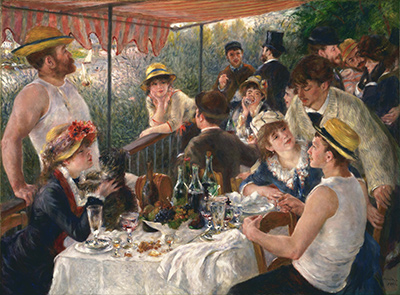
Explore a Montmartre dance, a gathering beside the Seine and the drawings behind Renoir’s paintings.
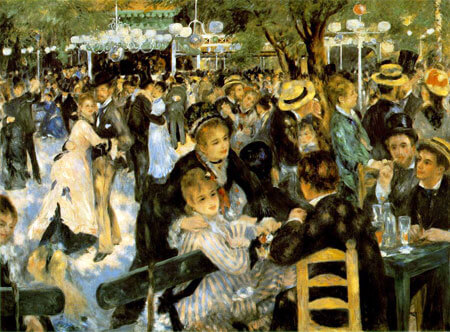
Renoir, Bal du moulin de la Galette
Dr. Beth Harris and Dr. Steven Zucker discuss Renoir’s 1876 Montmartre dance scene, its light and its crowds.
Watch on YouTubeLooking at the front
The woman sits cross-legged and turns her head out of the drawing. Renoir gives little to the setting: a small shaded area beside her face and a line near the bottom are the main clues to space. The model’s right arm bends across her body, but the hand dissolves into faint marks. The museum describes the sketch as quickly executed, with energetic shading and loose lines. These are visual and technical observations, not evidence that the sitter was caught in an unplanned private moment. Art Institute catalogue essay. [1]
The rocking chair is unusually assertive. Its curved sides repeat and enlarge the rounded lines of the seated body; the lower rocker stretches nearly across the sheet. Renoir uses a searching line beneath it to suggest a shadow or slight movement. The figure and chair are therefore equally important to how the drawing feels: the woman's calm gaze is held inside a lively structure of curls and sloping marks. The Art Institute points to the chair’s ornament and the blurred feet as part of that impression of motion. Art Institute catalogue essay. [1]
Her contemporary dress matters even though Renoir has not given it a detailed texture or pattern. The museum places the sheet before his greater turn toward timeless bather subjects in the mid-1880s. It compares Renoir’s interest in modern clothing here with earlier pictures of women in fashionable dress, including The Parisienne of 1874. This comparison locates the drawing within Renoir’s changing interests; it does not identify this model as the woman in that painting. Art Institute catalogue essay. [1]
Charcoal, graphite and the paper
The Art Institute’s conservator identifies charcoal as the main medium of the front. Broad, soft charcoal passages suggest the dress, body and chair. Renoir used harder graphite lines for the face, hair and cloth around the neck. Some tonal variation in the hair appears to come from stumping or erasure, and erasure may also have helped lift out the hands. Those qualifications matter: the technical report describes what examination supports, rather than presenting every pale line as a certain deliberate correction. Art Institute technical report. [1]
The support is ivory wove paper with a J. Whatman, Turkey Mill, 1881 watermark. That year is a date in the paper, not a date assigned to the drawing; the museum dates the work about 1883. The sheet keeps a deckled top edge, with irregularly torn sides and a straight-trimmed bottom. Its physical boundaries help explain why the image looks like an individual working sheet rather than a finished painting translated into black and white. The current official image includes the lower margin and later marks visible on the object. Art Institute support report. [1]
At the lower right is a Renoir estate stamp. It was applied after the artist’s death, according to the museum’s mark documentation; it should not be read as a pen signature made while he drew the seated woman. The museum finds no visible compositional revisions on the front under its examination conditions. That finding does not mean the drawing was prepared without thought; it simply limits what can be inferred from the surviving sheet. Art Institute technical report and mark documentation. [1]
A second woman on the back
The reverse holds a faint, unfinished graphite sketch of a woman seen from behind, with hair gathered in a bun and a towel or shawl loosely around her back. It is not a mirrored copy of the seated, dressed figure on the front. The Art Institute says infrared imaging makes the reverse easier to see and compares it with some of Renoir’s bather studies. It describes that relationship as a possibility, not an established preparatory role for a particular later painting. Art Institute catalogue and technical report. [1]
The two sides show a striking difference. On the front, a dressed woman inhabits a recognizably modern chair; on the back, a lightly drawn body and draped cloth have almost no setting. Turning a sheet over does not necessarily reveal an intended pair or a chronological sequence of ideas. The owner provides no firm order of execution. It does, however, reveal how freely Renoir could reuse a piece of paper for different figure problems. Art Institute catalogue. [1]
How it reached Chicago
The Art Institute traces the drawing from Renoir’s estate after 1919 to the Paris dealer André Schoeller. Its provenance then records a sale by Justin K. Thannhauser in New York to the Art Institute in 1943. The museum notes a dealer photograph dated July 1939 and an estate stamp. Those records establish a documented later life for a fragile sheet whose original studio purpose remains less certain. Art Institute provenance and notes. [1]
Looking again
Begin at the head, where graphite sharpens the facial features against the softer charcoal around it. Follow the diagonal of the woman’s body down to the rocker’s looping ends. The chair seems lively even though the figure appears at rest. Then remember that the faint reverse presents another study on the same paper: the front image is only one part of the object.
Renoir artworks directory
Questions about Woman Seated in a Chair
No. The front is a charcoal and graphite drawing on paper, with touches of stumping and erasure identified by the Art Institute.
The Art Institute’s object title does not name the sitter. The drawing shows a woman in contemporary dress, and the page does not assign her an identity without a supported object record.
1943.520R identifies the front; 1943.520V identifies the unfinished graphite drawing on the reverse of the same sheet.
No. 1881 is the date in the paper watermark. The Art Institute dates Renoir’s drawing about 1883.
Discussion
What do you notice when you return to Woman Seated in a Chair?
How do the scrolling chair and the model’s pose work together on the front of the sheet?
Reader Insights
How do the scrolling chair and the model’s pose work together on the front of the sheet?
The Art Institute records a faint second woman on the reverse, visible more clearly with infrared imaging.
What can the 1881 paper watermark tell us without making it the drawing’s date?
Join the Conversation
Share a close observation or a source-backed question about Renoir’s Woman Seated in a Chair.
References
- Nancy Ireson and Kimberly Nichols, Art Institute of Chicago, cat. 18, essay and technical report. Front and reverse, medium, paper, watermark, condition and provenance View source.
- api.artic.edu, Art Institute Open Access record 113275 View source.
- api.artic.edu, official IIIF image View source.