by Tom Gurney
Tom Gurney BSc (Hons) is an art history expert with over 20 years experience
Published on June 19, 2020 / Updated on October 2, 2026
Email: tomgurney1@gmail.com / Phone: +44 7429 011000
A young boy stands with his back turned, holding a cat close to his shoulder. He twists his head to look at the viewer. The gesture makes the scene feel private and suddenly observed, but the pose is deliberate and unusual within Renoir's work. The Musée d’Orsay identifies the painting as Le Garçon au chat, dated 1868, an oil on canvas measuring 123.5 × 66 cm. Its accession number is RF 1992 409. The boy's name is unknown. Musée d’Orsay object record. [1]
The English route title, Young Boy with a Cat, points to this Orsay canvas. It should not be confused with Renoir's later Child with Cat (Julie Manet): that work has a different sitter, date, format and owner. Even if two Renoir pictures include children and cats, subject words alone do not establish an object identity. The Orsay painting is recognized by the back view, the cat held at shoulder height and the boy's over-the-shoulder gaze.
At a glance
- ArtistPierre-Auguste Renoir
- French titleLe Garçon au chat
- Date1868, signed and dated by the artist
- MediumOil on canvas
- Dimensions123.5 × 66 cm
- SitterUnidentified boy
- CollectionMusée d’Orsay, Paris
- AccessionRF 1992 409, acquired at public auction in 1992
Watch: Pierre-Auguste Renoir
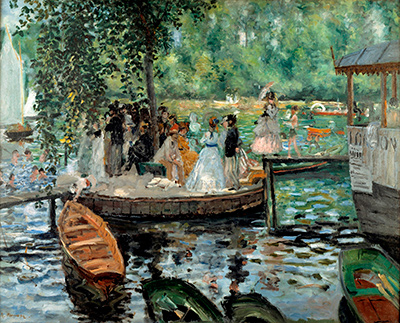
Explore a Montmartre dance, a gathering beside the Seine and the drawings behind Renoir’s paintings.
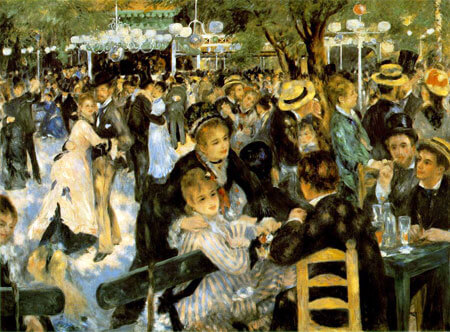
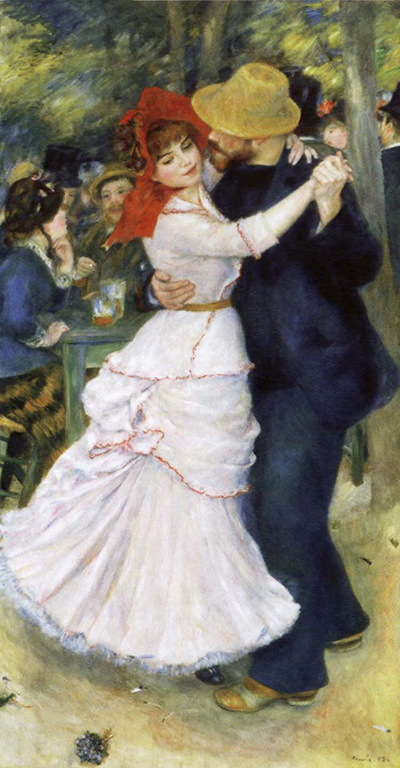
Renoir, Bal du moulin de la Galette
Dr. Beth Harris and Dr. Steven Zucker discuss Renoir’s 1876 Montmartre dance scene, its light and its crowds.
Watch on YouTubeWhat the composition shows
The canvas is tall and narrow. The boy's body occupies much of its height, while the cat and turned head give the upper part a more intimate focus. We see his back before we meet his gaze. That sequence differs from a conventional frontal portrait, in which face and identity lead the encounter. Here, the viewer first notices posture, skin and the animal pressed against the boy, then realizes that he is looking back.
The Musée d’Orsay describes the model as seen from behind and cuddling the cat. It says the identity remains unknown and finds no clear mythological subject. Those limits matter. The painting invites questions about who the child was and why Renoir chose this pose, but it does not supply the answers. The gesture of holding an animal can be described without inventing a family relationship or an allegorical meaning. Musée d’Orsay interpretive notice. [1]
The cat creates a small zone of contact against the boy's exposed body. His glance draws attention back out towards us. The pose thus connects touch and looking, intimacy and display. Renoir avoids a lavish interior or a narrative event that would explain the moment. Cloth and furnishings offer enough setting to support the figure, while leaving the viewer to attend to the turn of the body.
The museum describes a cool colour harmony and a relatively realistic treatment, connecting both to Renoir's early interest in Courbet and Manet. That does not mean this painting copies a specific canvas by either artist. It means the cold tones and unidealized pose belong in a conversation with recent French painting, rather than with the warm, soft figures by which Renoir is often remembered. Musée d’Orsay context. [1]
An early Renoir, before Impressionism’s exhibitions
The signature and date read “Renoir 68” in the museum's object details. In 1868 the first Impressionist group exhibition still lay six years ahead. Renoir was working among peers including Frédéric Bazille, Alfred Sisley and Claude Monet, while trying to secure recognition through the Salon. The Orsay notice describes his rejection at the Salons of 1866 and 1867 and the success of his large outdoor portrait Lise with a Parasol. Young Boy with a Cat belongs to that searching moment, not to a settled late style. Musée d’Orsay historical account. [1]
The comparison with Lise with a Parasol is useful because the subjects and formats are so different. Lise is clothed and placed outdoors, standing almost full length under a parasol. This boy is turned away and holds an animal close to his body. The two pictures show Renoir testing what a large single figure could do, rather than repeating one successful portrait formula.
The Orsay calls the male nude without an equivalent in Renoir's work. It is a precise claim about this configuration, not a statement that Renoir never represented male figures. He painted male friends, patrons and workers, and later made many studies of the human figure. What remains exceptional here is the combination of a young male nude, a cat, a back view and a direct look at the viewer. Musée d’Orsay interpretation. [1]
Ownership and the 1992 acquisition
The museum's provenance begins with the Paris collection of Edmond Maître, then lists Eduard Arnhold in Berlin. It records a Christie's London sale in 1981, a private collection in Japan, and a Sotheby's New York sale on 10 November 1992. The painting was acquired at that auction with the support of Philippe Meyer and assigned to the Musée d’Orsay. These named points do not account for every move between owners; the intervals should remain intervals rather than a continuous invented story. Musée d’Orsay provenance. [1]
The acquisition added a rare early work to a collection better known for Renoir's mature pictures. The Orsay's record says the early years were underrepresented when the painting was purchased. The object has since been included in exhibitions about Renoir's beginnings and the origins of Impressionism. An exhibition history records occasions when a work was shown; it does not establish that every visitor saw it or that it is currently on display. Musée d’Orsay collection and exhibition history. [1]
The page image comes from a book-derived Wikimedia Commons reproduction that is labelled with a Public Domain Mark. Its narrow format and figure have been visually matched to Orsay RF 1992 409. Commons source file. [2]
Looking again
Begin with the cat rather than the boy's face. Follow the child's arms into the curve of his back, then turn with his head to meet the glance. The picture offers no secure story about the child, but it gives a carefully organized encounter between sitter, animal and spectator. Its cool palette and unusual pose make it a useful reminder of how varied Renoir's early figure painting could be.
Renoir artworks directory
Questions about Young Boy with a Cat
The Musée d’Orsay does not know his identity. The painting can be identified as Orsay RF 1992 409 without assigning a name to its model.
Renoir signed and dated it 1868. The Orsay records it as an oil on canvas measuring 123.5 × 66 cm.
No. The Orsay painting shows an unidentified boy from the back in 1868. Child with Cat (Julie Manet) is a separate Renoir painting with another sitter and object history.
It belongs to the Musée d’Orsay, Paris, accession RF 1992 409. Check the museum's current record for display details.
Discussion
What do you notice when you return to Young Boy with a Cat?
How does the boy’s glance change a scene you first see from behind?
Reader Insights
How does the boy’s glance change a scene you first see from behind?
The Musée d’Orsay identifies the exact canvas but does not name its young model.
What separates this 1868 painting from the later Child with Cat portrait?
Join the Conversation
Share a close observation or a source-backed question about Renoir’s Young Boy with a Cat.
References
- Musée d’Orsay, Le Garçon au chat, RF 1992 409, object identity, interpretation, inscription, provenance and exhibition record View source.
- Whole-work image: Wikimedia Commons book reproduction, Garçon au chat, Public Domain Mark on file page. Visually matched to Orsay RF 1992 409 and exported under the existing local filename; its tones are cooler and flatter than Orsay's current photograph, so the museum image is the better guide to fine colour View source.