Pierre-Auguste Renoir.jpg)
 by Tom Gurney
Tom Gurney BSc (Hons) is an art history expert with over 20 years experience
Published on June 19, 2020 / Updated on October 2, 2026
Email: tomgurney1@gmail.com / Phone: +44 7429 011000
A girl stands in a garden holding an open parasol over one shoulder. Her dark sailor-style outfit, lace cuffs, red-trimmed hat and sturdy black boots are painted with more definition than the flowers and foliage around her. This is Aline Nunès, the daughter of Alfred Nunès, whom Renoir visited at Yport on the Normandy coast in 1883. The Barnes Foundation’s scholarly catalogue [1] reproduces this exact portrait as Portrait of Aline Nunès and places it beside the artist’s companion portrait of her brother Robert.
The route’s title, Young Girl with a Parasol, is a descriptive English name for the same canvas. Aline is sometimes spelled “Nunes” without the accent in older English captions; the Barnes catalogue uses Nunès. The parasol, clothing and standing pose make the local image identifiable against its catalogue illustration. Her brother’s portrait has a sea background and remains in the Barnes Foundation, but Aline’s painting followed a different ownership path.
Contents
- The painting at a glance
- A child in a garden
- The Nunès family at Yport
- How Aline’s portrait differs from Robert’s
- A shared purchase and a later separation
- The picture as a portrait
Watch: Pierre-Auguste Renoir
Explore a Montmartre dance, a gathering beside the Seine and the drawings behind Renoir’s paintings.
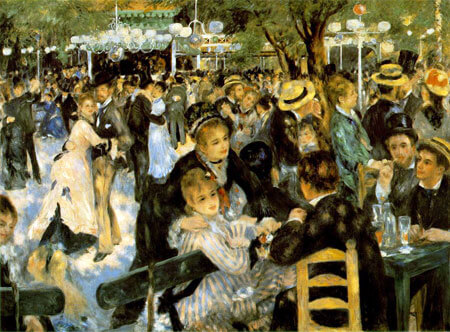
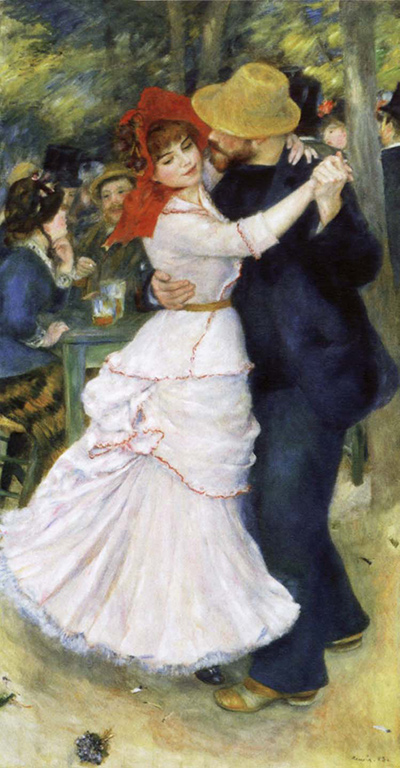
Renoir, Bal du moulin de la Galette
Dr. Beth Harris and Dr. Steven Zucker discuss Renoir’s 1876 Montmartre dance scene, its light and its crowds.
Watch on YouTubeAt a glance
- ArtistPierre-Auguste Renoir (1841–1919)
- SitterAline Nunès, daughter of Alfred Nunès
- TitlesPortrait of Aline Nunès; Young Girl with a Parasol
- Date1883, in the Barnes Foundation catalogue
- MediumOil on canvas
- Listed size130 × 79 cm in the Web Gallery of Art [2]; not confirmed here against a current owner record
- Last documented status used herePrivate collection in the Barnes catalogue; current owner and display location unverified
The Barnes source establishes the sitter, date, family context and the relationship to Robert’s portrait. The 130 × 79 cm measurement comes from a secondary gallery listing, so it should be checked against an owner, exhibition or sale record before a final fact-box release. No current public collection record for Aline’s canvas has been verified in this review.
A child in a garden
Aline stands nearly full length in the centre of a tall canvas. Her feet turn outward on green ground, and she looks slightly to the viewer’s left. One hand holds the shaft of the parasol; the other rests lower, near a small hanging accessory. The umbrella arcs behind her head, its grey-blue surface edged with warmer red. It gives a pale halo to the dark hat and jacket without being confused with either of them.
The clothes make a strong silhouette. A dark fitted coat falls over a light skirt or hem, with white lace at the collar and wrists. Long dark stockings continue the shape towards heavy shoes. The red accent beside the hat and small warm strokes among the flowers punctuate the black and green. Renoir paints Aline’s face gently, keeping it clearer than the loose foliage around it, so we can recognise a named child within a lively setting.
Behind her, the garden is not laid out as a precise botanical inventory. Dense leaves occupy the right, while red blossoms at left and yellow-green strokes below bring colour close to her dark clothing. The parasol and figure are comparatively stable; the vegetation seems to flicker around them. This makes the setting feel active without requiring a definite season, time of day or named plant species that the catalogue does not supply.
The parasol has a practical role in the pose and a visual one in the composition. Its long shaft forms a diagonal through the dark dress. Its pale canopy opens a second shape around the head, giving the viewer a way into the portrait before following the face, hands and clothes down the canvas. Renoir can keep the garden loose because the umbrella and figure hold the painting’s structure.
The Nunès family at Yport
The Barnes catalogue records Renoir’s August 1883 visit to Alfred Nunès, mayor of Yport and a relative of Camille Pissarro. Renoir painted two of Alfred’s children, Aline and Robert, during the stay. The source describes Aline’s setting as a domestic garden, presumably at the family villa. “Presumably” is important: the exact spot in which she stood and the stages of the painting process are not documented by a site plan or working notes.
Robert’s companion painting, Sailor Boy (Portrait of Robert Nunès) [3], shows him against the sea and cliffs near Yport. He wears a blue sailor suit and holds a shellfish tool. Aline’s dark outfit has sailor-like features too, but her background is a garden and her prop a parasol. The Barnes scholars note this distinction between public coast and private garden and discuss how the paired settings reflect nineteenth-century expectations for boys and girls. That is a reading of the portraits’ presentation, not a complete biography of either child.
Renoir’s visit to Yport belongs to his broader work for families who spent time along the Normandy coast. The two Nunès canvases show how he could use a recognisable environment while placing a child firmly at the centre. Robert’s portrait is tied to a shore view; Aline’s uses foliage and flowers. The pairing invites comparison, but each picture has its own composition and later history.
How Aline’s portrait differs from Robert’s
Both children stand upright in unusually tall portraits. Robert’s background opens to distant water, while Aline’s closes around her with leaves and flowering plants. His suit is vivid blue with a red pompom; her clothes are mostly dark, relieved by white lace and the parasol’s pale surface. In his picture, the sea provides a horizontal distance behind the figure. In hers, the canopy and garden create a more enclosed space.
The difference is not simply a change of backdrop. In Aline’s portrait, the umbrella’s diagonal directs attention to her hands and face. The foliage presses close enough for her dark outline to alternate between clear and partly absorbed. The picture’s intimacy comes from that proximity. Robert’s pose and coastal prospect make him appear farther out in the open. Neither arrangement tells us how the children felt about posing; both are constructed visual presentations made by Renoir.
The comparison also guards against a common source error. Barnes owns Robert’s BF325, not Aline’s current canvas. Its object number, dimensions, provenance after their separation and present display details cannot be transferred to her work. The Barnes catalogue illustrates Aline precisely because the paintings were once paired, then explains that Barnes later sold her portrait.
A shared purchase and a later separation
According to the Barnes catalogue, Albert C. Barnes purchased both Nunès portraits in 1914. He kept Robert’s painting, which remains in the foundation’s collection, but sold Aline’s sometime after 1935. The source does not give a precise disposal date in the passage used here. Its illustration caption describes Aline’s work as in a private collection. That is a historical catalogue status, not a verified statement of present ownership.
This sequence explains why a search for Aline may return Barnes material without a Barnes object page for the painting itself. The foundation’s research provides an important visual and historical identification, while the separate canvas’s subsequent location needs its own evidence. Older listings have associated the painting with particular private collections, but they should not be presented as the current owner without a dated, exact-object source.
The Web Gallery of Art [2] lists the canvas as 1883, oil on canvas, 130 × 79 cm, privately held. This supports a working size and medium but is not an owner’s technical record. The painting’s tall shape in the local reproduction is consistent with that listing, yet visual proportions cannot authenticate centimetre measurements. The final published facts should preserve the distinction between Barnes’s scholarly identification and the secondary size listing.
The picture as a portrait
This painting is more than a generic image of a girl in sunshine. The sitter’s name connects it to a specific family, place and companion portrait. The dark tailored clothes and visible lace show how she was presented, while Renoir’s handling of the garden gives the scene movement. The parasol lifts colour and light around her head, setting a pale arc against the plants and directing the viewer to her face.
It would be tempting to turn the expression into a story about Aline’s mood, or to describe the garden as a spontaneous outdoor sitting. The accessible catalogue does not establish either. We can observe her slight sideways gaze and the lively brushwork. We can place the canvas within Renoir’s 1883 visit to Yport and the paired portraits of the Nunès children. Those are firmer and more useful facts than a guessed conversation or exact hour in the garden.
The original location remains open in this review. Readers looking for the work should use a current exhibition or owner catalogue before planning a visit. For the picture itself, begin at the umbrella’s bright rim, follow its shaft to Aline’s hand, then let the dark coat and white lace lead the eye to the boots. The surrounding colour will become more active as the figure’s clear outline gives way to garden marks.
Renoir artworks directory
Questions about Young Girl with a Parasol
She is Aline Nunès, daughter of Alfred Nunès, mayor of Yport. The Barnes Foundation’s catalogue identifies her in the companion portrait to her brother Robert’s Sailor Boy.
The Barnes catalogue dates her portrait to 1883, during Renoir’s visit to the Nunès family at Yport that August.
The painting depicts a domestic garden. Barnes scholars consider it presumably the garden at the Nunès villa, but the exact location and working sequence are not verified.
No. Barnes bought both children’s portraits in 1914 and later sold Aline’s sometime after 1935. Robert’s portrait remains in the foundation.
The Barnes catalogue identifies it as privately held. A current owner or public display location has not been verified here.
Discussion
What do you notice when you return to Young Girl with a Parasol?
How does the pale parasol frame Aline’s face?
Reader Insights
How does the pale parasol frame Aline’s face?
The Barnes catalogue identifies this as Aline Nunès’s 1883 companion portrait to Robert’s Sailor Boy.
What changes when you compare Aline’s garden with Robert’s coast?
Join the Conversation
Share a close observation or a source-backed question about Aline’s portrait.
References
- Barnes Foundation, Renoir in the Barnes Foundation, catalogue 17: exact image of Aline’s portrait, identity, 1883 Yport visit, comparison with Robert, 1914 paired purchase and subsequent sale View source.
- Web Gallery of Art, Young Girl with a Parasol (Aline Nunès): secondary listing for 130 × 79 cm and oil-on-canvas medium; size awaits owner-level verification View source.
- Barnes Foundation, Sailor Boy (Portrait of Robert Nunès), BF325: the separate companion portrait and its present owner record View source.