by Tom Gurney
Tom Gurney BSc (Hons) is an art history expert with over 20 years experience
Published on June 19, 2020 / Updated on October 2, 2026
Email: tomgurney1@gmail.com / Phone: +44 7429 011000
A girl turns to the left against a warm, loosely painted background. Her pale dress slips across the shoulders and a blue ribbon circles her neck, tied into a bow. The ribbon is small but vivid: it separates her face and upper body from the red-orange field. Pierre-Auguste Renoir's Jeune fille au ruban bleu is dated 1888 by the Musée des Beaux-Arts de Lyon, where it is catalogued as 1997-47. The English route Young Woman with a Blue Ribbon refers to this exact oil painting. Lyon collection record. [1]
The museum's French title means “young girl with a blue ribbon”. Neither it nor the English title supplies the sitter's name. A blue ribbon appears in other nineteenth-century portraits, and Renoir painted many girls, so the Lyon accession number is the safest way to distinguish this canvas. Its size is 55.7 × 46.3 cm without the frame. Lyon object details. [1]
At a glance
- ArtistPierre-Auguste Renoir
- French titleJeune fille au ruban bleu
- Date1888
- MediumOil on canvas
- Size55.7 × 46.3 cm, without frame
- SitterUnidentified girl; no name in the owner record
- CollectionMusée des Beaux-Arts de Lyon
- Inventory1997-47
Watch: Pierre-Auguste Renoir
Explore a Montmartre dance, a gathering beside the Seine and the drawings behind Renoir’s paintings.
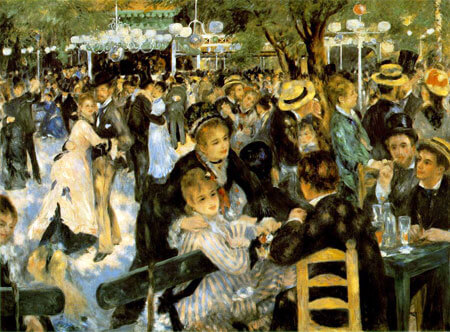
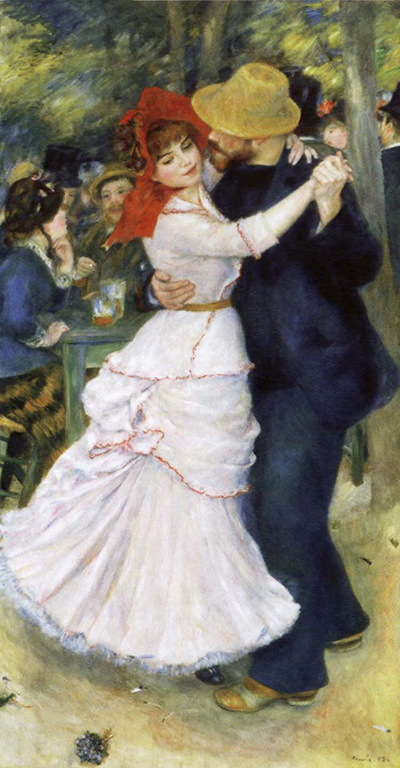
Renoir, Bal du moulin de la Galette
Dr. Beth Harris and Dr. Steven Zucker discuss Renoir’s 1876 Montmartre dance scene, its light and its crowds.
Watch on YouTubeWhat the ribbon does in the picture
Renoir gives the neck ribbon a sharply recognizable colour while letting the background shift through warm reds, browns and greens. The bow hangs beneath the chin, between the pale face and the pale garment. It helps the viewer read where the head turns and how the shoulders sit. The detail is descriptive, but it also organizes the portrait's colour. Removing it in imagination makes the neck and dress merge more readily.
The sitter faces away from the viewer in profile, so the painting depends less on a returned gaze than on outline and posture. Her nose, lips and chin form a clear contour against the orange field. A brown ponytail falls behind the ear; the lower body is cut off by the canvas. Renoir has not filled the background with furniture or a named room. The warm paint around the figure carries enough variation to keep the setting active without turning it into a second subject.
The girl's bare shoulders and loosely placed dress are visible facts. They do not tell us her social status, whether the garment was everyday clothing, or what she thought of the sitting. The museum's keyword list describes a girl, profile, shoulder, dress and costume ribbon, but gives no biographical identification. This page keeps the reading at that level rather than inventing a story for her. Lyon descriptive fields. [1]
The face is more firmly described than some of the background. Light blue and grey strokes pass through the white dress, while the orange backdrop stays visibly brushed. Such differences make it too simple to label the whole canvas either tightly drawn or wholly loose. Renoir could use a controlled profile and free colour at the same time in this late-1880s portrait.
Renoir in 1888
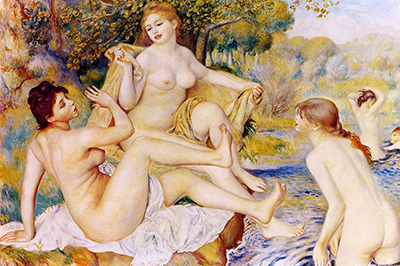
By 1888 Renoir had worked through several years of experiments with figure design after his 1881 journey to Italy. He had studied old art and prepared large figure compositions with drawings. The Lyon portrait does not require us to force those developments into a single “new style”, but its defined profile beside open brushwork makes the relationship between line and colour easy to examine. Compare it with The Great Bathers of the mid-1880s, where large figures were prepared through many studies, or with the later Girls at the Piano, where two figures are organized around music.
Renoir's interest in portraiture also had practical consequences. Portrait commissions and dealers gave him audiences beyond the independent Impressionist exhibitions. The verso of the Lyon painting carries a Durand-Ruel label calling it Fillette au ruban, a useful object-specific trace of the dealer's handling or inventory. A label is evidence for an association with the dealer, but without a dated transaction record it should not be turned into a precise sale story. Lyon inscription and label record. [1]
The reverse also bears a printed label for a Renoir exhibition at Bernheim-Jeune in January 1900. The museum's bibliography lists several possible catalogue numbers for that show, rather than one secure match. It is fair to say the label associates this canvas with the exhibition; it would be overconfident to assign a single 1900 catalogue entry from the available record. Lyon labels and bibliography. [1]
Ownership through the twentieth century
The museum lists Durand-Ruel and Bernheim-Jeune among earlier galleries and names Paul Harth and Marguerite Pacquement in the ownership trail. Its record documents two transactions in May 1943 through Galerie Raphaël Gérard: an acquisition recorded on 21 May and a sale on 28 May, with prices noted in the dealer ledgers. Myran Eknayan acquired the painting in 1943. The Lyon record cites Wildenstein Plattner Institute registers for those entries. These wartime dates deserve careful research; the transaction list alone does not establish the circumstances, voluntariness or restitution status of any sale. Lyon provenance and archival references. [1]
The painting later passed to Jacqueline Delubac in 1985. She bequeathed it to the Lyon museum in 1997. The collection record is unusually detailed about the object itself: it records a signature at lower left, numbers on the stretcher and frame, and the dealer and exhibition labels. Those physical marks help connect the present canvas to earlier records despite shifts in title from Fillette au ruban to Jeune fille au ruban bleu. Lyon collection history. [1]
The reproduction on this page is an independent 2013 museum photograph by Jean-Pierre Dalbéra, supplied through Wikimedia Commons under CC BY 2.0. A Commons contributor cropped away the frame, and this web copy was resized and recompressed. This is distinct from the Lyon museum's own photograph credited to Alain Basset on its object page. The separate licenses should not be confused. Dalbéra photograph and license [2]; Lyon object image credit. [1]
Looking again
Trace the profile from forehead to chin, then follow the blue ribbon down across the neck. Compare the firmness of those forms with the warmer, more mobile strokes behind the head. The portrait does not identify its model, yet the specific turn of her face and the painted relation between skin, fabric and background keep her from becoming a generic “Renoir girl”.
Renoir artworks directory
Questions about Young Woman with a Blue Ribbon
The Lyon museum does not name her. The work can be securely identified as its 1888 canvas 1997-47 without assigning the girl an identity.
The owner dates it 1888. It is an oil on canvas measuring 55.7 × 46.3 cm without its frame.
The Lyon record uses Jeune fille au ruban bleu. A Durand-Ruel label on its stretcher calls it Fillette au ruban. Both refer to this Lyon canvas in the object record.
It belongs to the Musée des Beaux-Arts de Lyon, inventory 1997-47, through the Jacqueline Delubac bequest.
Discussion
What do you notice when you return to Young Woman with a Blue Ribbon?
How does the blue ribbon divide the pale figure from the warm background?
Reader Insights
How does the blue ribbon divide the pale figure from the warm background?
The Lyon museum records dealer and exhibition labels but does not name the sitter.
Which details are visible in the canvas, and which require its documented reverse?
Join the Conversation
Share a close observation or a source-backed question about Renoir’s Young Woman with a Blue Ribbon.
References
- Musée des Beaux-Arts de Lyon, Jeune fille au ruban bleu, 1997-47, identity, dating, measurements, marks, provenance and exhibition history View source.
- Whole-work photograph, Jean-Pierre Dalbéra, Pierre-Auguste Renoir (Musée des Beaux-arts de Lyon) View source.
- Creative Commons, CC BY 2.0 View source.