by Tom Gurney
Tom Gurney BSc (Hons) is an art history expert with over 20 years experience
Published on June 19, 2020 / Updated on October 2, 2026
Email: tomgurney1@gmail.com / Phone: +44 7429 011000
One young woman faces us, her fingers resting near her mouth. Another leans towards her from the right, shown in profile. They wear dark dresses and hats, yet the painting is full of colour: pale faces and hands, warm brown furniture, and shifting green and cream marks behind them. Pierre-Auguste Renoir painted Young Women in Black, also translated Girls in Black, in 1880–82. It belongs to the Pushkin State Museum of Fine Arts in Moscow, inventory Ж-3329. Pushkin collection record. [1]
The museum catalogues the canvas as 81.3 × 65.2 cm, oil on canvas. Its title describes the clothing rather than naming the sitters. The public object entry does not identify either woman, and a viewer cannot recover their names from their fashionable dress. That restraint matters because the two poses can suggest a conversation without telling us what is said. Pushkin collection record. [1]
At a glance
- ArtistPierre-Auguste Renoir
- Owner titleGirls in Black (Девушки в черном)
- English page titleYoung Women in Black
- Date1880–82
- MediumOil on canvas
- Size81.3 × 65.2 cm
- CollectionPushkin State Museum of Fine Arts, Moscow, Ж-3329
Watch: Pierre-Auguste Renoir
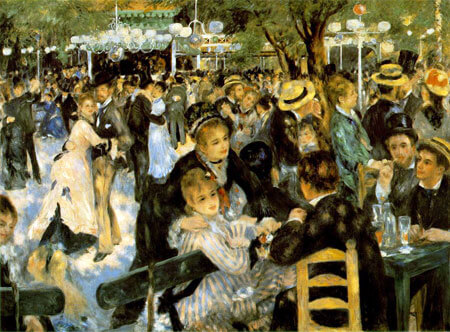
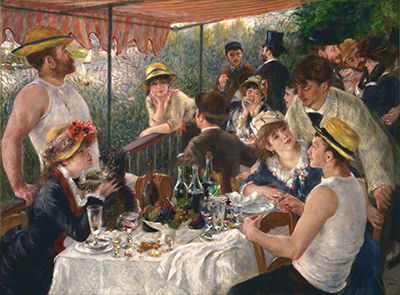
Explore a Montmartre dance, a gathering beside the Seine and the drawings behind Renoir’s paintings.
Renoir, Bal du moulin de la Galette
Dr. Beth Harris and Dr. Steven Zucker discuss Renoir’s 1876 Montmartre dance scene, its light and its crowds.
Watch on YouTubeTwo poses, two kinds of attention
The woman at left sits almost frontally. A soft black hat frames her face, and the fingers at her lips make her gaze appear inward and thoughtful. The woman on the right bends towards her, but Renoir turns that face sideways. Their heads are close while their eyes do not meet. It is possible to read a social exchange into this arrangement, but the visible evidence is subtler: one figure confronts the viewer, the other directs attention towards her. Pushkin object record and image. [1]
Black is the stated subject, but Renoir varies it. The nearer dress absorbs light around its bodice and skirt; buttons and a pale collar break the surface. On the right, the dark clothing is interrupted by a grey scarf or bodice and the white shape beside the face. The uncovered hands and faces become the brightest anchors. Because the figures overlap against a busy background, those light shapes also help us separate one body from another. Pushkin collection image. [1]
Look just behind the hats. Other heads and silhouettes appear among light walls and greenish marks. The image has the feel of a public setting, though the museum's brief object record does not give a verified address or establishment. An account on the Russian Culture portal describes a Parisian café; that is one interpretation of the setting, and the canvas itself does not display a sign that would identify a specific café. The foreground figures remain the point of focus. Pushkin collection record [1]; Culture.ru, Girls in Black. [2]
Clothing as a visual structure
The dark dresses do more than signal contemporary fashion. They make large, connected masses around the two faces, so the palest parts of the picture gather at the centre and upper right. The nearer woman's hand and face form a small chain of warm light. On the right, the leaning arm leads down toward the table or furniture at the lower edge. Renoir can suggest a crowded, moving space behind them because the foreground silhouettes hold their place so firmly. These are formal observations, not evidence that the women were photographed or caught unaware. Pushkin collection image. [1]
The hats help arrange the meeting. The left brim cuts diagonally across the picture and partly hides the hair. The right hat is broader and turns with its wearer's profile. Between them the background is broken into glimpses of other people. The detail gives the main pair a place within a social scene without requiring a narrative about their relationship. They might be friends or acquaintances, but the owner has not documented their identities or connection in the public record. Pushkin collection record. [1]
The painting is sometimes dated simply 1881 in abbreviated lists. The Pushkin Museum's current range is 1880–82, and that is the range used here. A range of dates need not mean Renoir worked on this single canvas for all three years. It records the museum's dating of the object, with a degree of uncertainty appropriate to an undated painting. Pushkin collection record [1]; Pushkin-linked collector archive. [3]
From Shchukin's collection to the Pushkin Museum
The Pushkin-linked archive of modern art patrons lists this exact 81.3 × 65.2 cm canvas among works associated with Sergei Shchukin. A separate collector database records the painting in his collection and explains that Shchukin's Moscow gallery was nationalised in 1918 and later opened to the public as a museum. The Pushkin object database records the work's arrival in its collection in 1948. These are landmarks in the work's collection history; the brief public records do not give every intermediate transaction, so no uninterrupted chain is claimed here. Pushkin patron archive [3]; NeWestMuseum, Shchukin collection [4]; Pushkin object record. [1]
The title varies across languages: the museum's English interface says Girls in Black, while this retained page address calls the picture Young Women in Black. Both point to the same inventory Ж-3329. The inventory, size and image distinguish it from Renoir's other portraits of women in black, including single-figure pictures. The title variation is a translation, not evidence for a second canvas. Pushkin collection record. [5]
Looking again
Begin with the left woman's direct face, follow her fingers down to the dark dress, and then look across to the right woman's pale profile. Their closeness gives the picture its human interest. The lively background makes the pair feel part of a larger gathering, while the title keeps attention on the contrast between dark clothing and illuminated faces.
Renoir artworks directory
Questions about Young Women in Black
It is in the Pushkin State Museum of Fine Arts, Moscow, inventory Ж-3329.
The museum dates the painting 1880–82. A single 1881 date in a shorter listing should not override the owner's current range.
The Pushkin Museum's public object record does not name either sitter. The painting suggests a shared social setting, but it does not establish their identities or relationship.
No. Girls in Black is the Pushkin Museum's English title for this same canvas, Ж-3329. Young Women in Black is an alternate English rendering used on this site.
Discussion
What do you notice when you return to Young Women in Black?
How do the two hats and illuminated faces stand out from the dark clothing?
Reader Insights
How do the two hats and illuminated faces stand out from the dark clothing?
The Pushkin Museum dates Ж-3329 to 1880–82 and does not name either sitter.
Which visible details suggest a busy social space without identifying a particular café?
Join the Conversation
Share a close observation or a source-backed question about Renoir’s Young Women in Black.
References
- Pushkin State Museum of Fine Arts, Girls in Black, Ж-3329. Current object identity, date, medium, dimensions and 1948 arrival View source.
- Culture.ru, Girls in Black View source.
- Pushkin Museum modern art patron archive, Renoir works. Lists the painting among the Shchukin-related works View source.
- NeWestMuseum, Sergei Shchukin and his collection. Collector context and the 1918 nationalisation of his gallery View source.
- Pushkin collection record View source.
- Whole-work image, independent 2009 photograph of the framed painting on Wikimedia Commons View source.
- Creative Commons, Public Domain View source.