by Tom Gurney
Tom Gurney BSc (Hons) is an art history expert with over 20 years experience
Published on June 19, 2020 / Updated on October 2, 2026
Email: tomgurney1@gmail.com / Phone: +44 7429 011000
Sunlight reaches the model in broken patches. Her skin is painted with pink, violet, blue and green as well as warm flesh tones; blue-green foliage makes those changing colours unusually visible. This is the work widely called Nude in the Sun. The Musée d’Orsay records its principal title as Étude (Study) and an alternative title as Torse; effet de soleil (Torso; Effect of Sunlight). It dates the oil painting to about 1876. Musée d’Orsay object record. [1]
The canvas was shown at the second Impressionist group exhibition in 1876, where its treatment of the body drew a particularly sharp published attack. The dispute was about how colour could describe a figure in natural light. Seeing the green and violet marks as patches of reflected light now is different from assuming that Renoir's contemporary critics all accepted them. Musée d’Orsay exhibition record [1]; Albert Wolff's 1876 review, transcribed. [2]
At a glance
- ArtistPierre-Auguste Renoir
- Holder titleÉtude; alternative Torse; effet de soleil
- Common English titleNude in the Sun or Nude in the Sunlight
- Datec. 1876
- MediumOil on canvas
- Dimensions81 × 65 cm
- CollectionMusée d’Orsay, Paris, RF 2740
- First documented exhibitionSecond Impressionist exhibition, Paris, 1876, no. 212
These identity details follow the current Musée d’Orsay record. [1] Older publications and file captions sometimes use 1875. The holder's qualified c. 1876 is the date used here; the 1876 exhibition provides a firm limit for when the picture existed.
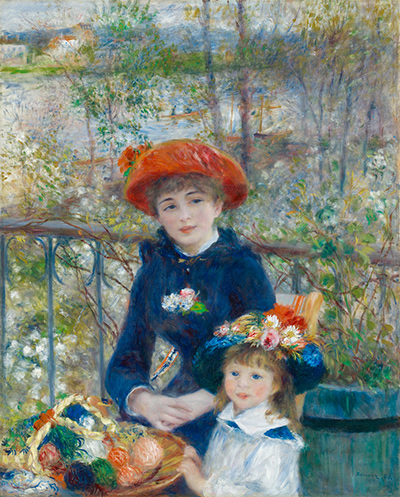
This work in Renoir’s career
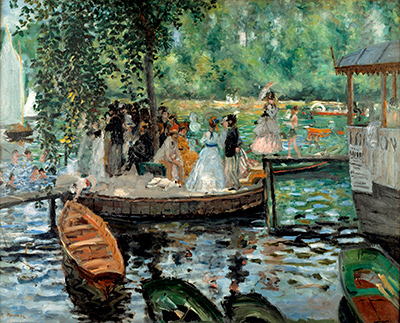
La Grenouillère
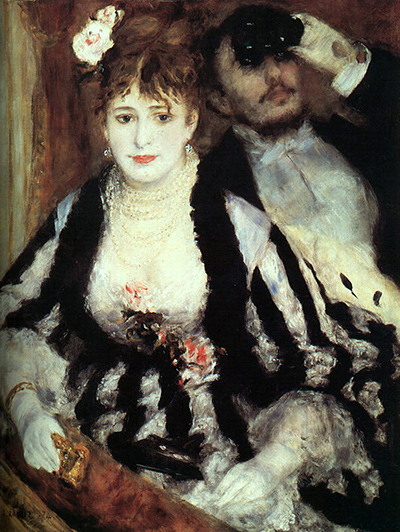
1869La Loge
1874Nude in the Sun
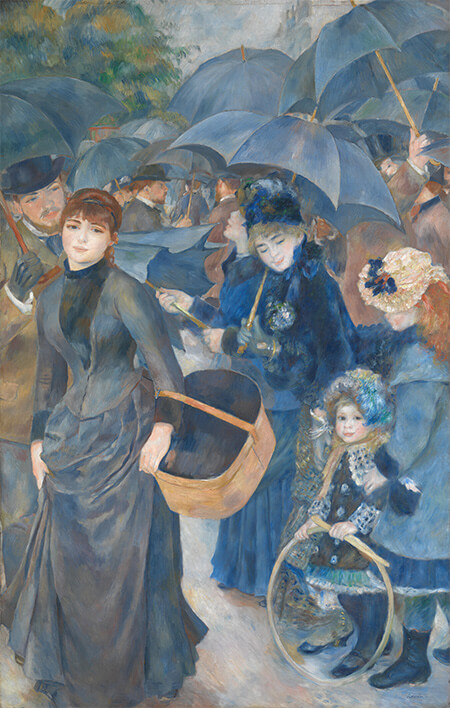
c. 1876The Umbrellas
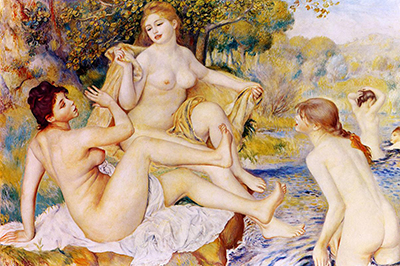
c. 1881–86The Great Bathers
1884–87The Bathers
1918–19Contents
- Annotated details of the painting
- The figure and the changing light
- Follow the colour from face to hand
- At the second Impressionist exhibition
- Compare another nude from 1876
- From Caillebotte to the Musée d’Orsay
- An early nude in Renoir's career
Annotated Details from Nude in the Sun
Renoir’s Orsay Étude of about 1876 sets a nude amid broken light and vegetation.
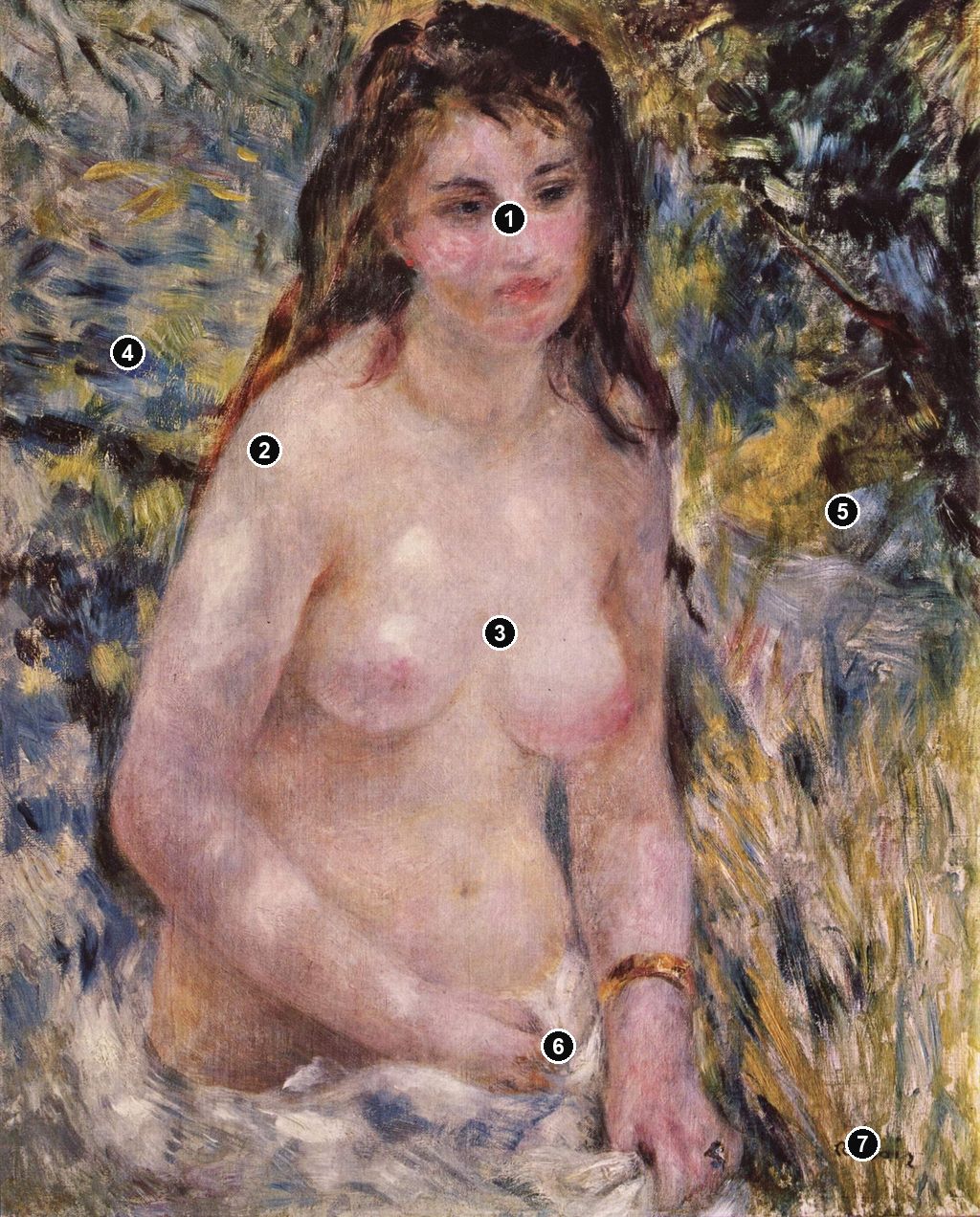
Details from NUDE IN THE SUN
The details show Orsay RF 2740, exhibited at the second Impressionist exhibition.
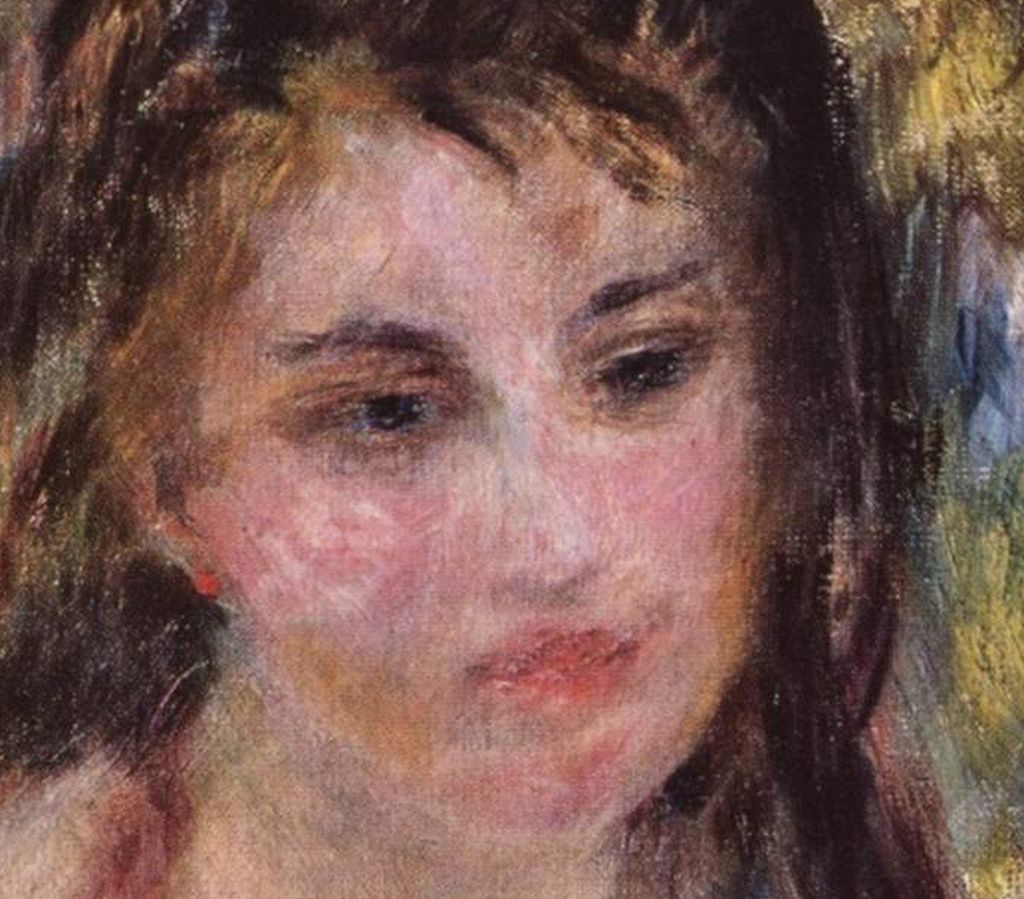
Face and gaze
The model looks away from the viewer; her face is built from warm and cooler touches.
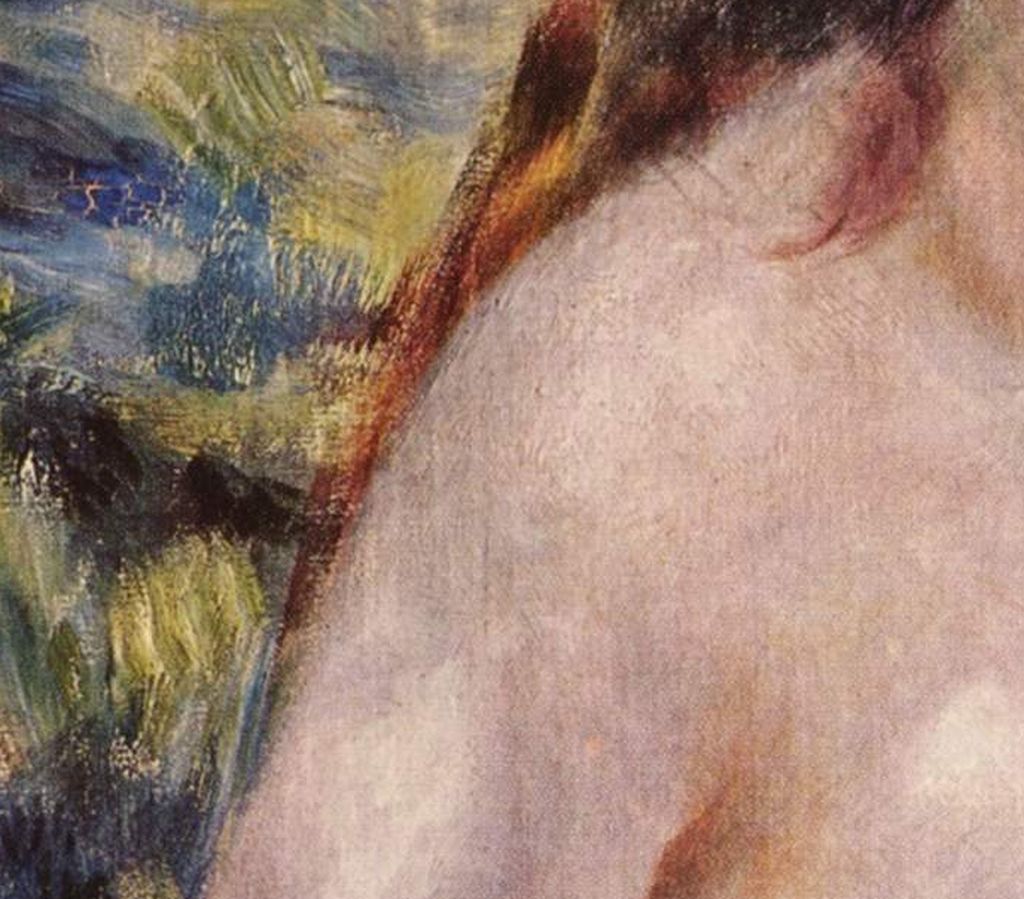
Light on the shoulder
Bright paint on the shoulder meets blue-green marks nearby.
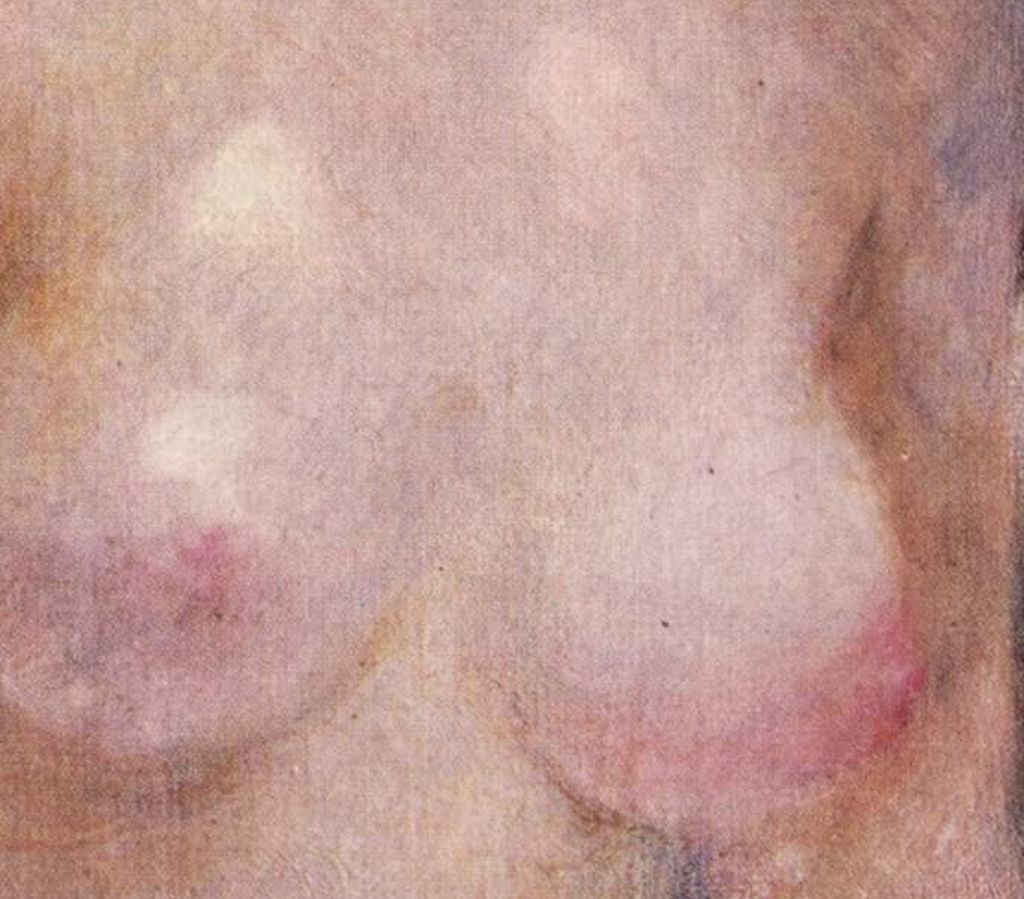
Cool tones on the torso
Violet and green modulate flesh rather than separating figure from outdoor light.
Foliage at left
Broken blue and green strokes establish a leafy setting.
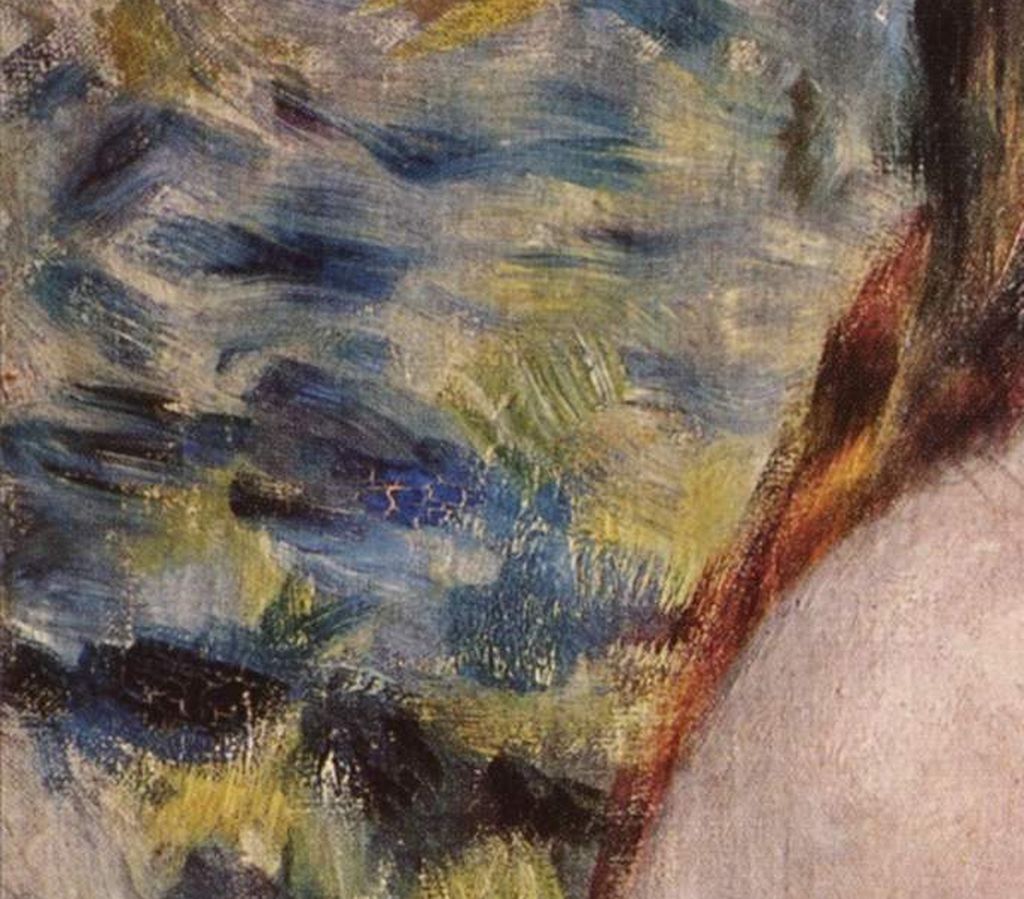
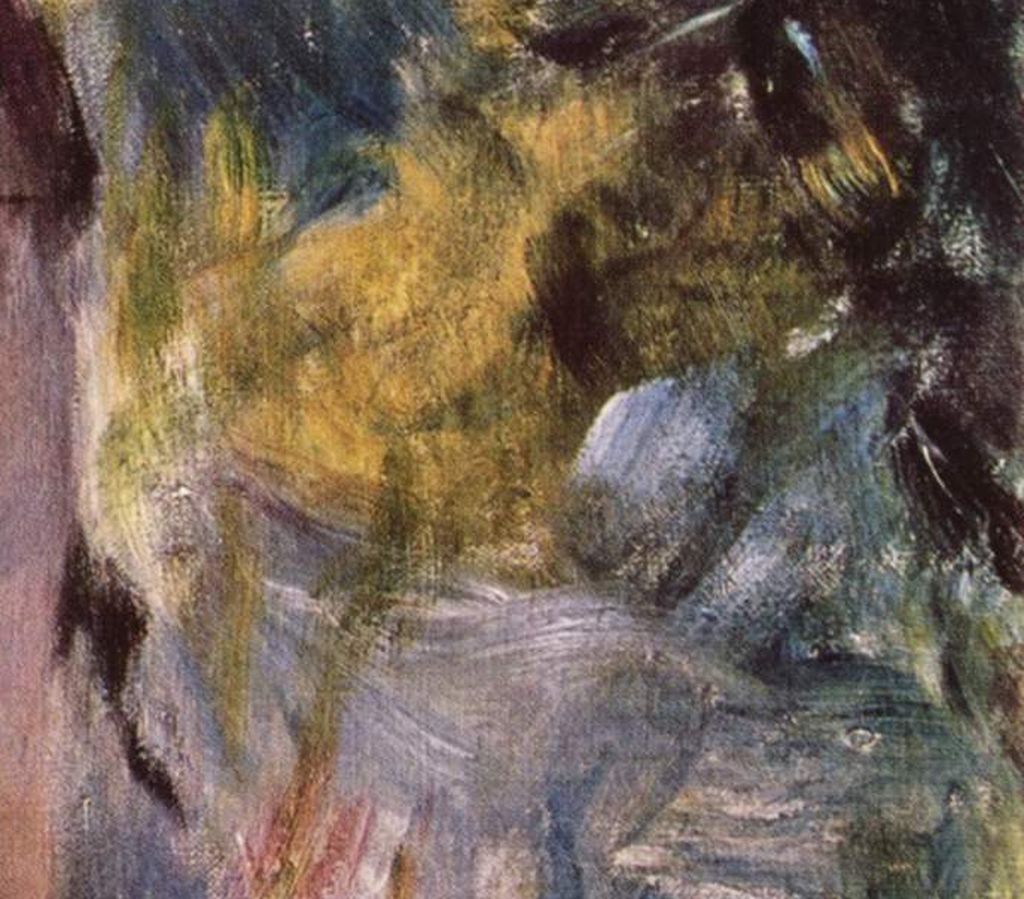
Foliage at right
The background repeats cool colours visible across the body.
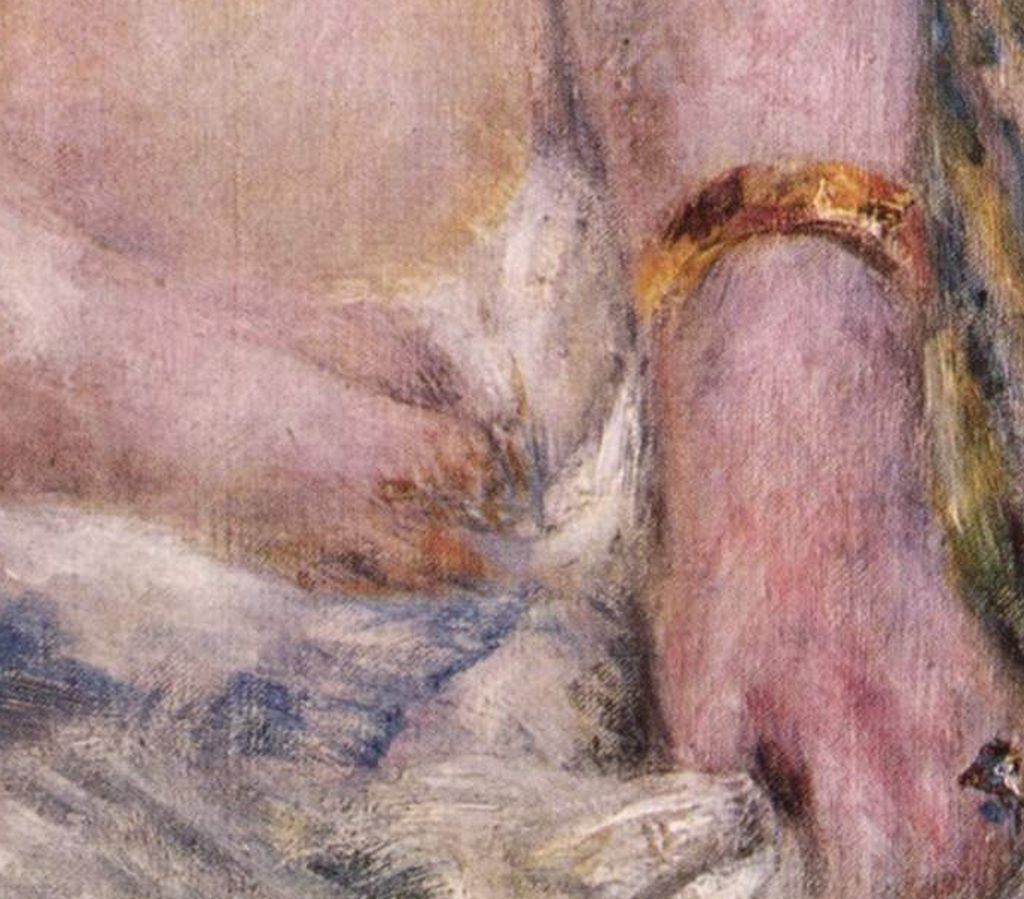
Hand and cloth
The lower hand and pale cloth anchor the seated pose.
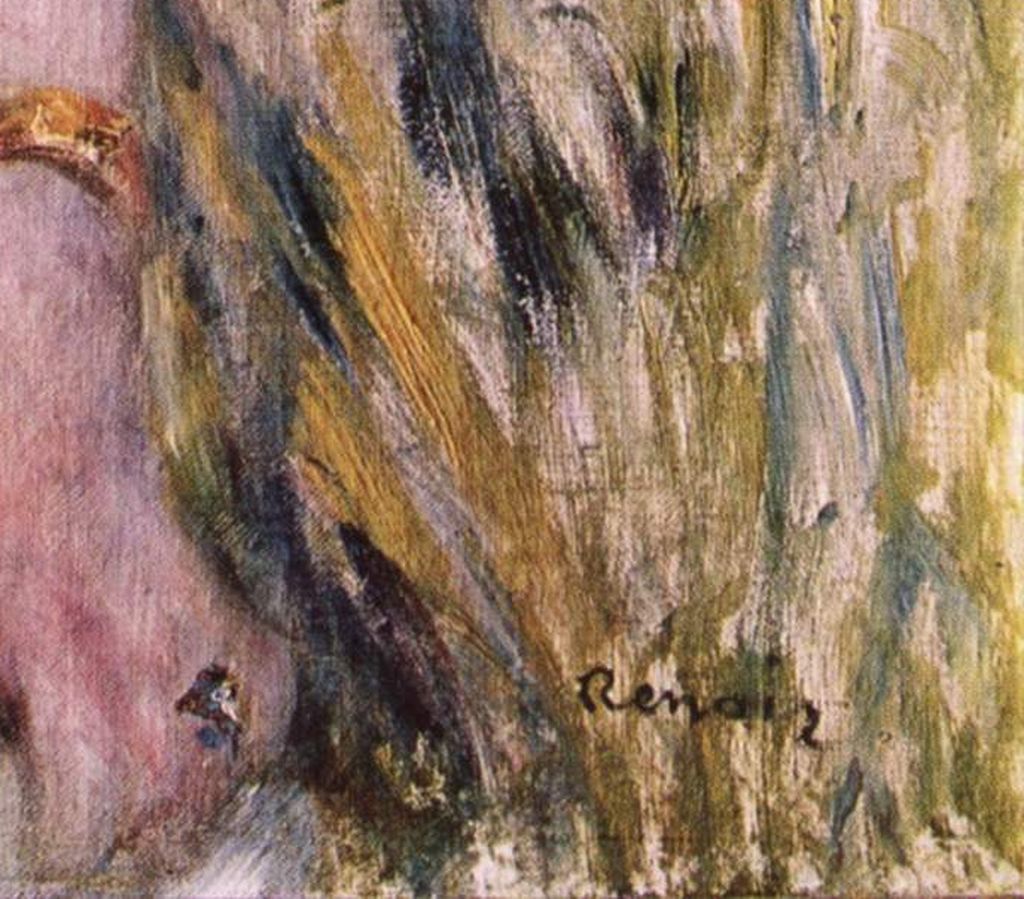
Signature and edge
The signature sits at the lower right of the Orsay canvas.
Watch: Pierre-Auguste Renoir
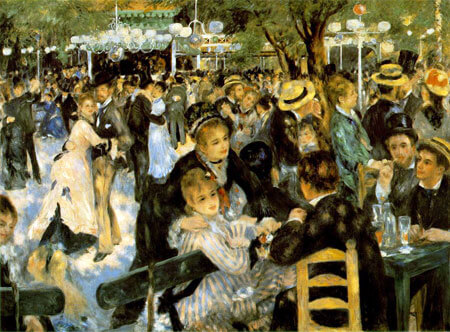
Explore a Montmartre dance, a gathering beside the Seine and the drawings behind Renoir’s paintings.
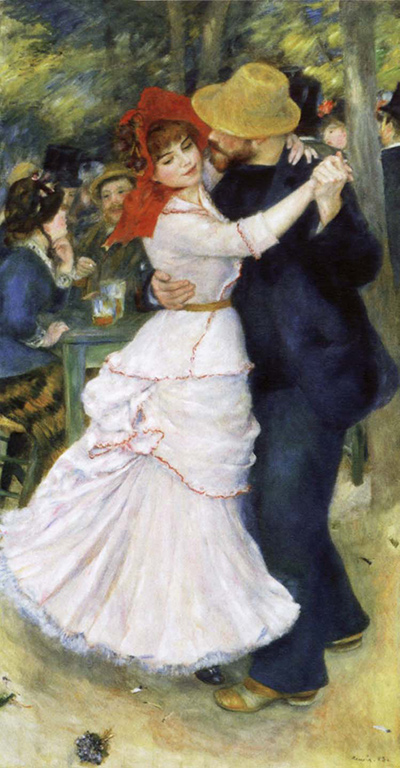
Renoir, Bal du moulin de la Galette
Dr. Beth Harris and Dr. Steven Zucker discuss Renoir’s 1876 Montmartre dance scene, its light and its crowds.
Watch on YouTubeRenoir artworks directory
The figure and the changing light
The model is set against vegetation rather than a neutral studio backdrop. Renoir makes the upper body the painting's focus. The surrounding greens and blues are not a flat curtain: loose marks suggest leaves and shadows at different depths. The face and torso emerge from them, while coloured touches interrupt any expectation of uniformly pink skin. Musée d’Orsay work image. [1]
Follow the light across the body rather than looking for one clean outline. Warm areas meet cooler violet and green marks. Those cool colours can read as the effect of foliage filtering daylight, because similar greens and blues recur around the figure. The visible marks also insist that an outdoor body cannot be separated neatly from its atmosphere. This is a close reading of the surface, not proof that every part of the canvas was made outdoors or at a known garden. The Orsay record identifies neither the sitter nor a specific place. Musée d’Orsay object record and image. [1]
The word étude matters. Renoir submitted a painting with the language of a study, foregrounding observation and handling as subjects in themselves. The alternative title, Torse; effet de soleil, likewise directs attention to the torso and an effect of light. Neither title licenses a claim that the picture was an abandoned fragment. An 81-centimetre canvas exhibited publicly in 1876 had a finished role for its maker even if its strokes remained conspicuously open. Musée d’Orsay title, dimensions and exhibition data. [1]
In a 2026 Musée d’Orsay lecture on Renoir’s bathers, Sylvie Patry reads that studio language more provocatively. “Study,” “torso” and “effect” are words associated with a working fragment or experiment, yet Renoir put this large canvas before the public. The lecturer suggests that doing so may have answered critics who had dismissed Impressionist pictures as sketches. This is a curatorial interpretation of the title and exhibition choice, rather than a recorded statement of Renoir’s intention. It gives the painting a place between the private work of observation and an ambitious public challenge to conventions of finish. Musée d’Orsay, Les Grandes Baigneuses de A à Z. [3]
The same lecture relates the model’s hand and drapery to the long tradition of the Venus pudica, especially the Cnidian Venus pose, while treating the leafy light as Renoir’s different pictorial question. Seen this way, the figure does not abandon older nude painting: a familiar gesture meets coloured shadows that refuse a smooth, timeless flesh tone. The comparison concerns a visual convention, not evidence that Renoir copied a particular ancient statue for this canvas. Musée d’Orsay lecture. [3]
Follow the colour from face to hand
The sitter's face is more steadily described than the leaves behind it. Dark hair frames her eyes and cheeks, while the upper background is broken into short marks of green, blue and yellow. Renoir gives the viewer enough detail to meet a person rather than an anonymous arrangement of colour. The contrast makes the looser vegetation feel lively without making the figure disappear.
Move down the canvas and the colour relationships change. Pale pinks across the shoulders and chest meet darker, cooler notes at the sides. The left arm, partly turned away, sits against a lively band of foliage. The hand at the lower right of the image holds white fabric at the edge. Its small bracelet is a distinct detail: the woman is posed and dressed for a picture, even though the title directs attention to a natural effect. That detail helps resist the idea that the canvas is only an impersonal exercise in optical sensation.
The cloth also sets a boundary between the exposed torso and the lower edge of the composition. Light-coloured folds carry some of the pink and blue notes found in the body, so the transition is soft rather than abrupt. At the same time, the hand gripping it gives the picture a simple action. There is no need to supply a story about where she has been or what she will do next; Renoir has made that one held edge enough to keep the figure from becoming a static diagram.
At the second Impressionist exhibition
The group displayed the painting at Paul Durand-Ruel's gallery in Paris, catalogue no. 212, from 30 March to 30 April 1876. It belonged to an independent Impressionist exhibition, not the official Salon. That distinction matters because the artists were creating an alternative place to show work whose methods could be challenged in official art culture. The exhibition catalogue and Orsay's collection record establish the work's participation. Musée d’Orsay exhibition history [1]; Orsay catalogue index. [4]
Writing in Le Figaro on 3 April 1876, the critic Albert Wolff singled out Renoir's torso. He described its greenish and violet patches in the language of bodily decay. That hostile response is revealing precisely because it rejects the painting's central experiment: colours that may describe light and shadow on skin looked to Wolff like a violation of what flesh ought to look like in a painting. His review is evidence of one prominent contemporary critic's reaction, not a survey of every viewer or critic at the exhibition. Transcription of Wolff's contemporary review. [2]
Wolff's words are often repeated as an entertaining anecdote. They are more useful as a test of what was at stake. If the body is assumed to have one stable, local colour, Renoir's shifting marks look wrong. If the figure is seen in relation to foliage and intermittent sun, the marks help build the light. The painting asks a viewer to move between those readings rather than supplying the polished finish that would hide the question.
The response was not uniformly hostile. In her Musée d'Orsay lecture, Sylvie Patry notes that another contemporary critic admired the work as a painterly achievement of colour, while she counts only a small number of reviewers who likened its violet and green skin tones to decay. Her point puts Wolff's memorable attack in proportion: the same visible marks could be treated as skilled colour or as a disturbing departure from accepted flesh tones. Musée d'Orsay lecture. [3]
Orsay's exhibition history carries the picture beyond its notorious first showing. It was listed at the Salon des XX in Brussels in 1886 and at a Durand-Ruel Renoir exhibition in 1892. These entries establish continued public circulation; they do not prove that later audiences agreed about the handling or that Wolff's response had become the prevailing judgment. The painting's documented appearances give a more reliable story than a single review standing in for its entire reception. Musée d’Orsay exhibition history. [1]
Compare another nude from 1876
The Pushkin State Museum of Fine Arts holds a different Renoir canvas catalogued as Female Nude, dated 1876, accession Ж-3330. Its sitter turns towards the viewer while seated on a pale surface against a cool blue setting. That is a different posture and pictorial problem from Orsay's upright torso against vegetation. The two paintings share a year in their museum records, but the records do not establish that one was a study for the other or that they show the same model. Pushkin Museum object record [5]; Musée d’Orsay object record. [1]
 Pierre-Auguste Renoir.jpg)
Put the paintings beside one another and the setting becomes decisive. In the Pushkin work, pale fabric and a cooler backdrop envelop the seated woman; her bent limbs make a compact shape. In Orsay's Étude, the face and upright body meet a busy screen of leaves, with more pointed colour contrasts at the edges of the skin. The comparison shows two ways Renoir could place a nude in a painted environment at roughly the same time. It also makes the word “effect” in the Orsay title feel precise: surrounding foliage is part of how the body is seen.
From Caillebotte to the Musée d’Orsay
The painter and collector Gustave Caillebotte later owned Étude. Orsay places the work in his collection from 1886 to 1894, saying he acquired it sometime between 1886 and April 1892; it does not give a precise purchase day. His bequest brought it into the French state collection, accepted in 1896 for the Musée du Luxembourg. It subsequently passed through the Louvre and its Jeu de Paume gallery before its assignment to the Musée d’Orsay in 1986. Musée d’Orsay provenance. [1]
That history provides an unusually clear path from independent exhibition to public museum. It also connects this disputed colour study with the broader Impressionist collection Caillebotte chose to preserve. The archival record supports the sequence of ownership and public acceptance; it does not tell us why he selected this specific picture or exactly how he described its paint.
An early nude in Renoir's career
This 1870s Étude is easy to confuse in search results with Renoir's much later bathers and other figure paintings. It has a narrower, earlier problem: how to place one body in broken natural light while leaving the marks of observation visible. The later Large Bathers of 1884–87 and The Bathers of 1918–19 involve different compositions, dates and aims. They can illuminate the changing importance of the nude in Renoir's work without being treated as versions or preparatory stages of this canvas. Orsay object record [1]; Philadelphia, The Great Bathers [6]; Orsay, Les Baigneuses. [7]
Look back at the face and torso after reading Wolff. His complaint points to the same coloured marks a modern viewer may find persuasive. The painting's force lies in that visible conflict between the expected colour of flesh and the colour Renoir used to make sunlight felt.
Questions about Nude in the Sun
The Musée d’Orsay's main title is Étude, with Torse; effet de soleil as another title. Nude in the Sun is a common English name for the same work, accession RF 2740.
Some older captions say 1875. The current Orsay record dates it about 1876, and documents its showing at the second Impressionist exhibition that year.
The museum record does not securely identify the sitter. Naming a model from resemblance alone would overstate the evidence.
At the second Impressionist exhibition, Durand-Ruel's gallery, Paris, in 1876, catalogue no. 212. This was separate from the official Salon.
In the Musée d’Orsay, Paris, accession RF 2740. The museum's current object record controls display information.
Discussion
Look closely at Nude in the Sun and use the questions below to compare what you see with the documented history.
Reader Insights
Where do the cool marks on skin echo the surrounding foliage?
Orsay records the work at the second Impressionist exhibition, no. 212.
Does Wolff’s hostile 1876 response change how you see those colours?
Join the Conversation
Share a close observation or a source-backed question about Nude in the Sun. The prompts above are starting points for discussion.
References
- Musée d’Orsay, Étude, RF 2740, identity, dimensions, exhibition and provenance View source.
- Albert Wolff, “Le Calendrier parisien,” Le Figaro, 3 April 1876, contemporary text transcribed by Les Cahiers naturalistes View source.
- Musée d’Orsay, Les Grandes Baigneuses de A à Z, 2026 lecture transcript, curatorial reading of the title, pose and filtered light View source.
- Musée d’Orsay, 1876 exhibition catalogue record View source.
- Pushkin State Museum of Fine Arts, Female Nude, Ж-3330, separate 1876 canvas used for comparison View source.
- Philadelphia, The Great Bathers View source.
- Orsay, Les Baigneuses View source.
- Whole-work reproduction: Wikimedia Commons Public Domain Mark Yorck Project file, compared with Orsay’s small reference photograph; Orsay controls the date and dimensions View source.