by Tom Gurney
Tom Gurney BSc (Hons) is an art history expert with over 20 years experience
Published on June 19, 2020 / Updated on October 2, 2026
Email: tomgurney1@gmail.com / Phone: +44 7429 011000
One woman plays an upright piano in a richly coloured room. Her pale, loose garment catches more light than the dark instrument and furnishings, making her the image's centre even as her attention seems absorbed by the keys. Renoir painted Woman at the Piano in 1875–76. It belongs to the Art Institute of Chicago, accession 1937.1025. The museum's scholarly catalogue treats it as Renoir's first painting of a piano player, years before his repeated two girl compositions of 1892. Art Institute scholarly catalogue, cat. 3. [1]
This picture is often easier to understand through its setting than through an imagined piece of music. A carpet, curtain, decorated piano, ceramic planter and piled scores place the player in a comfortable urban interior. Renoir lets the woman's light garment spread across much of the foreground. Music gives her something to do; colour and fabric make the activity into a picture about looking as much as listening.
At a glance
- ArtistPierre-Auguste Renoir
- Date1875–76; the canvas is signed but not dated
- MediumOil on canvas
- Dimensions93 × 74 cm
- CollectionArt Institute of Chicago, 1937.1025, Mr. and Mrs. Martin A. Ryerson Collection
- Probable sitterNini Lopez, likely, according to the Art Institute; not a confirmed personal identification
- Early exhibitionProbably the Femme au piano listed at the second Impressionist exhibition, 1876
Watch: Pierre-Auguste Renoir
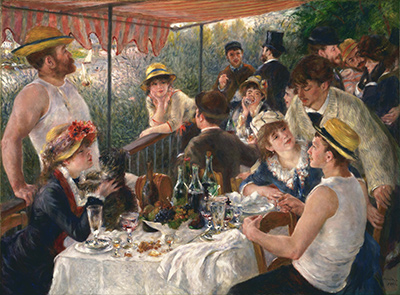
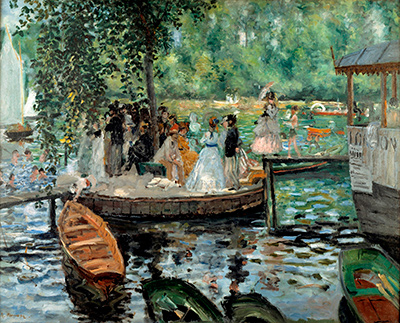
Explore a Montmartre dance, a gathering beside the Seine and the drawings behind Renoir’s paintings.
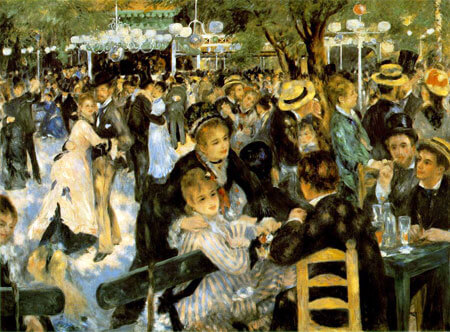
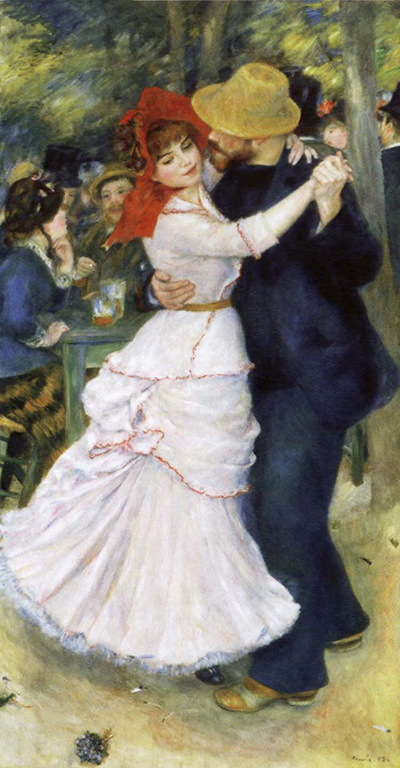
Renoir, Bal du moulin de la Galette
Dr. Beth Harris and Dr. Steven Zucker discuss Renoir’s 1876 Montmartre dance scene, its light and its crowds.
Watch on YouTubeWhat the room tells us
The vantage point is high enough to show the woman's hands at the keyboard. Renoir paints the side and top of the upright piano as a set of dark planes. Bound music volumes and loose illustrated sheets rest above it. Behind the player, a fringed curtain divides spaces; a large ceramic planter and a framed work add to the room's layered surfaces. The Art Institute catalogue describes these details as consistent with a bourgeois interior of the 1870s. They make the scene specific without establishing an address. Art Institute, cat. 3. [1]
The woman wears a peignoir, a loose indoor garment, whose luminous whites and blue shadows dominate the painting. Dark trim holds its flowing shape together. The garment is not a precise costume diagram; brushwork gathers and releases its folds. The sitter's reddish hair, soft face and turned posture contrast with the piano's hard edges. Renoir made a picture of private activity that also displays a fashionable, visually appealing figure. The Art Institute reads that mixture as part of his interest in the Parisienne, a contemporary urban woman presented through dress and manner. That is an art-historical reading, not a label Renoir attached to the canvas. Art Institute catalogue essay. [1]
The scores suggest a range of music, but they cannot be decoded into a certain playlist. The Art Institute asks whether the tunes might have included popular or classical pieces; it does not claim to have identified them. The visible volumes are enough to show that music belongs in this room. They also imply repeated practice rather than one isolated performance.
Who is playing?
The Art Institute considers the sitter likely Nini Lopez, a model Renoir worked with during the later 1870s. The word “likely” matters. A related work, A Girl Crocheting at the Clark Art Institute, has a red-haired model who might also be Lopez, but likeness across pictures is not a signed identification. The painting's strongest documented facts are its maker, date range, medium and collection. Naming the model should remain a qualified scholarly proposal. Art Institute, sitter discussion. [1]
Neither the sitter's possible name nor the room's appearance proves she was posing in her own home or playing for a particular listener. Renoir arranges a woman, an instrument and domestic things for an image. The result feels close to a moment overheard, but its construction becomes clearer through technical study.
What the X-ray reveals
An X-ray examined by the Art Institute shows that Renoir revised both the woman and the piano. At an earlier stage her skirt was wider and hid more of the seat. He narrowed the figure, changed her hairstyle from a lower arrangement to one swept up, and adjusted the profile so more of her face could be seen. The instrument changed too: its earlier form appeared narrower and more foreshortened. These are decisions made while painting, not details that could be read from the final surface alone. Art Institute technical report. [1]
The report finds no observed underdrawing in the examined infrared or microscopic evidence. Renoir laid in broad areas, including a dark red wash for the piano, then worked over them with thin paint, thicker strokes, scraping and blended passages. An artist can revise intensively without first making a detailed preparatory drawing on the canvas. This evidence checks the easy assumption that visible brushwork must mean a picture was executed all at once. Art Institute technical summary. [1]
The peignoir's light effect depended on layers, too. The Art Institute describes an off-white or beige area worked with white, blue and pale green, with deeper blue towards the lower part of the garment. The painting thus makes a softly lit indoor scene without using uniform shadow across every object. Technical images belong to the museum's scholarly study and are research evidence here; they are not claimed as cleared supplementary reproductions for this page.
Did it appear in the 1876 exhibition?
The second Impressionist exhibition listed a painting called Femme au piano. The Art Institute says it is fairly certain that the Chicago canvas was that work, since no other Renoir piano painting from the decade is known. That is a strong identification, but not the same as a surviving catalogue entry with the museum accession number. Renoir contributed eighteen works to the 1876 show. Contemporary critics largely passed over the piano picture while arguing about other submissions, especially his controversial nude study. Art Institute, exhibition and reception study. [1]
The likely exhibition makes the picture part of Renoir's active Impressionist years, but its subject is an interior rather than the sunlit riverside. Visible strokes, bright fabric and unusual light remain important. The work widens the picture of what Renoir was testing in the middle of the 1870s. His contemporaries did not all respond to that variety in the same way, and a later scholarly catalogue should not be mistaken for a record of 1876 public approval.
From early buyers to the Art Institute
The Art Institute's provenance records the painting with Paul-Victor Poupin by April 1876. Some intervening Durand-Ruel and New York sale stages are marked possible rather than certain. A firm later transaction is Durand-Ruel's sale to Martin A. Ryerson in Chicago on 16 December 1911. The work passed to Ryerson's widow and entered the Art Institute through her 1937 bequest. Respecting those qualifications keeps the ownership account from sounding more complete than the evidence. Art Institute provenance. [1]
The museum's accession number, 1937.1025, is a useful safeguard when comparing Renoir's many music pictures. The institution's object and catalogue pages control its present title and attribution; the image shown here is an exact, visually checked public-domain reproduction derived from the Art Institute's collection image. Art Institute object record [2]; scholarly catalogue. [1]
Before the later piano paintings
Renoir returned to music subjects in later decades, with an important step between this solitary player and the famous pair. The Art Institute identifies his 1888 portrait of the daughters of Catulle Mendès as his next painting of piano players. The Met's record identifies the three girls in that separate society portrait and their mother, the pianist Augusta Holmès; it does not make the Chicago sitter part of the Mendès family. In 1892 Renoir then repeated a scene of two young girls at an instrument, including a canvas acquired for the French state and another now in the Met. The Chicago picture has one player and a different composition. It begins a theme without being an early state of either later work. Art Institute comparison [1]; Met, The Daughters of Catulle Mendès [3]; Orsay, Girls at the Piano; Met 1892 variant.
Looking across those works reveals a change in social arrangement. The Chicago woman plays alone, surrounded by music and furnishings; the later girls share a score. The pictures offer different ways to make the act of listening visible. Their titles, sitters and collection histories must remain separate even though a piano sits at the centre of each.
Looking again
Start at the keys and the woman's hands, then follow the bright garment down to the seat that Renoir revised. Look across the dark piano to the scattered music above it. The subject is quiet, yet the paint is active: light fabric, polished dark wood and decorated objects ask for different kinds of touch. The painting shows Renoir learning how a modern room and a solitary musician could carry as much pictorial interest as a crowded outdoor scene.
Renoir artworks directory
Questions about Woman at the Piano
The Art Institute dates it to 1875–76. It is signed, but the museum does not give a year inscribed on the canvas.
The Art Institute considers Nini Lopez likely. The identification is a scholarly proposal, not a confirmed name written on the picture.
No. This Chicago painting shows one woman and dates from 1875–76. The later two girl paintings are separate canvases in several collections.
It belongs to the Art Institute of Chicago, accession 1937.1025. The museum's current object record gives its display information.
Discussion
What do you notice when you return to Woman at the Piano?
How does the pale garment draw your attention away from the dark piano and back to the player?
Reader Insights
How does the pale garment draw your attention away from the dark piano and back to the player?
The Art Institute’s X-ray study records changes to the figure, hairstyle and instrument.
What separates this single player from Renoir’s two girl piano paintings of 1892?
Join the Conversation
Share a close observation or a source-backed question about Renoir’s Woman at the Piano.
References
- Art Institute of Chicago, Renoir Paintings and Drawings, cat. 3, essay, technical report, exhibition history and provenance View source.
- Art Institute of Chicago, Woman at the Piano, 1937.1025, collection identity and public-domain image policy View source.
- Metropolitan Museum of Art, The Daughters of Catulle Mendès, 1998.325.3, the distinct 1888 music portrait and identification of the Mendès family View source.
- Musée d'Orsay, Girls at the Piano, RF 755, distinct later state-acquired painting View source.
- Metropolitan Museum of Art, Two Young Girls at the Piano, 1975.1.201, distinct Lehman variant of the later composition View source.
- Whole-work image: AIC-derived Commons file, marked CC0/Public Domain Mark on the file page; visually matched to the Art Institute object View source.