



 by Tom Gurney
Tom Gurney BSc (Hons) is an art history expert with over 20 years experience
Published on June 19, 2020 / Updated on October 29, 2026
Email: tomgurney1@gmail.com / Phone: +44 7429 011000
Anglers: Introduction
Three anglers wait beside dark water while an aeroplane hangs above the trees. Between them stretches an expanse of ochre ground, bounded by white houses and a distant factory chimney. Henri Rousseau brings these different activities into a remarkably quiet scene. Known at the Musée de l’Orangerie as Les Pêcheurs à la ligne, the painting dates from 1908–09 and measures just 46 × 55 centimetres.[1] Its small world accommodates both the patience of fishing and the excitement of flight.
At a Glance
- ArtistHenri Rousseau
- SubjectAnglers
- ExploreThe people at the water’s edge; A bank that turns towards the viewer
This work across Henri Rousseau’s career
Carnival Evening
1886 [2]The Merry Jesters
1906 [7]The Snake Charmer
1907 [8]Anglers (current article)
1908–1909 [1]Contents
- The people at the water’s edge
- A bank that turns towards the viewer
- An aeroplane in a quiet sky
- Houses, aircraft and a changing repertoire
- From private collections to the Orangerie
- Annotated details
The people at the water’s edge
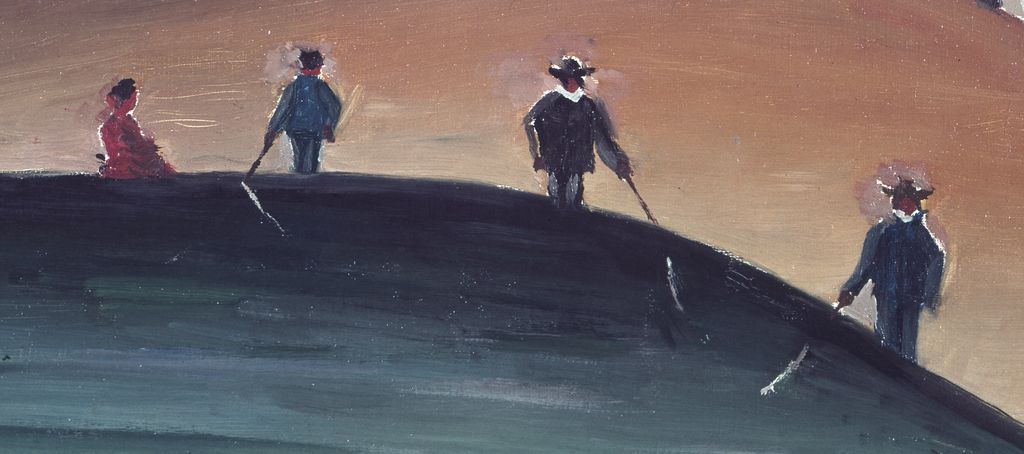
The anglers form a loose sequence across the lower part of the picture. Two stand near the centre; the third occupies the downward curve towards the right. Their dark blue and green clothing connects them, while their differing hats and stances keep them distinct. A smaller figure dressed in red appears to the left of the group. That bright patch catches the eye without explaining who the person is or how they belong to the gathering.
Fishing supplies an activity that can be understood through a few thin marks. Rods slope from the figures towards the water, and pale lines interrupt its dark edge. The bodies remain upright and contained. There is little suggestion of a sudden catch or a conversation carried across the bank. Each angler has a separate place, leaving intervals through which the broad sweep of the shore remains visible. Rousseau makes waiting legible through spacing as much as through gesture.
The figures also make the scale of the landscape uncertain. The nearest angler seems large beside the houses behind him, yet the houses have an almost toy-like clarity of their own. Their windows are individually marked, their roofs carefully bounded. The people and buildings each ask to be seen distinctly, even where their relationship resists ordinary measurement. The result draws attention to every component: a hat, a fishing rod, a doorway and a roof all retain their particular shape.
The Orangerie interprets the scene through Rousseau’s interest in the leisure of people of modest means.[1] Fishing gives that reading a concrete basis, though the painted figures offer no reliable occupations or personal histories. A stretch of water, enough room to stand and time to wait become the essentials of this shared outdoor space.
A bank that turns towards the viewer
The strongest movement belongs to the land. A dark rim separates the green-blue water from the ochre bank, running almost level on the left before bending steeply down towards the lower-right corner. The open ground above this line forms an unusually large, unoccupied area. Its width holds the houses apart and gives the anglers room, even as the descending curve brings the nearest figure towards us.
Water and earth are built from broad fields of colour. Beneath the near-black upper edge of the water, deep green gives way to cooler, paler horizontal strokes. These strokes suggest a surface extending across the foreground, but offer few distractions from the bank’s outline. The ochre ground is equally spare. Its warmer colour spreads between the dark water and the pale buildings, creating a luminous middle zone without requiring a busy incident at its centre.
The museum draws attention to the unusual way the houses meet this ground. Their fronts face the viewer while their bases follow the sloping bank; the anglers’ feet are cut off, making the people seem attached to the edge or poised on the water.[1] Looking from left to right, one can feel these competing directions. The buildings remain steady and upright, while the surface beneath them appears to tip forward. The curve supplies depth and, at the same time, displays the landscape almost as a spread-out arrangement.
Repetition helps hold it together. Rows of dark windows punctuate the white walls, reddish roofs answer one another across the open space, and the trees create a dense green screen behind both groups of houses. At the far right, the chimney extends above this leafy boundary. The houses diminish along the bank, giving the eye a route into the distance, while the chimney restores a strong vertical. These small adjustments allow the scene to feel orderly without making its space entirely predictable.
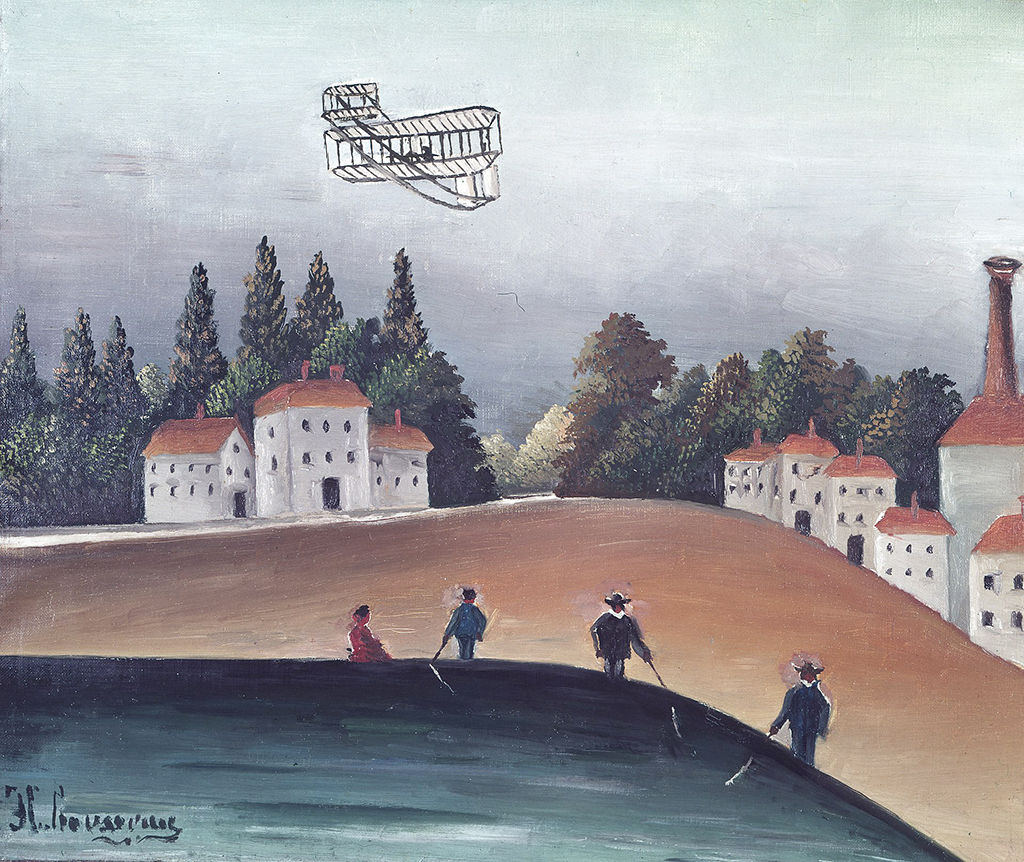
Anglers — Henri Rousseau.
An aeroplane in a quiet sky
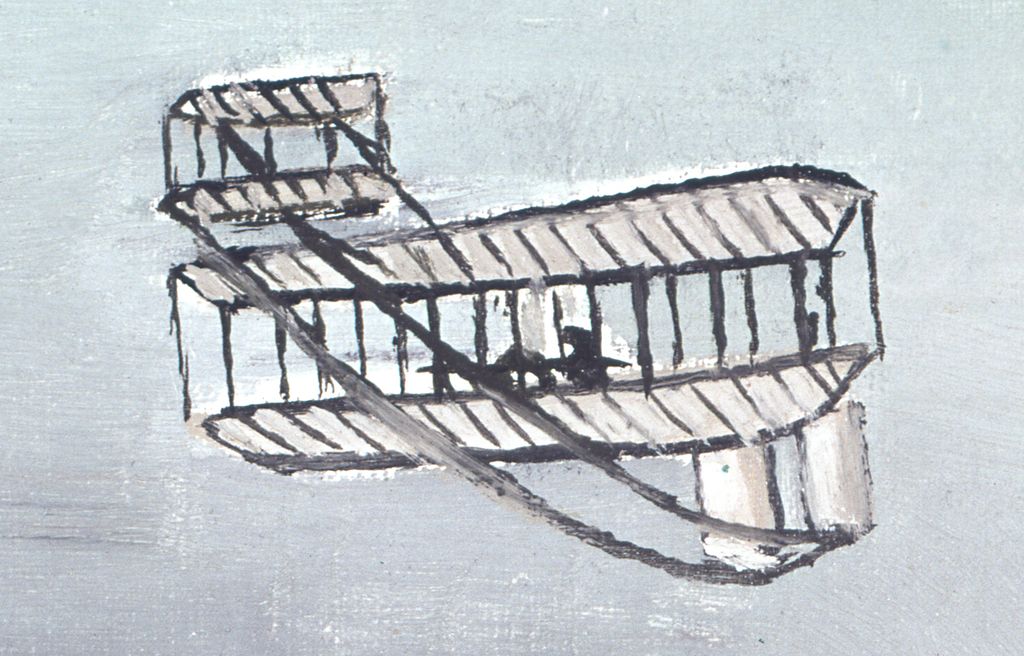
Above the buildings, Rousseau leaves a generous area of pale, clouded sky. The aeroplane occupies the upper-left part of this opening. Dark outlines describe stacked wings and their supports, with enough empty space between the lines for the sky to remain visible through the machine. Its intricate framework contrasts with the solid blocks of the houses. The plane seems suspended, almost available for inspection, while the anglers below continue their absorbing task.
The Orangerie identifies the aircraft as Wilbur Wright’s biplane and relates it to the public flights he made at Le Mans in 1908. The museum points to images circulated in Le Petit Journal illustré de la jeunesse on 27 December 1908 and Le Petit Journal on 5 September 1909.[1] These publications place the motif within the illustrated news culture surrounding early aviation. They are possible avenues for understanding the image’s circulation; the museum’s account does not establish a single illustration as Rousseau’s exact model.
The machine changes how the whole landscape feels. A fishing scene can suggest habits repeated over many afternoons, whereas this conspicuous object introduces a recent technical achievement. The factory chimney makes a second connection with modern industry. Neither interrupts the arrangement violently. One rises at the right edge, the other floats across the upper field, so that modern machinery becomes part of the scene’s measured distribution of shapes.
The biplane is difficult for a viewer to overlook, yet no clear gesture from the anglers announces a collective spectacle. That separation allows two kinds of time to coexist: the sustained waiting beside the water and the brief passage suggested by an aircraft overhead. Rousseau gives each enough space to register.
Annotated Details from Anglers
The numbered points identify visible features discussed in this article. Return from each detail to the whole composition. Henri Rousseau, Anglers (Les Pêcheurs à la ligne), 1908–1909. Musée de l’Orangerie, Paris, RF 1963 31. Françoise Foliot photograph published on Wikimedia Commons in 2019. Photograph: Françoise Foliot / Fonds Françoise Foliot, preserved by Wikimédia France. Image source. CC BY-SA 4.0. Numbered overview and cropped details adapted from Françoise Foliot’s photograph; the overview is resized and numbered, and the details are cropped. These adaptations are offered under CC BY-SA 4.0. No recolouring or retouching.
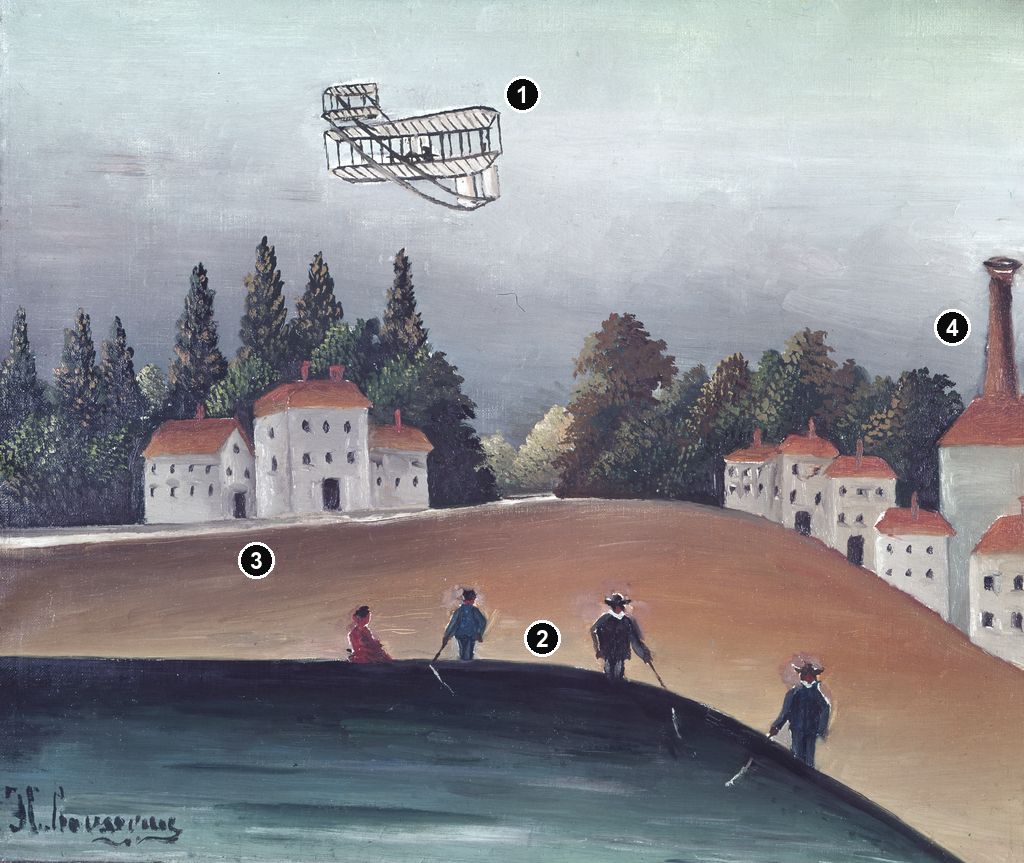
Details from ANGLERS
Compare the biplane’s open lines with the figures at the water, the solid house fronts and the chimney rising above the trees.
The open framework of the biplane
Dark outlines describe stacked wings and their supports, leaving pale sky visible through the machine. Its thin open construction contrasts with the solid blocks of houses below.
Four figures along the curved bank
Three upright anglers and a smaller red-clad figure occupy separate points along the shore. Rods and pale line fragments make their activity legible, while the original dark bank conceals their feet.
Pale walls and repeated windows
The left-hand houses face the viewer with carefully bounded roofs and rows of dark openings. Their pale fronts form a compact group against the much less regular mass of trees.
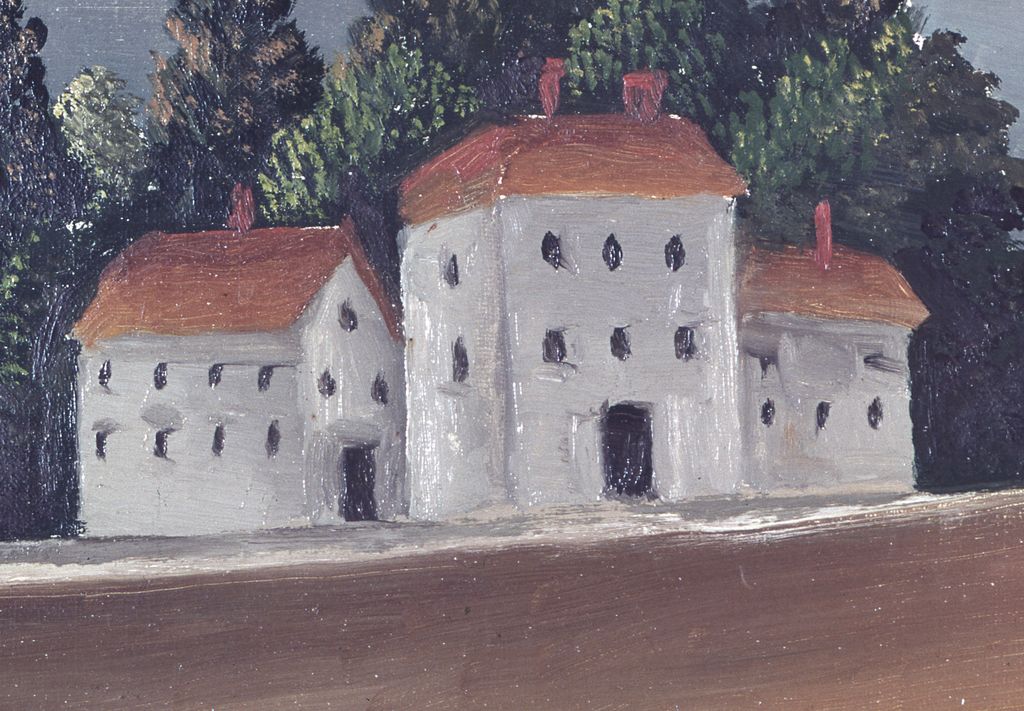
A chimney above the roofline
The tall narrow stack rises at the far right, its rounded opening set against pale sky. Its upright form answers the tree trunks while adding another trace of machinery to the view.
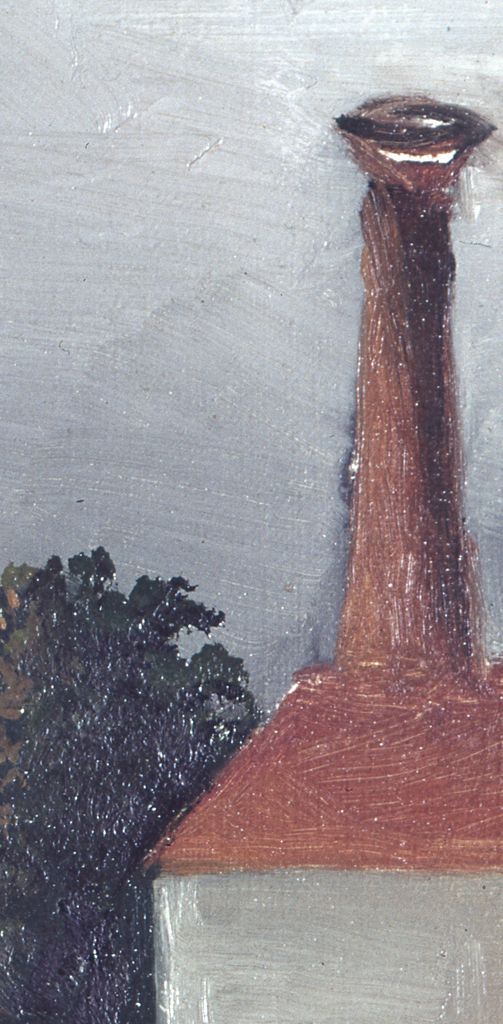
Houses, aircraft and a changing repertoire
The painting has also appeared under the English title The Fishermen and the Biplane. In the 1985 Henri Rousseau catalogue, Michel Hoog discusses it alongside The Quay of Ivry, a related composition with people strolling, a metal bridge and a dirigible.[12] The comparison makes the distinctive choices in Anglers easier to see. Its foreground is less populated, its open bank less interrupted, and the aircraft’s exposed framework gives the sky a different kind of accent.
Both pictures bring together pale houses, trees, a tall chimney, water and an aircraft. In The Quay of Ivry, the bridge extends across the left-hand space and the walkers occupy several levels of the shore. In Anglers, the bridge has gone, leaving the sweep of land and water more continuous. Hoog describes Rousseau’s landscapes as arrangements of recurring elements whose positions change from picture to picture.[12] Such a comparison reveals the flexibility of a seemingly simple vocabulary: a small change of staffage or structure can alter the pace of an entire view.
The Orangerie’s 2026 exhibition places these variations within Rousseau’s efforts to find buyers. Its account describes small landscapes and other pictures suited to the budgets and homes of artisans, shopkeepers and members of the lower middle class, alongside his more ambitious exhibition paintings. It also connects the suburban views with his walks around the changing outskirts of Paris.[13] At its modest size, Anglers rewards the close attention such a domestic setting could encourage. The fine rods, repeated windows and open lattice of the plane are details to discover nearby.
The title The Quay of Ivry invites a geographical association, but Hoog cautions against pinning Rousseau’s related suburban imagery to an exact observed location.[12] Here the landscape’s persuasive quality comes through the relationships it constructs. There is room for ordinary recreation beside housing and industry, and room overhead for an unfamiliar machine. The town seems complete enough to inhabit, while its curious slopes keep the viewer aware of the painter arranging it.
From private collections to the Orangerie
The Orangerie records the painting in the collections of Ambroise Vollard, then Paul Guillaume and subsequently Domenica Walter, identified in its provenance as Madame Jean Walter. The French state acquired it from her in 1963 with assistance from the Société des Amis du Louvre. It entered the Musée de l’Orangerie in 1977.[1] The purchase had secured public ownership before this later transfer to the museum.
The work had already travelled beyond France. The museum lists its appearance at the Marie Harriman Gallery in New York in 1931 and at the Kunsthalle Basel in 1933.[1] That history gives this small riverside scene an international life quite different from the stillness it depicts. Within Rousseau’s paintings, it offers an especially concentrated encounter with his inhabited landscapes: people pursue a familiar pastime while buildings, trees and a new machine share the same carefully apportioned world.
Henri Rousseau artworks directory
This directory brings together works covered on this site and other works documented in the cited museum records and catalogues. Alternate titles share one entry; distinct versions remain separate. Historical dates for works without an article follow the cited catalogues. This is not a catalogue raisonné.
Frequently Asked Questions
There are three standing anglers and a smaller red-clad figure beside them. The red figure’s age, identity and relationship to the anglers are not established.
The Orangerie identifies it as Wilbur Wright’s biplane, connecting the subject with his public flights at Le Mans in 1908 and contemporary illustrated newspapers.[1]
It belongs to the Musée de l’Orangerie in Paris, inventory RF 1963 31. It is an oil painting on canvas, 46 × 55 cm.[1]
Discussion
Look again at the images and ideas explored in Anglers. These editorial prompts invite your observations.
Reader Insights
How does the curved bank change your sense of where the anglers are standing?
What happens to the scene’s mood if you imagine the sky without the biplane?
Which repeated detail most strongly connects the two groups of houses?
Join the Conversation
Share a detail, comparison or question about Anglers below.
References
- Musée de l’Orangerie. Les Pêcheurs à la ligne, object record 196430, inventory RF 1963 31; commentary, Résumé, Historique–Provenance and Expositions; record updated 27 July 2026, accessed 23 October 2026. View source. (in French).
- Philadelphia Museum of Art, Carnival Evening,1963-181-64,object59593. View source.
- Musée de l’Orangerie / Juliette Degennes, Henri Rousseau,L’ambition de la peinture: Un artiste dans son époque (in French). View source.
- National Gallery, Surprised!, NG6421. View source.
- Musée d’Orsay, La Guerre,RF19461 (in French). View source.
- MoMA, The Sleeping Gypsy. View source.
- Philadelphia Museum of Art, The Merry Jesters, 1950-134-176, object51097. View source.
- Musée d’Orsay, La Charmeuse de serpents, RF 1937 7 (in French). View source.
- Musée de l’Orangerie, La Carriole du Père Junier, RF 1960 26 (in French). View source.
- Solomon R. Guggenheim Museum / Cornelia Lauf, The Football Players,60.1583: current collection record. View source.
- MoMA, The Dream, 252.1954. View source.
- Michel Hoog. Entries 42, “The Quay of Ivry,” and 43, “The Fishermen and the Biplane,” in Henri Rousseau, Museum of Modern Art, 1985, pp. 196–199, PDF pp. 201–204. View source.
- Musée de l’Orangerie. Henri Rousseau, l’ambition de la peinture, exhibition texts, 25 March–20 July 2026, section “Variations et déclinaisons. À la recherche du marché”; accessed 23 October 2026. View source. (in French).
- The Museum of Modern Art, Henri Rousseau: Essays (1985), selected catalogue entries, chronology and notes on early devotees. View source. Selected entries, chronology (pp.91–95) and early-devotee notes (pp.262–264) were consulted. Historical collection credits do not establish present ownership.
- Daniel Catton Rich, Henri Rousseau (The Museum of Modern Art, 1942), selected drawings and landscape studies; historical catalogue. View source. The dated 1942 publication is used for the two Quai d’Auteuil ink views; its Malakoff date differs from the 1985 catalogue.
- MANAS, Laval, Henri Rousseau, dit le Douanier, urban landscapes and preparatory study (in French). View source.
- National Gallery of Art, Self-Portrait (1895), pen-and-ink drawing, accession 1995.47.66. View source.
- The Museum of Modern Art, War (published January 1895), lithograph, accession 684.1943. View source.
- Barnes Foundation, Landscape and Four Young Girls, object 5521, BF855. View source.


 Henri Rousseau.jpg)


 Henri Rousseau.jpg)