



 by Tom Gurney
Tom Gurney BSc (Hons) is an art history expert with over 20 years experience
Published on June 19, 2020 / Updated on October 29, 2026
Email: tomgurney1@gmail.com / Phone: +44 7429 011000
Le Canal: Introduction
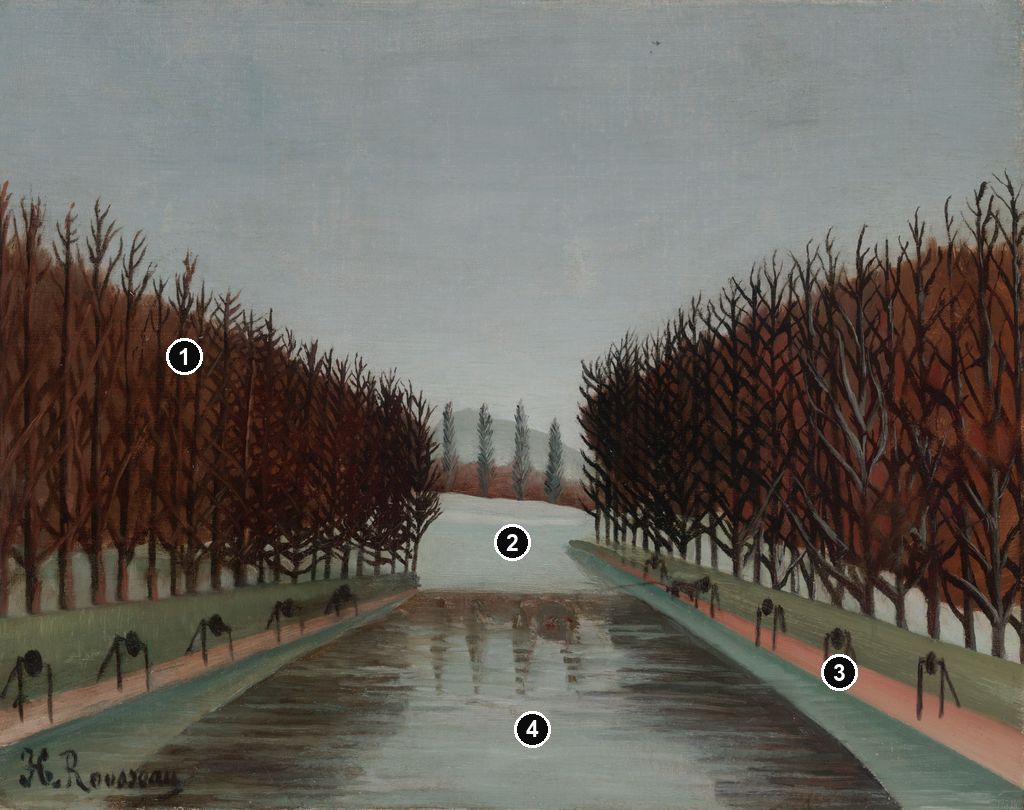
In Henri Rousseau’s Le Canal, two avenues of trees draw the eye towards a pale opening. The water between them widens towards us, carrying broken bands of reflection across its grey-green surface. Above, the branches stand out against a quiet sky: dense enough to enclose the view, open enough for light to show through their tangled outlines. The scene’s stillness grows from this balance between a strong central direction and hundreds of small, irregular lines.
Bowdoin College Museum of Art reproduced the painting as Le Canal, about 1905, in its 2011 catalogue Modernism at Bowdoin. The accompanying checklist recorded an oil on canvas measuring 12⅞ × 16⅛ inches, in the Katharine Ordway Collection at Yale University Art Gallery, New Haven.[1]
Yale’s current collection record also dates Le Canal to about 1905. It identifies the canvas as accession 1980.12.12 and gives its height and width as 32.7 × 41 cm, retaining the Katharine Ordway Collection credit.[2]
At a Glance
- ArtistHenri Rousseau
- SubjectLe Canal
- ExploreLooking along the water; Trees as a branching screen
This work across Henri Rousseau’s career
Carnival Evening
1886 [3]Le Canal (current article)
c. 1905 (2011 catalogue) [1]The Merry Jesters
1906 [8]The Snake Charmer
1907 [9]Contents
- Looking along the water
- Trees as a branching screen
- Reflections that slow the view
- A quiet palette with warm edges
- An avenue made for sustained looking
- Annotated details
Looking along the water
Rousseau places the viewer directly before the canal. The near edge of the water runs out of the picture at the bottom, leaving no foreground bank on which to establish a firm standing place. We seem poised over its surface, facing straight along the channel. The two sides recede towards the upper middle of the canvas, where a light strip of water and a few distant uprights interrupt the darker ranks of trees. That opening becomes the destination of almost every long line in the composition.
The banks make the direction especially clear. Narrow pinkish paths run beside the water, accompanied by green strips that separate one coloured plane from another. Their edges form long diagonals, broad and distinct at the front, closer together as they retreat. The paths are simple enough to grasp immediately, so the eye can move along them without losing its way among the branches. They give a firm framework to a scene whose upper half is full of restless detail.
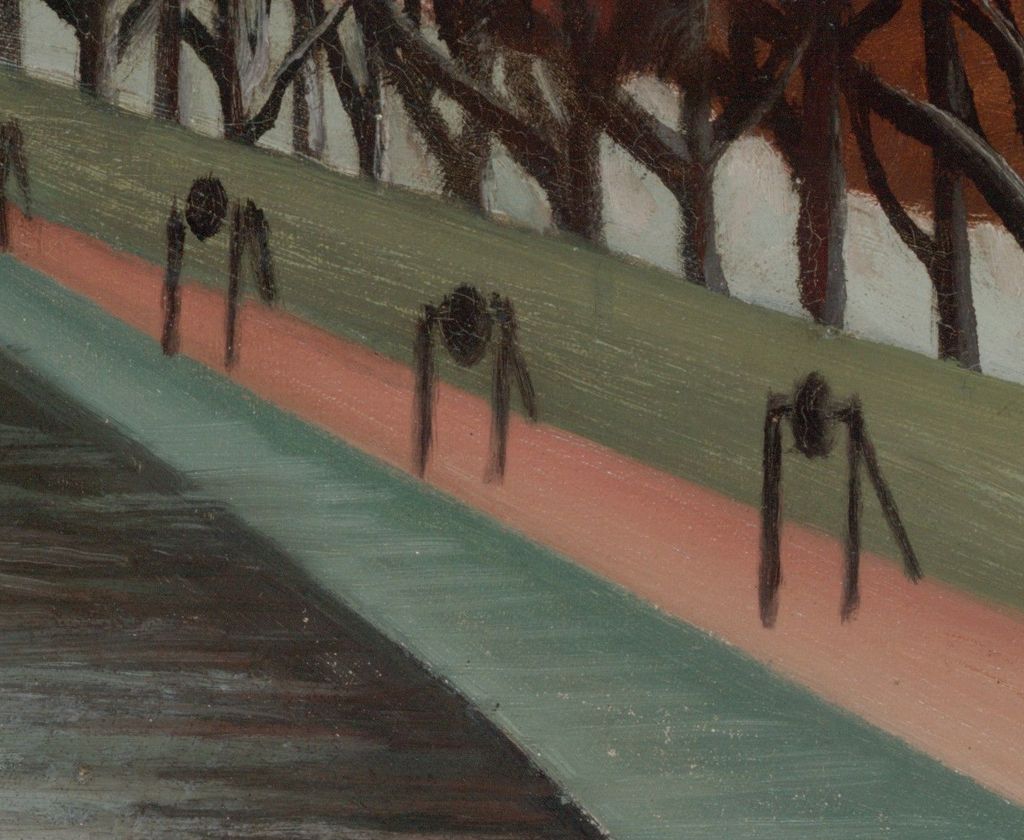
Small dark, looped forms repeat beside the paths. They read as posts and short railings, marking the inner margins of the banks. Near the foreground their bowed tops and thin supports can be distinguished; farther away they merge into tiny dark marks. Their shrinking scale reinforces the convergence of the paths, making the passage towards the centre feel gradual through a succession of small intervals.
Trees as a branching screen
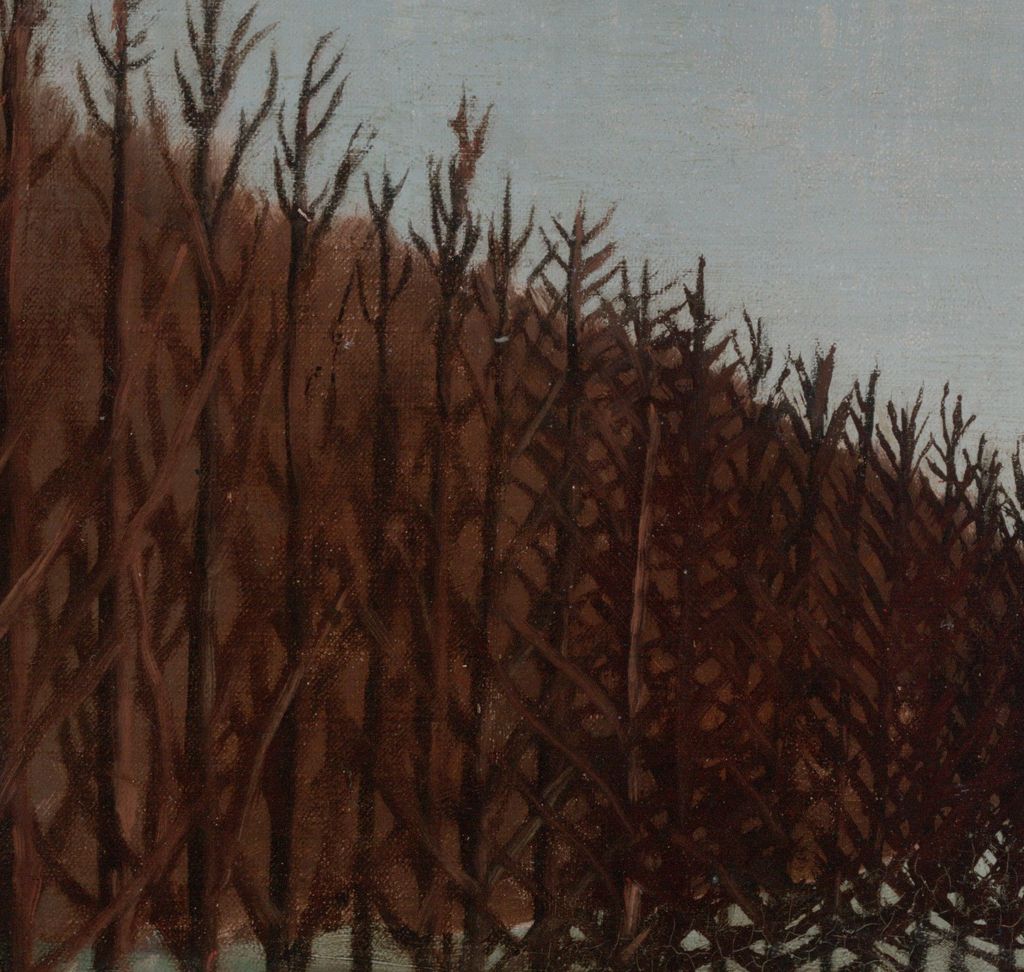
The trees provide the painting’s most intricate drawing. Their lower trunks are relatively easy to follow, rising from pale spaces along the outer sides of the paths. Higher up, each trunk divides into forks, and those forks divide again. Brown and black lines overlap until individual trees become difficult to separate. The avenue starts as a row of distinct vertical supports and becomes a continuous branching screen above them.
Looking across that screen reveals differences within the repetition. Some trunks lean; others rise more upright. A branch may stretch into an adjacent tree’s space, while another turns sharply back towards its own stem. The near trees have especially elaborate networks, and their limbs press against the edges of the picture. As the avenue recedes, these networks contract into smaller clusters. Distance is therefore expressed through both the size of the trees and the amount of detail that remains legible within them.
The two banks answer one another without becoming exact mirror images. The broad arrangement is paired, but the contours of the tree masses differ, as do the angles of the branches. On each side, dark lines produce a serrated boundary against the sky. This gives the central space an uneven rim: the eye can follow the general sweep towards the distance while pausing over individual projecting twigs. The composition feels ordered at a glance and more varied when examined closely.
The canopy also changes our sense of enclosure. Pale slivers between branches allow the sky to penetrate the avenue, even where the dark mesh seems thick. Little glimpses of light give the silhouettes an intricate, perforated texture. The same grey that spreads freely across the upper sky survives in tiny pockets within the branches. It links the open centre with the crowded sides of the painting.
Reflections that slow the view
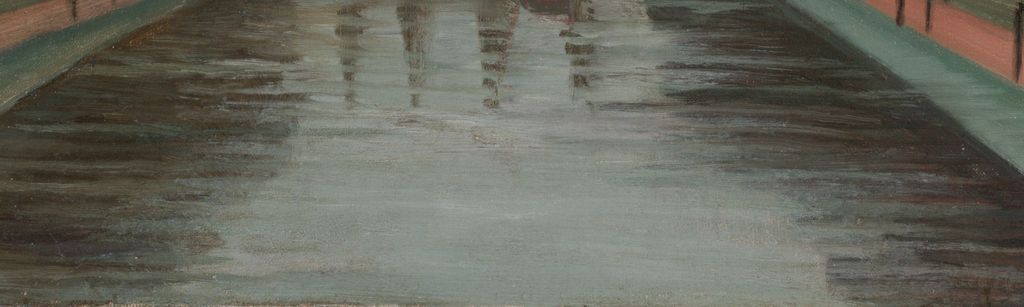
The water introduces a different kind of movement. The banks and tree rows pull the eye forward; the reflections spread across that direction in short horizontal strokes. Pale grey and muted green bands alternate with dark patches, particularly in the nearer water. Their irregular ends suggest a disturbed reflection, though there is no clearly depicted event to explain the disturbance. We can read the surface through the broken shapes themselves, without supplying a passing boat or a gust of wind.
Near the far end of this foreground stretch, several narrow dark reflections hang down into the lighter water. They echo the upright accents in the distance and briefly strengthen the channel’s central axis. Closer to us, the horizontal bands become broader and more prominent. The water thus has two roles: it continues the view into depth and presents a flat, marked surface immediately before the viewer. Our attention moves between following the canal and studying the pattern spread across it.
The contrast with the paths is precise. Their edges are comparatively steady and their pink-tan colour remains easy to trace. The water beside them breaks into uneven tonal pieces. Those differences help distinguish solid ground from a reflective surface, even though the whole picture uses a restrained range of colour. Rousseau gives each part a different visual rhythm: long continuous banks, branching trees, repeated loops and interrupted reflections.
Annotated Details from Le Canal
The numbered points identify visible features discussed in this article. Return from each detail to the whole composition. Henri Rousseau, Le canal, c. 1905. Yale University Art Gallery, Katharine Ordway Collection, 1980.12.12. Official full-resolution museum image retrieved in October 2026. Image source. Public domain. Numbers added to the overview; details cropped from the official museum image. No recolouring or retouching.
Details from LE CANAL
Follow the branching lines down to the converging paths, then compare the repeated posts with the broken reflections on the water.
A branching screen
Brown and dark branches repeatedly divide and cross one another. Small openings to the grey sky keep this dense tree mass from becoming a solid silhouette.
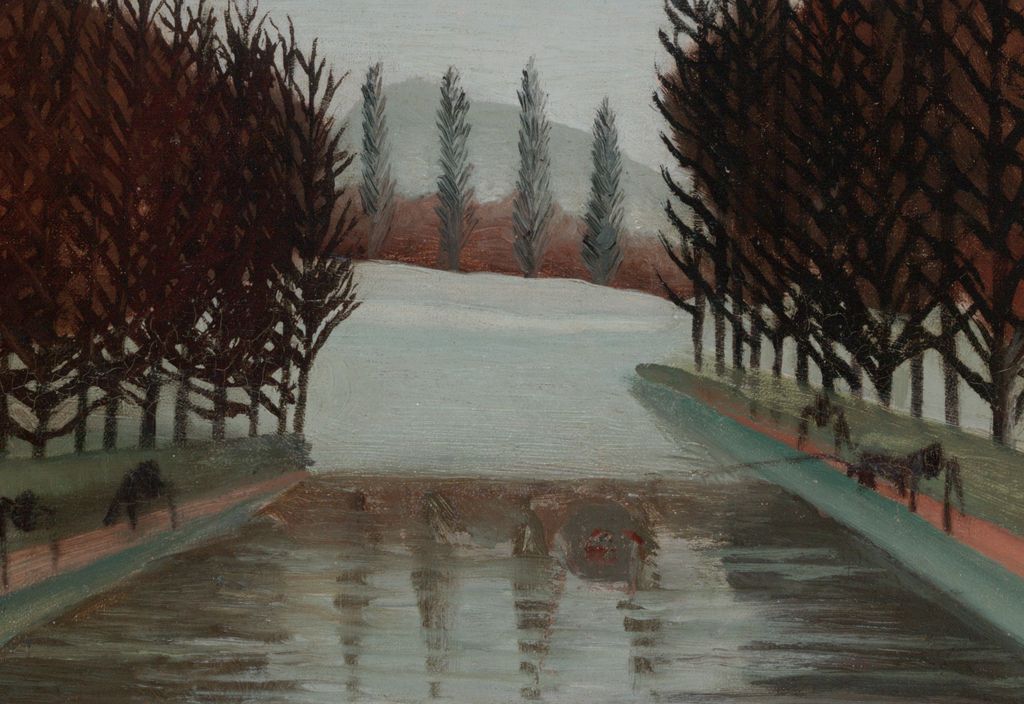
Banks converging on a pale opening
The two paths narrow towards the lighter water in the distance. Smaller trunks and rails accompany their converging edges, while distant upright trees mark the opening beyond.
Looped forms beside the path
Dark loops sit above thin supports along the reddish bank. Their repeated intervals and changing size strengthen the path's retreat into the picture.
Broken reflections across the canal
Short grey, green and brown marks spread sideways over the nearer water. These broken horizontal bands interrupt the forward pull of the canal's long edges.
A quiet palette with warm edges
Grey sky occupies a generous part of the composition. Its broad, relatively undisturbed area gives the eye room after the concentrated activity of the trees. The colour is close enough to the paler water to connect the top and bottom of the painting, while the darker reflections give the canal greater tonal variety. Between those cool expanses, the warm paths stand out as narrow ribbons.
Brown tones in the trees extend that warmth upwards. They are most noticeable among the larger branches, where the linework spreads over the sky, and where neighbouring limbs create denser patches. The warmth is subdued: it does not overwhelm the grey-green setting. Instead, the paths and trees establish a muted contrast with the water and sky. Much of the picture’s effect depends on these small changes within a limited palette.
The bare-looking branches may invite a seasonal reading, but the image offers a more secure subject for attention in their shapes and spacing. Their openness exposes the framework of the avenue. We can see how an upright becomes a fork, how one fork crosses another and how those intersections accumulate. Following these lines brings us close to the painting’s construction, even as the larger arrangement continues to carry us into the distance.
An avenue made for sustained looking
No human figure can be clearly identified in the view. The paths remain available to the imagination, and their emptiness makes their shape especially conspicuous. Without a walker to establish a small episode, the central passage holds attention through its changing proportions. The wide foreground, narrowing banks and distant gap give us a sequence to follow, while the branches and reflections offer reasons to stop along the way.
The title names the canal without identifying a particular waterway. Its banks, trees and rails give the scene a recognisable structure, but those elements do not establish an exact location. The strongest account of the picture begins with what Rousseau has placed before us: a straight channel, paired avenues and an opening whose light seems held between them. Readers exploring his treatment of ordinary waterside settings can continue with Banks of the Bièvre near Bicêtre.
Within Le Canal, the richest comparison lies between its own two halves. The upper portion is a web of rising and dividing lines; the lower portion is crossed by broken horizontal marks. Both are organised around the same narrowing space. Moving from branches to reflections makes this quiet scene active to look at, drawing attention to the little loops along the bank and the pale sky caught between the twigs.
Henri Rousseau artworks directory
This directory brings together works covered on this site and other works documented in the cited museum records and catalogues. Alternate titles share one entry; distinct versions remain separate. Historical dates for works without an article follow the cited catalogues. This is not a catalogue raisonné.
Frequently Asked Questions
The 2011 Bowdoin College Museum of Art catalogue dates it to about 1905. The approximate date should be retained rather than treated as an exact year.[1]
Bowdoin’s checklist credited the Katharine Ordway Collection at Yale University Art Gallery in New Haven. It listed the medium as oil on canvas and the dimensions as 12⅞ × 16⅛ inches.[1]
The canal banks converge, the trees become smaller, and the little dark railings diminish along the paths. Together these repeated changes lead the eye towards the light opening in the distance.
Discussion
Look again at the images and ideas explored in Le Canal. These editorial prompts invite your observations.
Reader Insights
Follow one foreground trunk into its branches. At what point does it become difficult to distinguish that tree from its neighbours?
How does your experience of the view change when you look first along the paths, then across the reflections?
Which differences between the two banks keep the paired avenues from feeling perfectly symmetrical?
Join the Conversation
Share a detail, comparison or question about Le Canal below.
References
- Bowdoin College Museum of Art. Modernism at Bowdoin: American Paintings from 1900 to 1940, 2011, Le Canal plate and entry, printed p. 16 (PDF p. 20); checklist, printed p. 31 (PDF p. 35); copyright statement, PDF p. 37. View source.
- Yale University Art Gallery, Le canal, 1980.12.12, current collection record: date, medium, dimensions and collection credit; collection data and image record, accessed 23 October 2026. View source 1. View source 2. View source 3.
- Philadelphia Museum of Art, Carnival Evening,1963-181-64,object59593. View source.
- Musée de l’Orangerie / Juliette Degennes, Henri Rousseau,L’ambition de la peinture: Un artiste dans son époque (in French). View source.
- National Gallery, Surprised!, NG6421. View source.
- Musée d’Orsay, La Guerre,RF19461 (in French). View source.
- MoMA, The Sleeping Gypsy. View source.
- Philadelphia Museum of Art, The Merry Jesters, 1950-134-176, object51097. View source.
- Musée d’Orsay, La Charmeuse de serpents, RF 1937 7 (in French). View source.
- Musée de l’Orangerie, La Carriole du Père Junier, RF 1960 26 (in French). View source.
- Solomon R. Guggenheim Museum / Cornelia Lauf, The Football Players,60.1583: current collection record. View source.
- MoMA, The Dream, 252.1954. View source.
- The Museum of Modern Art, Henri Rousseau: Essays (1985), selected catalogue entries, chronology and notes on early devotees. View source. Selected entries, chronology (pp.91–95) and early-devotee notes (pp.262–264) were consulted. Historical collection credits do not establish present ownership.
- Daniel Catton Rich, Henri Rousseau (The Museum of Modern Art, 1942), selected drawings and landscape studies; historical catalogue. View source. The dated 1942 publication is used for the two Quai d’Auteuil ink views; its Malakoff date differs from the 1985 catalogue.
- MANAS, Laval, Henri Rousseau, dit le Douanier, urban landscapes and preparatory study (in French). View source.
- National Gallery of Art, Self-Portrait (1895), pen-and-ink drawing, accession 1995.47.66. View source.
- The Museum of Modern Art, War (published January 1895), lithograph, accession 684.1943. View source.
- Barnes Foundation, Landscape and Four Young Girls, object 5521, BF855. View source.


 Henri Rousseau.jpg)


 Henri Rousseau.jpg)