



 by Tom Gurney
Tom Gurney BSc (Hons) is an art history expert with over 20 years experience
Published on June 19, 2020 / Updated on October 29, 2026
Email: tomgurney1@gmail.com / Phone: +44 7429 011000
View of Clichy Bridge at Asnières: Introduction
A red-orange tug approaches through green water, two white sails stand farther upstream, and a small brown balloon hangs in an immense cloudy sky. Henri Rousseau brings these different kinds of movement together in a tightly enclosed river scene. Buildings and bare branches line one bank; a dense wall of golden foliage rises along the other. Between them, the bridge makes a low, dark arch. The channel leads the eye towards it, while the balloon draws attention upwards, beyond the little world of boats, windows and trees.
At a Glance
- ArtistHenri Rousseau
- SubjectView of Clichy Bridge at Asnières
- ExploreThe painting and its former title; Three boats and three ways of moving
This work across Henri Rousseau’s career
Carnival Evening
1886 [1]The Merry Jesters
1906 [7]The Snake Charmer
1907 [8]Contents
- The painting and its former title
- Three boats and three ways of moving
- Unequal banks give the river its shape
- The bridge gathers the lower picture
- A balloon in a much larger sky
- Colour holds the different parts together
- A possible civic setting
- Annotated details
The painting and its former title
The Barnes Foundation identifies this work as View of Clichy Bridge at Asnières, dates it about 1900–1902, and records oil on canvas, 44 × 40 cm, inventory BF861.[6] Its former name, Study for View of the Pont de Sèvres, is explicitly recorded in the institution’s 2023–24 annual report.[12] That older title does not establish a preparatory relationship to another painting. The composition rewards attention as a complete arrangement: a near-square upright field with a disproportionately generous sky and an intricate concentration of activity below.
The bridge named in the current title occupies only a narrow strip of the surface. Even so, it provides the point towards which the banks, boats and water converge. Rousseau gives it a structural role that reaches far beyond its size. Looking first at the tug, then following the sails, one arrives at the crossing through a sequence of small, distinct forms.
Three boats and three ways of moving
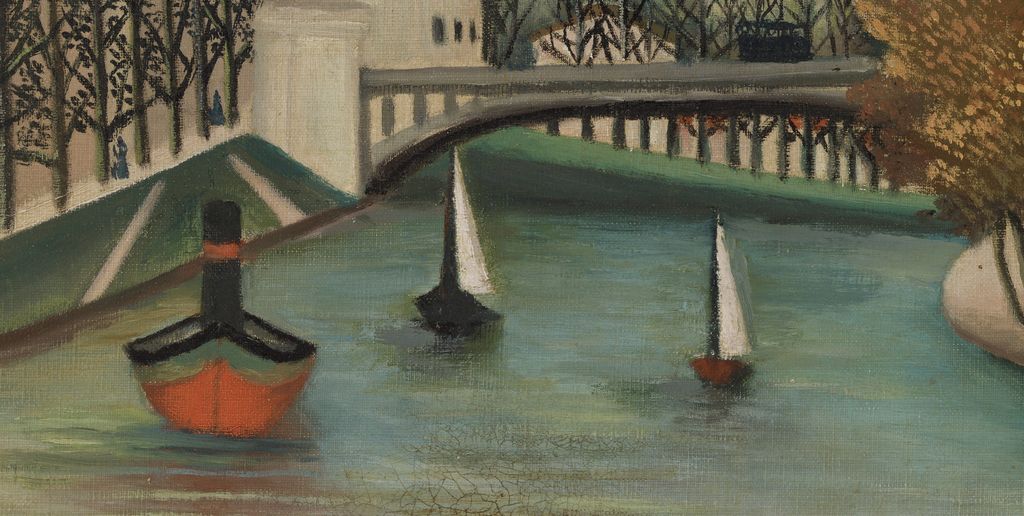
The tug faces out towards the viewer near the lower left. Its orange bow has a pointed centre and two rounded shoulders, enclosed by a dark green rim. Above it, the black structure divides into strong upright and slanting pieces. The smokestack, with its narrow warm band, forms a blunt vertical accent. This vessel has a compact, almost symmetrical presence, as though its weight were gathering immediately in front of us.
The sailboats offer a much lighter construction. Each has a slim, pale triangle above a small dark hull; one hull appears almost black, the other reddish brown. Their sails seem exceptionally tall beside the narrow pieces of boat beneath them. Where the tug spreads its bow across the water, the sailboats cut upwards. Their thin outlines allow the surrounding river to remain visible and spacious.
Position reinforces those differences. The nearer sailboat sits to the right of the tug, while the other stands higher and farther left, near the bridge’s approach. Together the three vessels make an uneven triangle. There is no rigid procession up the centre of the river. Instead, attention moves from one side to the other, finding a sequence in objects that remain distinctly separate.
Little visible disturbance accompanies this traffic. Short horizontal marks and softened patches surround the hulls, while the river retains a broad, smooth appearance. The sense of travel comes chiefly from the shapes and positions of the boats. The tug’s frontal bow suggests an approach; the sails suggest a different, more oblique passage. Rousseau can make the scene feel inhabited and active without filling it with elaborate gestures or a crowded waterfront.
Unequal banks give the river its shape
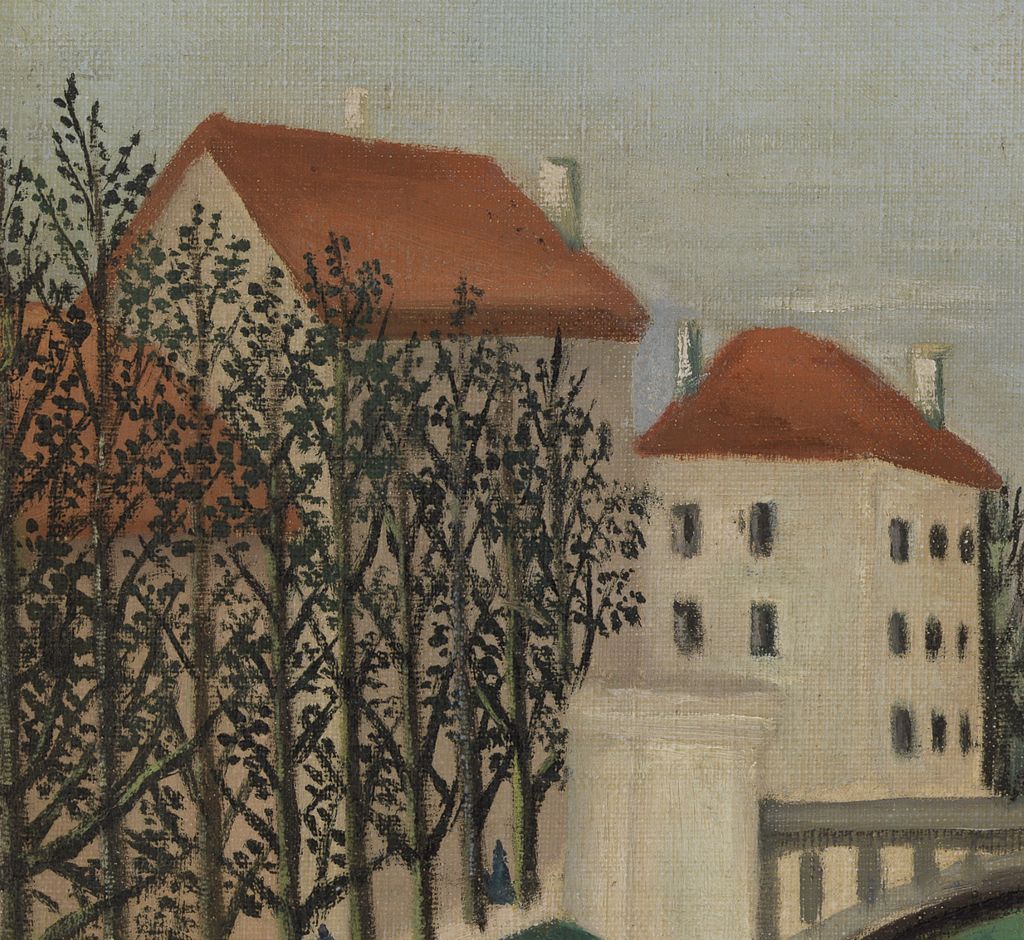
The left bank is built from pale walls, sharp roof slopes and a lattice of bare trees. Two cream buildings rise above the waterside, their red roofs providing the strongest warm colour in this part of the picture. Small dark windows punctuate their flat fronts. They are easy to count as separate marks, yet too small to distract from the larger blocks of building around them. Chimneys add brief pale interruptions along the roofs.
In front, the trees create a much finer pattern. Their trunks and branching twigs cross the light architecture, bringing a restless network into an otherwise solid area. The repeated windows remain orderly behind them. This overlap gives the bank depth through contrasting kinds of mark: dark openings held within the building, and dark branches extending freely over its surface.
At water level, two pale sloping strips descend through the green embankment. Their diagonals lead towards the river and echo, on a smaller scale, the slopes of the roofs above. The bank becomes an arrangement of connected angles. Even a brief glance can distinguish these descending lines from the vertical trunks and the horizontal parapet.
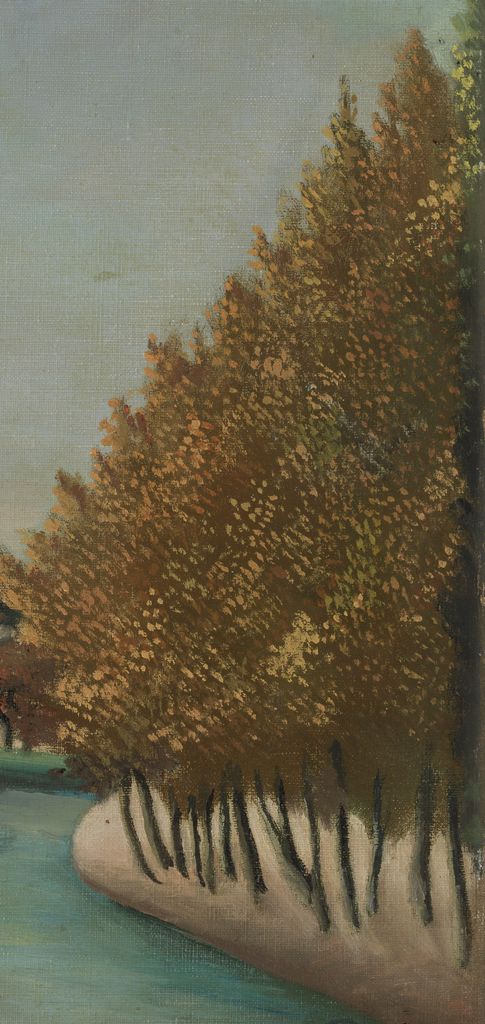
The right side grows from an entirely different rhythm. Here, a rounded pale bank curves forward, carrying a close succession of slender dark trunks. Above them, the foliage thickens into a continuous brown and gold mass. Its upper edge rises steeply towards the right border. Small yellowish touches cover the crowns, making this side feel densely worked beside the open branching opposite.
This inequality is central to the view. If the banks were mirror images, the river would resemble a straight corridor. Their contrasting contours give it a bend and make its width appear to change. The right bank pushes towards the foreground, while the left retreats along straighter edges. Water seems to turn between them. The buildings offer openings and intervals; the foliage offers accumulation. Each side makes the other more legible.
The bridge gathers the lower picture
The bridge joins these unequal shores with a long upper bar and a curved underside. Its low arch is easiest to follow where the dark curve lies against the lighter distance. Behind or beneath the crossing, slender supports produce another repeated pattern, much tighter than the widely spaced tree trunks nearby. The bridge is therefore both a clear outline and a delicate screen.
It sits below the broad middle of the canvas, leaving the sky largely unbroken. The tops of the houses and the rising foliage reach above it, but the crossing itself holds the river scene together at a low level. The boats approach a destination that seems compact enough to encompass in a single glance.
Scale changes as the eye moves backwards. The tug’s broad black uprights give way to the sailboats’ narrow masts, then to the bridge’s finer repeated supports. Farther away, bare trees rise as a small web of branches. Similar dark linear forms become progressively more intricate. Depth emerges through that shift, even where the colours remain close and the separate planes feel firmly outlined.
The arch leaves a strip of green bank visible beyond the foreground water. This glimpse sustains the suggestion of a river continuing through the scene. The bridge closes the view enough to give it coherence, while preserving a passage through which the eye can travel.
A balloon in a much larger sky
Above this busy lower register, the sky has room to expand. Soft grey and blue-green cloud masses spread across it, with only slight changes of light and density. Their edges are less decisive than the roofs, hulls and trunks below. After the small repeated details of the riverbanks, this breadth gives the gaze a different pace.
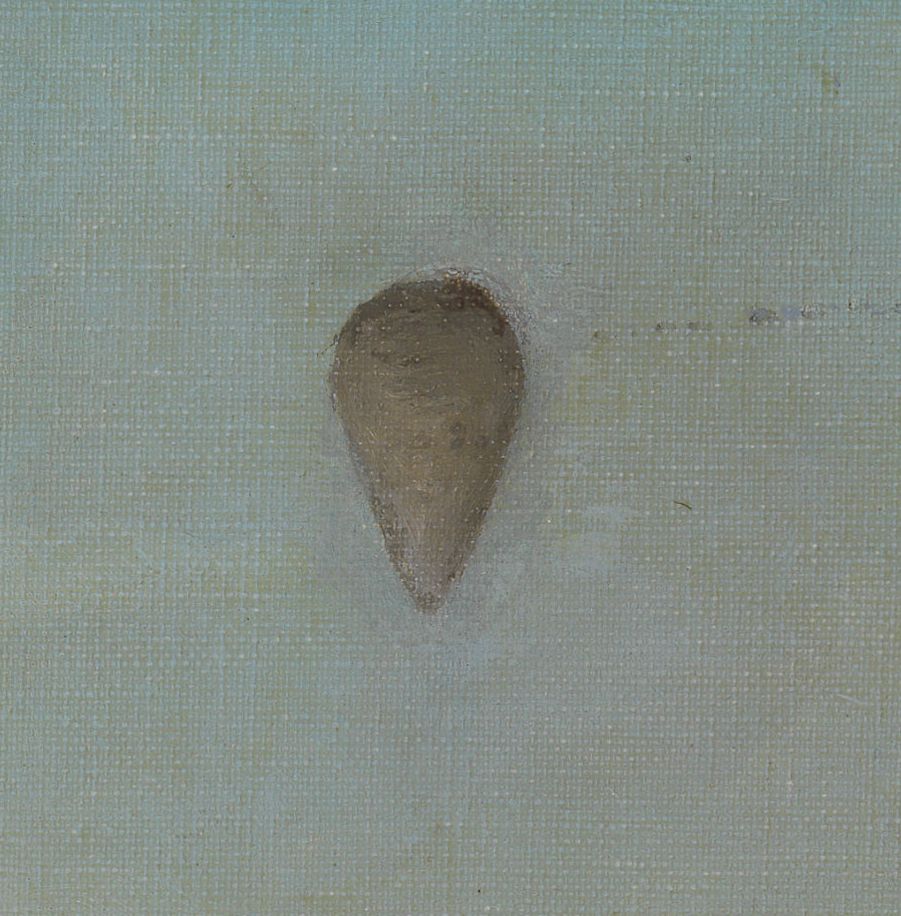
The balloon is isolated high towards the right of centre. Its rounded top narrows to a point, producing a small downward-facing shape. There is no surrounding cluster of objects to help measure it. Its distance feels open-ended in a way that the river’s does not: along the water, boats, banks and bridge offer successive markers, while the balloon hangs within a largely undivided field.
Its dark brown colour relates quietly to the roofs and foliage, but its isolation gives it unusual prominence. A much larger object could be less conspicuous if it were embedded in the detailed lower scene. Here, the eye picks out a single bounded shape against soft cloud. The balloon balances the tug across the vertical reach of the painting, although the two forms differ greatly in size and visual weight.
This separation introduces a faintly dreamlike stillness. The sensation comes from the composition itself: an ordinary riverside world below, with one small suspended form above. The balloon does not need an assigned symbolic meaning to change the experience of the landscape. It makes the air feel like another space through which movement might occur.
Colour holds the different parts together
Much of the painting lies within a restrained range of greens, greys, creams and browns. Against that field, the red roofs, orange bow and reddish sailboat hull become small points of warmth. Their distribution carries colour from the upper left of the river scene down into its foreground and across to the right. The accents are separated sufficiently to remain visible as a loose pattern.
The pale sails play a complementary role. They bring two sharp notes of light into the green water and answer the cream buildings on the bank. At the same time, their triangular outlines repeat the roofs in a different orientation and scale. Colour and shape create relationships between objects that otherwise have little in common.
These connections give order to the crowded lower half. Windows, leaves and bridge supports each have their own local rhythm; the larger colours bind those rhythms together. Readers interested in Rousseau’s style and technique can begin here with a simple act of looking: follow a colour across the canvas, then observe how its changing outline alters its effect.
Annotated Details from View of Clichy Bridge at Asnières
The numbered points identify visible features discussed in this article. Return from each detail to the whole composition. Henri Rousseau, View of Clichy Bridge at Asnières, c.1900–1902. Barnes Foundation, Philadelphia, BF861. Museum-derived reproduction published on Wikimedia Commons in 2018 under the former Study for View of the Pont de Sèvres title. Image source. Public domain. Numbers added to the overview; details cropped from the published original. No recolouring or retouching.
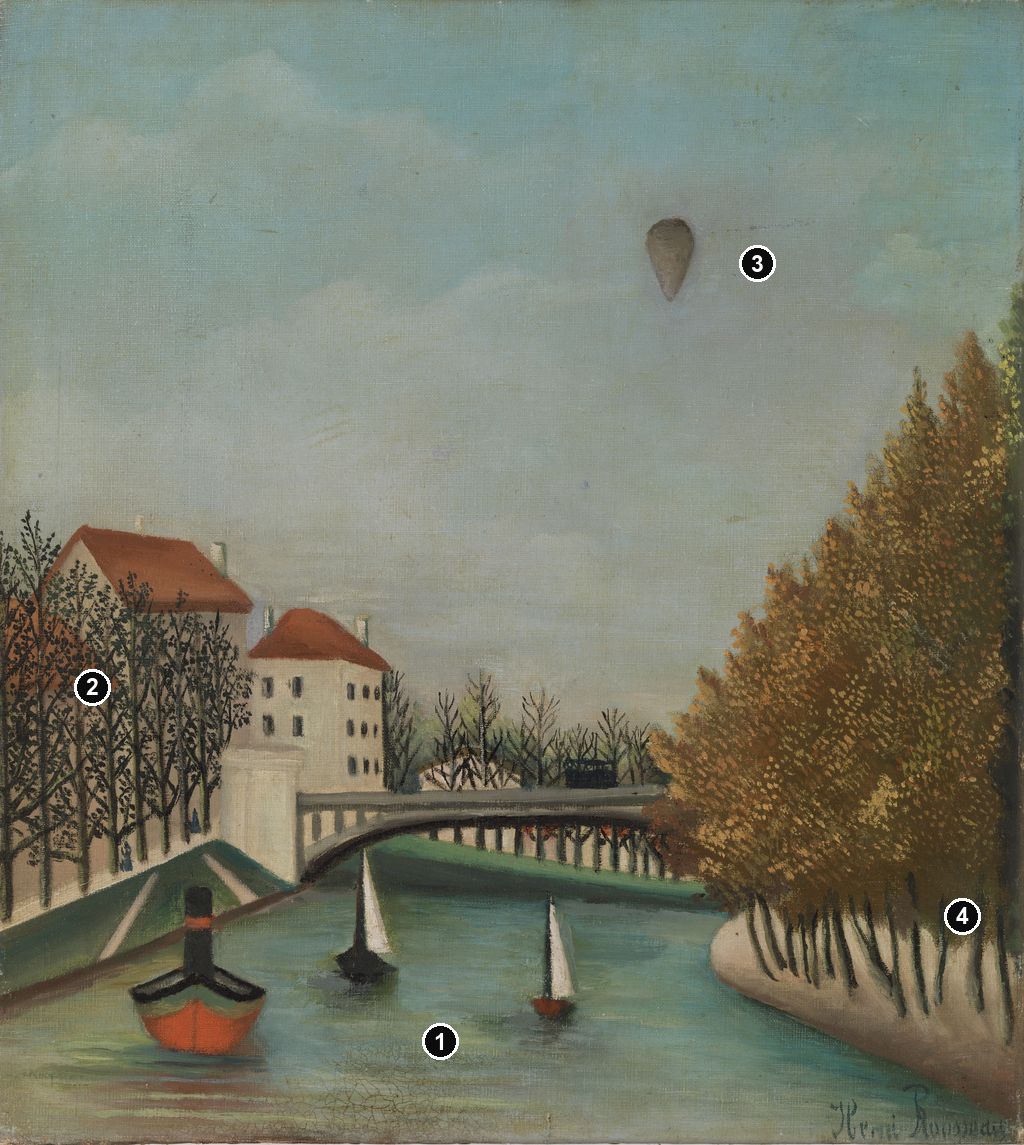
Details from VIEW OF CLICHY BRIDGE AT ASNIÈRES
Follow the boats towards the bridge, compare the two banks, then look up to the balloon in the broad sky.
Three boats beneath the bridge
The broad orange tug faces the viewer while two narrow pale sails rise farther along the channel. Their staggered positions carry the eye towards the low arch and its finer repeated supports.
Roofs, windows and bare branches
Warm roof slopes and small dark windows divide the cream façades. In front, thin trunks and branching twigs cross these larger blocks, giving the left bank a much finer pattern.
An isolated balloon in the sky
The small brown shape hangs alone within a broad field of softly changing cloud. Its clear outline makes it conspicuous despite its size, drawing attention upwards from the crowded river scene.
Golden foliage and the curved bank
Repeated warm leaf marks gather into a dense crown above the slender dark trunks. The pale bank curves forward below them, giving this shore a different rhythm from the buildings and bare branches opposite.
A possible civic setting
The Barnes proposes that Rousseau probably made the painting for a government-sponsored competition to decorate Asnières’s new town hall. Its commentary connects the required presentation of a modern place of healthy leisure with the bridge, tug, balloon and sailboats. This remains a proposed purpose, rather than confirmation that the canvas was submitted or commissioned.[6]
That interpretation gives a useful context for the balance visible in the picture. Solid buildings, a river crossing and different vessels coexist within a leafy setting. Nothing overwhelms the others. The heavy tug occupies its own patch of water, and the small sails retain room around them. Seen this way, the painting offers a compact image of activity held within an orderly landscape. Its calm is compatible with movement, extending from the river traffic to the balloon overhead.
The Barnes’s annual report also names this canvas among six Rousseau paintings given new high-resolution X-radiographs and states that radiographs of all eighteen were submitted to a thread-count research project. It supplies no specific hidden image or pigment finding for this work.[12] Those examinations add a material dimension to its study while leaving the visible arrangement—the curling channel, asymmetrical shores and expansive sky—as the clearest starting point for understanding it.
Henri Rousseau artworks directory
This directory brings together works covered on this site and other works documented in the cited museum records and catalogues. Alternate titles share one entry; distinct versions remain separate. Historical dates for works without an article follow the cited catalogues. This is not a catalogue raisonné.
Frequently Asked Questions
That is its former title, recorded by the Barnes. The institution now uses View of Clichy Bridge at Asnières.[12] The older wording alone cannot prove that it prepared another painting.
Its small, clearly bounded silhouette sits alone against a broad area of softly changing sky. The crowded details below make that isolation especially noticeable.
The staggered boats lead towards the bridge, while the banks narrow the channel. Broad foreground shapes give way to finer supports and branches in the distance.
Discussion
Look again at the images and ideas explored in View of Clichy Bridge at Asnières. These editorial prompts invite your observations.
Reader Insights
How would the scene change if the sky ended just above the buildings and trees?
Which has the stronger presence: the broad tug near the foreground or the tiny balloon above?
Follow the dark vertical marks from the boat to the trees and bridge. Where do they suggest weight, and where do they create delicacy?
Join the Conversation
Share a detail, comparison or question about View of Clichy Bridge at Asnières below.
References
- Philadelphia Museum of Art, Carnival Evening,1963-181-64,object59593. View source.
- Musée de l’Orangerie / Juliette Degennes, Henri Rousseau,L’ambition de la peinture: Un artiste dans son époque (in French). View source.
- National Gallery, Surprised!, NG6421. View source.
- Musée d’Orsay, La Guerre,RF19461 (in French). View source.
- MoMA, The Sleeping Gypsy. View source.
- Barnes Foundation. View of Clichy Bridge at Asnières (Vue du pont Clichy à Asnières), BF861, current collection record, identity fields and short description; accessed 23 October 2026. View source.
- Philadelphia Museum of Art, The Merry Jesters, 1950-134-176, object51097. View source.
- Musée d’Orsay, La Charmeuse de serpents, RF 1937 7 (in French). View source.
- Musée de l’Orangerie, La Carriole du Père Junier, RF 1960 26 (in French). View source.
- Solomon R. Guggenheim Museum / Cornelia Lauf, The Football Players,60.1583: current collection record. View source.
- MoMA, The Dream, 252.1954. View source.
- Barnes Foundation. Annual Report 2023–24, Conservation, printed pp. 29–31, especially p. 30, PDF pp. 16–17. View source.
- The Museum of Modern Art, Henri Rousseau: Essays (1985), selected catalogue entries, chronology and notes on early devotees. View source. Selected entries, chronology (pp.91–95) and early-devotee notes (pp.262–264) were consulted. Historical collection credits do not establish present ownership.
- Daniel Catton Rich, Henri Rousseau (The Museum of Modern Art, 1942), selected drawings and landscape studies; historical catalogue. View source. The dated 1942 publication is used for the two Quai d’Auteuil ink views; its Malakoff date differs from the 1985 catalogue.
- MANAS, Laval, Henri Rousseau, dit le Douanier, urban landscapes and preparatory study (in French). View source.
- National Gallery of Art, Self-Portrait (1895), pen-and-ink drawing, accession 1995.47.66. View source.
- The Museum of Modern Art, War (published January 1895), lithograph, accession 684.1943. View source.
- Barnes Foundation, Landscape and Four Young Girls, object 5521, BF855. View source.


 Henri Rousseau.jpg)


 Henri Rousseau.jpg)