



 by Tom Gurney
Tom Gurney BSc (Hons) is an art history expert with over 20 years experience
Published on June 19, 2020 / Updated on October 29, 2026
Email: tomgurney1@gmail.com / Phone: +44 7429 011000
The Painter and His Model: Introduction
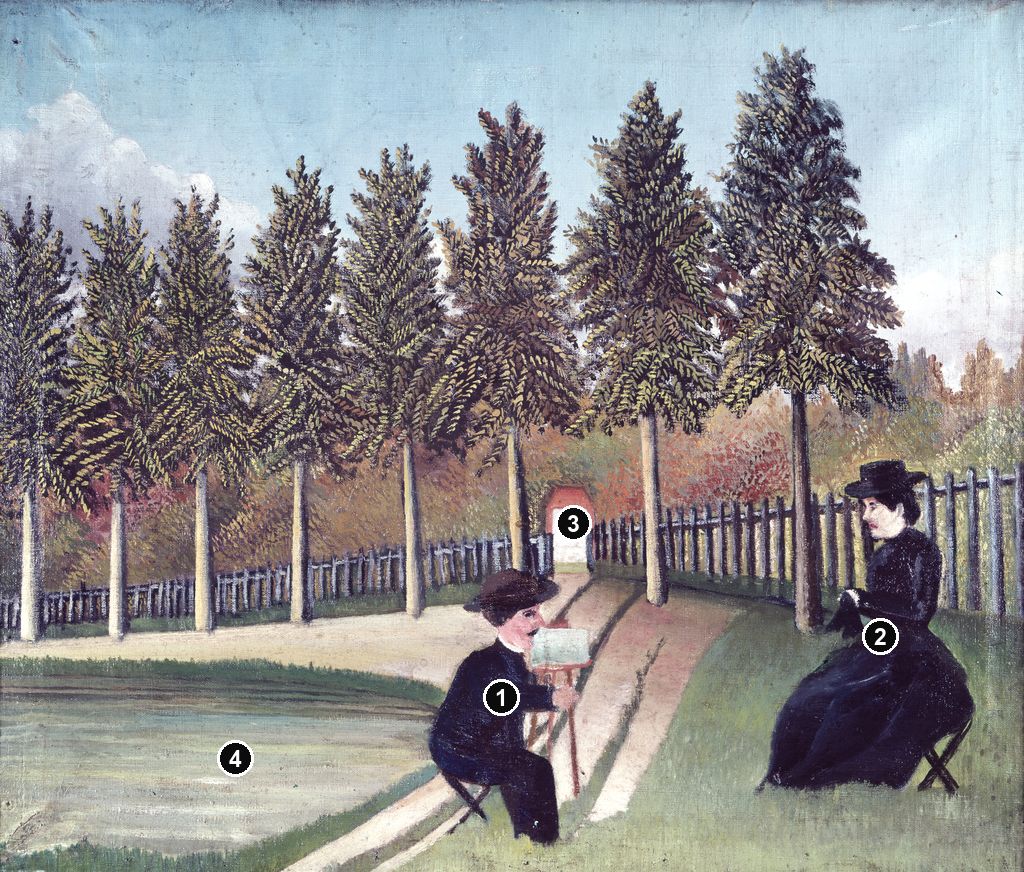
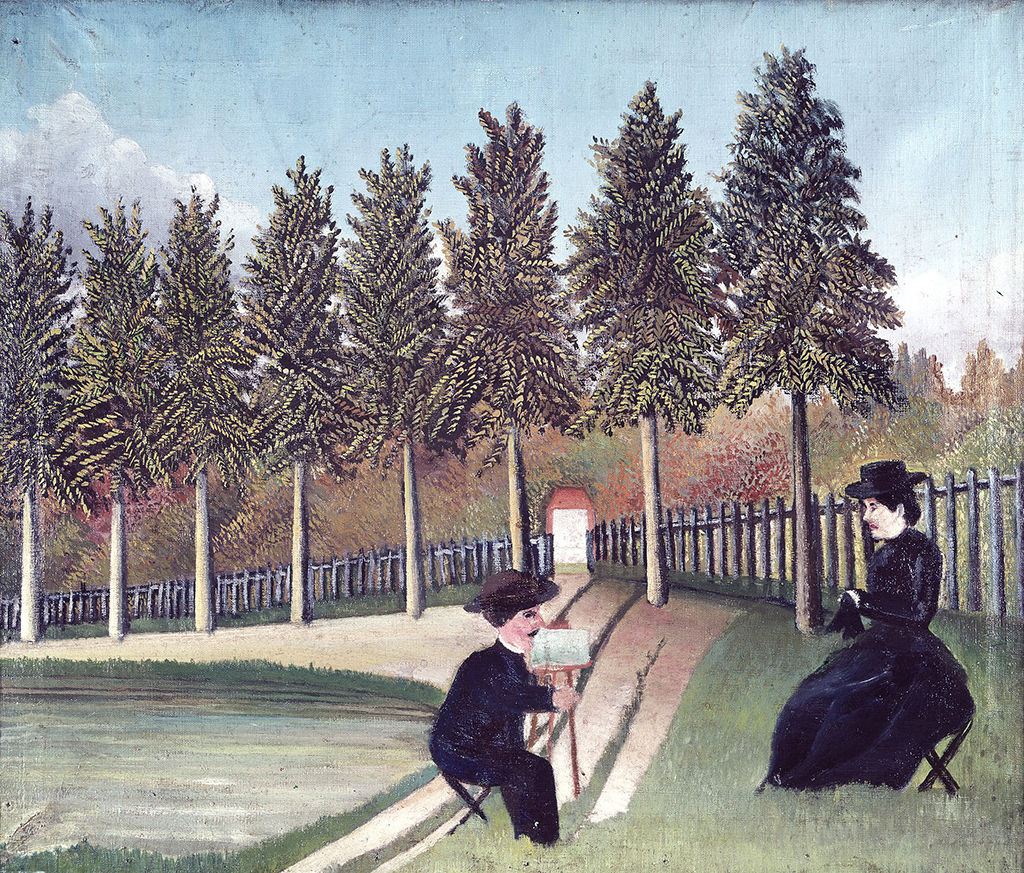
Henri Rousseau places the work of painting in an unusually spacious garden. A small, dark-clothed artist sits beside his easel; a woman faces him across a strip of grass. Behind them, a pale path runs towards a distant gate between ranks of trees. The Centre Pompidou calls this picture Le Peintre et son modèle, or The Painter and His Model, and dates it to 1900–1905. The alternative title L’Artiste peignant sa femme identifies the woman as a wife, but the museum’s current record does not establish either figure’s identity.[1]
At a Glance
- ArtistHenri Rousseau
- Current titleLe Peintre et son modèle (The Painter and His Model)
- Date1900–1905
- MediumOil on canvas
- Dimensions46.5 × 55.5 cm
- CollectionCentre Pompidou, Musée national d’art moderne, Paris
- AcquisitionBequest of Nina Kandinsky, 1981
- Inventory numberAM 81-65-861[1]
This work across Henri Rousseau’s career
Carnival Evening
1886 [2]The Merry Jesters
1906 [7]The Snake Charmer
1907 [8]Contents
- Two figures and a little easel
- The garden’s two kinds of space
- Painting a portrait in a landscape
- A title that leaves the sitters unnamed
- A recollection of the studio
- Annotated details
Two figures and a little easel
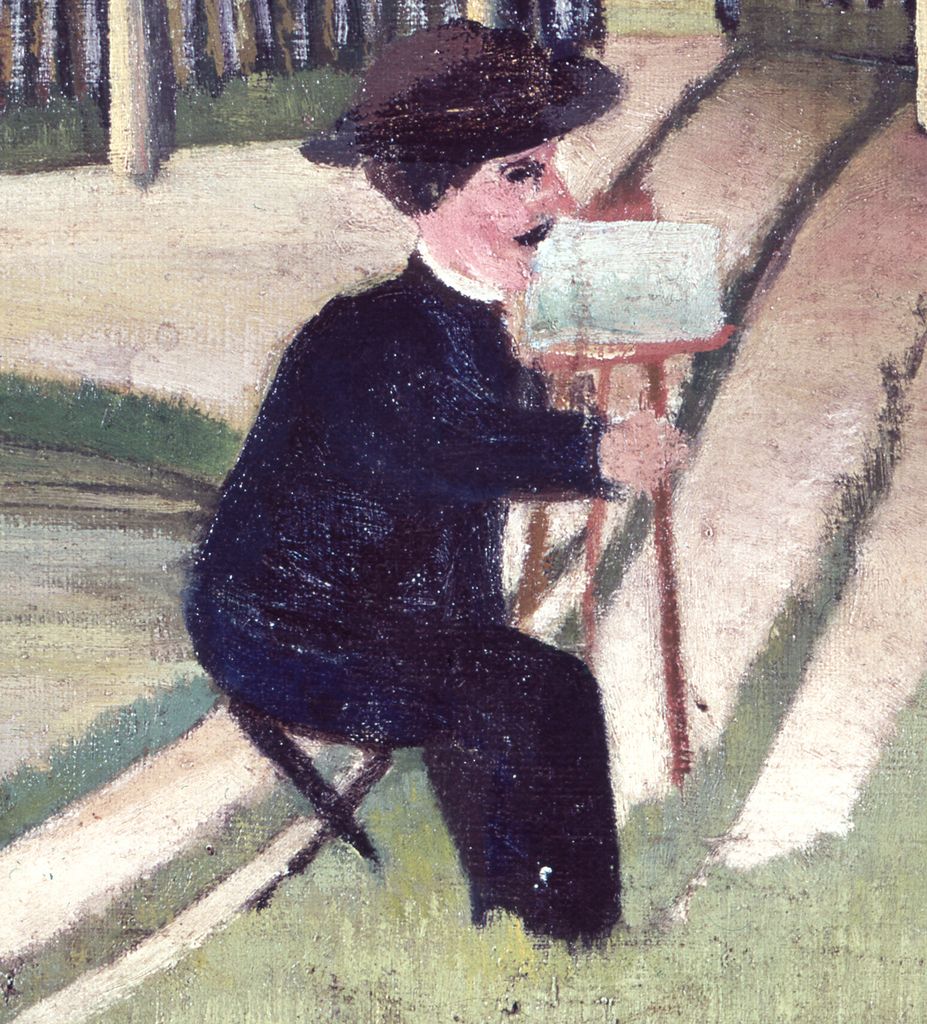
The painter occupies the lower centre of the canvas, slightly to the left. His broad-brimmed brown hat shades a small pink face shown in profile. The dark mass of his clothing narrows towards his bent legs, while the crossed supports of his seat are visible below him. His head turns towards the woman, establishing the act of looking on which the scene depends. Between the two faces stands a little easel, with a pale green rectangle at its top. Its small size makes the occupation legible without revealing enough to identify the image being made.[1]
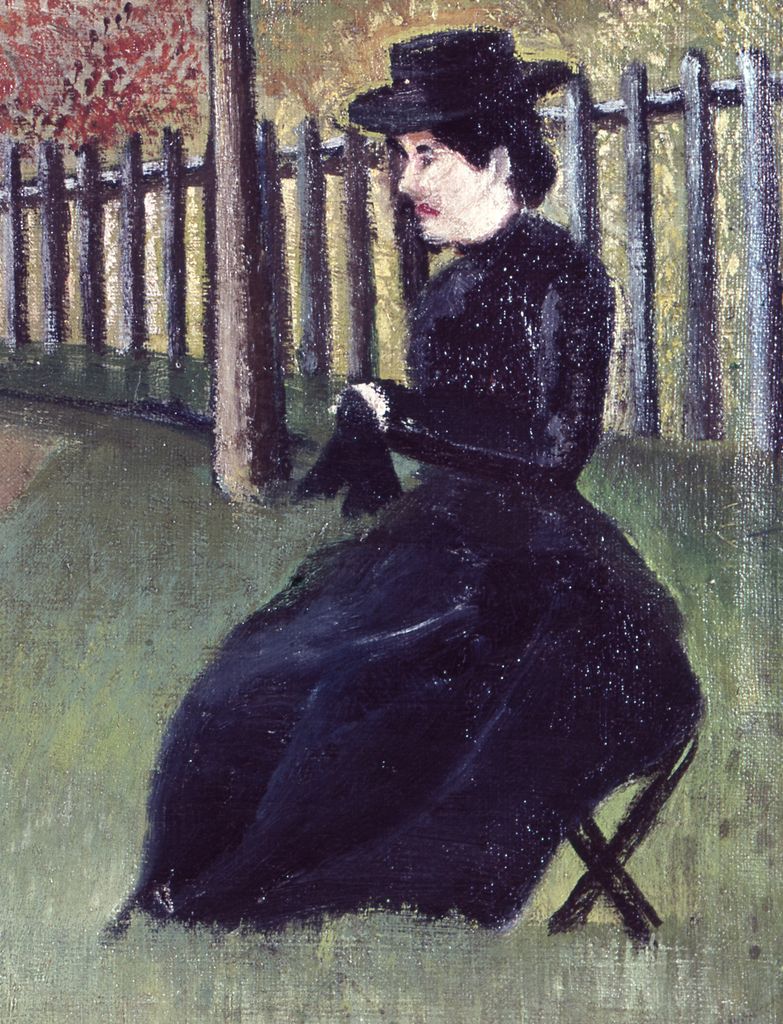
The woman is considerably larger. Seated on a folding stool towards the right edge, she rises above the painter on the green slope. Her black hat has a firm horizontal brim; the long outline of her dress spreads down and out over her knees. Her hands are gathered in front of her body. The pale face turns left, answering the painter’s profile, but her posture is more upright and still. The two figures belong to one exchange while retaining very different silhouettes: his compact and bent forward, hers broad and composed.
That difference in scale gives the model a commanding presence. The painter has the equipment and performs the action, yet the woman supplies the largest uninterrupted dark form in the foreground. Her dress has enough breadth to balance the pond on the opposite side. The arrangement of shapes gives her importance before we know anything about her identity.
Both people are settled into their places, and the open ground between them keeps their relationship clear. Neither face is obscured. Even with the easel occupying that interval, the exchange feels direct: one person looks, the other holds a pose, and the surrounding garden allows that action room to unfold.
The garden’s two kinds of space
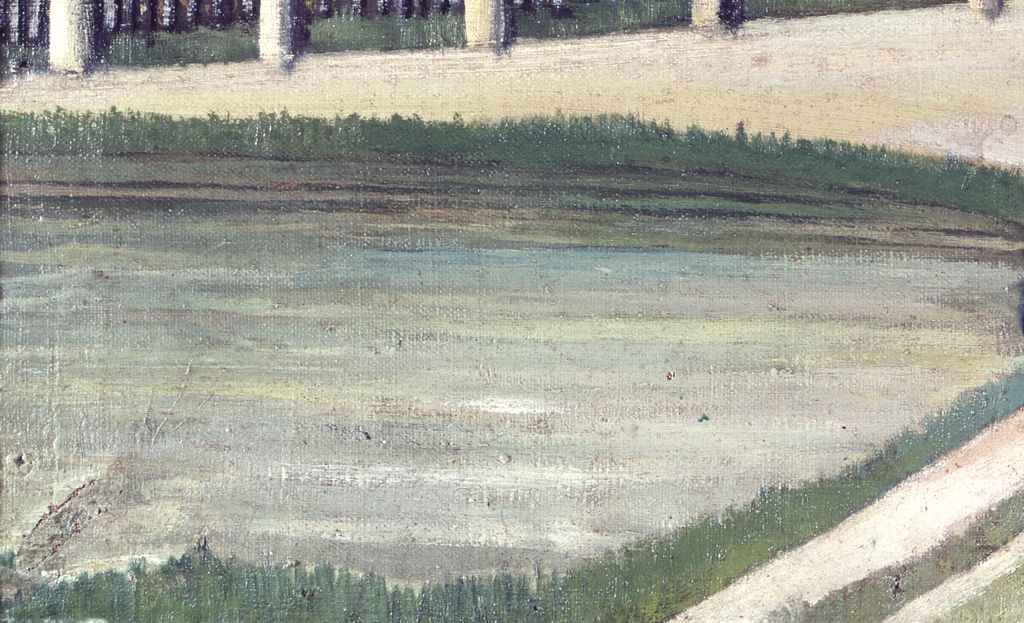
The garden combines broad, almost level areas with a strongly receding central passage. At the lower left, the pond spreads into a flattened curve. Horizontal strokes and bands of green give its surface a quiet, enclosed character. Its rounded bank leads the eye towards the painter’s seat. Across the foreground, grass provides another broad plane on which the two dark figures stand out. These expanses make the near part of the painting feel open and shallow.[1]
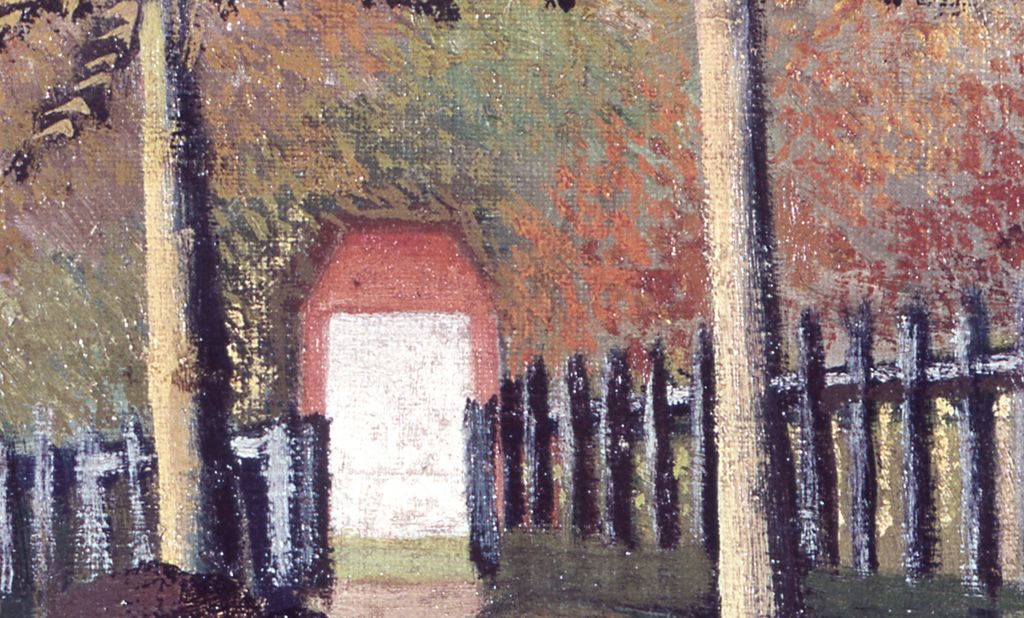
The path changes the pace. Beginning near the lower edge, its pale tracks narrow sharply as they rise towards a small, light-coloured gate or doorway with a red roof. Green divides the tracks, so that the grass appears to continue through the route itself. Another pale stretch runs across the garden behind the pond. The crossing and curving paths offer several possible directions, but the central opening remains the most insistent destination. Its small red cap catches the eye between the subdued greens and browns.
Black fencing reinforces that recession. On the right, its upright pickets are large and distinct close to the woman, then become smaller and more tightly gathered towards the gate. On the left, the fence follows the ground behind the pond. These repeated dark marks draw the separate parts of the garden into one enclosure. They also echo the figures’ clothing: the black shapes of human presence belong to the same visual rhythm as the garden’s boundaries.
Above the fence, the trees rise like a sequence of columns. Their bare lower trunks remain easy to follow, while their leafy crowns overlap. The treetops vary in height, climbing towards the right, and their branching sprays break up the smooth blue of the sky. White clouds gather mainly on the left. Farther back, muted yellow, russet and green foliage forms a softer band behind the sharper trunks and fence.
The garden’s order never becomes mechanical. A trunk leans, a crown spreads unevenly, a path bends away from a straight line. Small variations keep the repeated forms active. The contrast is especially clear between the narrow, largely vertical trunks and the many short, slanting marks of their leaves. Rousseau gives the trees distinct silhouettes while allowing their foliage to knit into a continuous screen. The eye can travel down the path into depth or move sideways across this patterned surface.
Annotated Details from The Painter and His Model
The numbered points identify visible features discussed in this article. Return from each detail to the whole composition. Henri Rousseau, Le Peintre et son modèle (The Painter and His Model), [1900–1905]. Centre Pompidou, Musée national d’art moderne, AM 81-65-861. The identities of both figures remain unestablished. Photograph: Françoise Foliot / Fonds Françoise Foliot, preserved by Wikimédia France. Image source. CC BY-SA 4.0. Numbered overview and cropped details adapted from Françoise Foliot’s photograph. The overview is resized and numbered; details are cropped. These adaptations are offered under CC BY-SA 4.0. No recolouring or retouching.
Details from THE PAINTER AND HIS MODEL
Compare the two seated figures, then follow the garden’s enclosing fence and the curved edge of the pond.
The painter looks past a little easel
The small figure leans towards a pale green rectangle, with the crossed supports of the seat visible below. The hat and turned face direct attention towards the model, while the tiny canvas leaves its image unresolved.
A model seated in a broad dark dress
The woman’s upright torso and spreading skirt make a large dark shape. Her folded hands, left-facing profile and crossed stool supports hold the pose together against the lighter grass and fence.
Fence posts converge towards a pale gate
Large dark pickets give way to smaller, closer marks beside the pale opening. Its red cap makes a compact warm accent where the garden’s boundaries meet in the distance.
A pond bounded by a curving bank
Long horizontal strokes spread across the pale green water. The narrow bank bends around its edge, joining the rounded pond to the paths and open grass of the foreground.
The Painter and His Model — Henri Rousseau.
Painting a portrait in a landscape
The subject joins two kinds of attention. A portrait painter looks closely at a person, while a landscape invites the viewer to wander across a setting. Here the artist’s face, the model’s face and the little easel form a compact group within a much larger field of paths, trees, water and sky. The scene can be read at either scale. From a distance the black figures punctuate the garden; closer looking reveals the quiet labour that connects them.
The Musée de l’Orangerie’s 2026 exhibition account describes Rousseau’s interest in placing figures against landscapes whose details contribute to a portrait’s meaning. It also notes his playful claim to have invented the “portrait-landscape”. That claim belongs to his presentation of his own work, rather than establishing that he originated the combination.[12] In this painting, the act of making a portrait becomes part of the landscape itself. The garden contains both the person posing and the person constructing her image.
The open foreground separates the figures, the path passes beside the working painter, and the fence rises behind the woman. Each element helps to place the human activity. Yet no particular location can be securely named from the museum record. A reader may recognise the experience of a formal park or enclosed garden without assigning the pond, trees and gate to a specific address.
Rousseau’s self-portrait offers another way into his presentation of the painter’s role. In The Painter and His Model, however, the small working figure encourages attention to an activity shared with another person. The painter has a task, the model maintains her pose, and the garden becomes the space in which that relationship is sustained.
A title that leaves the sitters unnamed
The difference between the titles matters because it changes what a viewer expects to find. The Artist Painting His Wife invites an intimate reading before the picture has been examined. The Painter and His Model leaves the relationship open. The current Centre Pompidou title supports the latter, more cautious understanding. It names the two roles visible in the scene without supplying a biography for either figure.[1]
The painting’s scale and dress offer no secure solution. A dark hat and black coat are enough to identify a painter at work, but they do not establish a self-portrait. Likewise, the woman’s composed pose can be described without deciding whether she was a relative, acquaintance or professional model. Her apparent prominence tells us how the composition is organised; it cannot, by itself, tell us who she was.
Dates have also varied. The museum’s bibliography records the picture as dated 1908 in the 1950 Venice Biennale catalogue. Its annotation for the 1964 exhibition Le Monde des Naïfs gives the title L’Artiste peint son modèle and the date “after 1900, before 1903”. The current owning record uses the broader range 1900–1905.[1] Those entries show a changing catalogue description, although they do not explain the revisions.
A recollection of the studio
The Centre Pompidou records the painting’s arrival in the national collection through Nina Kandinsky’s bequest in 1981. Its bibliography preserves a glimpse of an earlier history. In the annotation to the 1964 Le Monde des Naïfs catalogue, the work is listed in Mme Nina Kandinsky’s collection, alongside a report that it was bought in Rousseau’s studio in 1908 or 1909. The museum identifies the basis of that report as an oral communication from Nina Kandinsky.[1]
This is a recollection transmitted through a later catalogue annotation. It does not identify Nina as someone who personally visited the studio in those years, nor does it provide an original invoice. The reported purchase date should also be kept distinct from the date of creation: an already completed painting could remain in a studio before being bought. The museum’s creation range and the reported studio purchase describe different stages of the picture’s history.
The picture continued to attract attention in later Rousseau scholarship. The museum lists reproductions in publications ranging from the 2001 Tübingen catalogue to the Barnes Foundation’s 2025 Henri Rousseau: A Painter’s Secrets. The list includes exhibition catalogues in which the painting was reproduced without being displayed; two entries for the 2015–2016 Rousseau publications expressly mark it as a work not exhibited.[1] Its presence in those books cannot be turned into a complete itinerary of loans.
Henri Rousseau artworks directory
This directory brings together works covered on this site and other works documented in the cited museum records and catalogues. Alternate titles share one entry; distinct versions remain separate. Historical dates for works without an article follow the cited catalogues. This is not a catalogue raisonné.
Frequently Asked Questions
Neither identification is established by the current Centre Pompidou record. The alternative title L’Artiste peignant sa femme calls the woman a wife, while the museum’s current title, Le Peintre et son modèle, leaves both figures unnamed.[1]
The current museum date is 1900–1905. Its bibliography records older catalogue dates, including 1908 in 1950 and “after 1900, before 1903” in 1964. The reported studio purchase in 1908 or 1909 is a separate matter from the date of painting.[1]
It belongs to the Centre Pompidou’s Musée national d’art moderne collection in Paris, inventory number AM 81-65-861. The museum records its acquisition through Nina Kandinsky’s 1981 bequest; collection ownership does not guarantee that a work is currently on display.[1]
Discussion
Look again at the images and ideas explored in The Painter and His Model. These editorial prompts invite your observations.
Reader Insights
How does the woman’s larger size affect the relationship between painter and model?
Where does your eye travel first: between the faces, along the path, or across the trees?
How does the title change the personal story you imagine for the two figures?
Join the Conversation
Share a detail, comparison or question about The Painter and His Model below.
References
- Centre Pompidou. Le Peintre et son modèle, current collection record, inventory AM 81-65-861, including bibliography annotations for the 1950 Venice Biennale catalogue, cat. 17, p. 235; Le Monde des Naïfs, 1964, cat. 17, unpaginated; and the 2015–2016 Rousseau catalogues. Accessed 23 October 2026. View source. (in French).
- Philadelphia Museum of Art, Carnival Evening,1963-181-64,object59593. View source.
- Musée de l’Orangerie / Juliette Degennes, Henri Rousseau,L’ambition de la peinture: Un artiste dans son époque (in French). View source.
- National Gallery, Surprised!, NG6421. View source.
- Musée d’Orsay, La Guerre,RF19461 (in French). View source.
- MoMA, The Sleeping Gypsy. View source.
- Philadelphia Museum of Art, The Merry Jesters, 1950-134-176, object51097. View source.
- Musée d’Orsay, La Charmeuse de serpents, RF 1937 7 (in French). View source.
- Musée de l’Orangerie, La Carriole du Père Junier, RF 1960 26 (in French). View source.
- Solomon R. Guggenheim Museum / Cornelia Lauf, The Football Players,60.1583: current collection record. View source.
- MoMA, The Dream, 252.1954. View source.
- Musée de l’Orangerie. Henri Rousseau, l’ambition de la peinture, exhibition texts, 25 March–20 July 2026, section “Rousseau et son cercle. L’invention du portrait-paysage”. Accessed 23 October 2026. View source. (in French).
- The Museum of Modern Art, Henri Rousseau: Essays (1985), selected catalogue entries, chronology and notes on early devotees. View source. Selected entries, chronology (pp.91–95) and early-devotee notes (pp.262–264) were consulted. Historical collection credits do not establish present ownership.
- Daniel Catton Rich, Henri Rousseau (The Museum of Modern Art, 1942), selected drawings and landscape studies; historical catalogue. View source. The dated 1942 publication is used for the two Quai d’Auteuil ink views; its Malakoff date differs from the 1985 catalogue.
- MANAS, Laval, Henri Rousseau, dit le Douanier, urban landscapes and preparatory study (in French). View source.
- National Gallery of Art, Self-Portrait (1895), pen-and-ink drawing, accession 1995.47.66. View source.
- The Museum of Modern Art, War (published January 1895), lithograph, accession 684.1943. View source.
- Barnes Foundation, Landscape and Four Young Girls, object 5521, BF855. View source.


 Henri Rousseau.jpg)


 Henri Rousseau.jpg)