



 by Tom Gurney
Tom Gurney BSc (Hons) is an art history expert with over 20 years experience
Published on June 19, 2020 / Updated on October 29, 2026
Email: tomgurney1@gmail.com / Phone: +44 7429 011000
View of the Quai d’Asnières: Introduction
A little red flag stands near the middle of Henri Rousseau’s View of the Quai d’Asnières. Behind it, five small sails are scattered across green water; beyond them rises an avenue of extraordinarily tall trees. The eye can follow that avenue almost from edge to edge, passing through openings in the trunks to a distant line of red roofs. Above everything, banks of cloud fill a brilliant blue sky. This is a landscape to explore sideways, with small interruptions continually changing the experience of its long, open view.
The painting belongs to the Barnes Foundation in Philadelphia, which identifies it as View of the Quai d’Asnières (Vue du quai d’Asnières), BF583. Its current date is given as April 1900–1902. Painted in oil on canvas, it measures 52 × 126.3 cm.[1] That exceptional width is central to the picture’s effect: even its tallest trees belong to an arrangement that keeps drawing our attention across the riverbank.
At a Glance
- ArtistHenri Rousseau
- SubjectView of the Quai d’Asnières
- ExploreA panorama built from intervals; The near bank and its red flag
This work across Henri Rousseau’s career
Carnival Evening
1886 [2]View of the Quai d’Asnières (current article)
April 1900–1902 [1]The Merry Jesters
1906 [7]The Snake Charmer
1907 [8]Contents
- A panorama built from intervals
- The near bank and its red flag
- Trees that change the pace of looking
- Five sails and two dark forms
- Clouds above the avenue
- Human presence along the far bank
- A painting examined beneath its surface
- Annotated details
A panorama built from intervals
The river occupies a relatively shallow band near the bottom of the canvas. Its breadth is easy to register because the far bank runs so steadily across it. Behind that bank, a path and rows of trees extend the horizontal movement. The sky has much greater height, yet the painting does not feel divided into two unrelated subjects. Tree crowns reach upward into the clouds, while gaps between the trunks let the sky descend toward the buildings. Land and sky are interlocked along a restless, uneven boundary.
There is no single broad road leading from the foreground to a destination deep inside the picture. Instead, depth emerges through successive strips: dark vegetation close to us, a lighter opening along the near bank, water, the opposite shore, trees and buildings. Each strip gives the next one a setting. Their simple order remains readable even where a branch or sail crosses it. The river consequently feels both accessible and slightly removed, as though we were looking from behind the edge of a planted or overgrown bank.
Within this arrangement, the spaces between objects matter as much as the objects themselves. Some trunks stand close together; others leave a clear view of a pale building or a stretch of green. The sails are separated by unequal amounts of water. A broad gap around the flag allows its tiny rectangle to command attention. Looking slowly reveals a balance between the continuous bands that hold the panorama together and the irregular intervals that keep it from becoming a diagram.
The near bank and its red flag
The foreground is darkest at the lower edge, where a rough line of upright, pointed leaves rises against the water and the pale bank. At the left, slender trunks divide into a network of narrow branches. Their dark lines are especially easy to see against the lighter distance. A tall, nearly bare wooden upright close to the left edge provides a heavier vertical, setting a different scale beside the fine saplings.
This corner supplies a sense of proximity without enclosing the whole view. Its branches form a loose screen, leaving the central and right portions of the water open. A pale ochre strip runs out from behind the trees and follows the near shore. That patch of brightness helps distinguish the ground on our side from the green river beyond it. It also carries the eye toward the flag, where the light strip meets darker foreground vegetation.
The flag is almost square, carried on a narrow black post. Its bright red has very little competition nearby. Across the water, red roofs repeat the colour in smaller, more distant fragments, but the foreground rectangle appears much more concentrated. It links the banks through colour while keeping their separation clear through scale. The post’s dark base is substantial enough to fix this small signal within the foreground, rather than leave it floating as an isolated patch.
No readable lettering or emblem identifies an occasion for the flag. Amid the greens, pale sails and blue sky, its concentrated red gives the wandering eye somewhere definite to return.
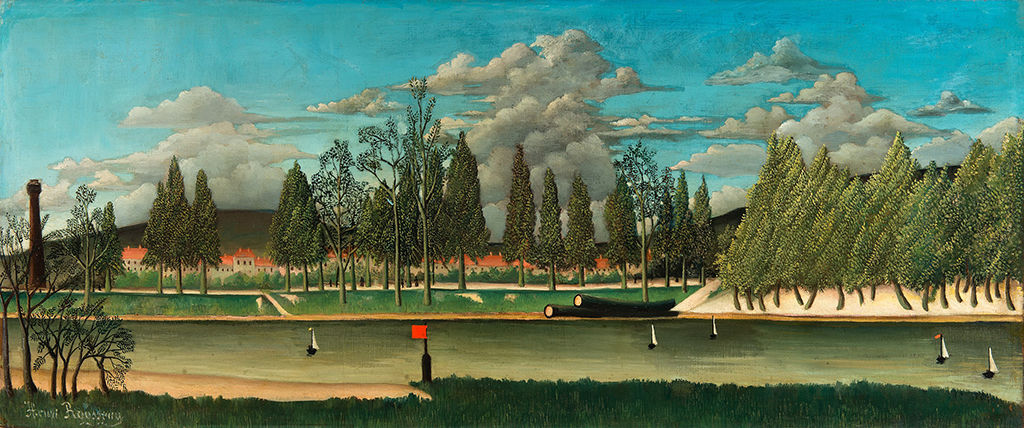
View of the Quai d’Asnières — Henri Rousseau.
Trees that change the pace of looking
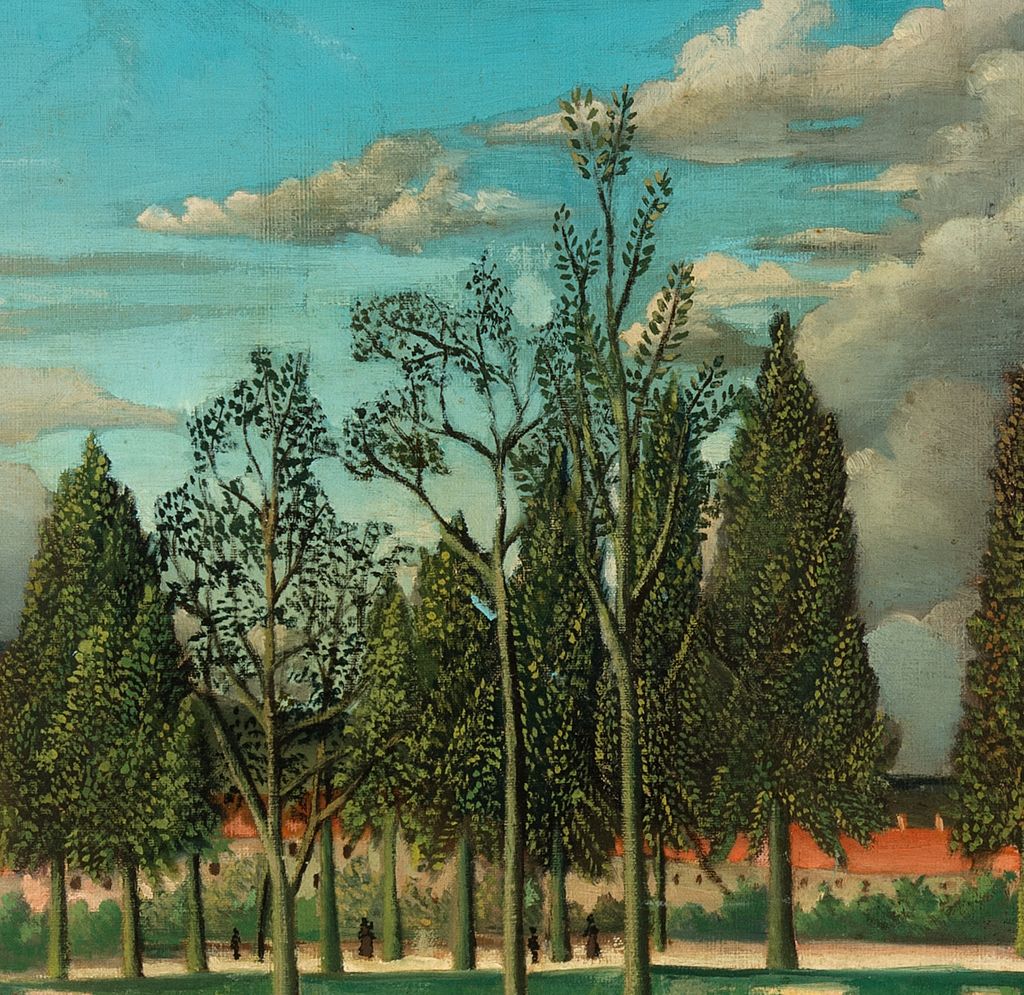
Across the river, the trees make a long sequence of vertical accents. Their trunks are remarkably slender in relation to their height. Some support tall, pointed crowns; others branch openly, with small leaves that allow much more of the background to remain visible. These different densities create alternating passages of obstruction and transparency. A dark crown stops the eye, while the next opening draws it toward a roof or a smaller tree behind.
The tallest, more open trees near the centre-left are particularly important. Their forks carry fine lines high into the clouded sky, so that the avenue’s geometry becomes less regular as it rises. Near the ground, trunks seem to stand along a fairly orderly route. Above, branches spread, overlap and break that order into a delicate lattice. The contrast brings variety into an otherwise strongly repeated motif without requiring a new subject at every turn.
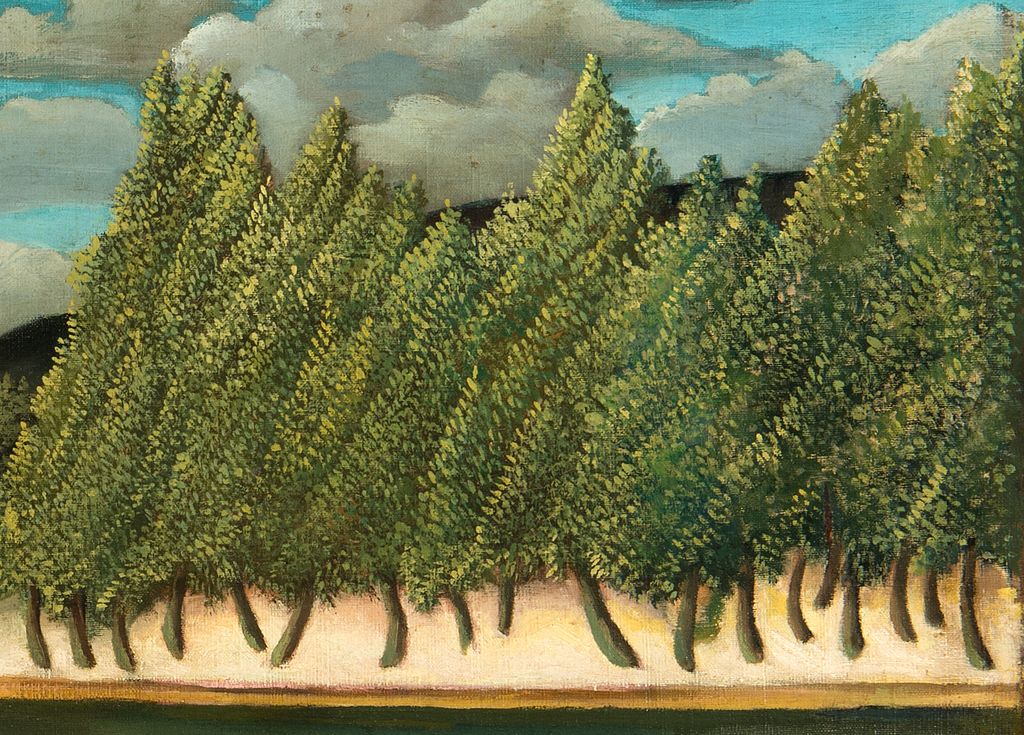
At the right, the rhythm changes more decisively. A dense group of trees leans to the left from a pale bank. Their tan trunks appear as a row of short diagonals beneath the much larger mass of foliage. The pale ground makes those diagonals unusually distinct. Beside the upright avenue, the group feels like a fan being pushed across the picture, although its painted inclination alone cannot establish the weather or the reason for the lean.
The group’s lower edge is scalloped by separate crowns and trunks, while the upper edge rises and falls in pointed clusters. This makes a large area of green legible as many adjoining forms. It also brings the foliage closer to the river: the pale slope and dark trunks meet the water with little intervening space. Moving from left to right, we pass from a relatively open view through separate trees into a much denser screen.
Repeated shapes and small changes in Rousseau’s technique determine how much of the far bank we can see. The distant buildings are revealed in pieces, and the route along the far bank alternately opens and closes as our gaze moves through the trunks.
Annotated Details from View of the Quai d’Asnières
The numbered points identify visible features discussed in this article. Return from each detail to the whole composition. Henri Rousseau, View of the Quai d’Asnières, April 1900–1902. Barnes Foundation, Philadelphia, BF583. Museum-derived photograph published on Wikimedia Commons in 2018. Image source. Public domain. Numbers added to the overview; details cropped from the published original. No recolouring or retouching.
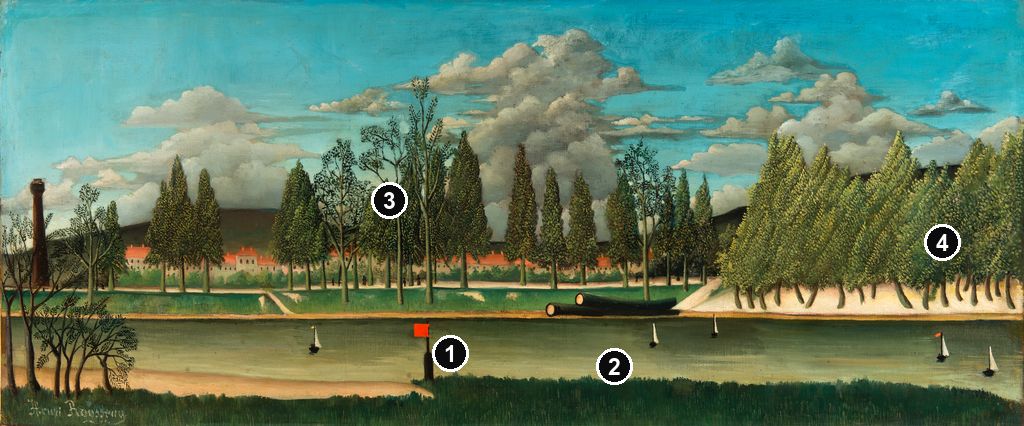
Details from VIEW OF THE QUAI D’ASNIÈRES
Move from the near-bank flag to the small sails, then compare the avenue’s fine branches with the dense leaning grove on the right.
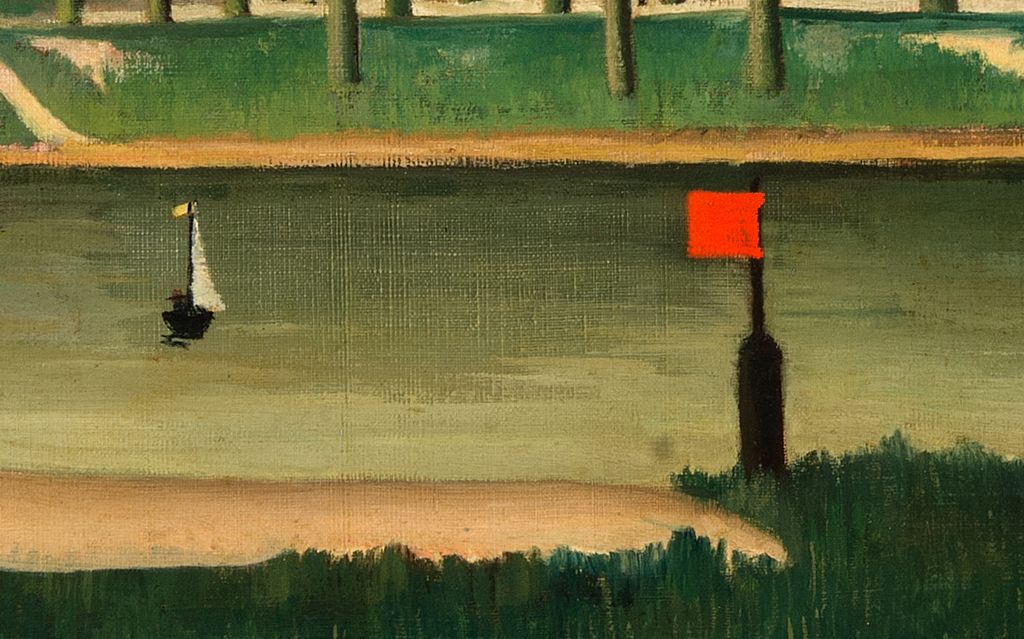
A red flag beside a small sail
The near-bank red rectangle stands on a narrow dark post. A small pale sail lies farther across the green water, making the flag’s concentrated colour and larger apparent scale especially clear.
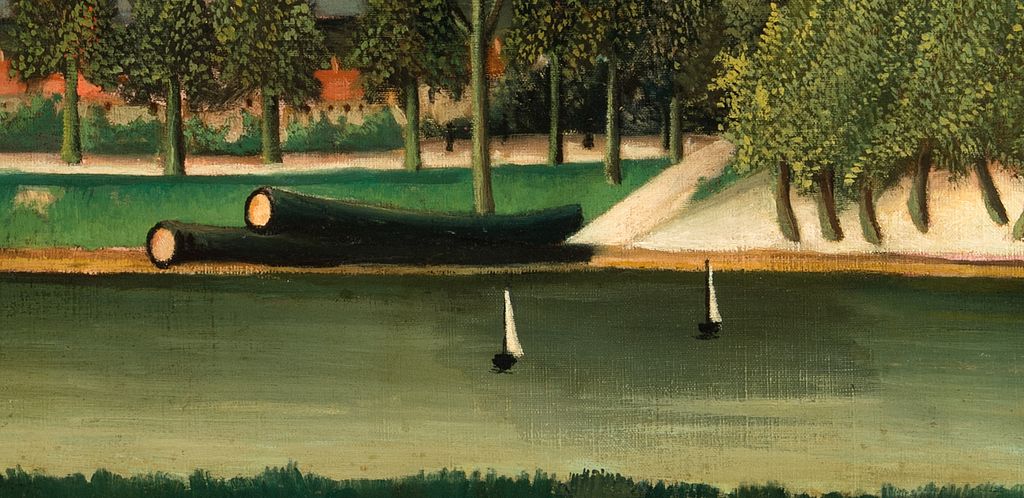
Long dark forms and small sails
Two broad horizontal shapes with pale ends lie close to the opposite bank. Their length and weight contrast with the narrow pale sails standing separately on the river below.
Fine branches before rounded clouds
Open branching crowns spread delicate lines across broad cloud surfaces. Lower down, narrow trunks reveal fragments of pale buildings and red roofs, keeping the avenue both dense and transparent.
A leaning grove on the pale bank
The right-hand trees form a dense mass above a row of angled trunks. The pale slope separates those dark diagonals, giving this end of the avenue a distinct rhythm without explaining why the trees lean.
Five sails and two dark forms
Five sailboats punctuate the river. Each is so small that its sail can be read almost as a pale stroke above a dark base. Their forms remain distinct against the green surface, with thin uprights and narrow triangular patches of white or cream. The boats are spread across much of the width, but they do not form an evenly spaced parade. Two lie nearer the middle-right, while the rightmost pair brings the sequence close to the edge. One of those sails carries a tiny red accent at its tip.
The open water gives these minimal forms unusual clarity. A few light and dark marks suffice to distinguish each sail from its surroundings. Their size also changes the apparent scale of the far bank. The avenue seems immense above such slight vessels, and the wide gaps of water make their isolation more noticeable. We can distinguish boats readily while remaining unable to read the details of their occupants or handling.
Near the opposite shore are two much larger, dark horizontal forms, each with a pale rounded end. They resemble long trunks laid close to the water. Their weight and length interrupt the delicate language of sails and slender trees. A pale end catches the eye just where the far bank turns toward the dense group at the right; the dark lengths run back into the shore’s green and brown tones.
These forms introduce a useful uncertainty of scale. On first glance, one might travel quickly from a small sail to a light circular end because both stand out against dark surroundings. A closer look makes their different proportions apparent. The river contains a series of small upright triangles, while the bank carries long, low masses. Their meeting gives this otherwise tranquil stretch a more complicated pattern of size and orientation.
Clouds above the avenue
The sky is an active part of the panorama. Large cloud formations occupy much of its width, leaving irregular openings of turquoise blue. Toward the centre, grey and cream masses pile upward behind the open-branched trees. Smaller detached shapes float above and to either side. Along their lower edges, several clouds stretch into thin, nearly horizontal bars, echoing the bank and river below.
The clouds have a quite different visual weight from the branches. Rounded lobes gather into broad bodies, with darker areas giving them a sense of fullness. The avenue below is made from narrow uprights and innumerable small leaf marks. Against the broad cloud surfaces, those fine lines become especially visible. The central bare-looking forks are therefore both trees within a riverside setting and a delicate pattern drawn across a much larger form.
Colour helps hold the crowded sky open. Bright blue remains between the cloud groups and around their upper edges, so the masses never close into an unbroken ceiling. At the right, the foliage cuts into a pale cloud bank; near the middle, dark pointed crowns rise against grey. Moving across the painting, we encounter changing combinations of light tree against dark cloud, dark tree against pale cloud, and thin branch against blue.
This repeated exchange makes it difficult to settle permanently on either foreground or distance. A tiny sail attracts attention, then a trunk draws the eye up toward a cloud, whose extended edge leads sideways to another tree. The panorama is broad enough to support these different routes. Its stillness comes with considerable visual activity, carried by changes in shape and spacing rather than an obvious dramatic event.
Human presence along the far bank
Small dark figures stand or move along the distant path, almost lost beneath the trees. Their scale encourages a second look: after the trees have established the avenue’s rhythm, the figures make its height newly apparent. Their dark marks also belong to the same narrow zone as the bases of the trunks, so people can merge briefly into the pattern before becoming distinguishable again.
The Barnes’s commentary places Rousseau’s scene alongside earlier treatments of Asnières by Monet and Seurat, which emphasised coal-barge labour and bathing workers respectively. It draws attention here to the dominance of trees and the toy-like scale of the boats.[1] Within this painting, that shift in emphasis can be felt directly. Human activity supplies a measure for the landscape, while the most expansive movement belongs to foliage, water and cloud.
The buildings behind the avenue remain similarly subordinate. Their pale walls and red roofs create a low, broken stripe rather than a commanding skyline. Seen through trunks and leaves, they suggest a place continuing beyond what we can inspect. The painting leaves much of that inhabited world screened from view, giving the river frontage its distinctive mixture of openness and concealment.
A painting examined beneath its surface
The Barnes’s 2023–24 annual report names View of the Quai d’Asnières, BF583, among six Rousseau paintings for which high-resolution X-radiographs were completed. It also states that radiographs of all eighteen Rousseau paintings in the collection were submitted to the Thread Count Automation Project.[12] These methods offer another scale of examination alongside the broad view: attention can move from the panorama to the structure of its painted support. The report does not give a particular hidden composition or thread-count result for this landscape.
Henri Rousseau artworks directory
This directory brings together works covered on this site and other works documented in the cited museum records and catalogues. Alternate titles share one entry; distinct versions remain separate. Historical dates for works without an article follow the cited catalogues. This is not a catalogue raisonné.
Frequently Asked Questions
It is in the Barnes Foundation collection in Philadelphia, accession BF583.[1]
The Barnes gives the qualified date April 1900–1902.[1]
Begin with the red flag near the centre of the foreground, then follow the five sails across the water. Look upward from them to see how the intervals between trees change, especially where the dense group leans left at the right-hand side.
Discussion
Look again at the images and ideas explored in View of the Quai d’Asnières. These editorial prompts invite your observations.
Reader Insights
How does the red flag change your route through the panorama?
Which has the greater visual weight: the tall avenue or the cloud formations above it?
How does the picture’s scale change when you notice the tiny figures along the far bank?
Join the Conversation
Share a detail, comparison or question about View of the Quai d’Asnières below.
References
- Barnes Foundation. View of the Quai d’Asnières (Vue du quai d’Asnières), BF583, current collection record, accessed 23 October 2026. View source.
- Philadelphia Museum of Art, Carnival Evening,1963-181-64,object59593. View source.
- Musée de l’Orangerie / Juliette Degennes, Henri Rousseau,L’ambition de la peinture: Un artiste dans son époque (in French). View source.
- National Gallery, Surprised!, NG6421. View source.
- Musée d’Orsay, La Guerre,RF19461 (in French). View source.
- MoMA, The Sleeping Gypsy. View source.
- Philadelphia Museum of Art, The Merry Jesters, 1950-134-176, object51097. View source.
- Musée d’Orsay, La Charmeuse de serpents, RF 1937 7 (in French). View source.
- Musée de l’Orangerie, La Carriole du Père Junier, RF 1960 26 (in French). View source.
- Solomon R. Guggenheim Museum / Cornelia Lauf, The Football Players,60.1583: current collection record. View source.
- MoMA, The Dream, 252.1954. View source.
- Barnes Foundation. Annual Report 2023–24, “Conservation and Exhibitions,” printed pp. 29–31, PDF pp. 16–17; X-radiograph and Thread Count Automation Project paragraphs. View source.
- The Museum of Modern Art, Henri Rousseau: Essays (1985), selected catalogue entries, chronology and notes on early devotees. View source. Selected entries, chronology (pp.91–95) and early-devotee notes (pp.262–264) were consulted. Historical collection credits do not establish present ownership.
- Daniel Catton Rich, Henri Rousseau (The Museum of Modern Art, 1942), selected drawings and landscape studies; historical catalogue. View source. The dated 1942 publication is used for the two Quai d’Auteuil ink views; its Malakoff date differs from the 1985 catalogue.
- MANAS, Laval, Henri Rousseau, dit le Douanier, urban landscapes and preparatory study (in French). View source.
- National Gallery of Art, Self-Portrait (1895), pen-and-ink drawing, accession 1995.47.66. View source.
- The Museum of Modern Art, War (published January 1895), lithograph, accession 684.1943. View source.
- Barnes Foundation, Landscape and Four Young Girls, object 5521, BF855. View source.


 Henri Rousseau.jpg)


 Henri Rousseau.jpg)