


 Henri Rousseau.jpg)
 by Tom Gurney
Tom Gurney BSc (Hons) is an art history expert with over 20 years experience
Published on June 19, 2020 / Updated on October 29, 2026
Email: tomgurney1@gmail.com / Phone: +44 7429 011000
Meadowland (The Pasture): Introduction
Two brown cattle, a small figure in a red cap and an immense rounded tree occupy Henri Rousseau’s Meadowland. The field opens towards us, yet the figures seem held in place, separated by intervals of green. Behind them, five slender trees rise into a pale blue sky. Rousseau gives this quiet rural subject an arresting order: the cattle stretch across the left, the human figure marks the centre, and the great canopy fills the right like a gathering of hundreds of small leaves.
The Artizon Museum, Ishibashi Foundation, Tokyo, identifies the painting as Meadowland, dated 1910. Its exhibition checklist records an oil on canvas measuring 46.0 × 55.3 cm.[1][2] Within that modest rectangle, Rousseau makes a tree almost as commanding as an architectural structure. A remembered commission offers one way into the picture’s history, but its particular balance of animals, person and foliage deserves attention before the story takes over.
At a Glance
- ArtistHenri Rousseau
- SubjectMeadowland (The Pasture)
- ExploreA pasture built from distinct groups; The round tree and the five narrow trees
This work across Henri Rousseau’s career
Carnival Evening
1886 [3]The Merry Jesters
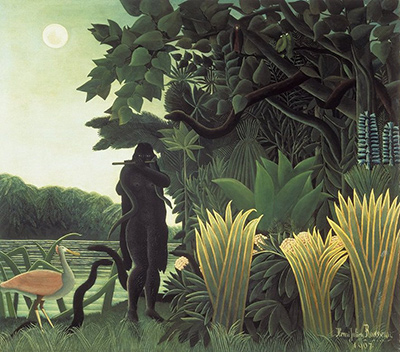
1906 [8]The Snake Charmer
1907 [9]Contents
- A pasture built from distinct groups
- The round tree and the five narrow trees
- The landscape a collector expected
- From Paris to a Japanese collection
- Annotated details
A pasture built from distinct groups
The open grass offers no road or winding path towards the background. A low, densely worked hedge crosses the field behind the cattle. The line gives the animals a setting while closing off a longer view. Above it, the sky supplies a generous area of relatively uninterrupted colour. The landscape feels spacious at its upper edge and enclosed near the ground.
The two cattle overlap. Both face left, with their broad bodies turned sideways towards us; the nearer animal’s head rises beside the other’s back. Their pale legs and undersides emerge from warm brown hides. Darker passages around the necks, flanks and bellies give the bodies a weight that the smooth expanse of pasture does little to explain. Horns and ears interrupt their silhouettes, adding small angular accents to an otherwise horizontal group. Each animal is plainly separated from the green behind it, even where their bodies crowd together.
The cowherd stands just to their right, wearing a blue jacket, tan trousers and a bright red cap. One arm reaches towards the nearer animal. The clothing produces a clear sequence of colours, descending from red through blue to pale ochre. The cap is especially effective because so little red appears elsewhere. It pulls the eye towards a person who could otherwise be overwhelmed by the large animals and tree.
Between the cattle and the canopy, the figure becomes a measure of their different sizes. The nearer animal’s body stands well above the person’s waist; the leaves reach far higher and spread much farther. Yet the figure also occupies an open interval, where its outline stays readable. Rousseau’s arrangement allows this smallest principal presence to hold its own. There is a quiet tension between the figure’s prominence in colour and its small share of the painted surface.
The pasture itself varies in green without becoming a catalogue of grasses and flowers. Its relative openness makes the objects look firmly placed, almost set out for inspection. Near the bottom, fine vertical touches interrupt the broad colour. At the lower right, the pale signature joins this surface of small marks. The eye moves from a sparse foreground to the crowded hedge and tree, finding more detail without travelling far into depth.
The round tree and the five narrow trees
The great tree has a short, dark trunk and a canopy that seems almost too large for its support. Its outer edge swells into a rounded, slightly irregular dome. The branches are largely hidden, so the leaves carry the work of describing the crown. Pale yellow-green marks recur across a darker interior, each small shape remaining visible within the mass. From a distance the canopy reads as one substantial object. Closer looking breaks it into a multitude of separate touches.
The leaves’ changing angles and overlapping rows make the surface seem to ripple. Pale marks crowd towards the lower edge and gather in small directional runs higher up. Dark gaps remain between them. The result is an unusually dense kind of brightness: the crown appears heavy with foliage while catching light almost everywhere. The dark trunk beneath provides a brief, solid pause after this abundance of small forms.
On the left, the five narrow trees offer a different rhythm. They rise as pointed columns, with alternating gold and green passages along their sides. Each has a distinct tip and a slightly different height. Together they form a screen above the hedge. Their spacing creates slim channels of blue, allowing the sky to remain visible between the vertical forms. The large tree on the right closes such openings within its own crown, holding its pale leaves against an apparently continuous dark mass.
The contrast between these two kinds of tree gives the composition much of its energy. Tall narrow forms lift the left side; the broad canopy spreads and settles on the right. Below them, the cattle repeat the sideways extension of the crown on a smaller scale. The upright cowherd stands between these horizontal masses. With few principal elements, Rousseau establishes several competing directions, then holds them within the calm rectangle of sky and grass.
The leaves also connect the two sides. Small repeated marks fill the hedge and reappear in the distant trees, although their scale and density change. This common visual texture connects the groups across the open spaces between them. Its quietness depends on a great deal of small activity, concentrated in foliage while the sky and foreground offer places for the eye to rest.
Annotated Details from Meadowland (The Pasture)
The numbered points identify visible features discussed in this article. Return from each detail to the whole composition. Henri Rousseau, Meadowland (The Pasture), 1910. Artizon Museum, Ishibashi Foundation, Tokyo. Google Art Project reproduction via Wikimedia Commons. Image source. Public domain. Numbers added to a separate resized overview. Details cropped directly from the published original without enlargement, recolouring or retouching.
.jpg)
Details from MEADOWLAND (THE PASTURE)
Compare the animal group and small cowherd with the two sharply different forms of tree.
Two cattle facing left
The brown bodies overlap while the heads, pale legs and angular horns remain distinct. Their broad horizontal group carries weight against the open green field.
 Detail 01 two-cattle-facing-left.jpg)
A red cap between cattle and tree
The cowherd’s red cap, blue jacket and pale trousers make a small figure conspicuous. One arm reaches towards the nearer animal, linking the person to the cattle.
 Detail 02 a-red-cap-between-cattle-and-tree.jpg)
A whole tree built from pale leaves
A short dark trunk supports a great rounded canopy. Separate pale leaves crowd its darker interior, turning a compact silhouette into a dense field of small directional marks.
 Detail 03 a-whole-tree-built-from-pale-leaves.jpg)
Five narrow trees against the sky
Five pointed crowns rise above the hedge at different heights. Slim openings between them keep the blue sky visible, contrasting with the closed mass of the rounded tree.
 Detail 04 five-narrow-trees-against-the-sky.jpg)
 in Detail Henri Rousseau.jpg)
Meadowland (The Pasture) — Henri Rousseau.
The landscape a collector expected
The museum associates Meadowland, cautiously, with a commission for an Italian artist and poet who admired a landscape with cattle at the 1907 Salon des Indépendants. Its account says that he requested another such picture and was disappointed by the result. The museum identifies the earlier painting as Breton Landscape, Winter and says that Meadowland is thought to be the commissioned work.[1]
The 1985 Museum of Modern Art catalogue names the disappointed admirer as Ardengo Soffici. It recounts his wish to buy an already sold Brittany landscape and Rousseau’s offer to make another. In that account, Serge Férat and Roch Grey brought the resulting picture to Italy, where Soffici met them in Venice. The catalogue calls the earlier painting View of Brittany, Summer. The seasonal title differs from the museum’s account, leaving uncertainty over which earlier painting Soffici had admired.[13]
Soffici’s reaction survives here through a chain of publication: the 1985 catalogue quotes a passage reproduced by Henri Certigny. In this mediated recollection, the field seemed too much like a public square, the red-capped figure looked theatrical, and the rounded tree failed to provide the woodland character he had wanted. His disappointment concerned the picture’s departure from an eagerly anticipated scene.[13] Such a response records the expectations of one viewer. It leaves room for another to find the unfamiliar arrangement compelling.
Looking back at the canvas after reading the story makes the source of friction understandable. The grass gives the figures a clear, level stage. The red cap is conspicuous. The rounded tree concentrates foliage into an emphatic, self-contained form. A purchaser seeking a more continuous woodland setting could find these qualities disconcerting. For a viewer encountering Meadowland on its own terms, the same separations make its construction unusually legible. We can see the balance of masses almost as readily as we recognise a field with cattle.
The anecdote is most useful when it returns attention to these visible choices. It cannot establish the figure’s identity, a botanical species or Rousseau’s private reasons for arranging the scene this way. Nor does disappointment tell us how every early viewer responded. With sustained looking, the great canopy changes from an odd silhouette into a surface of individually legible leaves.
From Paris to a Japanese collection
The museum states that the Japanese painter Tsuchida Bakusen purchased Meadowland in Paris.[1] That is a valuable trace of the canvas’s journey, although the short account supplies no purchase date, price or dealer. The 1985 catalogue separately lists Roch Grey and a private collection in Osaka in its provenance, and identifies the owning institution by its historical name, the Bridgestone Museum of Art, Ishibashi Foundation.[13] These notices provide points in its collecting history without supplying a continuous sequence of transfers.
The present institutional credit is Artizon Museum, Ishibashi Foundation. The museum’s 2020–21 collection checklist places Meadowland among the works selected for that exhibition.[1][2] The little canvas thus has both a remembered Italian encounter and a documented Japanese collecting history. Its travels add to its interest, while the image keeps drawing attention back to a remarkably compact rural world: two overlapping animals, a small patch of red and a crown assembled leaf by leaf. Within Rousseau’s wider paintings, it offers a sustained encounter with the expressive possibilities of an everyday subject.
Henri Rousseau artworks directory
This directory brings together works covered on this site and other works documented in the cited museum records and catalogues. Alternate titles share one entry; distinct versions remain separate. Historical dates for works without an article follow the cited catalogues. This is not a catalogue raisonné.
Frequently Asked Questions
Discussion
Look again at the images and ideas explored in Meadowland (The Pasture). These editorial prompts invite your observations.
Reader Insights
How does the red cap change the prominence of the smallest principal figure?
What happens to your sense of the large tree when you move between its overall silhouette and its individual leaves?
Does knowing Soffici’s disappointment alter your response to the open field and the separation of the groups?
Join the Conversation
Share a detail, comparison or question about Meadowland (The Pasture) below.
References
- Artizon Museum, Ishibashi Foundation. Meadowland, Henri Rousseau, museum-supplied object record and commentary, Google Arts & Culture, accessed 23 October 2026. The online dimensions field contains a unit error; dimensions here follow the museum’s checklist below. View source.
- Artizon Museum, Ishibashi Foundation. Ishibashi Foundation Collection Selection, exhibition checklist, published 3 November 2020, exhibition 3 November 2020–24 January 2021, p. 1, no. 002; publishing colophon, p. 4. View source.
- Philadelphia Museum of Art, Carnival Evening,1963-181-64,object59593. View source.
- Musée de l’Orangerie / Juliette Degennes, Henri Rousseau,L’ambition de la peinture: Un artiste dans son époque (in French). View source.
- National Gallery, Surprised!, NG6421. View source.
- Musée d’Orsay, La Guerre,RF19461 (in French). View source.
- MoMA, The Sleeping Gypsy. View source.
- Philadelphia Museum of Art, The Merry Jesters, 1950-134-176, object51097. View source.
- Musée d’Orsay, La Charmeuse de serpents, RF 1937 7 (in French). View source.
- Musée de l’Orangerie, La Carriole du Père Junier, RF 1960 26 (in French). View source.
- Solomon R. Guggenheim Museum / Cornelia Lauf, The Football Players,60.1583: current collection record. View source.
- MoMA, The Dream, 252.1954. View source.
- The Museum of Modern Art. Henri Rousseau: Essays, essays by Roger Shattuck, Henri Béhar, Michel Hoog, Carolyn Lanchner and William Rubin; translations from French by Richard Miller, 1985, catalogue entry 62, “Meadowland,” p. 240 (PDF p. 243), including the Soffici recollection quoted through Henri Certigny and the historical provenance. View source.
- The Museum of Modern Art, Henri Rousseau: Essays (1985), selected catalogue entries, chronology and notes on early devotees. View source. Selected entries, chronology (pp.91–95) and early-devotee notes (pp.262–264) were consulted. Historical collection credits do not establish present ownership.
- Daniel Catton Rich, Henri Rousseau (The Museum of Modern Art, 1942), selected drawings and landscape studies; historical catalogue. View source. The dated 1942 publication is used for the two Quai d’Auteuil ink views; its Malakoff date differs from the 1985 catalogue.
- MANAS, Laval, Henri Rousseau, dit le Douanier, urban landscapes and preparatory study (in French). View source.
- National Gallery of Art, Self-Portrait (1895), pen-and-ink drawing, accession 1995.47.66. View source.
- The Museum of Modern Art, War (published January 1895), lithograph, accession 684.1943. View source.
- Barnes Foundation, Landscape and Four Young Girls, object 5521, BF855. View source.
 Henri Rousseau.jpg)
 Henri Rousseau.jpg)