


 by Tom Gurney
Tom Gurney BSc (Hons) is an art history expert with over 20 years experience
Published on June 19, 2020 / Updated on October 29, 2026
Email: tomgurney1@gmail.com / Phone: +44 7429 011000
The Chair Factory: Introduction
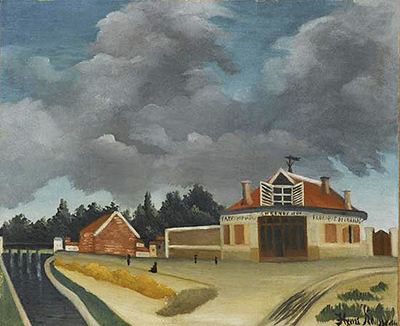
Clouds occupy most of Henri Rousseau’s The Chair Factory. They pile above a low line of trees, while a red-roofed building and a handful of tiny people gather near the bottom of the canvas. The factory gives the painting its name, yet the spacious sky and pale, curving ground determine how we encounter it. This is the smaller of Rousseau’s two views of the site at Alfortville: an oil painting on canvas, dated about 1897, measuring 38 × 46 cm and now in the Musée de l’Orangerie, Paris.[1]
At a Glance
- ArtistHenri Rousseau
- SubjectThe Chair Factory
- ExploreA factory beneath an immense sky; The road, riverbank and tiny people
This work across Henri Rousseau’s career
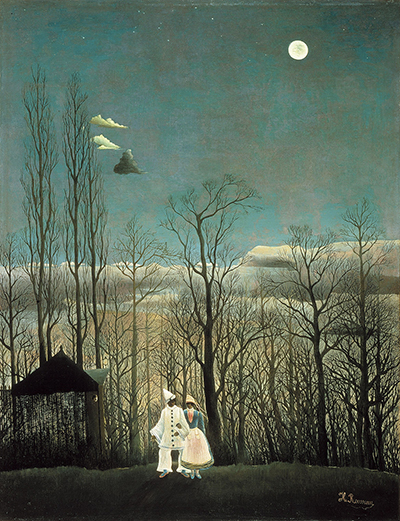
Carnival Evening
1886 [2]The Merry Jesters
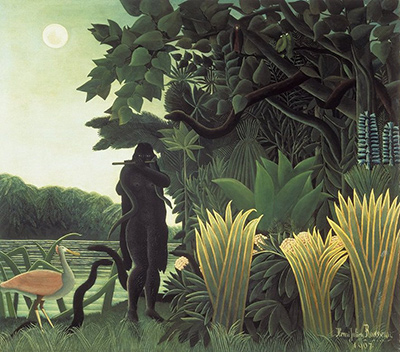
1906 [7]The Snake Charmer
1907 [8]Contents
- A factory beneath an immense sky
- The road, riverbank and tiny people
- Trees along the skyline
- Two versions, two balances
- A modest format and a later collecting history
A factory beneath an immense sky
The building stands to the right, its cream walls warmed by a red roof and ochre shutters. A central entrance, dark behind a projecting frame, gives the façade its strongest vertical accent. Above it, an open-shuttered dormer breaks the roofline, and a little black shape rises against the clouds. Lettering runs across the front and side of the building. These details make the structure particular and recognisable, but they occupy a surprisingly small share of the painted surface. Even the roof seems pressed down beneath the expanse above it.
Rousseau gives that sky considerable variety. A tall cloud rises left of centre, darker through its middle and edged with lighter grey. On the right, another mass descends towards the roof. Between and around them, openings of blue prevent the clouds from joining into one continuous ceiling. Their lower edges extend sideways above the trees, bringing the distant atmosphere close to the little buildings. The sky feels weighty, although the picture leaves the weather’s next development unresolved. Its changing greys and blues are enough to make the apparently quiet scene feel active.
The eye can travel upward through these cloud forms before returning to the factory. That movement is part of the picture’s peculiar scale: the painting is small, while the atmosphere it contains seems extensive. The museum’s commentary draws attention to the greater space given to landscape and sky in this version, and to the way the factory sits more comfortably in scale with its neighbouring structures.[1] The building remains an anchor without commanding every part of the view.
The road, riverbank and tiny people
At the lower left, dark water slips into the composition beside an embankment. Upright posts make a short, regular sequence across its far end. The pale bank curves towards the foreground, accompanied by a darker green strip that sharpens its edge. Beside it, a yellow band of irregular mounds lies across the light ground. Their colour is conspicuous, but their material is difficult to establish from the painting. Rousseau lets the broken contour carry much of their visual interest.
The road opens into a broad, almost empty area before the factory. Its apparent width depends partly on the smallness of the people scattered across it. These figures register first as dark vertical marks, with only slight changes of shape to distinguish one from another. A low, broader figure interrupts the sequence near the left side of the open ground. At this scale, specific activities remain hard to read. Their placement matters more immediately: they lead the eye across the interval between the red-brick outbuilding and the factory entrance, giving the open space a human measure.
The emptiness around them is carefully varied. A dark, flattened shape lies near the yellow mounds. Along the lower right, parallel diagonal strokes cut across the pale surface beside patches of green. They add another direction to a foreground already organised by curves. Their exact identity is uncertain; visually, they draw the eye towards the corner and counter the sweep of the riverbank. Rousseau’s signature sits nearby, among the small dark marks at the edge.
This low foreground asks for a different kind of attention from the clouds. Above, forms swell and overlap; below, a few edges and short strokes describe the terrain. The winding bank carries us into the distance, while the open road spreads sideways towards the building. Those movements meet in a space that feels accessible without resolving into a strict diagram. The curves suggest a way through the scene, while the broad areas of colour keep drawing attention back to its surface.
Trees along the skyline
A dense line of trees stands behind the buildings. Individual pointed crowns rise from the darker mass, especially around the small red-brick structure. The foliage brings the distant skyline low across the picture and helps separate the pale ground from the immense sky. Its green is deep enough to hold the composition together without competing with the factory’s warm roof.
The contrast becomes clearer beside Rousseau’s larger view of the chair factory at Alfortville. In that painting, industrial chimneys rise on the left beyond the outbuilding. The smaller canvas has no corresponding cluster. The Orangerie notes that period postcards show chimneys belonging to the Alfortville landscape and proposes that Rousseau replaced them with trees to allow nature a greater presence.[1] That is a persuasive interpretation of the difference, though the artist’s reason for changing the skyline remains a suggestion.
The visible result is a more continuous belt of foliage. Small chimney stacks still punctuate the factory’s own roof, but they belong to the building’s silhouette rather than establishing a separate industrial district behind it. Warm masonry, dark trees and pale open ground sit in broad, easily grasped relationships. The landscape surrounds the workplace so thoroughly that it becomes possible to look for some time before returning to the business named across its façade.
Two versions, two balances
The larger painting measures 73 × 92 cm and is dated 1897 by the Orangerie. The museum considers it probably the version shown at the Salon des Indépendants that year.[12] The museum’s 2026 exhibition video credits instead date the larger canvas about 1907, without explaining the difference from its collection record. The smaller canvas remains about 1897 in both sources. This inconsistency leaves the sequence of the two paintings unsettled.[3]
Its factory has greater authority: the walls rise more prominently, the entrance is taller in relation to the surrounding space, and the sharply drawn building faces the viewer with an almost ceremonial steadiness. The smaller version allows more room around the architecture, so that the factory feels like one place within a landscape.
The difference extends to the ground. In the larger canvas, the road and bank turn in firm, sustained curves, and the factory’s edges have a conspicuous rigidity. Here, their outlines feel less insistently ruled. The Orangerie describes the smaller painting as more naturalistic and spontaneous in appearance.[1] That description concerns its effect. It does not tell us how rapidly Rousseau worked, or establish which canvas came first. A softened line can be a considered choice as readily as the trace of a quick encounter.
The sequence of the two paintings has, in fact, invited disagreement. The 1985 MoMA catalogue considered the appealing possibility that the small version was a preliminary sketch, then favoured a later repetition because its dimensions were unusually generous compared with Rousseau’s other known sketches. Its illustration caption cautiously proposed a date after 1897.[13] This remains a scholarly hypothesis. The current Orangerie record dates the smaller canvas about 1897, without settling its relationship to the larger one.[1]
The comparison is therefore most useful when it stays with what the paintings disclose. Rousseau reconsidered the distribution of sky, vegetation, buildings and human activity. A change of size accompanies a change of emphasis. The smaller work’s generous atmosphere and loosely joined ground shapes make a complete arrangement, even while the circumstances of its making remain uncertain.
A modest format and a later collecting history
A canvas of this size also belongs within a practical side of Rousseau’s career. The Orangerie’s 2026 exhibition text describes his use of small formats suited to the budgets and interiors of customers including artisans, shopkeepers and the modest middle classes. It places his views of the changing Paris outskirts alongside other subjects through which he sought a market.[14] That context helps explain why scale matters here, although it supplies no identified commission or first buyer for this particular painting.
The documented ownership becomes clearer much later. The museum records the work with the dealer Paul Guillaume from 1931 and subsequently in the collection of Madame Jean Walter. In 1959, the French state acquired it from her with assistance from the Société des Amis du Louvre; the purchase was approved on 21 February. It passed through the Louvre before its physical entry into the Orangerie in 1977.[1] Its inventory number, RF196028, should therefore be distinguished from its acquisition date. The larger version was purchased separately in 1963.[12]
The smaller painting’s museum exhibition history includes New York in 1931 and Basel in 1933.[1] Its compact dimensions did not prevent it from travelling beyond France. Looking at it today, that portability sits alongside a different kind of expansiveness: a little factory, minute people and a narrow reach of river are made to inhabit a sky that seems much larger than the object carrying it.
Henri Rousseau artworks directory
This directory brings together works covered on this site and other works documented in the cited museum records and catalogues. Alternate titles share one entry; distinct versions remain separate. Historical dates for works without an article follow the cited catalogues. This is not a catalogue raisonné.
Frequently Asked Questions
The Musée de l’Orangerie dates this small version about 1897. Its sequence in relation to Rousseau’s larger painting of the same site remains uncertain.[1]
The Orangerie identifies the larger, 73 × 92 cm version as probably the exhibited painting. That exhibition history should not automatically be transferred to this 38 × 46 cm canvas.[12]
It is in the Musée de l’Orangerie, Paris, under inventory number RF196028. The state purchased it in 1959, and its physical entry into the Orangerie followed in 1977.[1]
Discussion
Look again at the images and ideas explored in The Chair Factory. These editorial prompts invite your observations.
Reader Insights
How does the painting’s balance change if you look first at the clouds and then at the factory?
What do the tiny figures contribute to your sense of the road’s width and the building’s scale?
Which difference between the two versions most changes the character of the place for you?
Join the Conversation
Share a detail, comparison or question about The Chair Factory below.
References
- Musée de l’Orangerie. La Fabrique de chaises, object RF196028, current collection record, commentary, provenance and exhibition history, accessed 23 October 2026. View source. (in French).
- Philadelphia Museum of Art, Carnival Evening,1963-181-64,object59593. View source.
- Musée de l’Orangerie / Juliette Degennes, Henri Rousseau, l’ambition de la peinture: Un artiste dans son époque, 2026, four-page video transcript, artwork credits on PDF p. 2: small Chair Factory about 1897; large Alfortville canvas about 1907, RF196332. The spoken text raises questions about the two versions without explaining the dating discrepancy with the collection record. Accessed 24 October 2026. View source. (in French)
- National Gallery, Surprised!, NG6421. View source.
- Musée d’Orsay, La Guerre,RF19461 (in French). View source.
- MoMA, The Sleeping Gypsy. View source.
- Philadelphia Museum of Art, The Merry Jesters, 1950-134-176, object51097. View source.
- Musée d’Orsay, La Charmeuse de serpents, RF 1937 7 (in French). View source.
- Musée de l’Orangerie, La Carriole du Père Junier, RF 1960 26 (in French). View source.
- Solomon R. Guggenheim Museum / Cornelia Lauf, The Football Players,60.1583: current collection record. View source.
- MoMA, The Dream, 252.1954. View source.
- Musée de l’Orangerie. La Fabrique de chaises à Alfortville, object RF196332, current collection record, commentary and provenance, updated 27 July 2026, accessed 23 October 2026. View source. (in French).
- Museum of Modern Art. Henri Rousseau: Essays, 1985, catalogue entry 18, p. 138 and fig. 1. View source.
- Musée de l’Orangerie. Henri Rousseau, l’ambition de la peinture, exhibition texts, 25 March–20 July 2026, “Variations et déclinaisons. À la recherche du marché,” accessed 23 October 2026. View source. (in French).
- The Museum of Modern Art, Henri Rousseau: Essays (1985), selected catalogue entries, chronology and notes on early devotees. View source. Selected entries, chronology (pp.91–95) and early-devotee notes (pp.262–264) were consulted. Historical collection credits do not establish present ownership.
- Daniel Catton Rich, Henri Rousseau (The Museum of Modern Art, 1942), selected drawings and landscape studies; historical catalogue. View source. The dated 1942 publication is used for the two Quai d’Auteuil ink views; its Malakoff date differs from the 1985 catalogue.
- MANAS, Laval, Henri Rousseau, dit le Douanier, urban landscapes and preparatory study (in French). View source.
- National Gallery of Art, Self-Portrait (1895), pen-and-ink drawing, accession 1995.47.66. View source.
- The Museum of Modern Art, War (published January 1895), lithograph, accession 684.1943. View source.
- Barnes Foundation, Landscape and Four Young Girls, object 5521, BF855. View source.
 Henri Rousseau.jpg)
 Henri Rousseau.jpg)