



 by Tom Gurney
Tom Gurney BSc (Hons) is an art history expert with over 20 years experience
Published on June 19, 2020 / Updated on October 29, 2026
Email: tomgurney1@gmail.com / Phone: +44 7429 011000
A Corner of the Park at Bellevue, Autumn, Sunset: Introduction
A pale path slips between rows of small golden trees, then disappears into a deep green park. Above it, much taller branches spread across a pinkish sky. Henri Rousseau’s A Corner of the Park at Bellevue, Autumn, Sunset, dated 1902, holds these two experiences together: the invitation to follow a walk and the pleasure of tracing a pattern. The painting belongs to the RISD Museum in Providence.[1] Its small human figure gives the scene a familiar scale, while the trees fill almost the whole world around it.
At a Glance
- ArtistHenri Rousseau
- SubjectA Corner of the Park at Bellevue, Autumn, Sunset
- ExploreAn upright landscape; Following the path
This work across Henri Rousseau’s career
Carnival Evening
1886 [2]The Merry Jesters
1906 [8]The Snake Charmer
1907 [9]Contents
- An upright landscape
- Following the path
- Autumn colour and the evening sky
- A landscape for everyday life
- Another walk beneath Rousseau’s trees
- From Paris to Providence
- Annotated details
An upright landscape
The oil painting on canvas measures 61.6 × 50.8 cm, with Rousseau’s signature at the lower left. RISD records its French title as Un Coin du plateau de Bellevue. Automne, Soleil Couchant.[1] The upright proportions suit a view in which height matters as much as distance. Looking from the bottom edge to the top, we pass from low plants to substantial trunks and finally to the fine spread of twigs and leaves. There is little room beside this growth for a separate expanse of scenery.
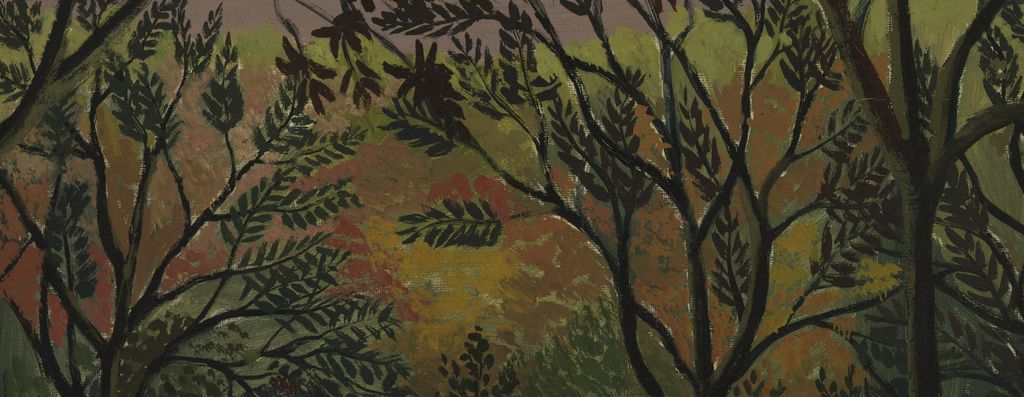
The large trees stand at irregular intervals. A strong trunk on the right balances the branching tree towards the left, but their outlines never become mirror images. Limbs cross the central opening and reach beyond the edges. This cropping makes the view feel like a portion of a larger grove: the trees continue outside the frame, just as the path seems to begin outside it. The corner promised by the title has an enclosed, particular character.
At the same time, the upper branches open the picture. They divide the sky into unequal pockets, allowing its quiet colour to show between sharply drawn silhouettes. The eye can move through these gaps even where it cannot find a clear route through the foliage below. Seen from a little distance, the canopy resembles a network laid over a broad field of colour; closer attention reveals how differently each branch turns or breaks into leaves. The picture gains much of its liveliness from that balance between an overall pattern and local variation.
Following the path
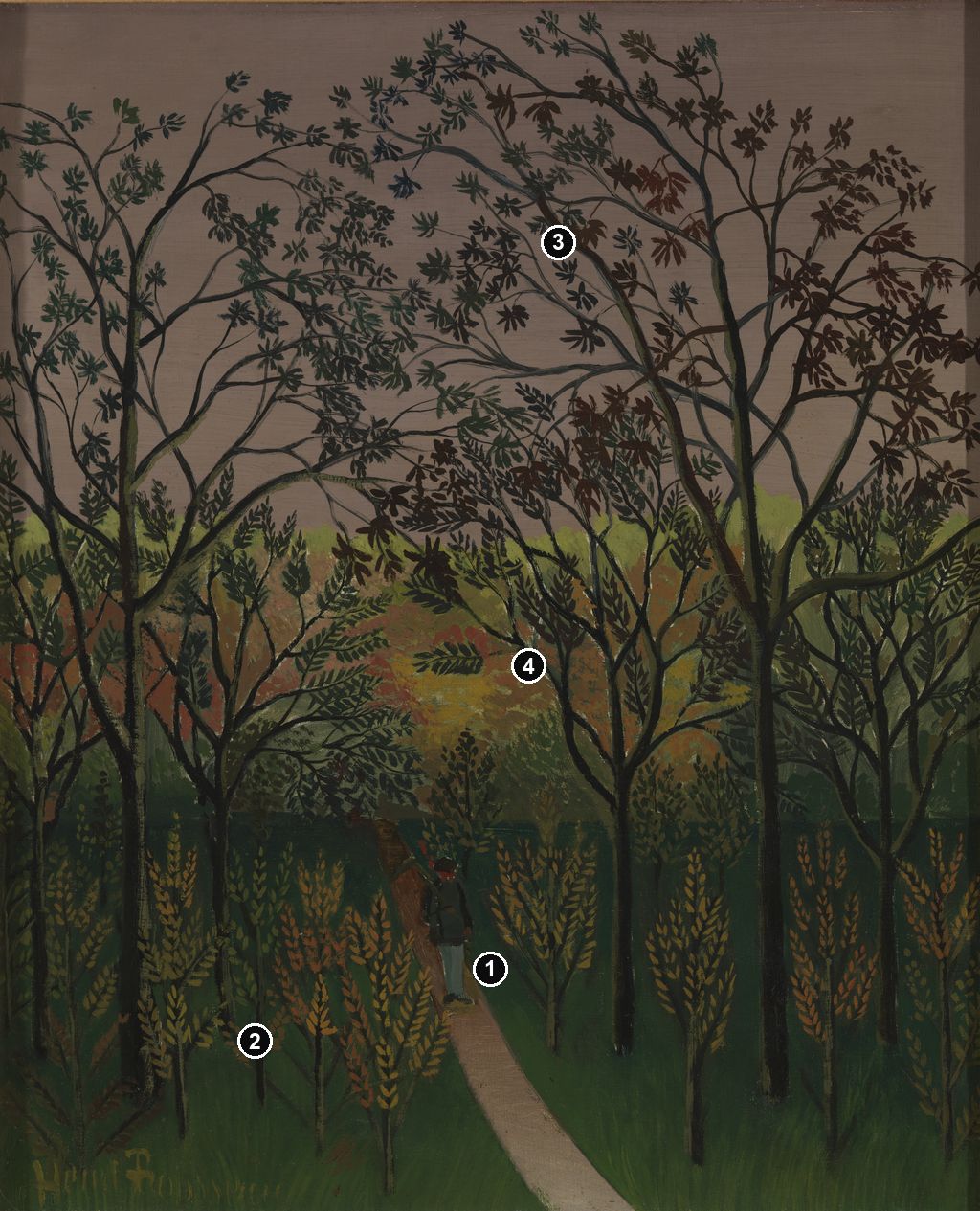
The path enters near the lower right of centre, broad enough to establish a firm starting point. It narrows as it rises towards the lone figure and the darker vegetation beyond. Against the greens on either side, its pale surface is exceptionally easy to follow. Rousseau supplies a simple way into a scene crowded with competing lines.
The small plants beside it reinforce that movement. Their slender stems and narrow arrangements of yellow and orange leaves repeat across the foreground, suggesting the regular spacing of a planted park. Each little upright has enough independence to be noticed, yet together they make a rhythm. Larger trunks interrupt this rhythm and bring a second scale into play. The low growth marks the walk at human height; the tall trees carry our attention well above it.
Near the centre, the figure’s dark clothing almost merges with the surrounding green. A lighter lower portion helps the person remain visible against the path. This is a modest interruption in a landscape otherwise dominated by plants, but it changes how we imagine its dimensions. The broad foreground becomes ground someone might cross, and the distant darkness becomes somewhere a walk might continue. The figure also offers a resting point for the eye between the narrow path below and the crowded branches above.
Maureen O’Brien, RISD’s curator of painting and sculpture, describes a solitary person strolling in a park on the outskirts of Paris.[7] The scale of the figure leaves room for the viewer’s own response. One person among so many trees can suggest privacy, quiet or a moment of absorption. Those possibilities arise from the arrangement before us; the small figure supplies no clear personal story. Its importance lies in how little Rousseau needs to make the park feel inhabited.
Autumn colour and the evening sky
The brightest colour is concentrated around the middle of the painting. Yellow-green, orange and muted red foliage forms a warm band behind the nearer trunks. Below, dark greens gather around the bases of trees and the smaller plants. Above, the pink and mauve sky provides a restrained background for the branching silhouettes. This layering makes the centre appear luminous without the need for a visible sun.
The autumn of the title is especially persuasive through the coexistence of colours. Green leaves remain in the upper left, while brown and reddish foliage spreads across much of the right. The smaller trees carry their own yellows and oranges. The park contains many separate patches of seasonal colour. Our attention travels between them, sometimes following a branch and sometimes jumping to a warmer shape further back.
O’Brien reads the scene as sunset passing into a rosy evening glow, and draws attention to the decorative quality of its shadows.[7] That reading helps explain the unusual combination of soft atmosphere and firm outlines. The sky has the subdued warmth of evening, while the trees remain emphatically legible. Darkness is already present in the ground and foliage, but it does not dissolve the forms into an indistinct mass.
The dark branches also work as a kind of drawing across the surface. Their curves can be enjoyed independently of the space they describe. A limb may lead us towards a distant cluster of leaves, then carry the eye sideways across the sky. This gentle competition between depth and surface keeps the scene active. We are invited to enter the park along its path and to remain outside it, looking at the elaborate structure Rousseau has given the trees.
Annotated Details from Bellevue, Autumn, Sunset
The numbered points identify visible features discussed in this article. Return from each detail to the whole composition. Henri Rousseau, A Corner of the Park at Bellevue, Autumn, Sunset, 1902. RISD Museum, Gift of Mrs. Henry D. Sharpe, 77.114. Courtesy of the RISD Museum, Providence, RI. Image source. CC0 / Public domain. Numbers added to a separate resized overview. Four details cropped directly from the 300 dpi museum original without enlargement, brightening, sharpening, recolouring or retouching.
Details from BELLEVUE, AUTUMN, SUNSET
Find the lone walker, compare the regular small plants with the large trunks, then follow the canopy and the warmer foliage behind it.
A lone walker on the pale path
A dark coat and lighter trousers distinguish the small figure from the surrounding green. The path narrows as it approaches the walker, giving the dense grove a familiar human scale.
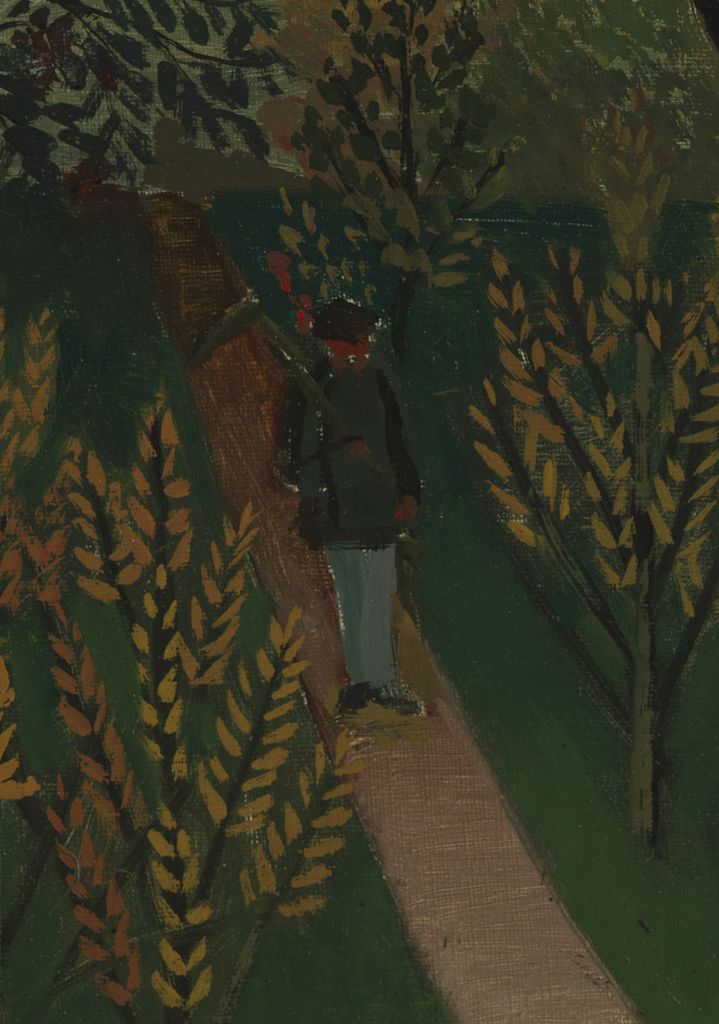
Small golden plants repeat beside the walk
Slender stems carry narrow yellow and orange leaves in repeated upright arrangements. Their regular rhythm marks the planted ground, while much thicker trunks interrupt the pattern.
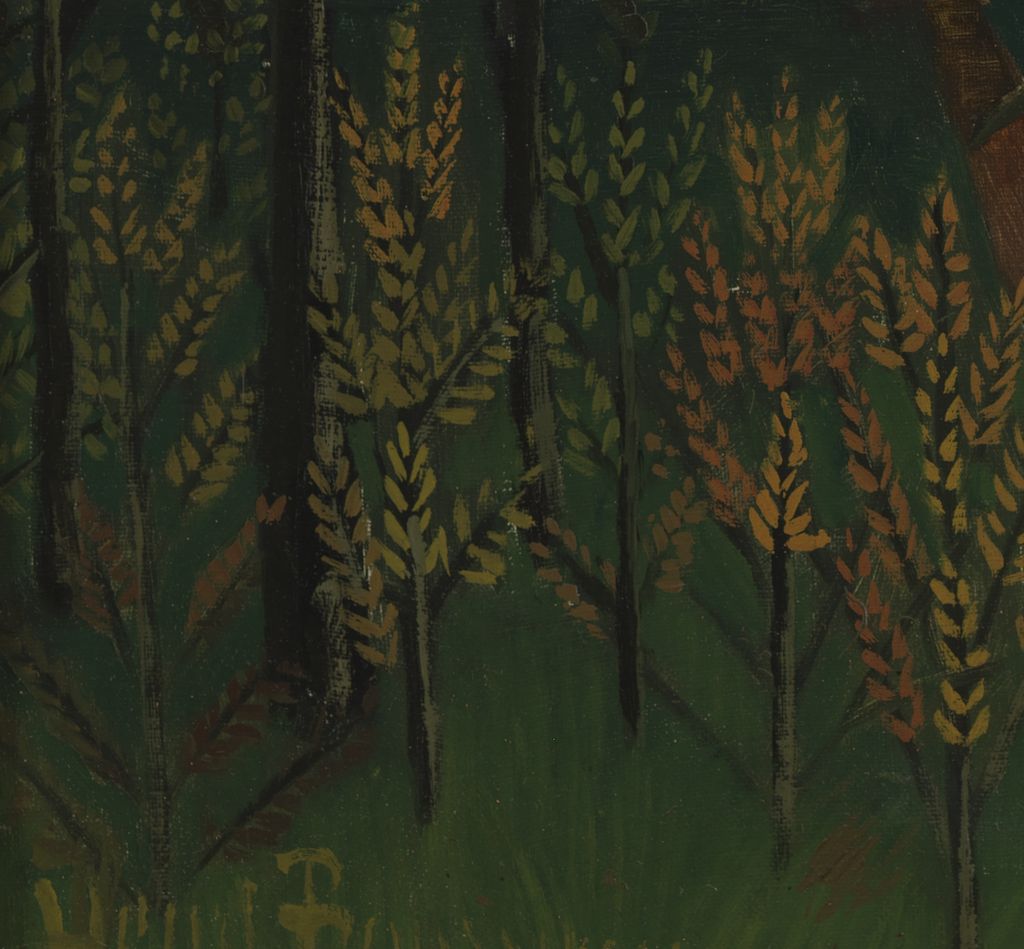
Branches draw across the evening sky
Dark limbs divide into finer twigs and small groups of leaves. Unequal openings allow the quiet sky to remain visible, so the canopy can be followed as both a network of lines and a screen of foliage.
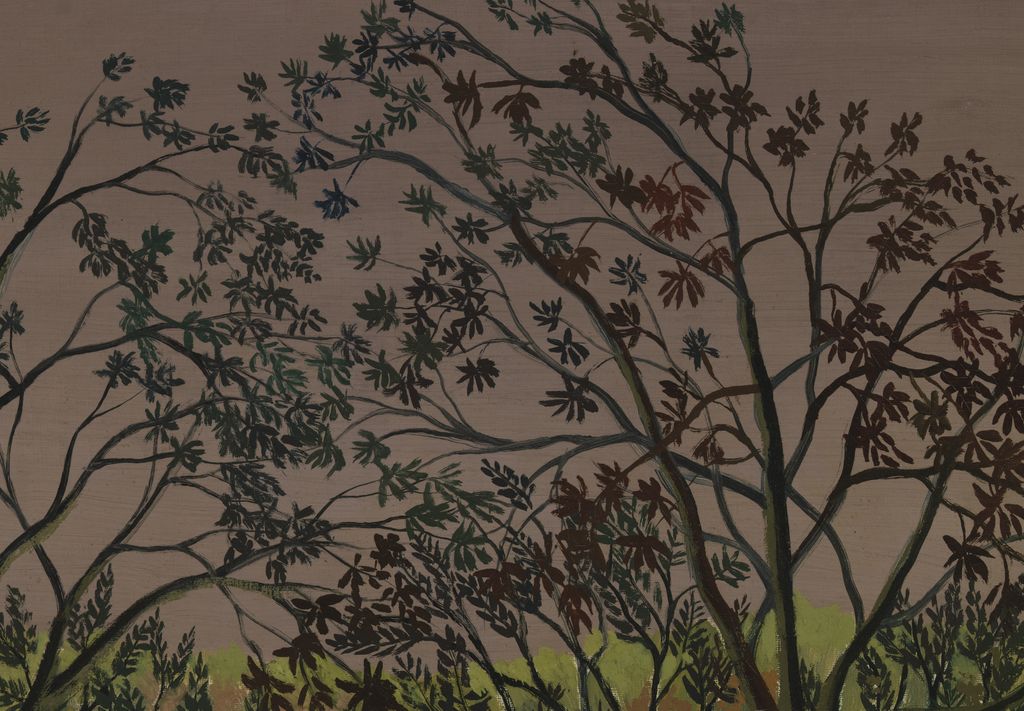
Warm foliage glows behind the trunks
Yellow-green, orange and muted red gather behind the nearer trees. The dark trunks cross this warm band, holding it within the denser, greener park around it.
A landscape for everyday life
The park belongs within the substantial landscape practice that sits alongside Rousseau’s more spectacular subjects. The Musée de l’Orangerie’s 2026 exhibition account describes an artist who varied subjects and formats for buyers including artisans, shopkeepers and people with modest interiors. It also connects his views around Paris with his own observations of a changing suburban landscape.[13] This context gives the Bellevue picture a place within a working painter’s varied output.
In Bellevue, the suburban view becomes a close encounter with a grove. Tall trunks, low plants and a single passage through them occupy the available space. The arrangement has an everyday intimacy: its small path seems to offer just enough room for one person to make a way between the trees.
Another walk beneath Rousseau’s trees
The Banks of the Bièvre near Bicêtre offers a useful comparison. The Metropolitan Museum of Art dates that painting to about 1908–09 and identifies its subject as the landscape around Bicêtre, on the southern edge of Paris.[14] There, too, pale paths and tall, curving trunks lead the eye through an upright composition. Small figures give a sense of the scale of their surroundings, while branches spread across the upper sky.
The spaces feel different. In the Bièvre picture, a waterway, fence and distant arches introduce more divisions and features into the view. Bellevue concentrates attention on the planted ground and the sky shining between branches. Its central warmth is held behind a screen of trees, and its path passes into foliage. Looking between the two paintings makes the Bellevue canvas’s particular intimacy clearer. Rousseau can make related elements serve different walks: one opens onto a more varied suburban prospect, the other draws us into the changing colours of a grove.
From Paris to Providence
RISD’s published provenance places the Bellevue painting in Paul Guillaume’s collection in Paris from 1927 to 1933, then in Mrs. Henry D. Sharpe’s collection in Providence from 1933 to 1977. The museum credits her gift and identifies the work as accession 77.114.[1] These recorded stages follow its making by several decades. They leave its earliest ownership unaccounted for in the museum’s brief public history, while giving a clear connection between its later Parisian collection and its home in Providence.
Henri Rousseau artworks directory
This directory brings together works covered on this site and other works documented in the cited museum records and catalogues. Alternate titles share one entry; distinct versions remain separate. Historical dates for works without an article follow the cited catalogues. This is not a catalogue raisonné.
Frequently Asked Questions
RISD Museum dates it to 1902 and records the medium as oil on canvas.[1]
It belongs to the RISD Museum in Providence, Rhode Island, as a gift of Mrs. Henry D. Sharpe, object number 77.114.[1]
The museum’s label describes a lone park stroller without naming the person.[7] The figure provides human scale and a focus for the path; a precise identity or emotional state cannot be established from the image.
Discussion
Look again at the images and ideas explored in A Corner of the Park at Bellevue, Autumn, Sunset. These editorial prompts invite your observations.
Reader Insights
Does your eye follow the path first, or the branches across the sky? How does that first movement affect your experience of the park?
How would the painting’s scale and atmosphere change if Rousseau had left out the lone figure?
Compare the warm foliage at the centre with the quieter sky. Which seems to provide the strongest light in the scene?
Join the Conversation
Share a detail, comparison or question about A Corner of the Park at Bellevue, Autumn, Sunset below.
References
- RISD Museum. A Corner of the Park at Bellevue, Autumn, Sunset (Un Coin du plateau de Bellevue. Automne, Soleil Couchant), current collection record, object 77.114; object details and provenance, accessed 23 October 2026. View source.
- Philadelphia Museum of Art, Carnival Evening,1963-181-64,object59593. View source.
- Musée de l’Orangerie / Juliette Degennes, Henri Rousseau,L’ambition de la peinture: Un artiste dans son époque (in French). View source.
- National Gallery, Surprised!, NG6421. View source.
- Musée d’Orsay, La Guerre,RF19461 (in French). View source.
- MoMA, The Sleeping Gypsy. View source.
- Maureen O’Brien / RISD Museum. Art and Design from 1900 to Now, exhibition wall texts, p. 3 of 83, Henri Rousseau, object 77.114, accessed 23 October 2026. View source.
- Philadelphia Museum of Art, The Merry Jesters, 1950-134-176, object51097. View source.
- Musée d’Orsay, La Charmeuse de serpents, RF 1937 7 (in French). View source.
- Musée de l’Orangerie, La Carriole du Père Junier, RF 1960 26 (in French). View source.
- Solomon R. Guggenheim Museum / Cornelia Lauf, The Football Players,60.1583: current collection record. View source.
- MoMA, The Dream, 252.1954. View source.
- Musée de l’Orangerie. Henri Rousseau, l’ambition de la peinture, exhibition texts, 25 March–20 July 2026, section “Variations et déclinaisons. À la recherche du marché,” accessed 23 October 2026. View source. (in French).
- The Metropolitan Museum of Art. The Banks of the Bièvre near Bicêtre, current collection record and painting image, object 39.15; object details and commentary, accessed 23 October 2026. View source.
- The Museum of Modern Art, Henri Rousseau: Essays (1985), selected catalogue entries, chronology and notes on early devotees. View source. Selected entries, chronology (pp.91–95) and early-devotee notes (pp.262–264) were consulted. Historical collection credits do not establish present ownership.
- Daniel Catton Rich, Henri Rousseau (The Museum of Modern Art, 1942), selected drawings and landscape studies; historical catalogue. View source. The dated 1942 publication is used for the two Quai d’Auteuil ink views; its Malakoff date differs from the 1985 catalogue.
- MANAS, Laval, Henri Rousseau, dit le Douanier, urban landscapes and preparatory study (in French). View source.
- National Gallery of Art, Self-Portrait (1895), pen-and-ink drawing, accession 1995.47.66. View source.
- The Museum of Modern Art, War (published January 1895), lithograph, accession 684.1943. View source.
- Barnes Foundation, Landscape and Four Young Girls, object 5521, BF855. View source.


 Henri Rousseau.jpg)


 Henri Rousseau.jpg)