



 by Tom Gurney
Tom Gurney BSc (Hons) is an art history expert with over 20 years experience
Published on June 19, 2020 / Updated on October 29, 2026
Email: tomgurney1@gmail.com / Phone: +44 7429 011000
The Muse Inspiring the Poet: Basel Version: Introduction
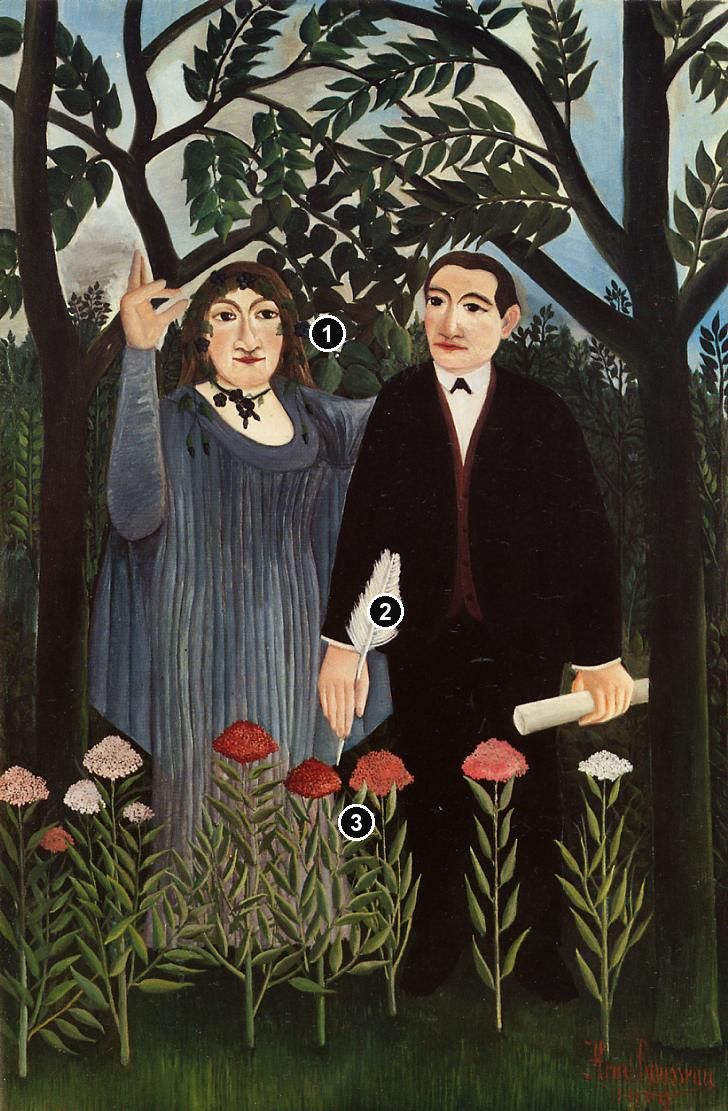
Marie Laurencin raises one hand into the branches, while Guillaume Apollinaire holds a white quill above a bank of flowers. Their dark, still figures stand close together inside a living frame of leaves. In Henri Rousseau’s Basel version of The Muse Inspiring the Poet, the garden seems to have grown around the couple, sheltering them and lending their formal poses an improbable grandeur. The painting is dated 1909 and belongs to the Kunstmuseum Basel.[1]
At a Glance
- Date1909.[1]
- CollectionKunstmuseum Basel, inventory1774.[1]
- SittersGuillaume Apollinaire and Marie Laurencin.[1]
This work across Henri Rousseau’s career
Carnival Evening
1886 [2]The Merry Jesters
1906 [7]The Snake Charmer
1907 [8]Contents
- A Poet and a Painter in the Garden
- How the Second Version Changes the Picture
- Letters and an Unfinished Canvas
- From Apollinaire to Charlotte von Wesdehlen
- Persecution, Exile and the 1940 Sale
- The Museum’s Research and the Restitution Request
- Annotated details
A Poet and a Painter in the Garden
Rousseau portrays the poet and critic Guillaume Apollinaire beside the painter Marie Laurencin, then his companion. Apollinaire championed Rousseau’s work in print; this double portrait gives their friendship a lasting visible form. Rousseau called such pictures “portrait-landscapes” and claimed the invention of the genre.[1] Here the connection between people and setting is unusually close: flowers rise before their legs, branches pass behind their heads, and Laurencin’s floral adornments bring the garden onto her body.[12]
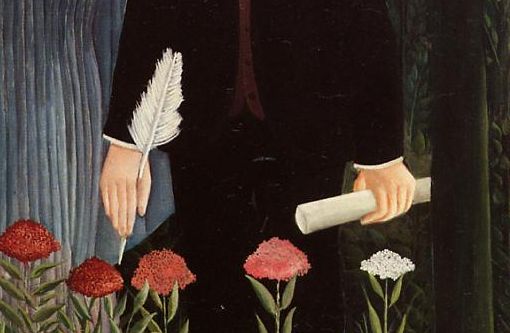
Apollinaire carries the tools of his profession, a conspicuous feather pen and a rolled sheet. Laurencin’s raised finger gives her the more active gesture. One arm reaches towards the poet’s shoulder; the other opens a space beside her face. Her loose blue-violet dress forms a broad sweep of vertical folds, set against his almost continuous black suit. Their hands and pale faces provide small areas of light within the darker enclosure.
The title casts Laurencin as an inspiring muse, though she was herself a working painter. Keeping her profession in view changes the encounter. Two people engaged in making art stand before us, even as the picture distributes its poetic attributes unevenly. Laurencin’s gaze meets the viewer with a slight smile; Apollinaire’s head turns towards her while his body remains frontal. His expression is harder to read. The contrast gives the pair an individual relationship within their ceremonial stillness.[12]
The canvas measures 146.2 × 96.9 centimetres, and Rousseau signed and dated it in red at the lower right. Its scale matters. These figures occupy a substantial vertical surface, with trees rising above them and flowers extending across their lower bodies. The museum records the work as oil on canvas, inventory number 1774.[1] The picture’s dignity comes partly from this sustained upright structure: trunks, people, pleats and stems all carry the eye upwards, while the sloping branches gather it back towards the faces.
How the Second Version Changes the Picture
The first version of The Muse Inspiring the Poet, now in Moscow’s Pushkin Museum, establishes the essential arrangement: Laurencin on the left, Apollinaire on the right, with trees on either side and flowers in front. The Pushkin’s current catalogue dates that canvas to 1909 and gives its dimensions as 131 × 97 centimetres. The Basel painting is therefore appreciably taller while remaining almost the same width.[13] Comparing the two reveals a thorough reconsideration within a familiar design.
In the Moscow picture, Laurencin has a larger head and a broader, more dominant body. Her purple gown spreads across much of the left half, while Apollinaire’s face turns more distinctly towards her. In Basel the two heads sit at more nearly equal heights, and the pair form a tighter central grouping. Laurencin retains the raised hand and long dress, but the poet appears more directly presented to us. The white quill and rolled paper become particularly sharp interruptions in his black silhouette.
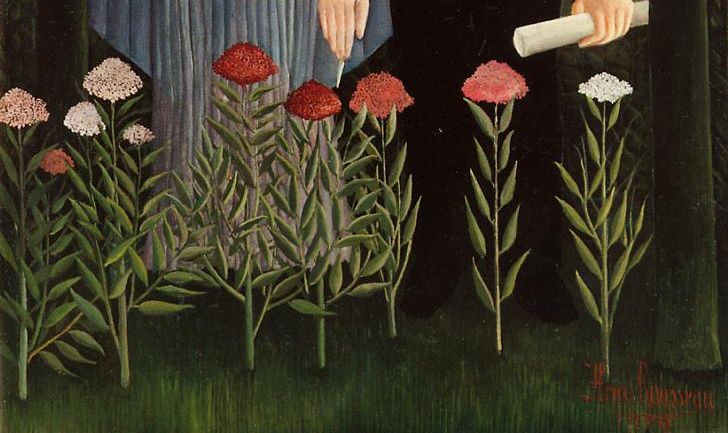
The flower bed changes just as clearly. Moscow has relatively isolated clusters, each emerging from a separate spray of narrow leaves, with open ground between them. Basel gathers red, pink and white heads into a fuller, more varied foreground. Some stems rise almost to the poet’s hanging hand. The foliage around the couple is also reorganised: heavy diagonal limbs cross the upper picture, smaller leaves overlap them, and fragments of blue sky appear through irregular openings. The garden has its own architecture in each canvas.
These differences affect the encounter. In Moscow, Laurencin’s size gives her a marked physical authority. In Basel, the closer relationship between the figures and the fuller foreground make the entire central group feel more compact. The trees function almost as the sides of a stage, though their branching growth prevents the enclosure from becoming geometrically regular. The people remain still while the surrounding plant forms supply movement.
The changed flowers also have a place in the painting’s remembered history. Apollinaire later explained the second portrait through a botanical mistake: Rousseau had painted stocks in the first version and corrected them with sweet william in the second. The French name œillets de poète gives the replacement a fitting association with the sitter’s profession. Michel Hoog, discussing this account in the 1985 Rousseau catalogue, also raised a financial possibility: a second canvas allowed the artist to provide another portrait while the earlier one found a buyer. That explanation remains a scholarly proposal, rather than an established record of Rousseau’s sole motive.[12]
Apollinaire’s account gives the flowers a literary significance without settling the identity or meaning of every painted plant. Comparing the pictures reveals Rousseau’s willingness to rebuild the setting. Changes in height, bodily proportions, branching and flower placement extend well beyond a simple substitution of one blossom for another.
Annotated Details from The Muse Inspiring the Poet: Basel Version
The numbered points identify visible features discussed in this article. Return from each detail to the whole composition. Henri Rousseau, The Muse Inspiring the Poet, Basel version, 1909. Kunstmuseum Basel, inventory 1774. Image via Wikimedia Commons; listed source: Duvaleix / Journal des peintres. Image source. Public domain. Numbers added to a separate resized overview. Three broad excerpts cropped directly from the published original without enlargement, sharpening, recolouring or retouching.
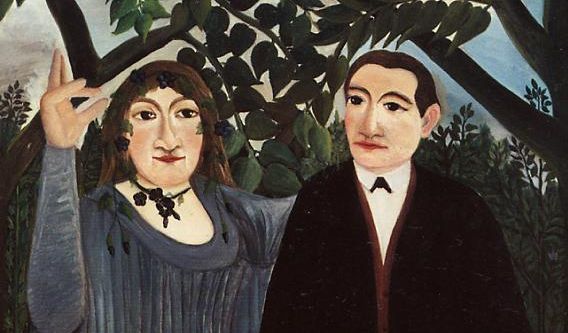
Details from THE MUSE INSPIRING THE POET: BASEL VERSION
Compare the nearly level heads, find the poet’s white writing tools, then follow the mixed flower bed across the foreground.
A raised hand beside two nearly level heads
Laurencin’s raised finger reaches into the branching garden. Her head sits close to the poet’s in height; pale faces and hands give the dark, compact central group its strongest points of light.
The poet’s quill and rolled paper
A bright feather rises beside the poet’s hanging hand, while the rolled sheet interrupts the black suit at the other side. These white shapes make the attributes of writing visible against the dark clothes.
Flowers gather in front of the figures
Red, pink and white heads stand at different heights above long green stems. The crowded foreground partly conceals the figures’ lower bodies, joining the human group to the surrounding garden.
Letters and an Unfinished Canvas
The double portrait developed over many months. Rousseau’s letters place the project in progress in 1908; in August he described working on a background inspired by a spot in the Luxembourg Gardens. The portrait had reached the Salon des Indépendants by the spring of 1909, and the second version appears in the correspondence on 31 May. This sequence distinguishes the beginning of the project from the later Basel canvas.[12]
The correspondence also shows the practical difficulties behind the formal image. Rousseau requested money, and his sitters were often unavailable. In a letter of 3 August 1909, he complained about Apollinaire’s failure to return and explained that he would continue from memory, despite problems with some colours. After 24 September, the portrait disappears from the letters discussed by Hoog. The messages offer glimpses of work in progress, without establishing an exact day of completion.[12]
A studio photograph supplies another kind of evidence. Reproduced in the same catalogue, it shows Rousseau before the portrait of Joseph Brummer, with the unfinished second Muse to the right. Areas reserved for the figures remain pale and outlined, while surrounding vegetation is already more developed. The contrast is striking beside the completed painting: the black suit and violet dress, which now anchor the composition, were still spaces waiting to be filled.[12]
This is a glimpse of a particular stage in this canvas. It makes the garden’s structural importance tangible, showing how much of its enclosing shape could exist before the figures had received their final appearance. Together, photograph and letters give Rousseau’s working practice a patient, practical character. He arranged, waited, remembered and continued. The finished stillness contains a history of interrupted encounters.
From Apollinaire to Charlotte von Wesdehlen
The Basel canvas soon entered a wider collecting world. The museum’s detailed provenance places it with Apollinaire from 1909 until probably 1912 or 1913, then with the Paris dealer Paul Rosenberg. In July 1913, Paul and Charlotte von Mendelssohn-Bartholdy bought it from Rosenberg for their Berlin collection.[1] According to the museum’s historical research, the couple acquired several Rousseaus that year and paid 6,000 French francs for this painting.[14]
Charlotte came from a family with substantial collections, and she and Paul had become significant collectors in their own right, particularly of Picasso. When they divorced in 1927, they divided their pictures; The Muse Inspiring the Poet went to Charlotte. Her later marriage to Georges Frédéric Petitpierre, Count von Wesdehlen, gave her Swiss as well as German citizenship. The name under which the painting was eventually sold to Basel therefore belongs to the woman who had retained it after the division of the earlier collection.[14]
Charlotte’s ownership continued from the 1927 division until 1940, when she sold the painting to Basel. The museum’s current provenance traces the purchase through her, with the dealer Christoph Bernoulli acting as intermediary.[1] Following her name through these changes restores a collector’s long connection to the canvas before the circumstances of its sale come into focus.
Persecution, Exile and the 1940 Sale
The Kunstmuseum’s historical investigation describes Charlotte von Wesdehlen as a woman of Jewish origin forced to leave Berlin because of Nazi persecution. She began making plans to emigrate to Switzerland in 1938 and was able to bring valuable paintings to Geneva. Other resources were much less accessible. Foreign-exchange restrictions prevented the transfer of capital and income, while discriminatory levies, including the Jewish property tax and the Reich Flight Tax, consumed her personal fortune. Possessing works of art in exile did not provide the cash needed for daily life.[14]
Through Bernoulli, she offered pictures to the Kunstmuseum Basel. Director Georg Schmidt wanted the Rousseau, but the museum’s budget was limited. Her original hope of receiving 25,000 Swiss francs fell during the negotiations to the 12,000 francs ultimately paid in September 1940. The museum’s research finds that she accepted because she urgently needed money and Basel could pay quickly. Schmidt’s own assessment placed the picture’s value substantially higher than the purchase price.[14]
The documentation allows both her negotiations and the pressure behind them to remain visible. She stated prices, considered the effects of customs charges and favoured a museum sale. The investigation nevertheless connects the unfavourable terms to her immediate need for funds. Her capacity to negotiate coexisted with the losses and restrictions that had followed her persecution and flight.[14]
In its later assessment, the museum and its Kunstkommission, or art commission, accepted that the sale would very probably not have occurred without Nazi persecution, that Charlotte depended on its proceeds for her living expenses, and that the price was low to unreasonably low. They also criticised the disrespectful and cold manner evident in the museum’s historical dealings with her.[15] These findings give the acquisition a gravity that the bare phrase “purchased in 1940” cannot convey.
The Museum’s Research and the Restitution Request
In 2021, lawyers acting for a claimant in Charlotte von Wesdehlen’s succession asked the Kunstmuseum to investigate the acquisition. The museum presented its findings to the lawyers in June 2022, and the claimant’s representatives subsequently requested the return of the painting.[16]
The museum treats the transaction as a sale of “flight assets”: property sold abroad by someone who had fled Nazi Germany. Its published assessment accepts that such sales can fall within the Washington Principles’ search for just and fair solutions. It also draws a distinction between the circumstances of a sale in Switzerland and those of dispossession within Nazi-controlled territory. In this case, the commission and museum placed weight on Charlotte’s access to the proceeds and the conditions in Switzerland, alongside the acknowledged persecution, financial pressure and inadequate price.[15]
The commission’s December 2023 decision rejected restitution and supported negotiations for financial compensation, together with public recognition of Charlotte’s history. This is the institution’s assessment of the case. Its decision acknowledges an injustice connected with the sale while favouring a remedy that would leave the painting in Basel.[15]
As of 23 October 2026, the Kunstmuseum’s public account continued to describe negotiations towards compensation. It did not announce a completed settlement or the return of the work.[16] The research has already made Charlotte’s place in the painting’s history clearer. Beside the friendship embodied by the two figures stands the experience of a collector who carried the picture into exile and sold it under financial pressure.
Henri Rousseau artworks directory
This directory brings together works covered on this site and other works documented in the cited museum records and catalogues. Alternate titles share one entry; distinct versions remain separate. Historical dates for works without an article follow the cited catalogues. This is not a catalogue raisonné.
Frequently Asked Questions
It belongs to the Kunstmuseum Basel, inventory 1774. The museum dates it to 1909 and records oil on canvas, 146.2 × 96.9 centimetres.[1]
In Basel the two figures are more nearly equal in height, the canvas is taller, and the foreground contains a denser mixture of pink, red and white flowers. In Moscow, Laurencin’s figure is larger and the separate flower clusters leave more open spaces. The Pushkin canvas measures 131 × 97 centimetres.[13]
Apollinaire associated the second version with a correction to the flowers. Hoog also proposed a financial explanation involving the sale of the earlier canvas. The evidence supports discussing both accounts without reducing every compositional change to a single proven cause.[12]
Discussion
Look again at the images and ideas explored in The Muse Inspiring the Poet: Basel Version. These editorial prompts invite your observations.
Reader Insights
How do the changed proportions of Laurencin and Apollinaire alter their relationship in the second version?
What does the unfinished studio photograph suggest about the garden’s role in building the composition?
How does knowing Charlotte von Wesdehlen’s history change the way a museum acquisition date reads?
Join the Conversation
Share a detail, comparison or question about The Muse Inspiring the Poet: Basel Version below.
References
- Kunstmuseum Basel. La Muse inspirant le poète, 1909, inventory 1774, object 1294; object metadata, inscription and detailed provenance, accessed 23 October 2026. View source. (in German).
- Philadelphia Museum of Art, Carnival Evening,1963-181-64,object59593. View source.
- Musée de l’Orangerie / Juliette Degennes, Henri Rousseau,L’ambition de la peinture: Un artiste dans son époque (in French). View source.
- National Gallery, Surprised!, NG6421. View source.
- Musée d’Orsay, La Guerre,RF19461 (in French). View source.
- MoMA, The Sleeping Gypsy. View source.
- Philadelphia Museum of Art, The Merry Jesters, 1950-134-176, object51097. View source.
- Musée d’Orsay, La Charmeuse de serpents, RF 1937 7 (in French). View source.
- Musée de l’Orangerie, La Carriole du Père Junier, RF 1960 26 (in French). View source.
- Solomon R. Guggenheim Museum / Cornelia Lauf, The Football Players,60.1583: current collection record. View source.
- MoMA, The Dream, 252.1954. View source.
- Michel Hoog. “The Muse Inspiring the Poet,” entry 58, in Henri Rousseau: Essays, The Museum of Modern Art, New York, 1985, pp. 231–232; studio photograph, p. 230, fig. 3. English translations from the French by Richard Miller. View source.
- Pushkin State Museum of Fine Arts. The Muse Inspiring the Poet (The Poet and His Muse): Portrait of the Poet Guillaume Apollinaire and the Artist Marie Laurencin, 1909, museum number Ж-3334; current object catalogue, accessed 23 October 2026. View source. (in Russian).
- Kunstmuseum Basel. Henri Rousseau, La muse inspirant le poète / Apollinaire et sa muse (1909): Summary of historical findings, pp. 1–3, accessed 23 October 2026. View source.
- Kunstmuseum Basel and Kunstkommission. Assessment of “flight assets” by the Museum and the Kunstkommission, English extract of the decision of 19 December 2023, pp. 1–8, especially pp. 6–8. View source.
- Kunstmuseum Basel. “A painting by Henri Rousseau: Kunstmuseum Basel in negotiations over compensation for ‘flight asset’ purchase”, current provenance-research account, accessed 23 October 2026. View source.
- The Museum of Modern Art, Henri Rousseau: Essays (1985), selected catalogue entries, chronology and notes on early devotees. View source. Selected entries, chronology (pp.91–95) and early-devotee notes (pp.262–264) were consulted. Historical collection credits do not establish present ownership.
- Daniel Catton Rich, Henri Rousseau (The Museum of Modern Art, 1942), selected drawings and landscape studies; historical catalogue. View source. The dated 1942 publication is used for the two Quai d’Auteuil ink views; its Malakoff date differs from the 1985 catalogue.
- MANAS, Laval, Henri Rousseau, dit le Douanier, urban landscapes and preparatory study (in French). View source.
- National Gallery of Art, Self-Portrait (1895), pen-and-ink drawing, accession 1995.47.66. View source.
- The Museum of Modern Art, War (published January 1895), lithograph, accession 684.1943. View source.
- Barnes Foundation, Landscape and Four Young Girls, object 5521, BF855. View source.


 Henri Rousseau.jpg)


 Henri Rousseau.jpg)