



 by Tom Gurney
Tom Gurney BSc (Hons) is an art history expert with over 20 years experience
Published on June 19, 2020 / Updated on October 29, 2026
Email: tomgurney1@gmail.com / Phone: +44 7429 011000
Portrait of a Woman: Introduction
A woman in a long black dress stands between a patterned curtain and a slender green branch. Her face is small above the great expanse of her gown, yet her steady eyes make her presence unmistakable. Behind her, flowerpots crowd a balcony, pale angular forms rise beyond its railing, and a bird crosses the cloudy sky. Henri Rousseau gives this formal portrait an unusual combination of ceremony and strangeness: everything seems carefully placed, while the place itself remains elusive.
The painting belongs to the Musée national Picasso-Paris, where it is titled Portrait de femme, inventory MP2017-39. The museum dates it to around 1895, records oil on canvas and dimensions of 160.5 × 105.5 cm in height and width, and gives its acquisition as the Picasso donation of 1978.[1] Its substantial size helps explain the imposing effect of the figure. Even in reproduction, the dress seems to occupy almost the whole available height.
At a Glance
- ArtistHenri Rousseau
- SubjectPortrait of a Woman
- ExploreThe black dress and the pale face; Unequal hands and two pieces of greenery
This work across Henri Rousseau’s career
Carnival Evening
1886 [2]The Merry Jesters
1906 [7]The Snake Charmer
1907 [8]Contents
- The black dress and the pale face
- Unequal hands and two pieces of greenery
- The curtain and the balcony
- Flowers, bird and small departures from ceremony
- Who is the woman?
- Picasso's purchase and the portrait's later life
- Looking alongside Rousseau's other portraits
- Annotated details
The black dress and the pale face
The gown establishes the picture's main shape. Its puffed shoulders spread outward beneath the collar, the bodice narrows at the waist, and the skirt widens gently toward the floor. With little pattern or bright folding to follow, the eye travels along the silhouette, registering the change from shoulder to waist and from waist to hem. The dark shape provides a firm centre around which the much smaller forms of the setting gather.
Three pale accents articulate that centre: the scalloped collar, the pointed band at the waist and the exposed hands. The blue-grey collar reaches across the shoulders like a small, shallow cape. Its rounded lower edge gives the neckline a softness that the upright black neckband withholds. Lower down, the blue waist decoration forms a downward curve, echoing the collar's general sweep at a much smaller scale. These separated patches of light let us measure the length of the body through the darkness.
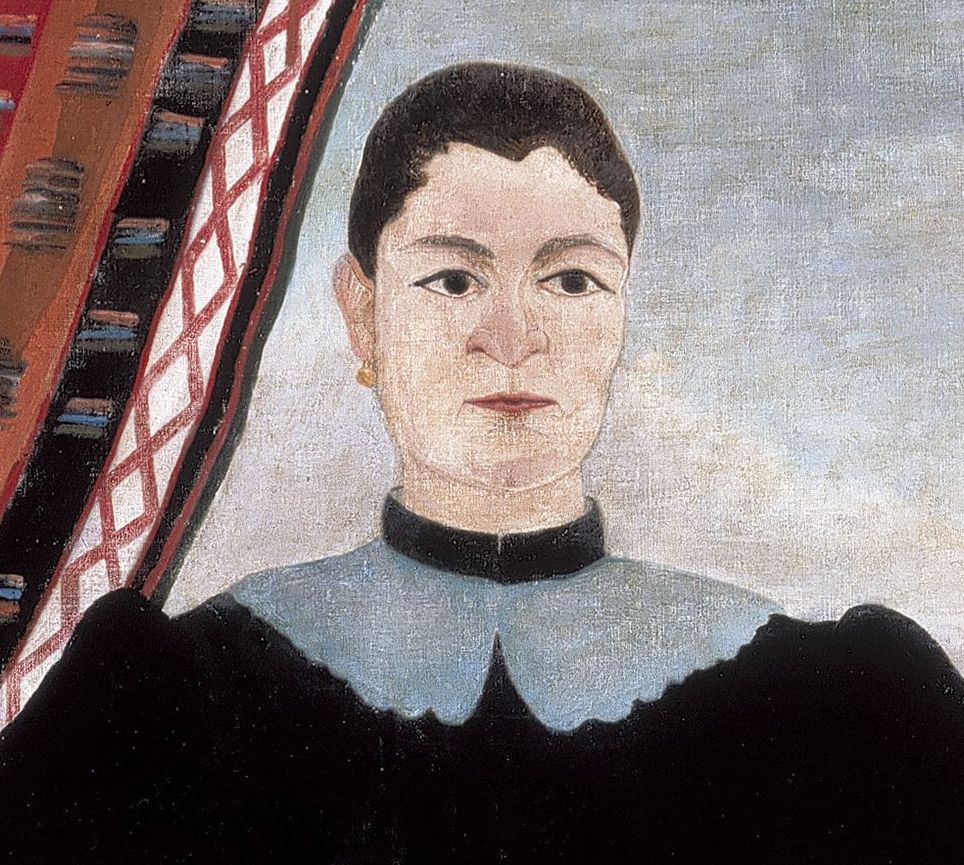
The face receives a different kind of attention. A dark, closely fitted cap of hair frames its pale surface. The eyebrows and eyes are clearly marked; the mouth is a restrained horizontal accent. The head faces outward, without a dramatic turn or an animated exchange with anyone else. There is no companion to explain the expression. Her directness leaves room for the viewer to feel the encounter as solemn, guarded or simply patient, without making any one of those responses a fact about her character.
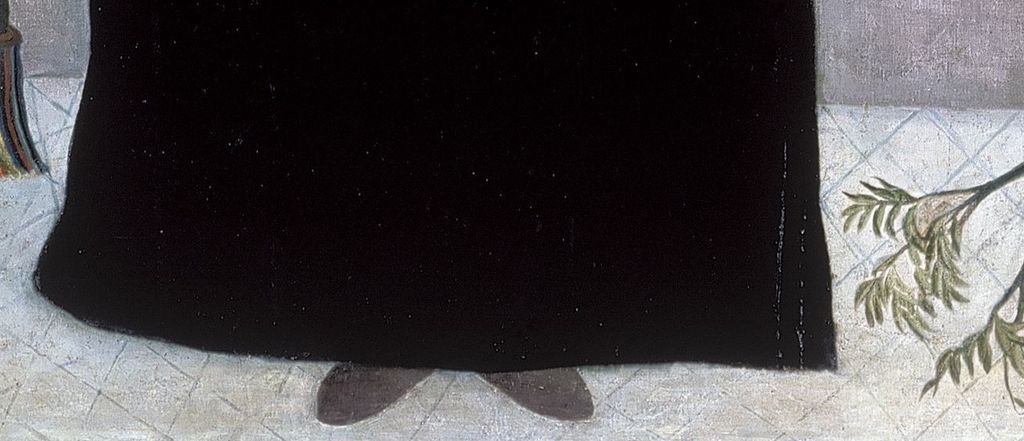
The small brown shoes are easy to overlook. They emerge below the hem at the very bottom of the painting, close together, with little of the feet exposed. Once noticed, they give the long dark dress a physical endpoint. Above, the face establishes the woman's address to us; below, these modest touches anchor her weight on the floor. The distance between them contributes more to her imposing presence than any conspicuous gesture does.
Unequal hands and two pieces of greenery
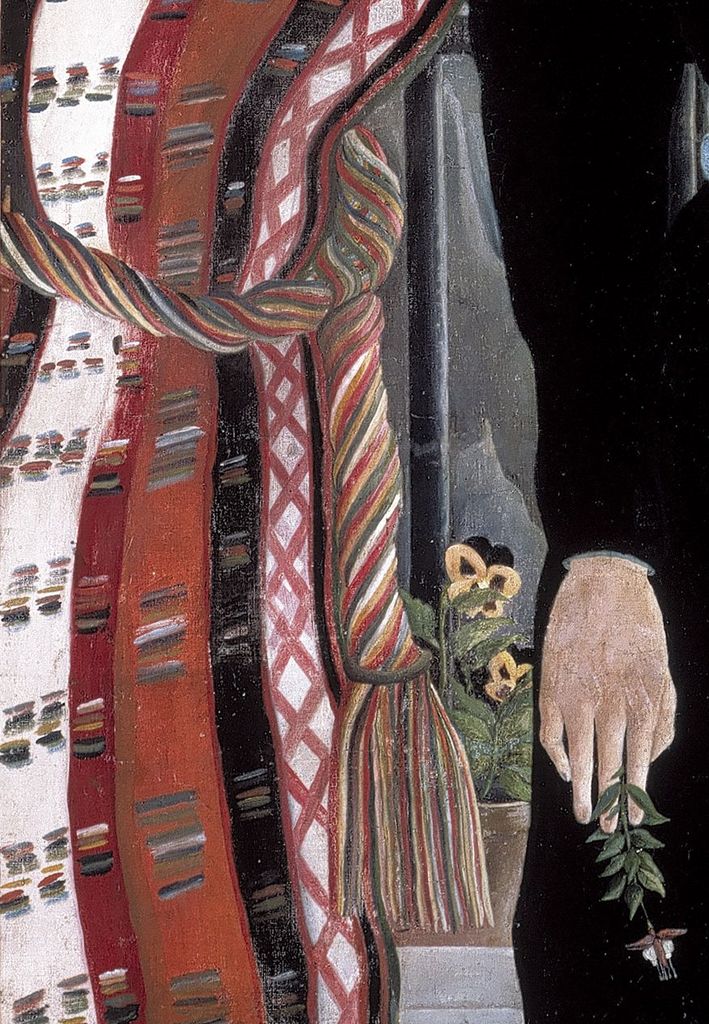
The arms disturb the figure's apparent symmetry. The hand beside the curtain hangs lower, its long fingers descending around a short leafy sprig. The opposite arm extends farther away from the body, bringing the other hand toward the flowerpots. Small differences in height and angle prevent the pose from becoming a simple mirror image. They also distribute our attention across the full width of the portrait: we look from the face toward one hand, then across the black gown toward the other.
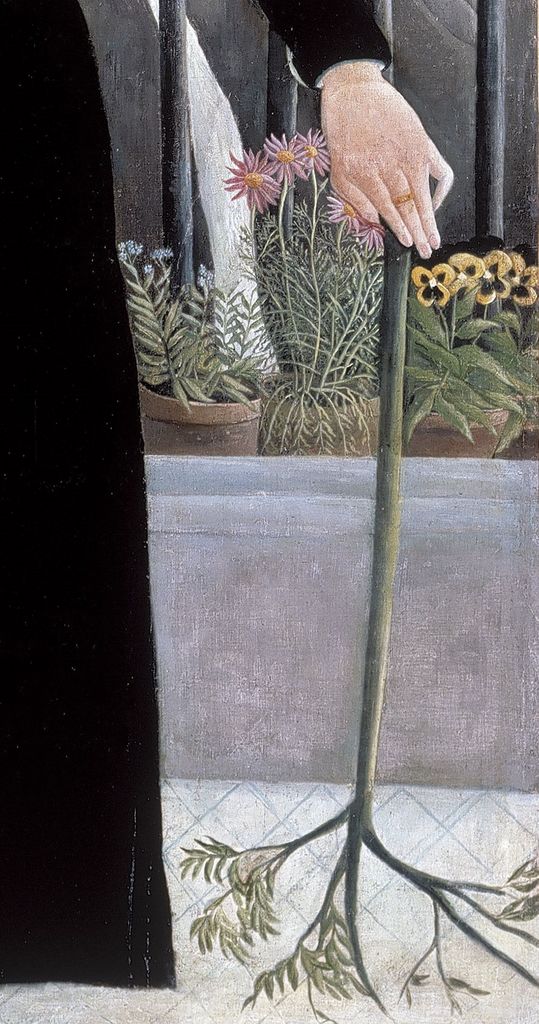
The branch on the right is particularly arresting. Its long green stem runs almost vertically down from the hand, finishing in a spread of fine twigs and leaves close to the floor. The leafy end is below the grip. This inversion turns an ordinary piece of vegetation into a conspicuous line through the composition. It continues the hand's downward movement and draws the eye toward the lower corner, where its branching tips can be read against the pale ground.
The little sprig on the other side produces a different effect. It remains close to the dress, so its leaves briefly interrupt the black silhouette. The longer branch has open space around it and can be followed almost from end to end. Rousseau thus gives the hands related objects with markedly different visual roles. One makes a small, intimate accent beside the body; the other extends the portrait outward into its surroundings.
The branch also offers a useful way to look at the floor. Against the diagonal network of tile lines, its smooth upright stem is unusually legible. Near the bottom, the twigs spread across that network and introduce more irregular divisions. The floor changes from a quiet support beneath the skirt into an active field of crossing lines. This detail rewards looking down after the face and collar have made their first impression.
Annotated Details from Portrait of a Woman
The numbered points identify visible features discussed in this article. Return from each detail to the whole composition. Henri Rousseau, Portrait of a Woman, c.1895. Musée national Picasso-Paris, MP2017-39. Image via Wikimedia Commons. Image source. Public domain. Numbers added to a separate resized overview. Details cropped directly from the published original without enlargement, sharpening, recolouring, cleaning or retouching.
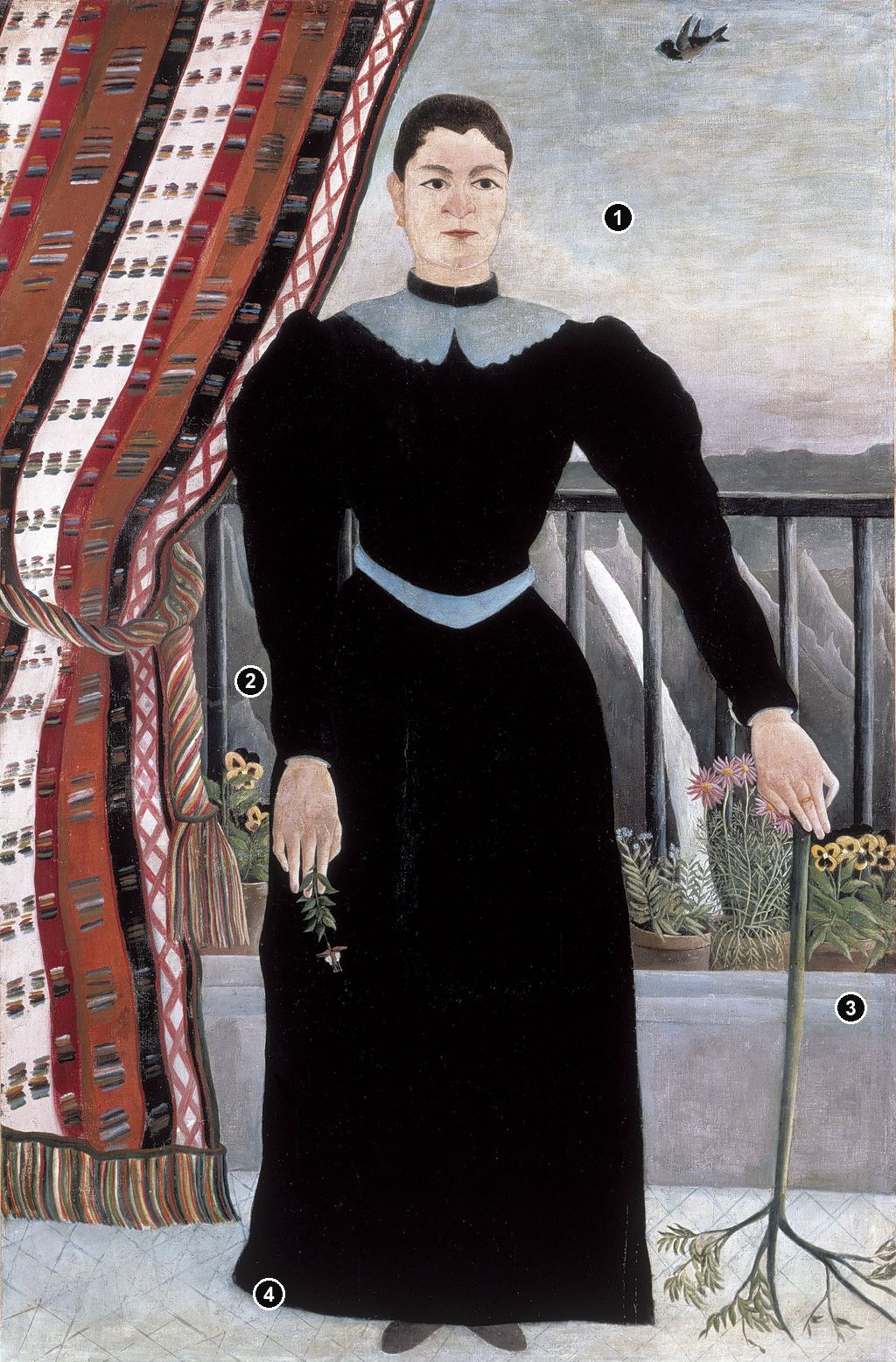
Details from PORTRAIT OF A WOMAN
Move from the face and collar to the two hands, then look down to the shoes. The curtain, plants and tiles give each part of the figure a different setting.
The face above a scalloped collar
A dark cap of hair frames the outward-looking face. Below the black neckband, the pale collar spreads into rounded scallops, separating the small head from the broad black shoulders.
A tied curtain beside the lowered hand
The striped binding gathers the patterned cloth beside the arm. The long fingers and small leafy sprig introduce irregular curves against the curtain’s repeated bands and the dark gown.
An inverted branch among the flowers
The right-hand grip leads down a long green stem to leaves spreading close to the floor. Flowerpots and small blooms crowd behind the hand, bringing a bright, finely divided pattern beside the broad black sleeve.
Small shoes beneath a long hem
Two brown shoes emerge from the dark hem. The tiled floor gives these small shapes a firm setting, while the branch’s lower leaves introduce a looser network of lines at the side.
The curtain and the balcony
The curtain supplies the largest passage of warm colour. Rust-red, cream and dark stripes run through it, broken by repeated small geometric marks. Those bands descend on a slant and bend toward the gathering point beside the woman's arm. A striped cord binds the fabric, while fringe marks its lower edge. The pattern gives the cloth a richness distinct from the unpatterned dress; its gathered mass also frames the figure on one side without enclosing her completely.
There is a striking change of rhythm where the curtain approaches the railing. The fabric's broad, leaning bands give way to thin upright bars and a dark horizontal rail. Against these straight boundaries, the woman's shoulders and sleeves appear full and rounded. Each adjoining surface asks us to look differently: across the curtain's repetitions, around the body's contour, then through the narrow intervals of the balustrade.
Beyond the railing, grey forms rise into points and ridges. They suggest a distant rocky landscape, although their steep, pale faces seem surprisingly close to the flowerpots. Farther back, a low dark band marks the horizon. The sequence is easy to name—floor, balcony, landscape, sky—yet difficult to turn into a continuous space through which we could walk. The figure and the curtain overlap the setting so decisively that its separate elements feel assembled around her.
The 1985 Rousseau catalogue proposes a photograph or photographic backdrop as a possible starting point. It also relays Fernande Olivier's later recollection that Rousseau called the setting the fortifications of Paris.[12] Neither suggestion makes this a securely identifiable view. Looking at the picture, the curtain feels domestic and ceremonial, while the open sky invites an outdoor reading. The uncertainty gives the woman's position an unusual stillness: she is visibly supported by a floor, but the world immediately beyond her resists precise location.
Flowers, bird and small departures from ceremony
At the base of the railing, the terracotta pots introduce a lower register of colour. Yellow, dark-centred flowers and pink, radiating blooms stand among finely divided greenery. The blooms sit close to the hands, providing small bright interruptions beside the dark sleeves. Their scale encourages a more intimate kind of looking after the broad first impression of the dress. One can move from the large silhouette to individual flower heads without leaving the figure's immediate surroundings.
The pots also make the balcony seem occupied. These are plants arranged and contained in a row, brought close to the woman and set against the distant grey forms. The contrast between their small stems and the large pointed shapes beyond is particularly odd. The painting holds both at nearly the same visual intensity, allowing a flower to attract as much attention as a ridge in the background.
High above this crowded strip, a small blue-dark bird occupies the open sky. Its lifted wings introduce the clearest suggestion of movement. Because it is separated from the figure, flowers and curtain, it can initially seem incidental. Once found, it makes the quiet sky an active part of the scene. The woman remains still below it; the bird's compact silhouette adds a brief upward flutter to a composition dominated by downward lines.
These details invite speculation, but no fixed symbolic code is established for the flowers or inverted branch. The catalogue itself offers botanical symbolism only as a possibility.[12] Their visible relationships are already expressive: the plants bring colour to the hands, the long branch lengthens a gesture, and the bird gives the space above the head a tiny independent life.
Who is the woman?
The sitter remains unidentified. The 1985 curators report Maurice Raynal's suggestion that she was Yadwigha, a Polish woman associated with Rousseau; they treat the identification as conjectural. They also connect the dress's style with a date after 1895.[12]
A name would change our expectations, encouraging us to search the face for a known relationship or episode. The painting currently offers a more limited encounter. We can recognise the woman's carefully arranged appearance, her full-length stance and the particular disposition of her fingers. Her occupation, social position and feelings remain beyond what those observations establish. That limit makes the hands and face especially absorbing: they seem individual, although the biography that might explain them is missing.
Picasso's purchase and the portrait's later life
The Sursock Museum's Picasso and the Family guide places Picasso's purchase of the portrait from a dealer on the Rue des Martyrs in 1908. It connects the acquisition with the banquet he subsequently organised for Rousseau at the Bateau-Lavoir, attended by figures including Guillaume Apollinaire and Gertrude Stein.[13] The 1985 catalogue reports a five-franc price and the portrait's prominent position at the gathering. Its essay also argues for Picasso's earlier familiarity with Rousseau's work through exhibitions.[12]
This history gives the painting an additional kind of presence. The woman who stands alone within the composition became part of a social occasion centred on her painter. The picture's unusual arrangement could be encountered by other artists as a large physical object, with the severity of the gown and the intricacy of the curtain sharing one surface. Its place in Picasso's collection links that encounter to the museum in which the work is preserved today.[1]
Looking alongside Rousseau's other portraits
Two other portraits sharpen our perception of this one. In Portrait de Madame M., the great puffed sleeves spread more emphatically, one arm bends toward the waist, and vegetation rises around the figure. Here, the curtain and balcony establish firmer architectural edges, while both hands lead downward. Looking between the pictures makes the arrangement of arms and surroundings seem as consequential as the choice of a black dress.
Boy on the Rocks offers a more concentrated comparison. A dark-clothed frontal figure appears against pale sky and pointed rocky forms, with hands clearly visible beside the body. In Portrait of a Woman, that strong outward address is extended through the length of the gown and complicated by the curtain, flowers and long branch. The woman holds the centre, but each surrounding detail gives the eye somewhere else to travel before returning to her face.
Henri Rousseau artworks directory
This directory brings together works covered on this site and other works documented in the cited museum records and catalogues. Alternate titles share one entry; distinct versions remain separate. Historical dates for works without an article follow the cited catalogues. This is not a catalogue raisonné.
Frequently Asked Questions
It is in the collection of the Musée national Picasso-Paris, inventory MP2017-39, with an acquisition credit of Picasso donation, 1978.[1]
They are separate compositions. This portrait includes a striped curtain, balcony railing and long inverted branch. Portrait de Madame M. places its figure among dense plants, with one arm bent at the waist.
The setting has recognisable components, including a tiled floor, railing, pots and sky. Its exact location is unestablished. The compressed arrangement allows it to be experienced as a constructed setting around the woman.
Discussion
Look again at the images and ideas explored in Portrait of a Woman. These editorial prompts invite your observations.
Reader Insights
How does the picture's balance change when you follow the two hands instead of looking first at the face?
Which detail most affects your sense of the setting: the curtain, the distant grey forms or the flowerpots?
What does the small flying bird contribute to a portrait whose main figure remains so still?
Join the Conversation
Share a detail, comparison or question about Portrait of a Woman below.
References
- Musée national Picasso-Paris. Portrait de femme, current collection record, MP2017-39; date, medium, dimensions, institution and acquisition fields. Accessed 23 October 2026. View source. (in French).
- Philadelphia Museum of Art, Carnival Evening,1963-181-64,object59593. View source.
- Musée de l’Orangerie / Juliette Degennes, Henri Rousseau,L’ambition de la peinture: Un artiste dans son époque (in French). View source.
- National Gallery, Surprised!, NG6421. View source.
- Musée d’Orsay, La Guerre,RF19461 (in French). View source.
- MoMA, The Sleeping Gypsy. View source.
- Philadelphia Museum of Art, The Merry Jesters, 1950-134-176, object51097. View source.
- Musée d’Orsay, La Charmeuse de serpents, RF 1937 7 (in French). View source.
- Musée de l’Orangerie, La Carriole du Père Junier, RF 1960 26 (in French). View source.
- Solomon R. Guggenheim Museum / Cornelia Lauf, The Football Players,60.1583: current collection record. View source.
- MoMA, The Dream, 252.1954. View source.
- Museum of Modern Art. Henri Rousseau: Essays, 1985, entry 12, p. 126; colour plate p. 127; Carolyn Lanchner and William Rubin, “Henri Rousseau and Modernism,” pp. 46–47, including p. 46, note 49. View source.
- Sursock Museum, with Musée national Picasso-Paris. Picasso and the Family, exhibition guide, 2019–20, illustrated chronology, 1908 entry, printed p. 22 (PDF page 22); publication credits, p. 2. View source.
- The Museum of Modern Art, Henri Rousseau: Essays (1985), selected catalogue entries, chronology and notes on early devotees. View source. Selected entries, chronology (pp.91–95) and early-devotee notes (pp.262–264) were consulted. Historical collection credits do not establish present ownership.
- Daniel Catton Rich, Henri Rousseau (The Museum of Modern Art, 1942), selected drawings and landscape studies; historical catalogue. View source. The dated 1942 publication is used for the two Quai d’Auteuil ink views; its Malakoff date differs from the 1985 catalogue.
- MANAS, Laval, Henri Rousseau, dit le Douanier, urban landscapes and preparatory study (in French). View source.
- National Gallery of Art, Self-Portrait (1895), pen-and-ink drawing, accession 1995.47.66. View source.
- The Museum of Modern Art, War (published January 1895), lithograph, accession 684.1943. View source.
- Barnes Foundation, Landscape and Four Young Girls, object 5521, BF855. View source.


 Henri Rousseau.jpg)


 Henri Rousseau.jpg)