


 by Tom Gurney
Tom Gurney BSc (Hons) is an art history expert with over 20 years experience
Published on June 19, 2020 / Updated on October 29, 2026
Email: tomgurney1@gmail.com / Phone: +44 7429 011000
Bouquet of Flowers II: Introduction
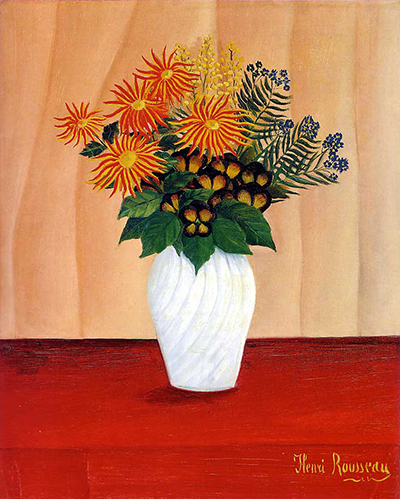
Five red and yellow flowers spread like small suns across Henri Rousseau’s bouquet. Their pointed petals reach into a pink curtain, while fine blue sprays extend to the right. Beneath them, dark rounded blossoms and broad green leaves crowd around the neck of a white vase. The arrangement grows in several directions at once, held together by the compact vessel and the red table beneath it.
Tate catalogues the painting as Bouquet of Flowers (N04727); Bouquet of Flowers II is the title used here. Its current record, consulted in October 2026, gives a date of about 1909–10, oil on canvas and dimensions of 61 × 49.5 cm.[1]
At a Glance
- ArtistHenri Rousseau
- SubjectBouquet of Flowers II
- ExploreFive flowers that spread the bouquet; Yellow spires and blue branches
This work across Henri Rousseau’s career
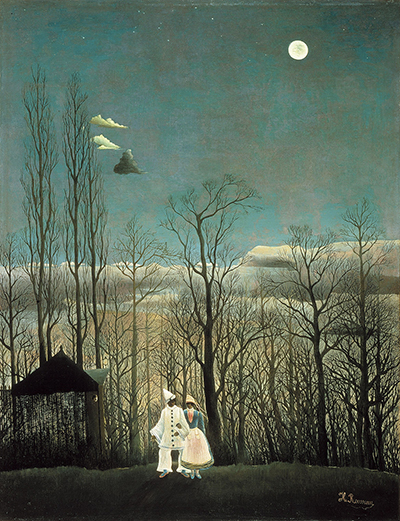
Carnival Evening
1886 [2]The Merry Jesters
1906 [7]The Snake Charmer
1907 [8]Bouquet of Flowers II (current article)
c. 1909–1910 [1]Contents
- Five flowers that spread the bouquet
- Yellow spires and blue branches
- The dark flowers at the vase’s mouth
- A vase with a turning surface
- Curtain, tabletop and signature
- The date and the painting’s history
Five flowers that spread the bouquet
The five conspicuous red flower heads occupy the left and middle of the arrangement. The smallest sits near the far left edge, separated from its larger neighbours by a little pink space. A second rises above and to its right, another stands higher still, and two broad heads dominate the lower left and centre-right. These unequal positions make a loose climbing sequence. The eye can follow them upward from the small side flower, then descend across the largest central bloom towards the darker flowers below.
Each head has a yellowish centre surrounded by long, narrow petals. Red and yellow-green run beside one another along these extensions, producing a striped, almost flickering edge. Some petals curl towards their neighbours; others project stiffly into the background. The outlines form a succession of hooks and sharp points rather than a smooth circular boundary. From a distance, the flowers seem round. Close looking reveals how much their apparent roundness depends on a ragged perimeter.
The centres also differ. The low left flower has a broad, fairly clear disc, while the central-right head seems pulled sideways by its spreading petals. The upper flowers turn their long rays into a mesh of crossing lines. Rousseau gives the heads enough family resemblance to unite them, then varies their size, angle and reach. Their repetition creates a rhythm without making the bouquet look like a row of identical ornaments.
Colour makes this group especially forceful. The red petals meet a curtain of a softer, quieter reddish pink, so their yellow borders do much of the work of separating flower from background. Where the petals overlap dark leaves, the contrast changes abruptly: the same red and yellow lines become bright against green. The flower head therefore seems to change density as the eye travels around it. One side opens into the curtain; another presses against the foliage.
Yellow spires and blue branches
Above the main red flowers, slender stems carry small yellow dots. Their branching forms rise near the centre of the picture, creating the bouquet’s highest tips. The separate marks remain legible against the pink ground, with gaps between them allowing the background to show through. The upper centre has a lighter texture than the packed arrangement below. The yellow touches also pick up the colour of the large flower centres, carrying it upward in smaller intervals.
The right side develops differently. Thin angled stems end in blue flower clusters, and long narrow leaflets spread from either side of the branches. Some curve downwards; others sweep outward towards the right edge. The blue heads are compact and uneven, their small pale or yellowish interruptions breaking up the dark blue. They are much less expansive than the red flowers, yet the extended framework carrying them gives this side of the bouquet considerable breadth.
Pink spaces separate these branches. They divide the sprays into readable units and let the eye trace a stem towards its flowering end. Near the centre, overlapping leaflets create a denser green lattice. Towards the right, the branches separate and the gaps widen. That transition makes the bouquet feel as though it is opening into the surrounding air, even though every contour remains sharply stated.
The two sides balance through different means. On the left, broad red heads fill space with petals. On the right, fine stems and repeated leaflets occupy a similar reach with much less solid colour. The central yellow spires sit between these contrasting structures. This uneven distribution gives the arrangement its particular energy: the flowers seem to lean and fan outward while the vase remains calmly upright beneath them.
The dark flowers at the vase’s mouth
A much denser band lies below the bright radial flowers. Here, rounded blossoms have purple-black outer edges and warm yellow patches towards their centres. Their lobed shapes suggest pansies, though the image alone cannot establish an exact botanical inventory. Several face forward, displaying their coloured patches like small masks. Others are partly hidden by neighbouring petals or leaves, and their outlines have to be pieced together from the visible fragments.
This dark group changes the pace of looking. The large flowers send the eye along long, pointed lines; these low blossoms invite it to pause over enclosed patches of colour. A forward-facing flower near the middle hangs below the rest, almost level with the upper leaves. Its warm interior is divided into several rounded areas, each bounded by a dark margin. It provides a small, intricate focal point between the large red flowers and the pale body of the vase.
Broad leaves overlap this group from below and at the sides. Their pointed tips make a spreading green collar around the vessel. Pale midribs and finer veins give direction to the leaf surfaces, while shifts between yellow-green and deeper green suggest ridges and turns. Some leaves extend sideways, others hang down. One central point reaches over the white vase, interrupting its upper outline and helping to join the mass of flowers to the vessel that supports it.
The dark blossoms, green leaves and white vase form a particularly clear sequence of tones. The almost black petals make the yellow centres glow; the leaves carry that dark band downward through more varied greens; the vase then opens into a broad pale area. The transition is compressed into a small part of the picture. It makes the neck of the vase feel full and concealed, with the bouquet gathered tightly before its stems spread above.
A vase with a turning surface
The white vessel has rounded shoulders and a body that narrows towards its base. Its outer shape is close to symmetrical, although the foliage hides much of the mouth. Within that steady silhouette, curved grey and pale green bands travel diagonally across the surface. They suggest spiral ribs, giving the vase a gentle twisting movement that continues even where its contour is almost vertical.
These bands are softer than the lines describing the flowers. They widen, fade and reappear within the white, leaving pale intervals between them. Their changing direction helps the eye imagine a surface turning away from the front. The effect remains delicate: a few coloured curves supply the volume, while much of the vase stays luminous and relatively quiet. This is a welcome pause after the crowded petals and leaf veins immediately above.
The vase is also narrower than the spread of the bouquet. Its modest base gathers the weight of an arrangement that extends far beyond it on both sides. That difference makes the whole construction seem poised. A small darkened area around the foot fixes the vessel to the table, and the red immediately beside it gives the white edge extra clarity. The painting concentrates its strongest light area low in the composition, beneath the more intricate flower colours.
Curtain, tabletop and signature
The background is a pink-peach curtain whose folds are broad enough to remain visible through the open branches. On the left, an oblique fold descends behind the small red flower; elsewhere, long vertical changes of tone run towards the table. The curtain supplies a larger, slower set of lines behind the bouquet’s fine detail. Its folds also prevent the surrounding pink from becoming a perfectly even field, while keeping it quiet enough for the flower silhouettes to register.
A thin dark edge marks the rear of the red tabletop. It passes behind the vase at a much lower level than the flower heads, leaving the bouquet largely surrounded by pink. Across the table, horizontal strokes and darker patches give the red surface some variation. Lower down, another long division separates the top from the broad front. These horizontal elements provide a firm base for the upright vase and the flowers’ many diagonals.
At the lower right, the pale signature spreads across the red table front. Its tall letters and curling flourish give this comparatively open area a final passage of fine line. The colour connects it visually with the vase, while the loops echo some of the curving movement in the petals and ribs. From the signature, the eye can return across the red surface to the vase’s foot, then follow the rising contours back into the flowers. Even the quieter lower part of the painting participates in the movement of looking.
The date and the painting’s history
Ronald Alley’s 1981 Tate catalogue weighed several datings. Jean Bouret suggested the 1902 or 1903 Salon des Indépendants flower still lifes, which remain unidentifiable because they were neither illustrated nor described. Dora Vallier tentatively favoured 1895–1900, citing precise finish and frontal presentation; Anatole Jakovsky used 1909. Alley preferred about 1909–10, finding insufficient reason to place it far before related late bouquets. His comparisons included a Barnes composition and two dated 1910 variants with different arrangements.[1]
The painting reached C. Frank Stoop in London around 1931 and entered Tate through his 1933 bequest.[1]
Henri Rousseau artworks directory
This directory brings together works covered on this site and other works documented in the cited museum records and catalogues. Alternate titles share one entry; distinct versions remain separate. Historical dates for works without an article follow the cited catalogues. This is not a catalogue raisonné.
Frequently Asked Questions
Start with the five red and yellow flower heads, then trace the thin blue-flowered branches to the right. The different ways they fill space explain much of the bouquet’s balance.
Their detail takes different forms. The radial flowers have striped, pointed petals; the low dark blossoms have rounded coloured patches; the blue sprays depend on fine stems and small clustered marks.
Curving bands cross its pale body, suggesting spiral ribs. These soft internal lines give the surface a turning movement within a stable, nearly symmetrical outline.
Discussion
Look again at the images and ideas explored in Bouquet of Flowers II. These editorial prompts invite your observations.
Reader Insights
Which holds your attention longer: the large striped flowers or the small dark blossoms near the vase?
How would the arrangement change if its blue sprays were as dense as the flowers on the left?
Where do the curtain folds help you see a flower or stem more clearly?
Join the Conversation
Share a detail, comparison or question about Bouquet of Flowers II below.
References
- Tate. Bouquet of Flowers, N04727, current Details, consulted 23 October 2026; Ronald Alley, catalogue entry in Catalogue of the Tate Gallery’s Collection of Modern Art other than Works by British Artists (1981), pp. 666–667, reproduced p. 666. View source.
- Philadelphia Museum of Art, Carnival Evening,1963-181-64,object59593. View source.
- Musée de l’Orangerie / Juliette Degennes, Henri Rousseau,L’ambition de la peinture: Un artiste dans son époque (in French). View source.
- National Gallery, Surprised!, NG6421. View source.
- Musée d’Orsay, La Guerre,RF19461 (in French). View source.
- MoMA, The Sleeping Gypsy. View source.
- Philadelphia Museum of Art, The Merry Jesters, 1950-134-176, object51097. View source.
- Musée d’Orsay, La Charmeuse de serpents, RF 1937 7 (in French). View source.
- Musée de l’Orangerie, La Carriole du Père Junier, RF 1960 26 (in French). View source.
- Solomon R. Guggenheim Museum / Cornelia Lauf, The Football Players,60.1583: current collection record. View source.
- MoMA, The Dream, 252.1954. View source.
- The Museum of Modern Art, Henri Rousseau: Essays (1985), selected catalogue entries, chronology and notes on early devotees. View source. Selected entries, chronology (pp.91–95) and early-devotee notes (pp.262–264) were consulted. Historical collection credits do not establish present ownership.
- Daniel Catton Rich, Henri Rousseau (The Museum of Modern Art, 1942), selected drawings and landscape studies; historical catalogue. View source. The dated 1942 publication is used for the two Quai d’Auteuil ink views; its Malakoff date differs from the 1985 catalogue.
- MANAS, Laval, Henri Rousseau, dit le Douanier, urban landscapes and preparatory study (in French). View source.
- National Gallery of Art, Self-Portrait (1895), pen-and-ink drawing, accession 1995.47.66. View source.
- The Museum of Modern Art, War (published January 1895), lithograph, accession 684.1943. View source.
- Barnes Foundation, Landscape and Four Young Girls, object 5521, BF855. View source.
 Henri Rousseau.jpg)
 Henri Rousseau.jpg)