



 by Tom Gurney
Tom Gurney BSc (Hons) is an art history expert with over 20 years experience
Published on June 19, 2020 / Updated on October 29, 2026
Email: tomgurney1@gmail.com / Phone: +44 7429 011000
La Falaise: Introduction
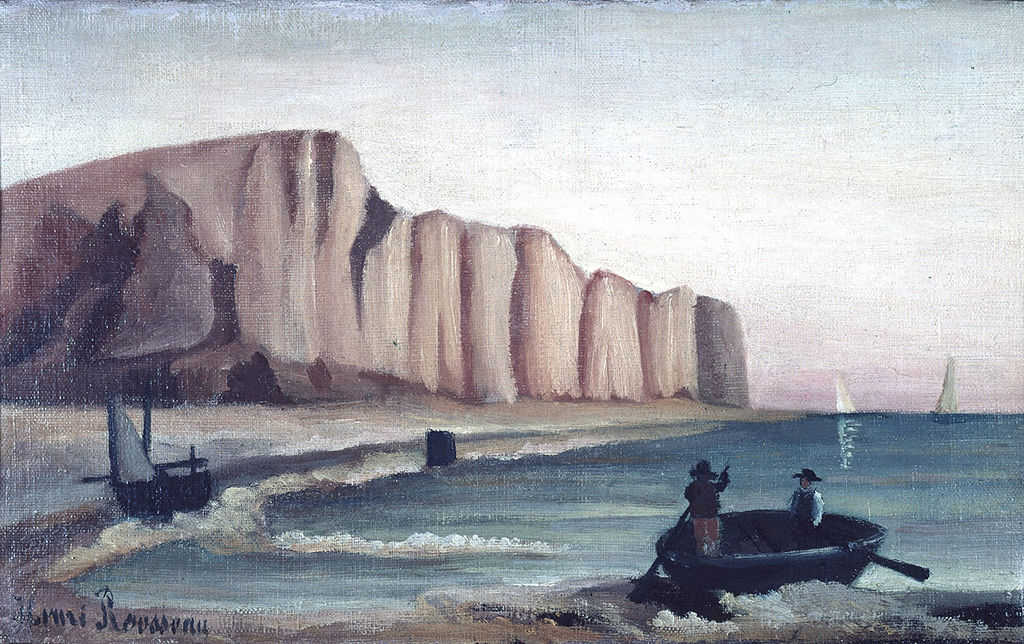
A long cliff fills the left of Henri Rousseau’s La Falaise (The Cliff), while two people occupy a black boat close to the shore. Between them, white surf describes a shallow curve across the sand. Painted around 1895, this small oil on canvas belongs to the Musée de l’Orangerie in Paris. Its view opens towards a distant sea, yet almost everything that gives the picture its character lies near the beach: the blunt rock faces, the interrupted line of foam and the boat’s heavy silhouette.[1]
At a Glance
- ArtistHenri Rousseau
- SubjectLa Falaise
- ExploreA cliff built from broad faces; Following the shore to the boats
This work across Henri Rousseau’s career
Carnival Evening
1886 [2]La Falaise (current article)
c. 1895 [1]The Merry Jesters
1906 [7]The Snake Charmer
1907 [8]Contents
- A cliff built from broad faces
- Following the shore to the boats
- A coastal view made from other pictures?
- A small canvas with a broad horizon
- From Paul Guillaume to the Orangerie
- Annotated details
A cliff built from broad faces
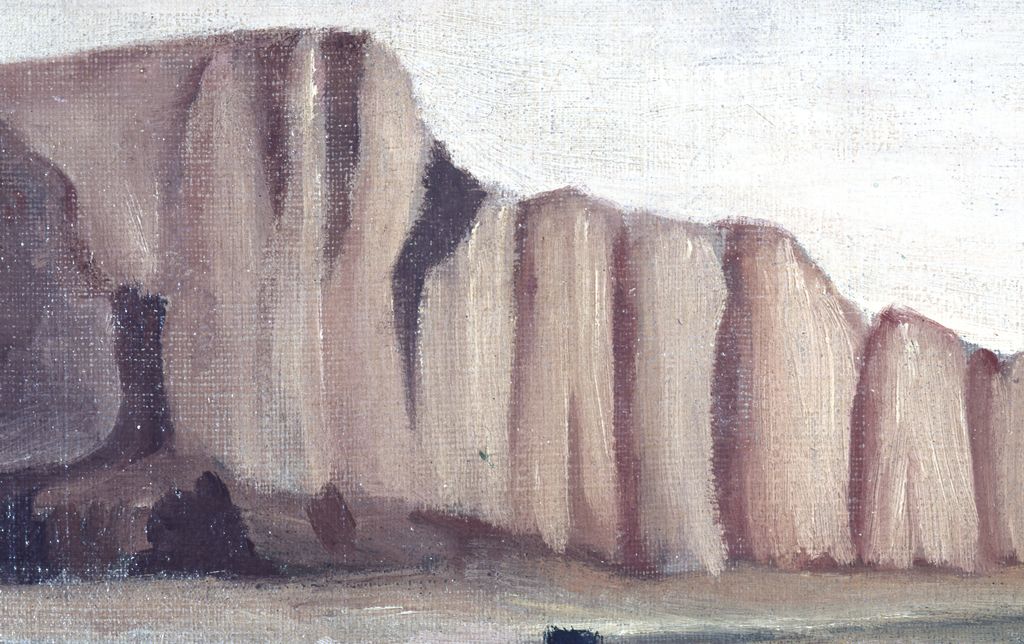
The cliff is the picture’s largest continuous form. It rises highest towards the left, where dark clefts divide the rock into uneven masses, then descends in a series of steps towards the right. Rousseau gives its long face a rhythm of pale ochre ridges and brown shadows. Some are narrow and sharply cut; others spread across broad, almost flat surfaces. The repetition makes the cliff legible at a glance, while variations in width prevent it from becoming a regular pattern.
A thin, muted green cap separates the warm rock from a pale sky. The outline runs across much of the canvas before dropping abruptly to the water. That final vertical edge makes the cliff feel like a substantial wall: beyond it, the sea suddenly has room to stretch away. The strongest depths within the rock occur at the left, where shadows gather in dark, angular patches. Farther along, lighter ridges carry the eye towards the distant end of the headland.
Rousseau keeps the sky comparatively empty. Its subdued peach and grey tones leave the rock’s outline clear without introducing a second spectacle overhead. The sea is similarly organised in horizontal bands. Against those long, low passages, the cliff’s repeated upright divisions look especially forceful. The scene gains much of its structure from this encounter between vertical rock and horizontal water.
The painting measures only 21 × 35 centimetres, excluding its frame. That modest size makes the breadth of the headland more striking: a few inches of canvas must carry the impression of a great length of coast. The museum records Rousseau’s signature at the lower left, where the dark lettering runs across the light foreground.[1] The lettering occupies the sandy strip below the much larger mass of rock.
Following the shore to the boats
The beach offers a different route through the view. Starting at the lower left, it bends around the little boat on the shore and narrows towards the foot of the cliff. A broken white line of surf follows the curve. Closer to the foreground boat, another low wave stretches across the water like a loose strand of white. These curves soften the cliff’s rigid divisions and give the eye a way to move around them.
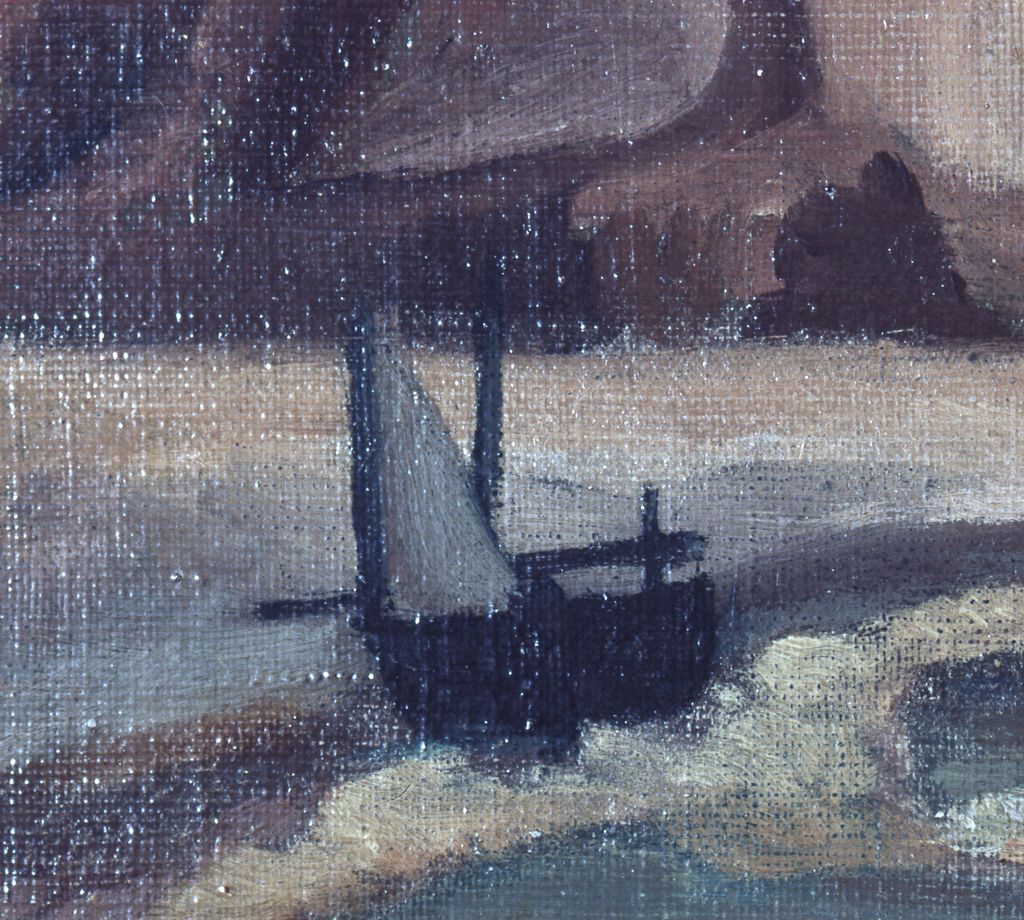
Several small interruptions keep the shoreline from reading as a single decorative ribbon. The beached boat at the left has a short mast and pale sail, its dark hull standing against the sand. Farther back, a squat, dark upright shape punctuates the shore. Rousseau gives this object a firm outline but little descriptive detail. It works as a marker along the beach without requiring the viewer to identify its purpose.
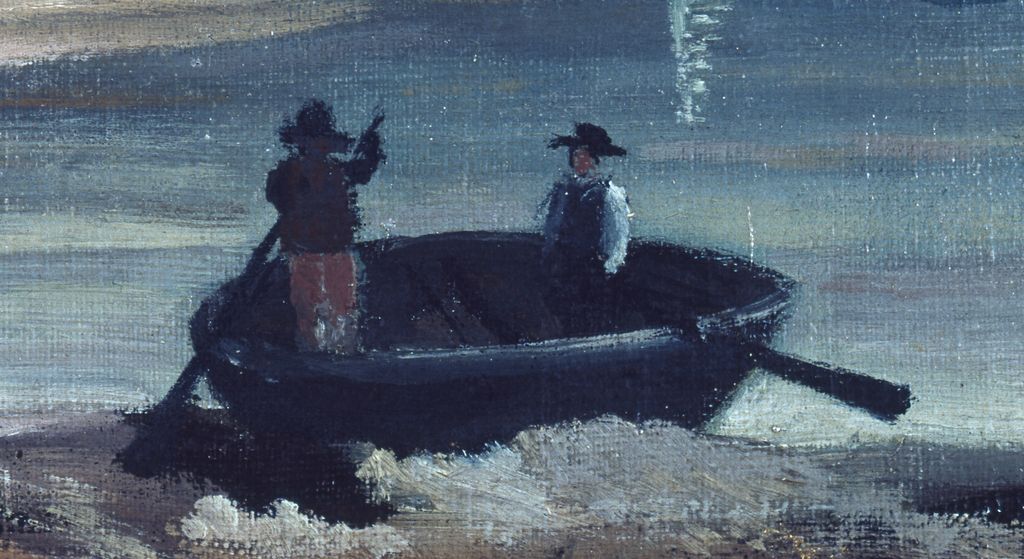
The largest boat occupies the lower right. Its hull is almost black, with a narrow grey edge that helps distinguish its upper rim from the interior. The two figures are reduced to a few contrasting shapes: dark hats, a brown lower garment on one, and a pale blue upper garment on the other. Their faces contribute little to the scene. Their size and placement matter more, providing a human measure against which to judge the cliff behind them.
One long oar projects to the right, carrying the boat’s dark outline into the lighter water. At the other end, a dark diagonal reaches towards the foreground. These slanting forms connect the boat with the shore’s movement through the picture. The hull also balances the distant rock: the cliff spreads across the upper left, while this much smaller but strongly dark shape gives the lower right its weight.
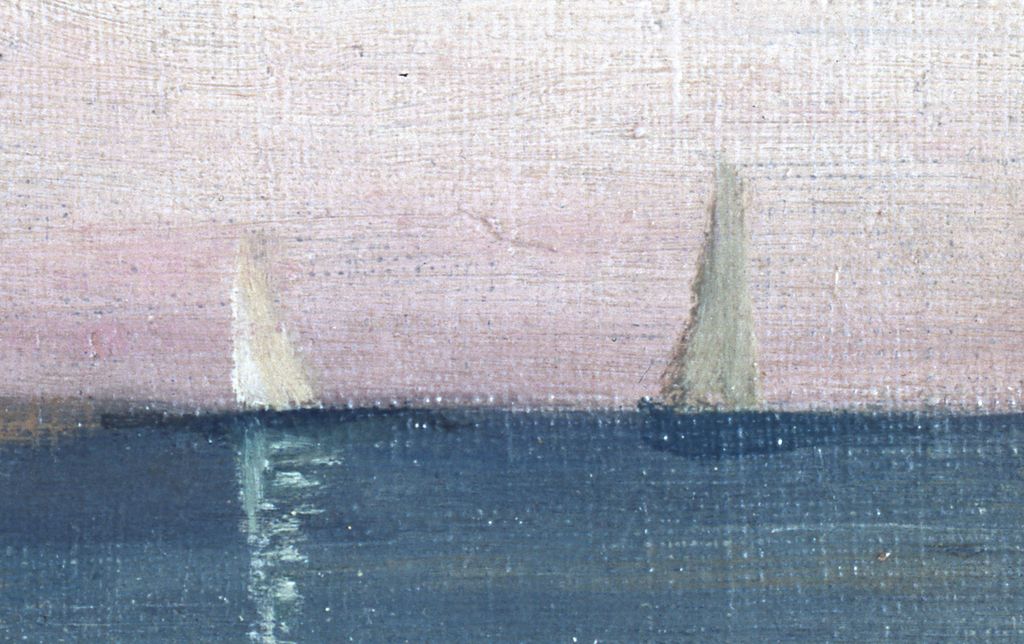
Two pale sails near the far right introduce another change of scale. They are tiny beside the sail of the boat on the beach. A narrow white reflection beneath the nearer distant sail adds a vertical glimmer to the sea. With very little detail, Rousseau establishes several distances: the foreground figures, the nearer shore and the open water beyond the headland. The museum describes the scene’s people as fishermen; the image itself leaves their immediate activity open.[1]
Annotated Details from La Falaise
The numbered points identify visible features discussed in this article. Return from each detail to the whole composition. Henri Rousseau, La Falaise (The Cliff), circa 1895. Musée de l’Orangerie, Paris, RF 1960 29. Photograph by Françoise Foliot. Photograph: Françoise Foliot / Fonds Françoise Foliot, preserved by Wikimédia France. Image source. CC BY-SA 4.0. Numbered overview and cropped details adapted from Françoise Foliot’s photograph. The overview is resized and numbered; details are cropped. These adaptations are offered under CC BY-SA 4.0. No recolouring or retouching.
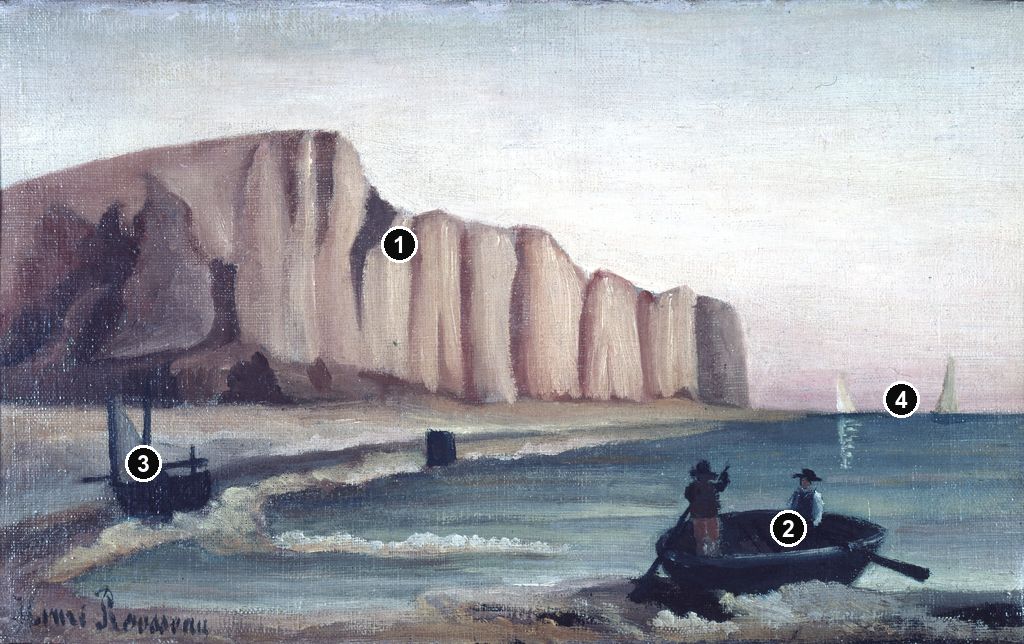
Details from LA FALAISE
Compare the cliff’s upright faces with the curving shore, the foreground boat and the small sails across the open water.
Pale rock faces and dark clefts
Broad pale faces alternate with narrow brown shadows. Their repeated upright divisions give the long cliff a strong rhythm against the quieter horizontal sky and sea.
Two figures and the foreground boat
Dark hats and contrasting clothing separate the two people within the heavy black hull. The long oars extend the boat’s diagonals across the lighter water and shore.
A small sailboat beside the sand
A pale triangular sail and dark hull interrupt the curved strip of sand. The boat is much smaller than the cliff yet large beside the distant sails across the water.
Two distant sails and a reflection
The pale sails stand apart against the low horizon. A broken vertical reflection beneath the nearer one adds a small glimmer to the broad bands of blue water.
La Falaise — Henri Rousseau.
A coastal view made from other pictures?
The Orangerie identifies the subject as a cliff on the Normandy coast, while treating the source of Rousseau’s view as a question. Its commentary proposes that he probably worked from a reproduction of a painting. Among the possible models it names are Claude Monet’s Falaises à Pourville and Gustave Courbet’s Falaise avec bateaux et Mer orageuse, also called La Vague. It also allows for the many cliff views produced by less familiar painters. Several sources may have contributed to a newly composed scene.[1]
Those possibilities offer a useful way to approach the painting’s construction. The cliff, the boats and the stretch of sea are unusually easy to distinguish as separate elements. Each has a clear outline and a limited range of internal forms. The distant sails can be read almost as signs placed upon the horizontal water. The rock, although strongly modelled in places, resolves into a sequence of broad coloured faces. This clarity gives the scene the directness that the museum associates with popular imagery.[1]
The proposed links with Monet and Courbet remain suggestions: neither an exact source reproduction nor a visit by Rousseau to the site has been established. Pourville belongs to the title of a possible model, while the location of Rousseau’s own view remains uncertain.[1]
A familiar coastal motif could have supplied the starting point for the picture’s arrangement. The high cliff and open sea are given distinct territories, while the beach curves between them. At the edge of these large spaces, the foreground boat brings a pair of people close to the viewer. Whatever its sources, the scene holds together through these carefully readable relationships.
A small canvas with a broad horizon
The painting’s scale belongs to a practical part of Rousseau’s work. In its 2026 exhibition texts, the Orangerie places La Falaise among picturesque subjects painted on small canvases suited to the budgets and rooms of modest buyers. The museum discusses such works alongside his decorative bouquets and still lifes, connecting their size with the audience he sought.[12] That context does not establish a particular purchaser or commission for this picture, but it helps explain the usefulness of a compact coastal view.
Warm rock and sand surround a cooler expanse of water, and the dark boats remain distinct against those lighter areas. The wide format leaves room for the beach to turn, the cliff to diminish and the distant sails to stand apart. Much of the pleasure lies in following the coast sideways: the compact arrangement accommodates both nearby activity and a far horizon.
From Paul Guillaume to the Orangerie
The Orangerie’s provenance begins with the painting in Paul Guillaume’s Paris collection in 1929. It next records it with Domenica Walter, identified in the detailed history as Mme Jean Walter, until 1959. The French state purchased it that year with the assistance of the Société des Amis du Louvre; the record gives 21 February 1959 as the date of the order approving the sale. The Louvre appears next in its history, followed by the painting’s physical entry into the Orangerie in 1977.[1]
The painting therefore entered public ownership in 1959, eighteen years before its physical arrival at the Orangerie. Its inventory number is RF 1960 29. The current provenance does not identify its first owner or explain how it reached Guillaume’s collection.[1]
The museum’s bibliography preserves several names under which the picture has appeared. Its listing for Les Arts à Paris in 1929 records La Barque, or The Boat; the 1931 Marie Harriman Gallery exhibition catalogue is listed with Boat with Cliffs. The titles are given here as recorded by the Orangerie.[1] Their changing emphasis feels apt when looking at the canvas: the cliff dominates its breadth, but the foreground boat gives it an immediate human centre.
Its exhibition history has also moved between different settings. The Orangerie lists New York appearances at Marie Harriman Gallery in 1931 and Sidney Janis Gallery in 1951, followed much later by the 1992 Dieppe Connection exhibition in Brighton. It also records the Rousseau exhibitions in Venice in 2015, at the Musée d’Orsay in 2016 and in Prague in 2016–17.[1] The New York gallery exhibitions, the coastal theme at Brighton and the later Rousseau surveys offered successive settings in which to encounter its shore and boats.
Henri Rousseau artworks directory
This directory brings together works covered on this site and other works documented in the cited museum records and catalogues. Alternate titles share one entry; distinct versions remain separate. Historical dates for works without an article follow the cited catalogues. This is not a catalogue raisonné.
Frequently Asked Questions
The Musée de l’Orangerie dates it to around 1895. It is oil on canvas, measuring 21 × 35 centimetres without its frame.[1]
The museum identifies a Normandy coastal subject but does not securely name the site. Monet’s Falaises à Pourville is one proposed source for a reproduction Rousseau may have consulted.[1]
It belongs to the Musée de l’Orangerie in Paris. The French state acquired it in 1959, and the museum records its physical entry into the Orangerie in 1977.[1]
Discussion
Look again at the images and ideas explored in La Falaise. These editorial prompts invite your observations.
Reader Insights
Where does your eye go first: to the long cliff or to the foreground boat? Which contrasts direct it there?
How do the curved surf and the straight divisions of the rock create different kinds of movement?
Does the scene’s small scale make its distant horizon feel more intimate or more expansive?
Join the Conversation
Share a detail, comparison or question about La Falaise below.
References
- Musée de l’Orangerie. La Falaise, object record RF 1960 29, updated 27 July 2026; commentary, “Résumé,” “Informations complémentaires,” “Historique – Provenance,” “Expositions” and “Sources.” Accessed 23 October 2026. View source. (in French).
- Philadelphia Museum of Art, Carnival Evening,1963-181-64,object59593. View source.
- Musée de l’Orangerie / Juliette Degennes, Henri Rousseau,L’ambition de la peinture: Un artiste dans son époque (in French). View source.
- National Gallery, Surprised!, NG6421. View source.
- Musée d’Orsay, La Guerre,RF19461 (in French). View source.
- MoMA, The Sleeping Gypsy. View source.
- Philadelphia Museum of Art, The Merry Jesters, 1950-134-176, object51097. View source.
- Musée d’Orsay, La Charmeuse de serpents, RF 1937 7 (in French). View source.
- Musée de l’Orangerie, La Carriole du Père Junier, RF 1960 26 (in French). View source.
- Solomon R. Guggenheim Museum / Cornelia Lauf, The Football Players,60.1583: current collection record. View source.
- MoMA, The Dream, 252.1954. View source.
- Musée de l’Orangerie. Henri Rousseau, l’ambition de la peinture, exhibition texts, 25 March–20 July 2026, “Variations et déclinaisons. À la recherche du marché.” Accessed 23 October 2026. View source. (in French).
- The Museum of Modern Art, Henri Rousseau: Essays (1985), selected catalogue entries, chronology and notes on early devotees. View source. Selected entries, chronology (pp.91–95) and early-devotee notes (pp.262–264) were consulted. Historical collection credits do not establish present ownership.
- Daniel Catton Rich, Henri Rousseau (The Museum of Modern Art, 1942), selected drawings and landscape studies; historical catalogue. View source. The dated 1942 publication is used for the two Quai d’Auteuil ink views; its Malakoff date differs from the 1985 catalogue.
- MANAS, Laval, Henri Rousseau, dit le Douanier, urban landscapes and preparatory study (in French). View source.
- National Gallery of Art, Self-Portrait (1895), pen-and-ink drawing, accession 1995.47.66. View source.
- The Museum of Modern Art, War (published January 1895), lithograph, accession 684.1943. View source.
- Barnes Foundation, Landscape and Four Young Girls, object 5521, BF855. View source.


 Henri Rousseau.jpg)


 Henri Rousseau.jpg)