


 by Tom Gurney
Tom Gurney BSc (Hons) is an art history expert with over 20 years experience
Published on June 19, 2020 / Updated on October 29, 2026
Email: tomgurney1@gmail.com / Phone: +44 7429 011000
Landscape with Ruins: Introduction
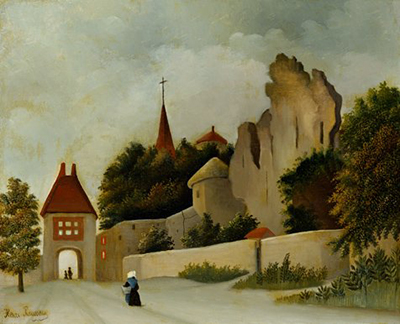
A woman carrying a basket crosses a broad, pale road towards a village gateway. Above her, the trees shelter red roofs and a church spire, while a great fragment of broken masonry rises into the clouds. Henri Rousseau's Landscape with Ruins brings an ordinary journey into the company of something much older. Its pleasure lies in the way these different presences fit together: the road remains open and welcoming beneath the immense, irregular wall.
At a Glance
- ArtistHenri Rousseau
- SubjectLandscape with Ruins
- ExploreA small painting with a towering ruin; Following the road through the gate
This work across Henri Rousseau’s career
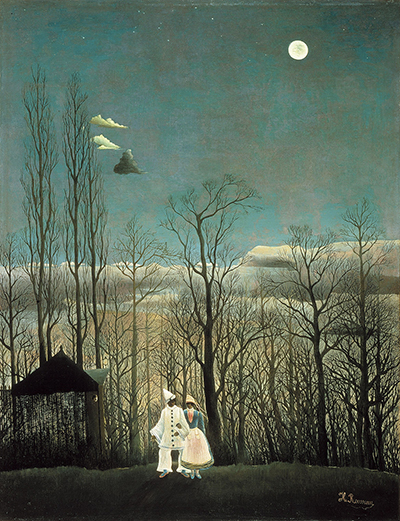
Carnival Evening
1886 [1]The Merry Jesters
1906 [6]The Snake Charmer
1907 [8]Contents
- A small painting with a towering ruin
- Following the road through the gate
- A wall between the road and the trees
- Clouds that answer the broken skyline
- A possible print source and a traditional subject
A small painting with a towering ruin
The Pola Museum of Art identifies Landscape with Ruins as an oil painting on canvas made around 1906. It measures 33.4 × 41.2 cm, giving this spacious view a modest physical scale. The museum's Japanese title, 廃墟のある風景, describes a landscape containing ruins without naming a particular place. Its collection commentary, republished from a 2010 exhibition catalogue, observes that ruins are an unusual subject within Rousseau's paintings.[7]
The ruin occupies the right half of the picture, but it cannot be taken in as a single regular building. Two narrow, dark openings puncture the high cream-coloured masonry. Its upper edge breaks into uneven peaks, with darker sides giving the remaining fragments thickness. Lower down, a rounded turret with a pale conical roof survives among the trees. These different heights let the architecture climb gradually from the low boundary wall to the jagged summit.
At the opposite side stands a much more complete gateway. Its steep red roof, paired chimney-like projections and small rectangular windows form a compact, legible building. The contrast is immediate: one structure offers an entrance and a clear outline, while the other exposes the broken ends of walls. Rousseau places the two close enough for the eye to compare them across the screen of foliage.
Following the road through the gate
The road gives the viewer somewhere to stand. Its light surface spreads across the bottom of the canvas, approaching the picture's edges without a sharply defined foreground boundary. Above it, almost everything is enclosed: the garden by its wall, the trees by the buildings, the village by its gateway. This broad expanse of clear ground makes the crowded middle distance easier to explore.
The woman is small in relation to the buildings, though considerably larger than the two dark figures beneath the arch. Her white bonnet catches the light; a blue shoulder covering stands out against her black skirt. A pale basket hangs on the left side of her body. Her compact shape supplies a useful measure of the space. The difference between her size and that of the people at the gate carries the eye back along the road more persuasively than an empty stretch of ground could do alone.
The archway frames a small passage of light beyond the shaded figures. Its curve answers the rounded forms elsewhere in the picture, yet remains clearly cut within the square gate tower. Above it, six pale window panes sit inside a red rectangular surround. Their ordered arrangement contrasts with the ruin's long, isolated slits.
Rousseau also distributes red across the scene. The gate's large roof establishes the colour at the left; the church spire then draws it upwards, and a broad, low roof appears between the trees nearer the centre. A much smaller roof caps an opening or structure along the foreground wall. These flashes prevent the architecture from disappearing into the greens and ochres. They give the eye a series of stopping places without competing with the great pale mass on the right.
A wall between the road and the trees
The long garden wall crosses the lower middle of the composition as a light band, separating the open road from the deep shade of the trees. Its upper edge leads towards the gateway, connecting the two sides of the view. Small plants and shrubs gather along its base, while larger foliage presses against it from behind.
The wall's relative neatness makes the broken masonry above it seem more irregular. Along the high ruin, a contour that begins vertically suddenly turns, falls away or opens into a hollow. Along the low wall, the eye can follow a sustained line. Both are made of pale surfaces, but their outlines suggest different conditions: one still defines and protects a space, the other has become a fragment within the vegetation.
The trees complicate that division. At the right, dark foliage reaches across part of the ruin and descends towards the garden wall. Farther left, rounded crowns almost conceal the base of the church spire. A small tree stands freely beside the gate, its trunk a simple vertical mark against the road. Each group has a different role in the arrangement, from screening buildings to closing an edge or setting a small upright against open ground.
The plants at the bottom right are more individually articulated. Pointed leaves rise out of a strip of grass, while a lower bed nearer the centre gathers into a soft mound. The broad masses that establish the village from a distance contain smaller boundaries, leaves and openings when the viewer moves nearer.
Clouds that answer the broken skyline
The sky takes up a generous part of the picture. Grey and cream clouds gather in rounded banks behind the pointed spire and the ruin. Their uneven edges allow the architecture to register clearly without setting it against a uniform blue background. The lightest areas make a pale interval above the trees; darker grey gathers higher up and towards the right.
The Pola Museum's commentary draws particular attention to the correspondence between the broken silhouette of the ruin, the clouds behind it and the irregular masses of leaves.[7] Following that suggestion reveals how much the picture depends on its upper edges. Stone, cloud and foliage have different textures and weights, yet all three rise and fall in unequal shapes. The ruin becomes part of a larger rhythm across the scene.
There are sharper accents within this rhythm. The cross above the church is exceptionally thin against the sky; beneath it, the spire widens to a red point among the trees. The high masonry is blunt and heavy by comparison. Its dark openings pull the eye down its face, while the cross draws attention to the empty air around it. Rousseau allows both a fine line and a massive surface to hold their place in the same sky.
A possible print source and a traditional subject
The Pola Museum proposes that Rousseau may have used an existing print or similar image, finishing the painting carefully at home. Its reasoning centres on the unusually orderly perspective linking the gate and walls. This is an interpretation of the composition; the museum does not identify a particular print or establish the exact site represented.[7]
The same commentary places the painting within a longer landscape tradition. It connects Rousseau's handling of the scene with his understanding, through visits to the Louvre, of seventeenth-century Dutch landscape and nineteenth-century French painting shaped by that inheritance.[7] This broad connection is especially useful here because the picture offers familiar elements of a settled landscape: a road, church, trees, old masonry and people going about their day. No named earlier painting is presented as its model.
For the museum, a road joining the inside and outside of a settlement also had a potential social appeal. It relates this traditional French subject to Rousseau's customers living modestly around Paris, who might have found such scenes recognisable and congenial.[7] The Musée de l'Orangerie's 2026 exhibition similarly describes his small canvases as suited to the budgets and homes of artisans, shopkeepers and the lower middle class.[12] Neither account supplies an original buyer for this painting.
Henri Rousseau artworks directory
This directory brings together works covered on this site and other works documented in the cited museum records and catalogues. Alternate titles share one entry; distinct versions remain separate. Historical dates for works without an article follow the cited catalogues. This is not a catalogue raisonné.
Frequently Asked Questions
The Pola Museum of Art dates it to around 1906. It is an oil painting on canvas measuring 33.4 × 41.2 cm.[7]
It belongs to the Pola Museum of Art in Japan. Its collection record lists it under the Japanese title 廃墟のある風景.[7]
The museum's commentary does not establish a specific site. It proposes a possible print source, but does not identify the print.[7]
Discussion
Look again at the images and ideas explored in Landscape with Ruins. These editorial prompts invite your observations.
Reader Insights
How does the difference in size between the woman and the people beneath the gate affect your sense of distance?
Follow the outlines of the ruin, trees and clouds. Where do they seem to echo one another, and where do they diverge?
Which element makes the village feel most accessible: the road, the gateway, the figures or the scattered red roofs?
Join the Conversation
Share a detail, comparison or question about Landscape with Ruins below.
References
- Philadelphia Museum of Art, Carnival Evening,1963-181-64,object59593. View source.
- Musée de l’Orangerie / Juliette Degennes, Henri Rousseau,L’ambition de la peinture: Un artiste dans son époque (in French). View source.
- National Gallery, Surprised!, NG6421. View source.
- Musée d’Orsay, La Guerre,RF19461 (in French). View source.
- MoMA, The Sleeping Gypsy. View source.
- Philadelphia Museum of Art, The Merry Jesters, 1950-134-176, object51097. View source.
- Pola Museum of Art. 廃墟のある風景 (Landscape with Ruins), current collection record, object 002-0003; Japanese commentary credited to アンリ・ルソー:パリの空の下で exhibition catalogue, 2010. Accessed 23 October 2026. View source. (in Japanese).
- Musée d’Orsay, La Charmeuse de serpents, RF 1937 7 (in French). View source.
- Musée de l’Orangerie, La Carriole du Père Junier, RF 1960 26 (in French). View source.
- Solomon R. Guggenheim Museum / Cornelia Lauf, The Football Players,60.1583: current collection record. View source.
- MoMA, The Dream, 252.1954. View source.
- Musée de l'Orangerie. Henri Rousseau, l'ambition de la peinture, exhibition texts, 25 March–20 July 2026, section “Variations et déclinaisons. À la recherche du marché.” Accessed 23 October 2026. View source. (in French).
- The Museum of Modern Art, Henri Rousseau: Essays (1985), selected catalogue entries, chronology and notes on early devotees. View source. Selected entries, chronology (pp.91–95) and early-devotee notes (pp.262–264) were consulted. Historical collection credits do not establish present ownership.
- Daniel Catton Rich, Henri Rousseau (The Museum of Modern Art, 1942), selected drawings and landscape studies; historical catalogue. View source. The dated 1942 publication is used for the two Quai d’Auteuil ink views; its Malakoff date differs from the 1985 catalogue.
- MANAS, Laval, Henri Rousseau, dit le Douanier, urban landscapes and preparatory study (in French). View source.
- National Gallery of Art, Self-Portrait (1895), pen-and-ink drawing, accession 1995.47.66. View source.
- The Museum of Modern Art, War (published January 1895), lithograph, accession 684.1943. View source.
- Barnes Foundation, Landscape and Four Young Girls, object 5521, BF855. View source.

 Henri Rousseau.jpg)
 Henri Rousseau.jpg)