



 by Tom Gurney
Tom Gurney BSc (Hons) is an art history expert with over 20 years experience
Published on June 19, 2020 / Updated on October 29, 2026
Email: tomgurney1@gmail.com / Phone: +44 7429 011000
Landscape: Introduction
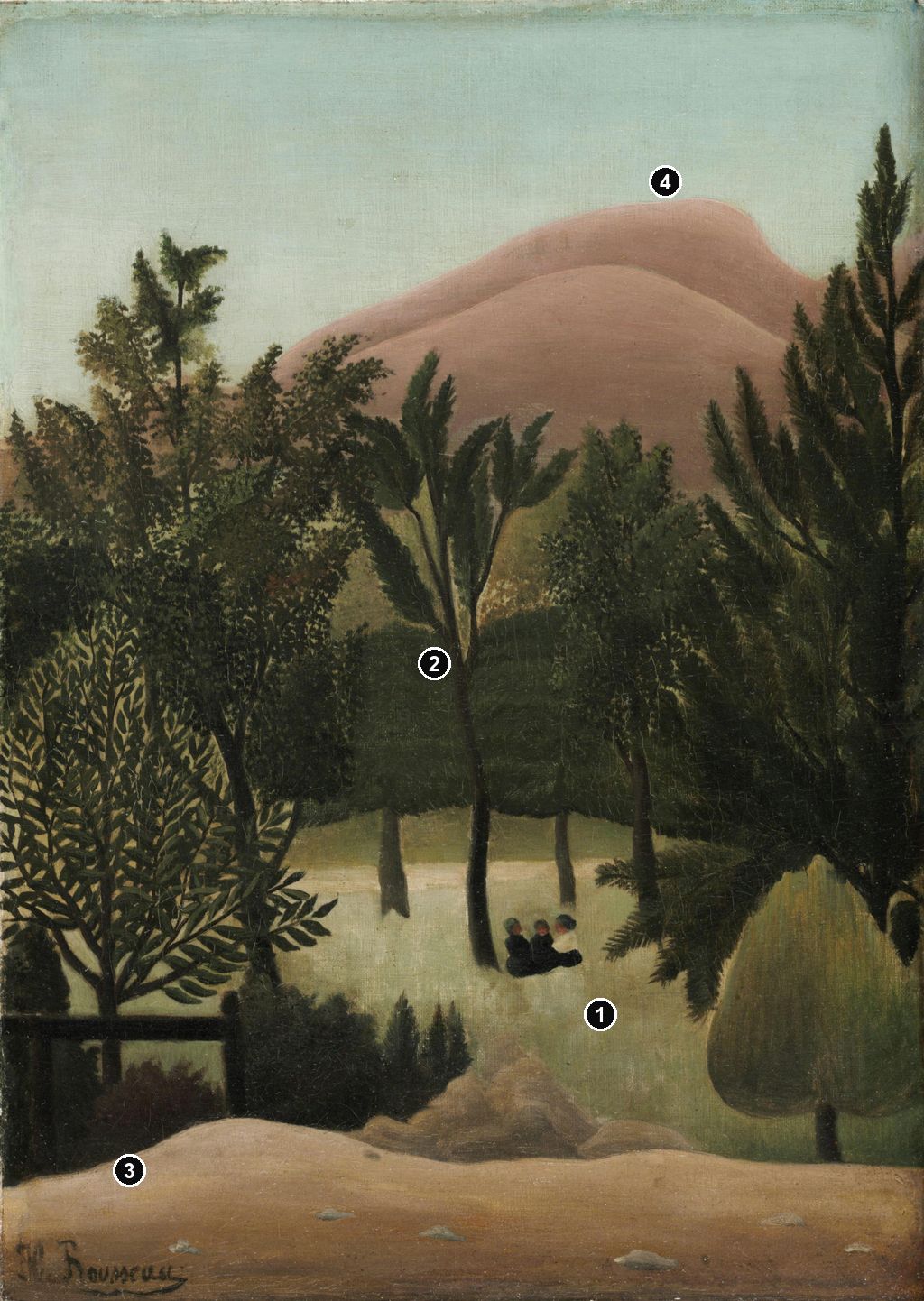
Three tiny people gather beneath a tree in Henri Rousseau’s Landscape. Around them, vegetation rises in dark tiers, while smooth rose-brown hills fill the distance. Their pale clearing seems sheltered, almost enclosed, yet above it stretches a spacious grey-green sky. The Philadelphia Museum of Art dates this small, upright oil painting to 1905–1910 and identifies it simply as Landscape.[1] Its pleasures lie in the encounter between those different scales: people who almost disappear, leaves with emphatic outlines, and rounded hills that seem to belong to a quieter world.
At a Glance
- ArtistHenri Rousseau
- SubjectLandscape
- ExploreA small painting with a tall view; Trees that frame and divide
This work across Henri Rousseau’s career
Carnival Evening
1886 [2]Landscape (current article)
1905–1910 [1]The Merry Jesters
1906 [7]The Snake Charmer
1907 [8]Contents
- A small painting with a tall view
- Trees that frame and divide
- The people beneath the canopy
- Ground, barriers and distant hills
- The Arensberg collection history
- Annotated details
A small painting with a tall view
The canvas measures 46.4 × 32.4 centimetres, making it a modestly sized picture whose height substantially exceeds its width. The museum records it as part of The Louise and Walter Arensberg Collection, 1950, under accession number 1950-134-177.[1] These details distinguish this particular Landscape from Rousseau’s many other views of open ground, trees and human activity. The title supplies no place-name, and the museum’s record does not identify a particular location.[1]
The upright format encourages the eye to climb. Starting with the brown strip of earth at the bottom, we pass a fence, pointed plants and pale mounds before reaching the clearing. Tree trunks lead upwards into crowns of foliage, and the central branches point towards the bare hills. Beyond the highest rounded ridge, the sky opens freely. It is a journey through successive bands, although the connections between them are difficult to follow with the certainty of an ordinary footpath.
The sky occupies a large area and contains little to arrest the eye. Against it, the hills form broad, continuous curves. Down below, almost every patch of vegetation has a busy edge. That contrast gives the composition its particular rhythm: restless detail in the lower part, long smooth movements above. The painting can feel dense and open at the same time, depending on where we look.
Trees that frame and divide
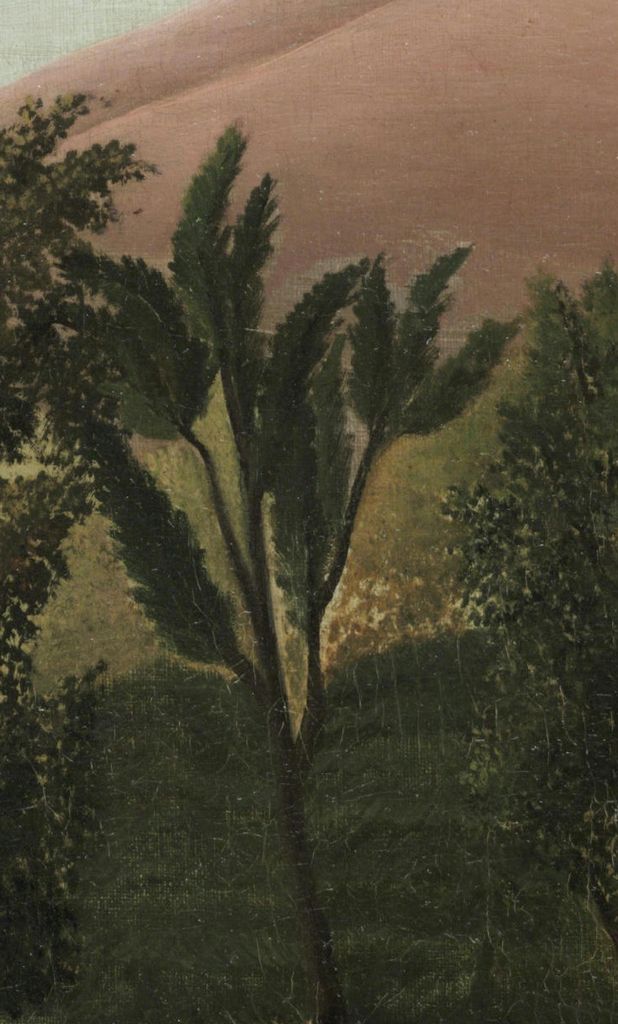
Near the centre, a slender dark trunk rises from the clearing and separates into a fan of branches. Each branch carries a long, pointed mass of leaves. Pale gaps between these dark shapes allow the hillside to show through, so the crown is both a solid presence and an open framework. Its branching pattern is unusually easy to read beside the denser trees on either side.
At the left, several crowns overlap. Some leaves form small rounded clusters; others make irregular sprays against the sky. At the right, a tall narrow tree has sharp, ascending growth, its uppermost point reaching much higher than the central fan. Lower down, long fronds project towards the clearing. These different silhouettes give the greenery variety. Looking from one tree to another, we can follow changes from rounded masses to narrow spikes, broad lobes and spear-shaped leaves without needing to assign a botanical name to each plant.
The two sides roughly balance one another, but their shapes do not repeat exactly. The tallest tree stands at the right edge, while the left side has a more broken outline and a brighter plant close to the viewer. Together they screen much of the middle distance. A smaller opening survives between them, drawing attention to the people. The effect resembles looking through a leafy enclosure, with the central tree acting as a slender dividing post.
Several lighter trunks appear farther back. Their lower ends are clearly visible against the pale ground, but their crowns merge into the dark band overhead. This creates a sense of depth through overlap. At the same time, the foliage joins into a nearly continuous screen. The eye can recognise separate trees while also reading them as one broad shape across the picture.
The people beneath the canopy
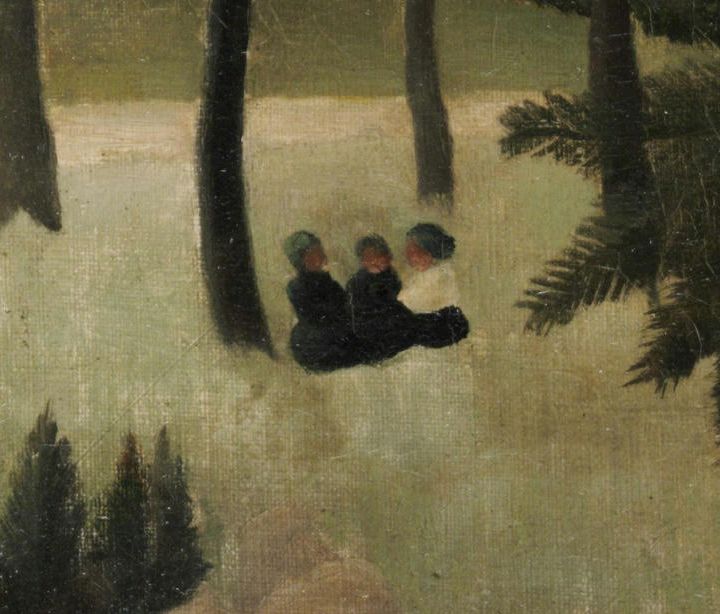
The figures occupy very little space. Three heads can be distinguished in a tight cluster near the foot of the central tree, with dark clothing and a small pale area providing contrast. Their closeness suggests shared company, though the picture leaves their relationship and activity open. It gives too little detail to establish a conversation, a family grouping or the precise posture of every person.
Their scale changes how the vegetation feels. The central trunk alone towers above them, while the trees at the sides extend far beyond their immediate surroundings. Yet their position in the light makes them easier to find than their size might suggest. Once noticed, the cluster becomes an intimate point around which the larger landscape arranges itself. The figures supply a human measure without taking command of the scene.
The pale clearing also carries some of the picture’s stillness. Its relatively uninterrupted surface allows the dark heads and bodies to register as distinct accents. Around it, branches point in numerous directions and foliage presses close; within it, movement is hard to determine. This difference between the busy perimeter and the quiet centre supports a reading of the scene as a moment of rest. That mood emerges from the arrangement rather than from an identifiable story.
Ground, barriers and distant hills
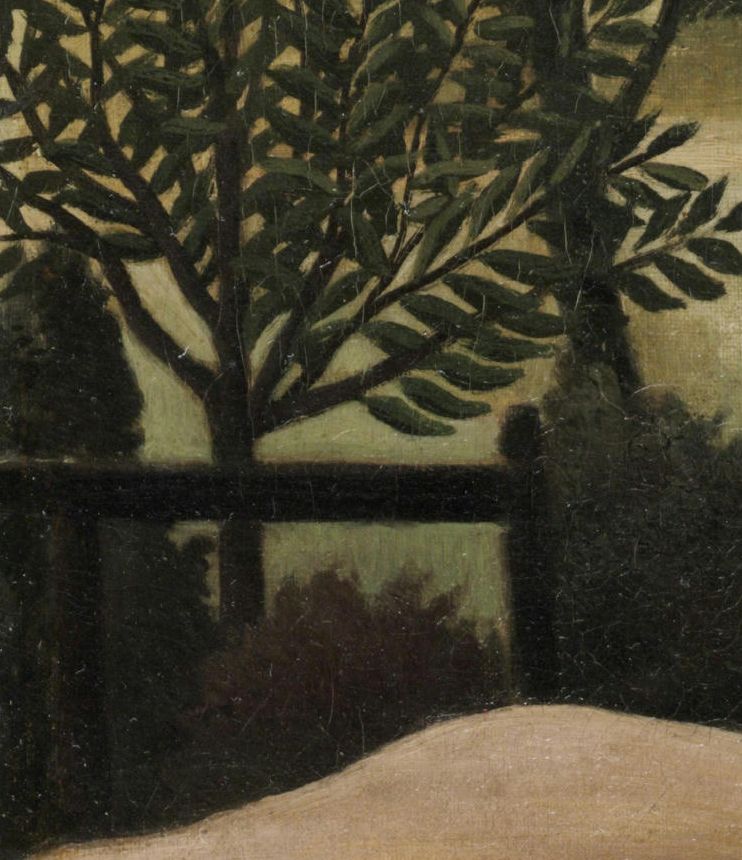
At the bottom left, the dark horizontal rail of a fence cuts across the plant forms. Its upright supports are blunt and clearly separated from the branching growth above. This small geometric structure interrupts the natural shapes and marks an edge close to the viewer. It also discourages an easy reading of the foreground as a continuous entrance into the clearing.
Near the lower centre, a pointed pale mound rises behind the brown foreground strip, accompanied by smaller angular forms. Their slopes introduce another interruption between our position and the people. The light ground can tempt the eye to trace a route backwards, but it never resolves into an unmistakable road. Instead, fence, plants and mounds make us look around obstacles before settling on the central opening.
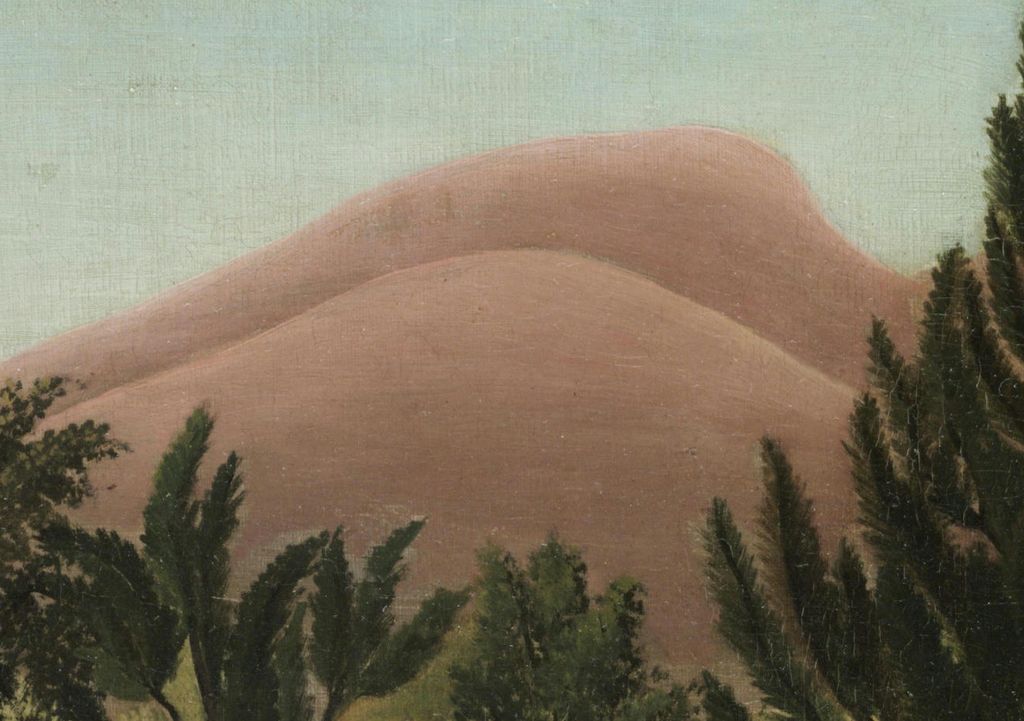
The distant hills offer a different kind of surface. Their rounded contours have almost none of the sharp articulation found in the trees. One slope overlaps another in broad bands of rose and brown, with little descriptive detail to establish their substance or precise distance. Their softness sets off the dark pointed foliage in front. Warm earth colours recur near the bottom of the painting, linking the distant heights with the foreground across the intervening green.
Small pale stones punctuate that lower strip. They give the nearest ground a scattered rhythm, contrasting with the larger uninterrupted hillside shapes. At the lower left, Rousseau’s signature occupies the same earthy zone. The painting therefore offers several scales of attention within a narrow space: stones and signature at our feet, people beyond the barrier, trees overhead and hills behind them all. This arrangement gives a compact canvas the sensation of a much more extensive setting.
Annotated Details from Landscape
The numbered points identify visible features discussed in this article. Return from each detail to the whole composition. Henri Rousseau, Landscape, 1905–1910. Philadelphia Museum of Art, 1950-134-177. The Louise and Walter Arensberg Collection, 1950. Museum-derived image published on Wikimedia Commons in 2022. Image source. Public domain. Numbers added to the overview; detail views cropped from the published original. No recolouring or retouching.
Details from LANDSCAPE
Find the small human group, follow the branching tree upwards, and compare the foreground barrier with the softer curves of the hills.
Three people in a pale clearing
Three small heads gather close to the central trunk. Dark clothing and a pale patch distinguish the group, while the quiet ground gives their tiny forms enough space to register.
A fan of pointed branches
The central tree separates into long, pointed masses of leaves. Lighter gaps between the branches let the hillside show through, making this crown more open than the dense trees beside it.
A fence behind the foreground leaves
A dark horizontal rail and blunt uprights interrupt the branching plant forms. Pointed leaves overlap this small geometric barrier, complicating any easy route into the clearing.
Smooth hills behind restless foliage
Broad rose-brown curves overlap beneath a spacious grey-green sky. Their smooth contours contrast with the broken, pointed edges of the trees in front.
The Arensberg collection history
The museum’s published provenance places Landscape with Louise and Walter Arensberg by 1921. It explains that this dating comes from the collectors’ provenance notes of 1 December 1951, which recalled acquiring the painting before their move from New York to Los Angeles in 1921.[1] This is a useful early point in the painting’s known collection history, though it does not establish an exact purchase date or name the person from whom they obtained it.
The museum’s 1950 collection credit provides a later institutional anchor.[1] Between the broad execution range and the Arensbergs’ ownership, the published record leaves room for questions. No named first owner or earlier dealer appears in the provenance supplied for this work.[1] Its small figures, distinctive fan-branched tree and bare hills consequently tell us more about the painted scene than the published collection information tells us about its original destination.
For readers exploring Rousseau’s style, the picture offers a concentrated example of how contrasting shapes can hold attention. Its smooth hills, crowded leaf patterns and tiny human cluster each ask for a different pace of looking. The central opening gives us somewhere to pause, while the vegetation repeatedly draws us back towards the edges. Even after the people have been found, the surrounding shapes continue to shift the balance between enclosure and distance.
Henri Rousseau artworks directory
This directory brings together works covered on this site and other works documented in the cited museum records and catalogues. Alternate titles share one entry; distinct versions remain separate. Historical dates for works without an article follow the cited catalogues. This is not a catalogue raisonné.
Frequently Asked Questions
The Philadelphia Museum of Art dates it to 1905–1910. The record gives a range rather than a single year.[1]
It belongs to the Philadelphia Museum of Art, which identifies it as accession 1950-134-177, The Louise and Walter Arensberg Collection, 1950.[1]
The museum’s title and published object record do not name the location.[1] The hills and plants alone cannot establish an exact site.
Discussion
Look again at the images and ideas explored in Landscape. These editorial prompts invite your observations.
Reader Insights
How does finding the three people change your sense of the trees’ scale?
Which shapes make the scene feel enclosed, and which suggest distance?
Where does your eye move when you follow the central trunk upwards?
Join the Conversation
Share a detail, comparison or question about Landscape below.
References
- Philadelphia Museum of Art. Landscape, Henri-Julien-Félix Rousseau, 1905–1910, object 51098, accession 1950-134-177; object metadata, official collection image and Provenance, including the museum’s note citing the Arensbergs’ provenance notes dated 1 December 1951. Accessed 23 October 2026. View source.
- Philadelphia Museum of Art, Carnival Evening,1963-181-64,object59593. View source.
- Musée de l’Orangerie / Juliette Degennes, Henri Rousseau,L’ambition de la peinture: Un artiste dans son époque (in French). View source.
- National Gallery, Surprised!, NG6421. View source.
- Musée d’Orsay, La Guerre,RF19461 (in French). View source.
- MoMA, The Sleeping Gypsy. View source.
- Philadelphia Museum of Art, The Merry Jesters, 1950-134-176, object51097. View source.
- Musée d’Orsay, La Charmeuse de serpents, RF 1937 7 (in French). View source.
- Musée de l’Orangerie, La Carriole du Père Junier, RF 1960 26 (in French). View source.
- Solomon R. Guggenheim Museum / Cornelia Lauf, The Football Players,60.1583: current collection record. View source.
- MoMA, The Dream, 252.1954. View source.
- The Museum of Modern Art, Henri Rousseau: Essays (1985), selected catalogue entries, chronology and notes on early devotees. View source. Selected entries, chronology (pp.91–95) and early-devotee notes (pp.262–264) were consulted. Historical collection credits do not establish present ownership.
- Daniel Catton Rich, Henri Rousseau (The Museum of Modern Art, 1942), selected drawings and landscape studies; historical catalogue. View source. The dated 1942 publication is used for the two Quai d’Auteuil ink views; its Malakoff date differs from the 1985 catalogue.
- MANAS, Laval, Henri Rousseau, dit le Douanier, urban landscapes and preparatory study (in French). View source.
- National Gallery of Art, Self-Portrait (1895), pen-and-ink drawing, accession 1995.47.66. View source.
- The Museum of Modern Art, War (published January 1895), lithograph, accession 684.1943. View source.
- Barnes Foundation, Landscape and Four Young Girls, object 5521, BF855. View source.


 Henri Rousseau.jpg)


 Henri Rousseau.jpg)