


 by Tom Gurney
Tom Gurney BSc (Hons) is an art history expert with over 20 years experience
Published on June 19, 2020 / Updated on October 29, 2026
Email: tomgurney1@gmail.com / Phone: +44 7429 011000
Walk in the Wood: Introduction
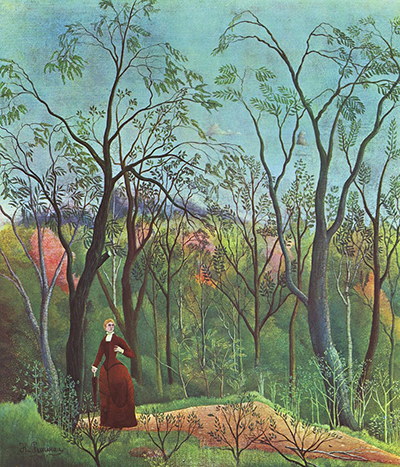
A woman in a long red dress stands beneath trees that stretch almost the full height of Henri Rousseau’s Walk in the Wood. Her closed umbrella touches the ground; one hand rises to her chest. Around her, slender branches divide a pale sky into irregular openings. The painting gives a small human gesture an enormous setting, while leaving the occasion for that gesture unresolved.
The Kunsthaus Zürich calls the picture La Promenade dans la forêt and dates it to about 1886. It is an oil painting on canvas, measuring 70 × 60.5 cm, inventory number 2479.[1]
Its upright format makes room for a surprising amount of air above the solitary figure. Looking upward from her pale face, the eye follows a forest whose largest forms are dark trunks and whose lightest passages seem almost empty.
At a Glance
- ArtistHenri Rousseau
- SubjectWalk in the Wood
- ExploreA clearing beneath immense trees; The woman and her closed umbrella
This work across Henri Rousseau’s career
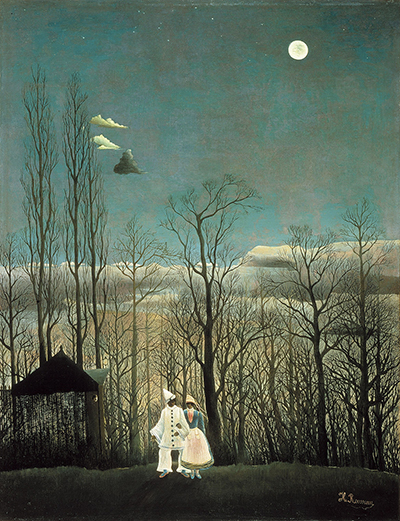
Carnival Evening
1886 [2]The Merry Jesters
1906 [7]The Snake Charmer
1907 [8]Contents
- A clearing beneath immense trees
- The woman and her closed umbrella
- Colour that opens the distance
- Looking closely at the branches
- From private ownership to Zürich
A clearing beneath immense trees
The woman occupies the lower left of the composition. A heavy, nearly black trunk rises beside her, leaning before dividing into a wide fan of branches. Across the painting, another substantial tree spreads its grey-brown limbs toward the top and right edges. Between these large trees stand numerous thinner ones, some pale enough to look like lines of light against the darker vegetation behind them. The difference in their thickness makes the woodland feel extensive without requiring a distant view of its outer boundary.
The two largest trees establish a loose enclosure. Their upper limbs reach inward, but never close into a roof. Sky remains visible between the leaves and around the finest twigs. This is a woodland experienced through its openings: a gap above the woman, another between the central saplings, a broad expanse near the top where a few curved branches carry small sprays of foliage. The eye can travel through these spaces as readily as it can follow a trunk.
At ground level the arrangement changes. An ochre strip sweeps across the foreground, widening into a low rise before narrowing toward the right. The woman stands near its left end. Small shrubs interrupt its edge, and a pale fallen branch lies across the ground at the lower right. This curving strip supplies the principal sideways movement in a painting otherwise filled with upward growth. Following it takes the viewer past the woman and across the width of the scene; following the trees leads into the immense space above her.
There is no sharply marked destination along the path. Its curve and the vegetation around it suggest a continuation, yet the view withholds a house, gate or other clear objective. We can place her within a walk, as the title invites us to do, without reconstructing her route. The clearing gives her a place to stand while leaving her destination unexplained.
The woman and her closed umbrella
Against the green woodland, the woman’s maroon clothing forms one continuous, warm shape. A fitted upper body expands into a long skirt whose folds turn inward near the knees and spread at the hem. Small buttons form a dark line down the front. Her white collar and cuffs break the red at three points, directing attention toward her face and hands. These accents allow the figure to remain legible even though she occupies so little of the canvas.
Her head turns toward the viewer’s right. The pale oval of her face, the gathered hair and the white collar make a compact group of light shapes beneath the dark tree. One hand rests high against her clothing, its fingers spread; the other holds the umbrella at her side. The pose can suggest a momentary interruption in walking. It does not reveal whether she has heard something, noticed someone or simply paused. The painting contains no visible second person who would settle that question.
The umbrella adds a particularly exact point of contact with the ground. A light curved handle rises above its narrow red body, which descends alongside the skirt. Its straightness answers the fine vertical trunks nearby, while its colour keeps it attached to the woman. Held closed, it leaves her body exposed to view and the space above her unobstructed. It is also small enough to measure the height of everything around her: the woman carries an object scaled to her hand, beneath trees scaled to the whole picture.
The 1985 MoMA catalogue notes that the figure has been identified as Rousseau’s first wife without clear evidence. It also reads her gesture as possible surprise.[12] Her precise appearance offers no corresponding certainty about her identity. Dress and posture hold our attention while her story remains open.
Colour that opens the distance
The darkest greens gather low in the picture, around the bases of the trunks and behind the woman. Higher up, a band of warm yellow, peach and muted pink appears among the more distant trees. The sky is a pale blue-green. These broad changes in colour allow the eye to distinguish foreground, middle distance and open air even where many branches overlap. The forest has depth, yet its separate layers remain easy to follow across the surface.
The warm distance is especially noticeable to the left and near the centre. Patches of pink emerge through the thin tree stems rather than forming a continuous wall. Their warmth reaches forward to the red dress and the brown earth. The woman therefore has a colour relationship with her surroundings despite her strong outline. Her dress is the most concentrated red, while the farther woodland carries quieter echoes of it.
The light trunks also change the balance. Some have pale edges or broad grey faces; others are almost white throughout. These upright marks keep the lower woodland from becoming a single dark mass. On the right, a light sapling crosses in front of a much larger trunk, giving two very different scales of growth within a small area. The foreground shrubs repeat this contrast on a smaller scale, combining dark stems with little pale leaves.
The MoMA catalogue’s account of the picture stresses its airy depth and delicate colour, drawing a comparison with Camille Pissarro. That is a scholarly comparison rather than evidence of a particular borrowed composition.[12] A pale gap can separate two branches, carry the eye farther into the wood or make a dark leaf stand out.
Looking closely at the branches
The leaves gather in small groups along curved stems. In some areas they appear as narrow paired leaflets; elsewhere, broader oval shapes cluster around a twig. Their repeated forms make each spray readable at a glance, but the sprays point in different directions. Across the upper sky they droop, curl and turn. Their changing angles keep the fine growth active even where the larger trees seem firmly planted.
Closer to the ground, the branches become more tangled. Thin white stems and darker crooked ones overlap behind the figure, then continue across the centre. The smaller growth makes the big trunks appear larger still. A viewer can move between these scales: from a single little leaf to a fine stem, from that stem to a dark branch, and then to the substantial trunk supporting the whole fan above. Each small form helps measure the larger ones.
Two interruptions stand out. Above the woman, a short branch ends in a small pale oval. At the lower right lies the detached branch, its pale forks spread against the earth. Both are conspicuous because they end differently from the tapering twigs overhead. The oval marks a definite stop; the fallen branch turns growth sideways. Their presence gives the woodland a few hard edges amid its many flowing lines.
These details can make the scene feel less settled, although they do not explain what the woman is doing. The detached branch has no visible connection with her raised hand. Nor does the short stub establish an event happening at the moment depicted. One sits above and close to the woman, while the other occupies the opposite lower corner. They encourage the eye to cross the painting and reconsider the relation between its human figure and its trees.
For another encounter between dressed figures and woodland, Rendez-vous in the Forest offers a useful companion. In Walk in the Wood, the single woman, closed umbrella and spacious sky concentrate attention on the experience of pausing alone. The absence of a visible companion leaves her gesture suspended within the larger activity of the branches.
From private ownership to Zürich
According to the Kunsthaus’s provenance research, updated on 6 August 2024, Wilhelm Uhde bought the picture from a Paris washerwoman in 1911 for 40 francs. His collection was confiscated as German enemy property during the First World War. At its Drouot sale on 30 May 1921, Léon Giraud bought this painting for 26,000 francs. A subsequent ownership gap precedes Antoine Villard’s documented possession by March 1933. After his death in 1934 it passed to his widow, Louise Caroline Villard, from whom the Kunsthaus purchased it in 1939.[1]
That history sits beside an image in which very little overt action occurs. The smallest pale shapes still hold the viewer: the face, the hands, the umbrella handle, the end of the cut branch. Each becomes visible through a different contrast with its surroundings. Together they bring the great vertical woodland back to a human scale, allowing an ordinary pause on a path to occupy the centre of our attention.
Henri Rousseau artworks directory
This directory brings together works covered on this site and other works documented in the cited museum records and catalogues. Alternate titles share one entry; distinct versions remain separate. Historical dates for works without an article follow the cited catalogues. This is not a catalogue raisonné.
Frequently Asked Questions
Her identity remains unproved; the suggestion that she is Rousseau’s first wife lacks clear supporting evidence.[12]
Sparse foliage leaves large spaces of pale sky visible. Thin trunks, small leaf clusters and warmer distant colours let the eye move between the trees, even where the undergrowth becomes intricate.
She holds a closed red umbrella with a light curved handle. Its tip reaches the ground beside her skirt.
Discussion
Look again at the images and ideas explored in Walk in the Wood. These editorial prompts invite your observations.
Reader Insights
How does the scene change when you look first at the woman, then at the upper branches?
Which details make the woodland feel spacious, and which make it feel enclosed?
Does the raised hand suggest a specific action to you, or does it keep the encounter open?
Join the Conversation
Share a detail, comparison or question about Walk in the Wood below.
References
- Kunsthaus Zürich. La Promenade dans la forêt, inventory 2479; object PDF, pp. 1–4; provenance research dated 6 August 2024. View source. (in German).
- Philadelphia Museum of Art, Carnival Evening,1963-181-64,object59593. View source.
- Musée de l’Orangerie / Juliette Degennes, Henri Rousseau,L’ambition de la peinture: Un artiste dans son époque (in French). View source.
- National Gallery, Surprised!, NG6421. View source.
- Musée d’Orsay, La Guerre,RF19461 (in French). View source.
- MoMA, The Sleeping Gypsy. View source.
- Philadelphia Museum of Art, The Merry Jesters, 1950-134-176, object51097. View source.
- Musée d’Orsay, La Charmeuse de serpents, RF 1937 7 (in French). View source.
- Musée de l’Orangerie, La Carriole du Père Junier, RF 1960 26 (in French). View source.
- Solomon R. Guggenheim Museum / Cornelia Lauf, The Football Players,60.1583: current collection record. View source.
- MoMA, The Dream, 252.1954. View source.
- Museum of Modern Art. Henri Rousseau, 1985, catalogue entry 3, p. 102; colour plate, p. 103. View source.
- The Museum of Modern Art, Henri Rousseau: Essays (1985), selected catalogue entries, chronology and notes on early devotees. View source. Selected entries, chronology (pp.91–95) and early-devotee notes (pp.262–264) were consulted. Historical collection credits do not establish present ownership.
- Daniel Catton Rich, Henri Rousseau (The Museum of Modern Art, 1942), selected drawings and landscape studies; historical catalogue. View source. The dated 1942 publication is used for the two Quai d’Auteuil ink views; its Malakoff date differs from the 1985 catalogue.
- MANAS, Laval, Henri Rousseau, dit le Douanier, urban landscapes and preparatory study (in French). View source.
- National Gallery of Art, Self-Portrait (1895), pen-and-ink drawing, accession 1995.47.66. View source.
- The Museum of Modern Art, War (published January 1895), lithograph, accession 684.1943. View source.
- Barnes Foundation, Landscape and Four Young Girls, object 5521, BF855. View source.
 Henri Rousseau.jpg)
 Henri Rousseau.jpg)