



 by Tom Gurney
Tom Gurney BSc (Hons) is an art history expert with over 20 years experience
Published on June 19, 2020 / Updated on October 29, 2026
Email: tomgurney1@gmail.com / Phone: +44 7429 011000
The Pink Candle: Introduction
A slender pink candle and a broad dark bottle stand above a pale plate, with a few small round forms gathered at their feet. In Henri Rousseau's The Pink Candle, these ordinary things have a presence out of proportion to the space they occupy. The Phillips Collection dates the painting to 1908 and records its acquisition in 1930. An oil on canvas measuring about 16.2 × 22.2 cm, it contains this varied arrangement within a small horizontal rectangle.[1]
The candle supplies the title and the clearest vertical line. Yet the eye keeps moving towards the bottle, whose spreading shoulders and white labels give it considerable weight. Between them, a triangular cream wedge rests on an oval plate. Rounded fruit, patterned fabric and the exposed grey-beige background add their own shapes to a composition that rewards looking slowly.
At a Glance
- ArtistHenri Rousseau
- SubjectThe Pink Candle
- ExploreA Small Painting with a Firm Structure; The Candle and Its Holder
This work across Henri Rousseau’s career
Carnival Evening
1886 [2]The Merry Jesters
1906 [7]The Snake Charmer
1907 [8]Contents
- A Small Painting with a Firm Structure
- The Candle and Its Holder
- The Bottle: Dark Mass and White Marks
- The Plate and the Things Around It
- Cloth, Pattern and the Space Behind
- Its Early History and a Later Question
- Annotated details
A Small Painting with a Firm Structure
The arrangement occupies almost the whole width of the canvas. At the lower left, three golden-yellow fruits press against one another close to the edge. The plate extends across the middle foreground; the bottle stands immediately beside it on the right. Above these close-set objects, the background opens into a relatively quiet field. This change from a crowded lower band to a broad, muted upper area gives each upright a clear silhouette.
The objects vary markedly in height. The bottle rises highest, approaching the upper edge. The candle ends lower, leaving more background above its projecting wick. The small dark fruit beside the candle has a thin stem that reaches upwards without competing with either large vertical. These different heights create steps through the picture, giving the compact arrangement an uneven, rising rhythm.
The broad bottle also supplies a counterweight to the several smaller forms on the left. Its dark body gathers attention in one place, while the fruit group disperses colour across separate circles. The centre remains active because the pale plate links those unequal sides. Its long outline carries the eye beneath the candle towards the bottle's base.[1]
The Candle and Its Holder
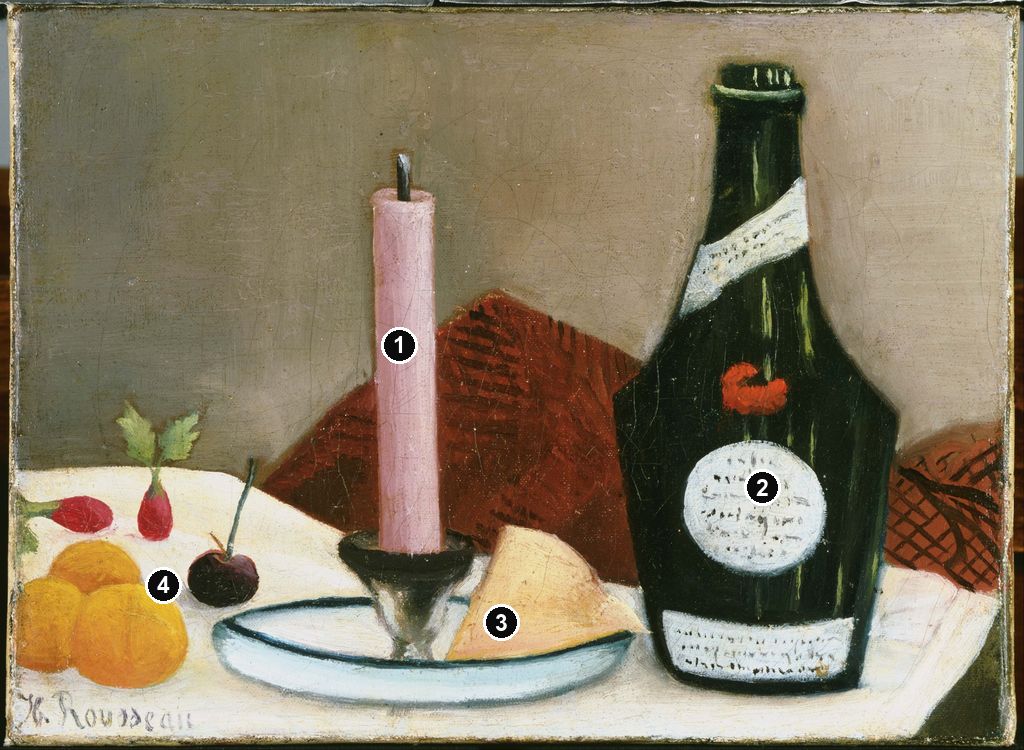
The candle's pink surface is relatively plain. A narrow change of tone along its length suggests a cylinder, while its slightly uneven upper edge surrounds the dark wick. That short projection is emphatic against the empty background. There is no flame. The candle contributes colour, height and an object to inspect, without casting the scene into a dramatic pool of candlelight.
Below it, the holder changes the character of the forms. A dark, shallow cup grips the candle; underneath, silver-grey planes taper towards the plate. Pale and dark passages meet sharply, making the holder look hard and reflective beside the softer pink column. The transition from the broad cup to the narrow lower support gives this little object a particularly compressed, angular structure.
Its position matters as much as its surface. The holder sits inside the plate's oval, close to the left side of the cream wedge. Candle, holder and plate are therefore nested, one shape within another. At the same time, the candle rises through the red-brown fabric behind it, dividing that dark patterned area. Pink remains visible against both the fabric below and the quieter wall above, allowing one continuous upright to pass between two very different backgrounds.
The unlit wick can invite associations, but the painting gives no explicit explanation of why the candle is there. Within the arrangement, it introduces the narrowest large form, the most delicate sustained colour and a strong contrast between wax-like softness and the holder's hard edges.
The Bottle: Dark Mass and White Marks
The bottle is nearly black, with green visible along its neck and body. Its upper rim catches several small pale strokes. A long neck widens into shoulders, then into a substantial lower body whose base rests close to the picture's bottom edge. The silhouette alternates between a narrow upright and spreading curves, providing much greater variation in width than the candle.
Three white labels interrupt this darkness. One crosses the neck diagonally; another forms a large round patch on the body; a low rectangular label follows the bottle near its base. Their differences give the viewer three distinct ways of reading the same surface. The diagonal label turns the eye across the neck, the circular one holds it near the centre, and the bottom label establishes a low horizontal band.
Small dark marks suggest writing on the pale labels, but they do not yield a securely readable message. Their visual effect is nevertheless clear. They break up the white areas, adding a fine, irregular texture within the bottle's broad contours. Between the upper label and the round one, a small red curved emblem introduces another bright accent. Its red echoes the smaller red forms on the opposite side of the painting.
The narrow green highlights retain a sense of a curved, glossy object even where the body seems almost flat. Looking between these highlights and the white labels, one alternates between seeing a bottle in space and seeing a strong dark shape marked with lighter shapes. The bottle brings Rousseau's style and technique into focus through this balance of rounded volume and flat pattern.[1]
The Plate and the Things Around It
The oval plate provides the arrangement's broadest horizontal movement. Its pale blue-white edge is outlined in dark blue-green, making the rim easy to follow even where it lies against the white cloth. The far edge is interrupted by the holder and the wedge; the nearer edge remains visible as a long shallow curve. These overlaps let us understand how the things occupy the plate without requiring a detailed account of its entire surface.
The cream wedge introduces a conspicuous triangle among cylinders, ovals and circles. Its rising slant faces the candle, while its lower edge rests against the plate's rim. A pinkish band near its base adds a subtle connection with the much stronger pink above. The wedge's angular outline is more useful to a close reading than an uncertain identification of the food it represents.
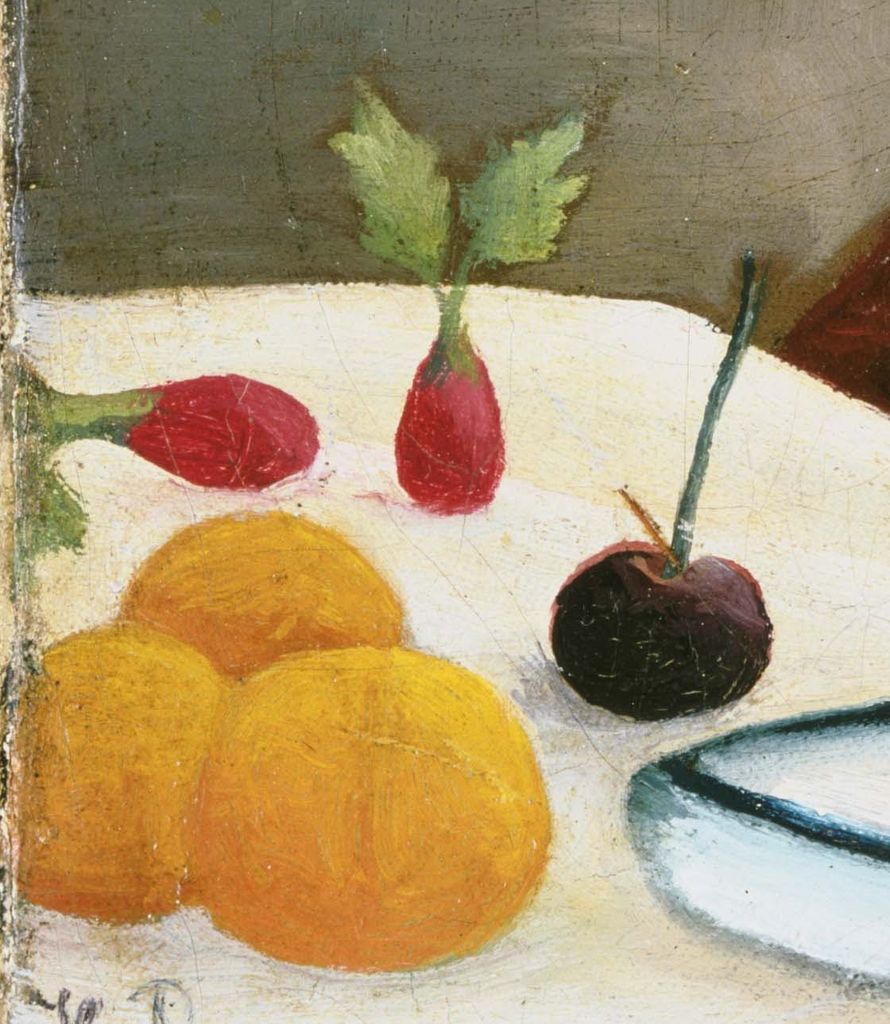
At the left, the three yellow fruits create a low cluster. Their shapes overlap, and small shifts towards orange and brown give them some individual volume. Behind them are two much smaller red bulb-like forms, one with a green leafy sprig rising above it. Nearby, the separate dark round fruit has a long, fine stem. That stem's slight diagonal gives this otherwise low, dense group a light upward gesture.
Scale becomes especially engaging here. The large yellow circles, little red forms and dark fruit each ask for a different pace of attention. The yellow group reads quickly as a rounded mass; the thin stem and branching leaves reward a closer look. Near the lower-left edge, the painted signature adds a further line of small marks beside the objects. Almost every part of this foreground offers a change in size or contour.
Cloth, Pattern and the Space Behind
The white cloth gives the objects a luminous foundation. On the right, its edge runs diagonally towards the lower corner, exposing a dark area beyond it. This slant introduces depth and a sense of the supporting surface continuing away. The plate and bottle overlap that surface, while the yellow fruits seem particularly close to the viewer because they sit near the lower edge.
Behind them, the red-brown fabric rises into a central ridge and reappears at the far right. Black linear marks cross its colour in bands and intersecting strokes. The pattern changes direction across the folds, suggesting a textile that bends and gathers. At the same time, the marks remain strong enough to be enjoyed as a design across the painted surface.
The ridge makes a rising diagonal behind the candle before descending towards the bottle. It sets the two uprights within a low, irregular surround. Where the bottle covers the fabric, its dark outline is especially assertive; where the fabric meets the grey-beige wall, its warm colour becomes the main distinction. These overlapping areas make the space legible through a succession of boundaries.
The quieter wall is essential to this density. It offers breathing room above the red pattern and around the neck of the bottle. Its subdued colour lets the pink, gold and white foreground stand forward. Viewed as a whole, the painting balances strongly marked edges with broad passages that ask for less attention. Its stillness comes partly from that distribution: the objects remain separate and readable even as their outlines, colours and overlaps bind them together.[1]
Annotated Details from The Pink Candle
The numbered points identify visible features discussed in this article. Return from each detail to the whole composition. Henri Rousseau, The Pink Candle, 1908. The Phillips Collection, Washington, DC, 1695. Google Art Project reproduction via Wikimedia Commons. Image source. Public domain. Numbers added to a separate resized overview. Details cropped directly from the published original without enlargement, recolouring or retouching.
Details from THE PINK CANDLE
Follow the differences between the candle’s narrow upright, the bottle’s dark mass and the smaller shapes gathered around the plate.
An unlit candle above a hard-edged holder
The dark wick rises from the uneven pink top without a flame. Below the long candle, pale and dark planes give the compact holder a harder, more reflective character.
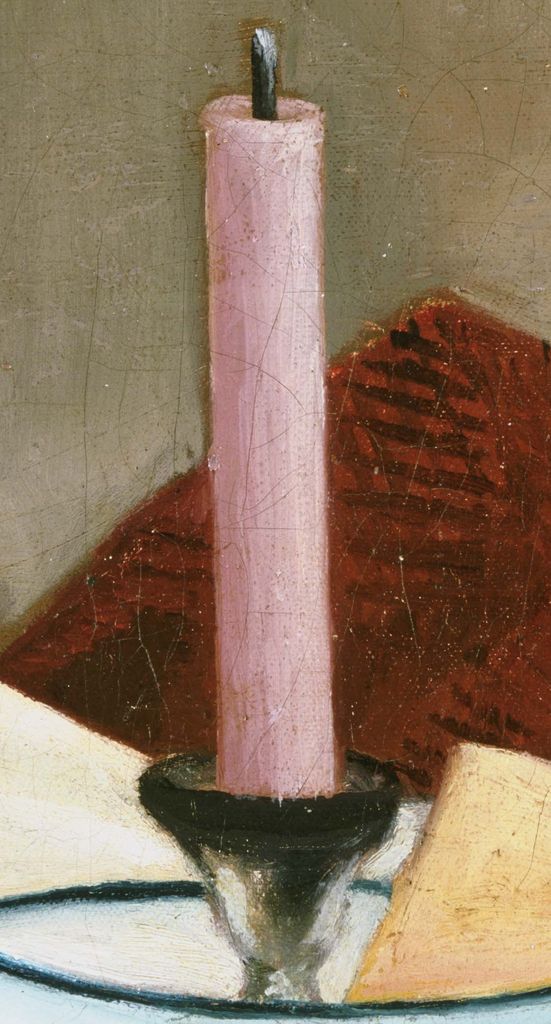
Three pale labels on a dark bottle
A diagonal neck label, round body label and low rectangular strip interrupt the green-black bottle. Their dark marks suggest writing without supplying a securely readable message.
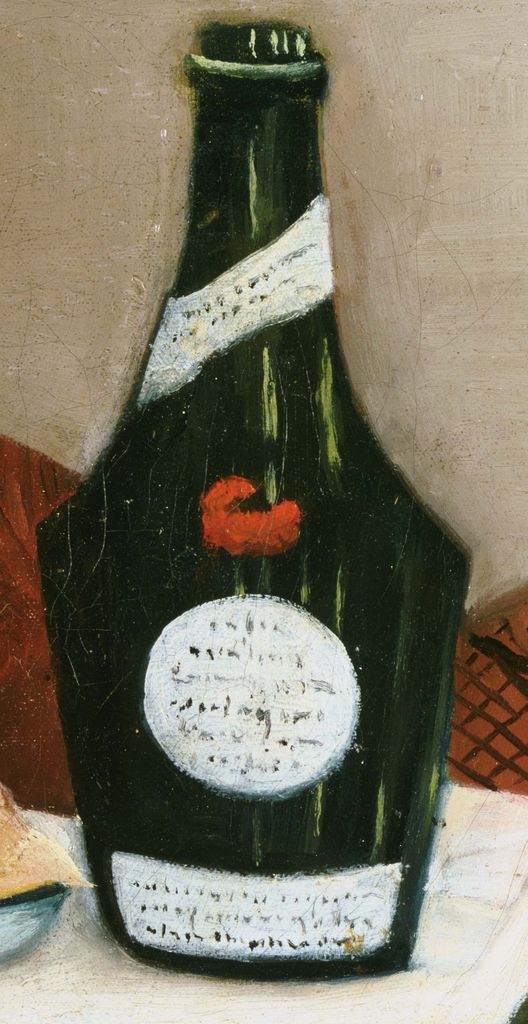
An oval plate and a triangular wedge
The dark rim carries the plate’s long curve beneath the holder and cream wedge. The triangle cuts across a composition otherwise rich in rounded objects and repeated ovals.
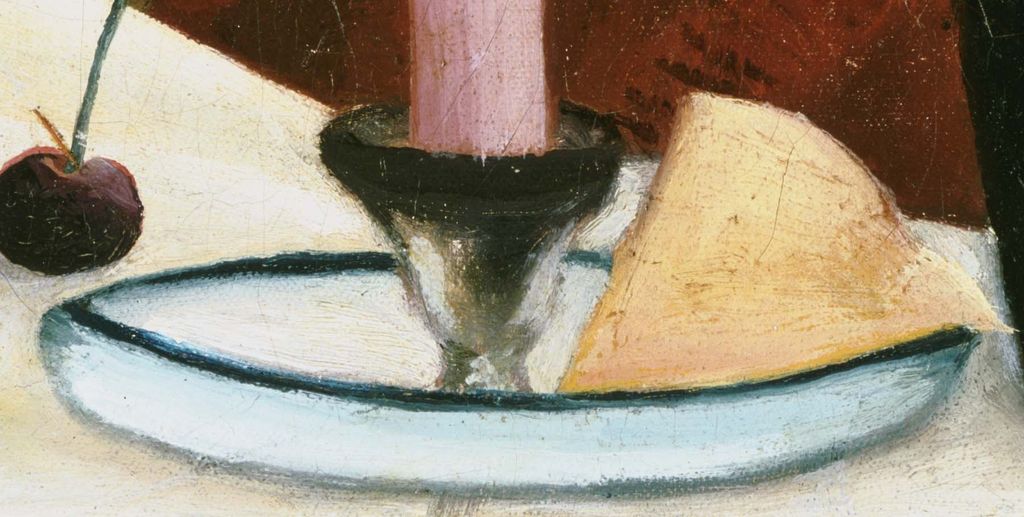
Fruit, red bulbs and a slender stem
Three golden fruits form the broadest cluster at the left. Smaller red shapes, a leafy sprig and a dark stemmed fruit give this low group several distinct scales and directions.
Its Early History and a Later Question
An unsigned gallery letter of 8 October 1941 records a former owner, Mrs Workman of London, and exhibitions at the Pennsylvania Museum in 1935, Yale in March 1937 and MoMA's Masters of Popular Painting in 1938, number 68.[12]
Gallery correspondence of 26 November reports Daniel Catton Rich's doubt about the attribution and his wish to exclude it from a Rousseau exhibition. The gallery defended its quality, named Knoedler as the dealer and reported Alfred Barr's disagreement with Rich. On 4 December, it welcomed Rich's agreement to have the painting for comparison and confirmed that photographs had been sent. That letter expresses hope of persuading him; it does not establish that his doubt was resolved.[13] The Phillips Collection continues to catalogue the painting as a work by Henri Rousseau.[1]
Henri Rousseau artworks directory
This directory brings together works covered on this site and other works documented in the cited museum records and catalogues. Alternate titles share one entry; distinct versions remain separate. Historical dates for works without an article follow the cited catalogues. This is not a catalogue raisonné.
Frequently Asked Questions
It belongs to The Phillips Collection in Washington, DC. The museum lists it as object 1695, acquired in 1930.[1]
The canvas measures approximately 16.2 × 22.2 cm, or 6⅜ × 8¾ inches. The Phillips dates it to 1908.[1]
The sources cited here do not establish a particular symbolic meaning. The visible unlit candle is a central part of the composition, contrasting with the wider bottle through its narrow shape and pink colour.
Discussion
Look again at the images and ideas explored in The Pink Candle. These editorial prompts invite your observations.
Reader Insights
Which first attracts your eye: the pink candle or the dark bottle? What makes you look towards the other?
How would the arrangement change if the red patterned fabric were replaced by the plain background?
Follow the repeated curves of the fruit, plate and labels. Where does the cream triangle interrupt that rhythm?
Join the Conversation
Share a detail, comparison or question about The Pink Candle below.
References
- The Phillips Collection. The Pink Candle, collection record, object 1695, accessed 23 October 2026. View source.
- Philadelphia Museum of Art, Carnival Evening,1963-181-64,object59593. View source.
- Musée de l’Orangerie / Juliette Degennes, Henri Rousseau,L’ambition de la peinture: Un artiste dans son époque (in French). View source.
- National Gallery, Surprised!, NG6421. View source.
- Musée d’Orsay, La Guerre,RF19461 (in French). View source.
- MoMA, The Sleeping Gypsy. View source.
- Philadelphia Museum of Art, The Merry Jesters, 1950-134-176, object51097. View source.
- Musée d’Orsay, La Charmeuse de serpents, RF 1937 7 (in French). View source.
- Musée de l’Orangerie, La Carriole du Père Junier, RF 1960 26 (in French). View source.
- Solomon R. Guggenheim Museum / Cornelia Lauf, The Football Players,60.1583: current collection record. View source.
- MoMA, The Dream, 252.1954. View source.
- The Phillips Collection Archives. Gallery letter to Daniel C. Rich, 8 October 1941, unsigned typed copy, PDF page 31. View source.
- The Phillips Collection Archives. Gallery correspondence to Daniel Catton Rich, 26 November and 4 December 1941, typed copies, PDF pages 41–43. View source.
- The Museum of Modern Art, Henri Rousseau: Essays (1985), selected catalogue entries, chronology and notes on early devotees. View source. Selected entries, chronology (pp.91–95) and early-devotee notes (pp.262–264) were consulted. Historical collection credits do not establish present ownership.
- Daniel Catton Rich, Henri Rousseau (The Museum of Modern Art, 1942), selected drawings and landscape studies; historical catalogue. View source. The dated 1942 publication is used for the two Quai d’Auteuil ink views; its Malakoff date differs from the 1985 catalogue.
- MANAS, Laval, Henri Rousseau, dit le Douanier, urban landscapes and preparatory study (in French). View source.
- National Gallery of Art, Self-Portrait (1895), pen-and-ink drawing, accession 1995.47.66. View source.
- The Museum of Modern Art, War (published January 1895), lithograph, accession 684.1943. View source.
- Barnes Foundation, Landscape and Four Young Girls, object 5521, BF855. View source.


 Henri Rousseau.jpg)


 Henri Rousseau.jpg)