



 by Tom Gurney
Tom Gurney BSc (Hons) is an art history expert with over 20 years experience
Published on June 19, 2020 / Updated on October 29, 2026
Email: tomgurney1@gmail.com / Phone: +44 7429 011000
The Chair Factory in Alfortville: Introduction
The chair factory announces itself in large, dark letters. Beneath its red roof, a pale building rises above a nearly empty road, while small figures pass along the riverbank. Henri Rousseau gives this ordinary commercial property the presence of a public monument. Its walls are crisply bounded, its entrance faces us, and its name seems to invite the same attention as a sitter's face. The museum’s collection record dates The Chair Factory in Alfortville to 1897. The oil on canvas measures 73 × 92 cm and belongs to the Musée de l’Orangerie in Paris.[1]
The museum’s records are not fully consistent about its year. Its collection page retains 1897, whereas the artwork credits in its 2026 exhibition video give about 1907 for this same canvas, RF196332. The transcript does not explain the discrepancy. Neither date settles the sequence of the two versions.[2]
Around that commanding building, the road bends, the river slips towards a distant bridge, and clouds swell across a blue-grey sky. People are present, but the factory holds the stage. Following those different kinds of movement reveals how carefully Rousseau has assembled his view.
At a Glance
- ArtistHenri Rousseau
- SubjectThe Chair Factory in Alfortville
- ExploreA factory with the presence of a portrait; Reading the frontage
This work across Henri Rousseau’s career
Carnival Evening
1886 [3]The Merry Jesters
1906 [7]The Snake Charmer
1907 [8]Contents
- A factory with the presence of a portrait
- Reading the frontage
- The road, the river and the changing direction of space
- Clouds over an industrial landscape
- Comparing the two Chair Factory paintings
- An ordinary subject on an ambitious scale
- From the Guillaume collection to the Orangerie
- Annotated details
A factory with the presence of a portrait
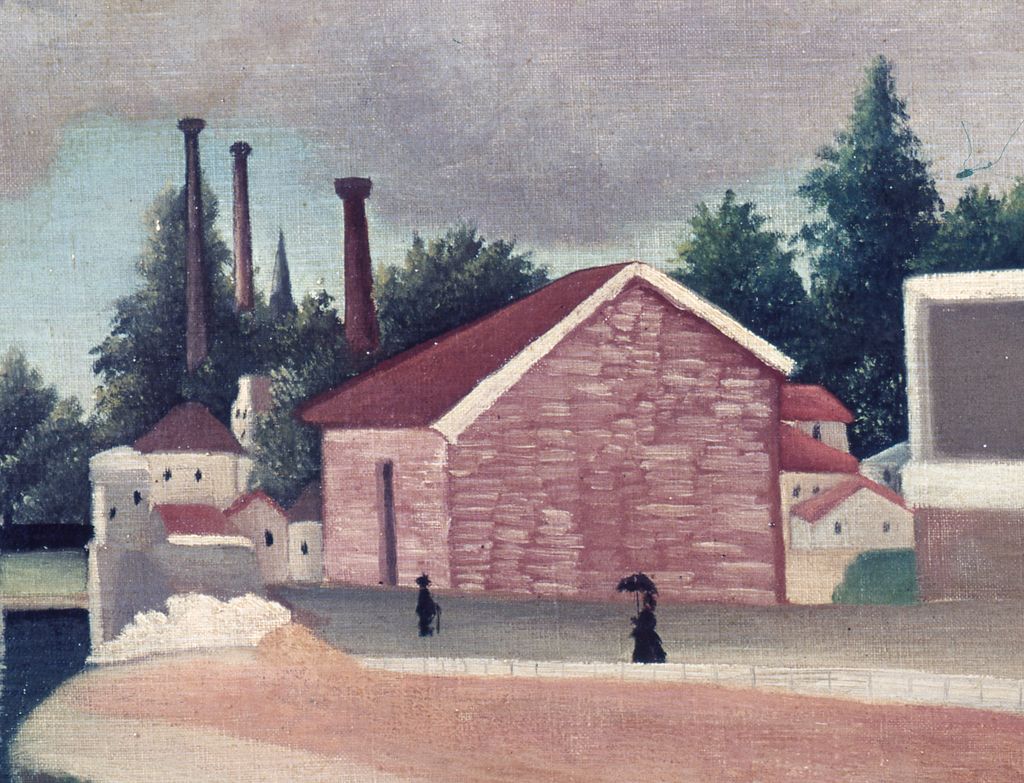
The main building occupies the right half of the picture, with its roof rising against the sky and its pale walls standing clear of the dark trees. To the left, a lower brick structure and a cluster of industrial chimneys offer a second, more distant group of forms. The factory's size relative to these neighbours makes it feel unusually important. The figures near the brick building and the fisherman beside the water appear almost weightless beside it.
The Orangerie describes the picture as a landscape-portrait, interpreting the enlarged building as the subject around which Rousseau organises his surroundings. It compares this emphasis through scale with the practice of medieval artists, who could enlarge what mattered most in a composition. That is a useful account of the effect here: the factory receives the prominence usually given to a principal figure. The comparison concerns a way of directing attention; it does not establish a particular medieval painting as Rousseau's source.[1]
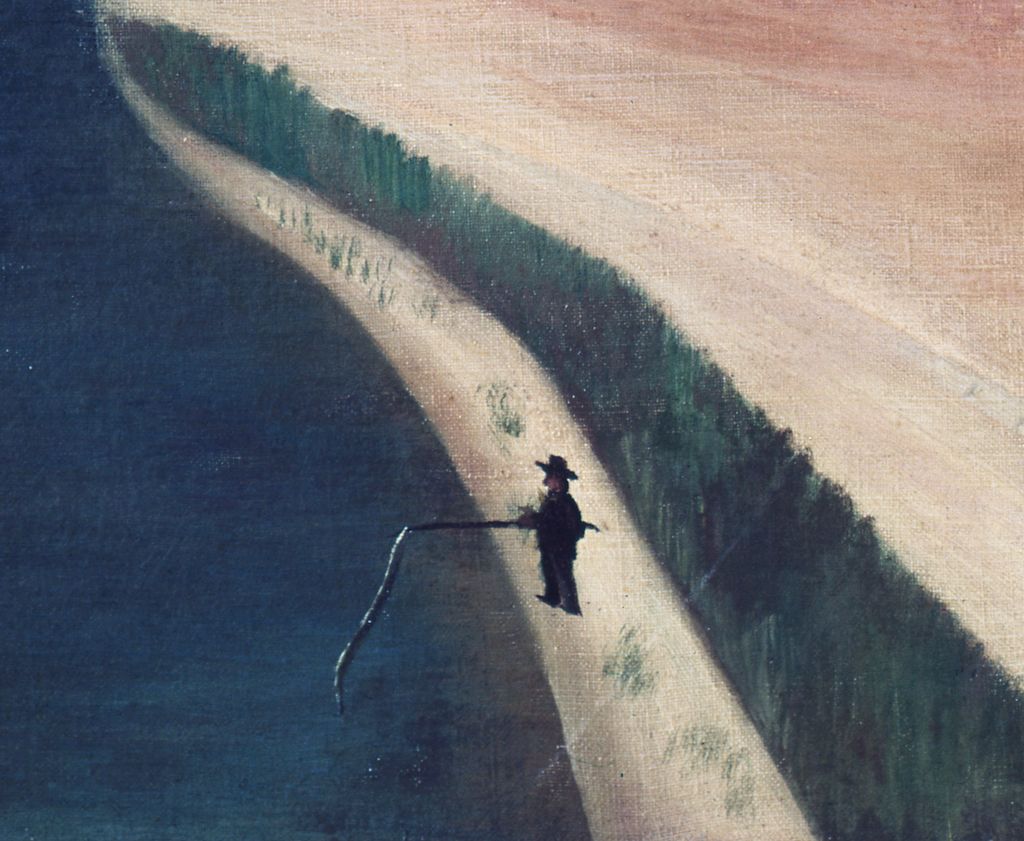
The people provide a quieter register. A pedestrian is a dark upright with a small suggestion of a head; the fisherman is distinguished by his position low on the bank and the fine line of his rod. Their actions make the setting habitable. Someone can walk beside these walls or settle by the water, even while the broad frontage commands our gaze. Their smallness also makes the stretch of open ground between us and the building seem expansive.
Reading the frontage
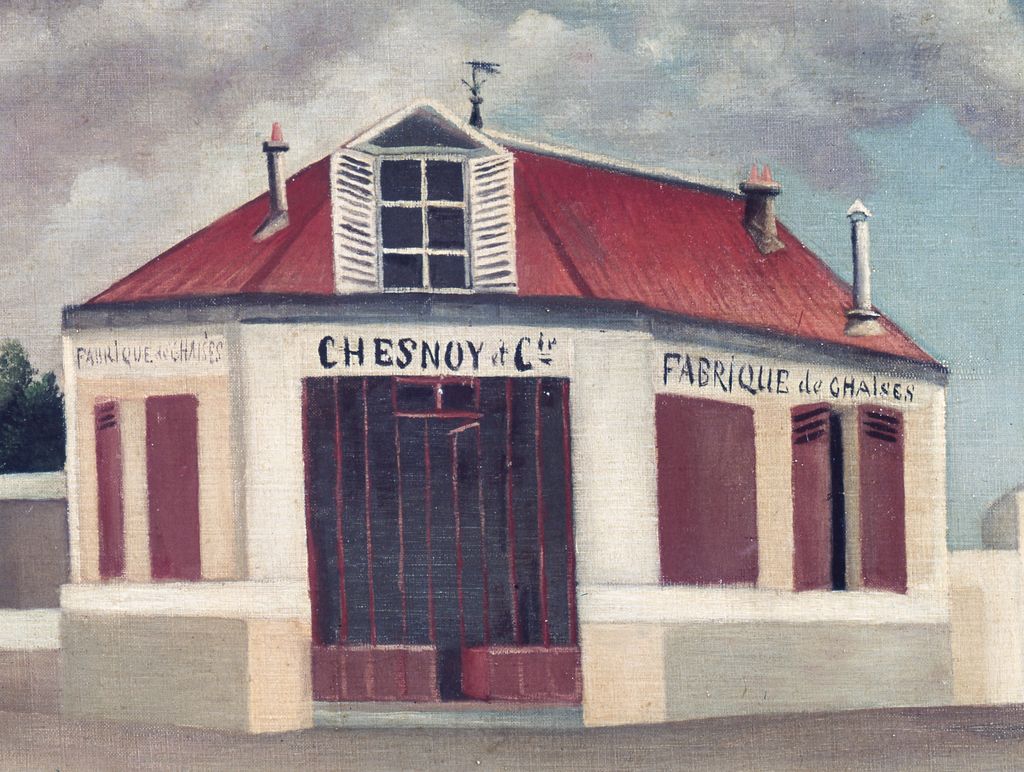
Rousseau gives the factory a recognisable identity through its lettering. The name CHESNOY & Cie sits above the entrance, and FABRIQUE DE CHAISES extends along the adjoining wall. The words follow the architecture, turning as the walls turn. They serve both as information and as a repeated pattern of dark marks across the light surface.
Below them, the entrance forms a tall, dark rectangle, picked out with narrow vertical divisions. Reddish-brown openings flank it, and a pale horizontal band links the lower parts of the walls. Almost every element can be separated and inspected: doorway, shutter, wall, plinth. The gaps between these parts are as conspicuous as the parts themselves. This measured spacing helps give the building its self-contained, frontal dignity.
Above the lettering, the roof introduces a different rhythm. Its red planes slope towards the walls, interrupted by small chimney stacks and a conspicuous central dormer. The dormer's open shutters spread around a dark window, giving the upper storey a focus that answers the entrance below. It is a surprisingly elaborate detail in a scene whose human inhabitants have been reduced to a few strokes. Rousseau allows us to examine the building at leisure while leaving the people comparatively anonymous.
The smaller brick building to the left reinforces this concentration on architecture. Its warm wall and triangular roof make a compact shape, set against the jagged dark mass of trees and chimneys. Together the two buildings establish a series of firm edges across the middle distance. Their different sizes and materials create variety within a scene that might otherwise seem dominated by a single facade.
Annotated Details from The Chair Factory in Alfortville
The numbered points identify visible features discussed in this article. Return from each detail to the whole composition. Henri Rousseau, The Chair Factory in Alfortville. The collection record gives 1897; the museum’s 2026 video credits give about 1907. Musée de l’Orangerie, RF196332. The larger of the two separate chair-factory paintings. Photograph: Françoise Foliot / Fonds Françoise Foliot, preserved by Wikimédia France. Image source. CC BY-SA 4.0. Numbered overview and cropped details adapted from Françoise Foliot’s photograph. The overview is resized and numbered; details are cropped. These adaptations are offered under CC BY-SA 4.0. No recolouring or retouching.
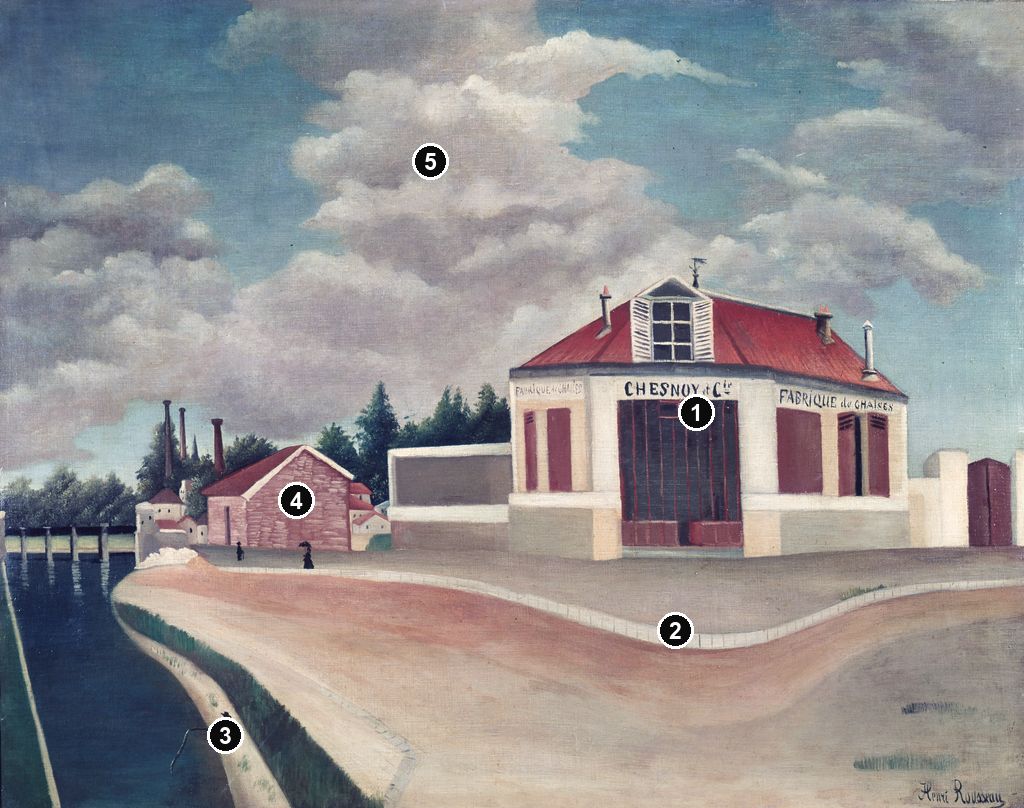
Details from THE CHAIR FACTORY IN ALFORTVILLE
Follow the building’s lettering and the road’s curve, then compare the small people, industrial skyline and broad cloud forms.
A factory front arranged around its name
Dark lettering stretches across the pale walls above a tall entrance. The open dormer and red roof give the building another centre above the doorway, while the shutters repeat its upright edges.
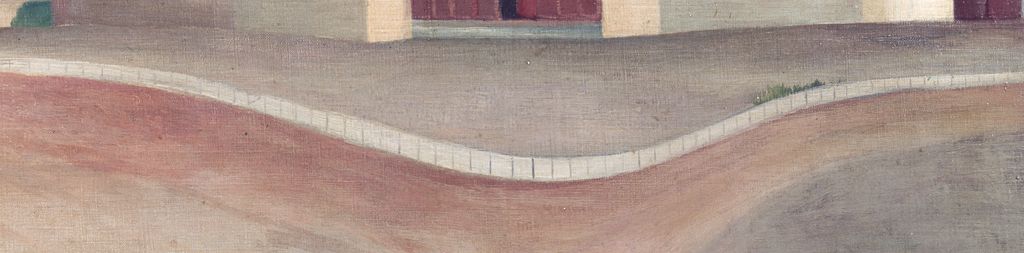
A pale pavement turns across the road
The pale strip dips below the factory, then rises towards the right. Its continuous curve separates the grey forecourt from the broad warm road, carrying the eye sideways beneath the rigid walls.
A fisherman beside the dark water
A small dark figure stands on the narrow pale bank. The fishing rod extends over the water, while the curving edge brings that modest action into the broad sweep of the foreground.
Brick walls, chimneys and passing figures
The low brick building gathers three thin industrial chimneys behind its roof. Two tiny people pass before the wall, giving the architecture a human measure without revealing individual identities.
Clouds swell through the open sky
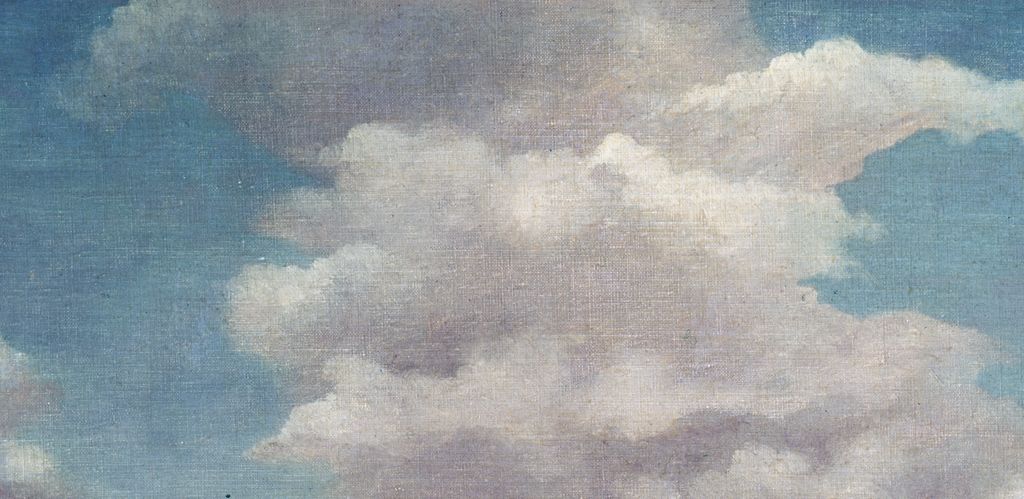
Pale edges and cooler grey centres give the clouds rounded volume. Patches of blue keep the masses separate, letting the sky alternate between broad openings and dense overlapping forms.
The road, the river and the changing direction of space
Against those rigid buildings, Rousseau sets a remarkably fluid foreground. A pale strip of pavement sweeps across the picture beneath the factory, dips near the centre and rises towards the right edge. Below it, the ochre road broadens towards us. Its curves are unusually continuous, with little incidental clutter to break their movement.
At the left, the bank makes another long bend. The dark water occupies a narrow channel between the edge of the canvas and the pale slope on which the fisherman stands. Farther back, the river appears to close towards the small bridge. The road opens into the foreground as the water recedes, giving the eye two routes through the same landscape.
These passages complicate the factory's stillness. We can look straight at its entrance, follow the pavement sideways, or turn down towards the water. The pale edging also sets off areas of colour: grey-green ground above, warm earth below, almost black water at the left. Rousseau makes a curb or bank perform much of the work that a more crowded view might distribute among carts, vegetation and passing traffic.
The Orangerie's commentary draws particular attention to the balance between the buildings' rigid lines and the calculated curves of the path and Seine bank.[1] Seen together, they give the picture its distinctive combination of firmness and ease. The structures stop the eye; the curves carry it onward. Distance emerges through these changes of direction and through the successive layers of bank, buildings, trees and sky.
Clouds over an industrial landscape
The sky has a fullness that rewards looking beyond the factory. Large cloud masses occupy much of the upper canvas, their rounded edges and shaded interiors giving them considerable weight. Open patches of blue separate them, especially towards the upper left. Across the centre, lighter cloud passages rise behind the red roof, while darker greys gather towards the sides.
Their soft modelling offers a different kind of description from the sharp divisions of the walls. The clouds overlap and swell; the factory is built from bounded planes. Yet their scale helps bind the composition together. The substantial cloud above the roof seems adequate to the building beneath it, preventing the upper part of the painting from becoming a merely empty background.
The 1985 MoMA retrospective catalogue praised the care taken over this sky and compared its cloud drawing and colour relationships with those of Nicolas Poussin. It also likened the whole setting to a severe theatrical set. These are critical comparisons rather than evidence of a copied source.[12] The theatrical analogy is especially suggestive when looking at the cleared foreground and the small people spaced before substantial architecture. Still, the river and changing cloud forms keep the scene open to the ordinary life of a place.
Comparing the two Chair Factory paintings
Rousseau also painted a smaller version of the chair factory, now in the same museum. The Orangerie dates that canvas to about 1897 and gives its dimensions as 38 × 46 cm. Its inventory number is RF196028; the larger painting discussed here is RF196332.[13] The difference extends well beyond physical size.
In the smaller picture, more of the composition belongs to the sky. The factory sits lower and appears less dominant beside the neighbouring buildings. Its roof and frontage remain recognisable, but they have less command over the whole view. The dark tree line takes the place of the industrial chimney cluster visible behind the brick structure in the large painting. The result is a different balance between buildings and vegetation.[13]
The foreground changes too. Yellow mounds punctuate the bank in the small version, while dark diagonal strokes and green patches interrupt the lower right. Its road and riverbank have a looser, less continuously defined appearance. By comparison, the large painting's long, pale curves hold their shape across broad, relatively clear surfaces. These differences are especially useful because the principal building remains similar: we can watch Rousseau redistribute emphasis without needing an entirely new subject.
The museum calls the smaller version more spontaneous and naturalistic, while observing that the comparison shows Rousseau recomposing a landscape.[13] Neither description establishes the order in which the pictures were made. The 1985 catalogue explicitly questioned the tempting assumption that the small canvas was a preliminary sketch, proposing instead that it might have been a later return to the theme. That remains a hypothesis.[12] Each painting can be understood through its own arrangement, without assigning it an unproved place in a sketch-to-finished-work sequence.
An ordinary subject on an ambitious scale
At 73 × 92 cm, this is an unusually large example of Rousseau's views of the surroundings of Paris. The Orangerie considers it probably the painting shown at the Salon des Indépendants in 1897.[1] Its broad, carefully articulated frontage would have offered exhibition visitors a commanding view of an everyday suburban subject.
Its scale belongs to a wider question about the audiences for Rousseau's paintings. The Orangerie's 2026 exhibition texts describe his small canvases as suited to the budgets and domestic spaces of customers including artisans, shopkeepers and members of the lower middle class. They also describe his pursuit of institutional recognition through ambitious works sent to the Indépendants.[14] This context helps explain why format matters. A suburban subject could become a modest domestic picture or receive the space and sustained attention associated with an exhibition canvas. No particular buyer or commission is established for this factory view.
Here, the increased format gives room to the intervals between things: the breadth of the road, the sweep of the bank, the cloud field around the roof. The factory is a local commercial building with its function written on its walls, yet Rousseau makes it carry an expansive composition. His attention reaches from the legible name above the door to the nearly featureless people beneath it.
From the Guillaume collection to the Orangerie
The museum records the large painting in Paul Guillaume's collection from 1931 and subsequently in the collection of Madame Jean Walter. The French state acquired it from her in 1963, with support from the Société des Amis du Louvre. It entered the Louvre's collections before its recorded physical arrival at the Orangerie in 1977.[1]
The smaller canvas followed a separate acquisition history: the state purchased it in 1959, also with the society's support, and its physical entry at the Orangerie likewise dates to 1977.[13] Their presence in one collection makes comparison particularly rewarding. The larger painting offers the more imposing facade and the more firmly articulated ground; the smaller one opens the same site towards trees and sky. In this large version, the painted business name remains the point to which the eye repeatedly returns, held above a doorway that seems enormous beside the people passing it.
Henri Rousseau artworks directory
This directory brings together works covered on this site and other works documented in the cited museum records and catalogues. Alternate titles share one entry; distinct versions remain separate. Historical dates for works without an article follow the cited catalogues. This is not a catalogue raisonné.
Frequently Asked Questions
It is in the Musée de l'Orangerie, Paris, under inventory number RF196332. The oil on canvas measures 73 × 92 cm.[1]
Discussion
Look again at the images and ideas explored in The Chair Factory in Alfortville. These editorial prompts invite your observations.
Reader Insights
How does the factory's lettering influence the way you look at its architecture?
Follow the pavement and then the riverbank with your eye. How does each route change your sense of the building's position?
Compare the two versions. Which change most alters the scene's character: the building's relative size, the chimneys, or the amount of sky?
Join the Conversation
Share a detail, comparison or question about The Chair Factory in Alfortville below.
References
- Musée de l'Orangerie. La Fabrique de chaises à Alfortville, 1897, RF196332. Current object commentary, dimensions and provenance, record updated 27 July 2026; accessed 23 October 2026. View source. (in French).
- Musée de l’Orangerie / Juliette Degennes, Henri Rousseau, l’ambition de la peinture: Un artiste dans son époque, 2026, four-page video transcript, artwork credits on PDF p. 2: small Chair Factory about 1897; large Alfortville canvas about 1907, RF196332. The spoken text raises questions about the two versions without explaining the dating discrepancy with the collection record. Accessed 24 October 2026. View source. (in French)
- Philadelphia Museum of Art, Carnival Evening,1963-181-64,object59593. View source.
- National Gallery, Surprised!, NG6421. View source.
- Musée d’Orsay, La Guerre,RF19461 (in French). View source.
- MoMA, The Sleeping Gypsy. View source.
- Philadelphia Museum of Art, The Merry Jesters, 1950-134-176, object51097. View source.
- Musée d’Orsay, La Charmeuse de serpents, RF 1937 7 (in French). View source.
- Musée de l’Orangerie, La Carriole du Père Junier, RF 1960 26 (in French). View source.
- Solomon R. Guggenheim Museum / Cornelia Lauf, The Football Players,60.1583: current collection record. View source.
- MoMA, The Dream, 252.1954. View source.
- Museum of Modern Art. Henri Rousseau, 1985, catalogue entry 18, “The Chair Factory,” printed p. 138 (PDF p. 143), including the discussion of the smaller version. View source.
- Musée de l'Orangerie. La Fabrique de chaises, about 1897, RF196028. Current object commentary, dimensions and provenance; accessed 23 October 2026. View source. (in French).
- Musée de l'Orangerie. Henri Rousseau, l'ambition de la peinture, exhibition texts, 25 March–20 July 2026, sections “Variations et déclinaisons. À la recherche du marché” and “L'ambition de la peinture officielle”; accessed 23 October 2026. View source. (in French).
- The Museum of Modern Art, Henri Rousseau: Essays (1985), selected catalogue entries, chronology and notes on early devotees. View source. Selected entries, chronology (pp.91–95) and early-devotee notes (pp.262–264) were consulted. Historical collection credits do not establish present ownership.
- Daniel Catton Rich, Henri Rousseau (The Museum of Modern Art, 1942), selected drawings and landscape studies; historical catalogue. View source. The dated 1942 publication is used for the two Quai d’Auteuil ink views; its Malakoff date differs from the 1985 catalogue.
- MANAS, Laval, Henri Rousseau, dit le Douanier, urban landscapes and preparatory study (in French). View source.
- National Gallery of Art, Self-Portrait (1895), pen-and-ink drawing, accession 1995.47.66. View source.
- The Museum of Modern Art, War (published January 1895), lithograph, accession 684.1943. View source.
- Barnes Foundation, Landscape and Four Young Girls, object 5521, BF855. View source.


 Henri Rousseau.jpg)


 Henri Rousseau.jpg)