



 by Tom Gurney
Tom Gurney BSc (Hons) is an art history expert with over 20 years experience
Published on June 19, 2020 / Updated on October 29, 2026
Email: tomgurney1@gmail.com / Phone: +44 7429 011000
View of the Fortifications to the Left of the Gate of Vanves: Introduction
A ladder stands against a great expanse of pale sky. Below it, a wall runs in from the left, a path curves away on the right, and three small figures give a human measure to an almost deserted landscape. In View of the Fortifications to the Left of the Gate of Vanves, Henri Rousseau makes a handful of ordinary structures conspicuous through the space around them. The eye wanders before settling on the smallest marks.
The Hermitage's 2014 catalogue identifies the painting as View from the Porte de Vanves, Paris: 1909, oil on canvas, 31 × 41 cm, inventory 6535. Its transcription of an artist-written reverse label locates the view left of the gate and dates it September 1909.[1]
At a Glance
- ArtistHenri Rousseau
- SubjectView of the Fortifications to the Left of the Gate of Vanves
- ExploreA landscape held low beneath the sky; The wall and its changing angles
This work across Henri Rousseau’s career
Carnival Evening
1886 [2]The Merry Jesters
1906 [7]The Snake Charmer
1907 [8]Contents
- A landscape held low beneath the sky
- The wall and its changing angles
- A ladder and an answering post
- Two kinds of tree rhythm
- The path, the figures and the artist's name
- A familiar place and its other views
- Annotated details
A landscape held low beneath the sky
The sky occupies roughly two-thirds of the picture. Its pale grey-blue surface contains little that asks for close attention: no strongly outlined cloud, bird or sun breaks the open field. This gives the lower third unusual weight. Wall, trees and human figures seem gathered along the bottom of an enormous stage.
Yet the skyline never settles into one straight boundary. On the left, rounded tree crowns descend gradually towards the centre; on the right, pointed trees rise sharply towards the edge. Between them the ladder and bent post make a pair of isolated interruptions. These uneven heights keep the gaze moving across the sky's lower margin. The opening above the centre feels wider because the trees press in from either side.
The tree rows also establish distance. Those above the left wall diminish until their trunks become slender marks near the ladder. The larger trees on the right remain more widely separated and individually legible. Our attention shifts between the two rows, estimating their positions across an open space. The landscape gains depth through these comparisons even where the ground itself offers few details to measure.
A slight warmth near the upper left makes the sky more varied than a single blank colour. Its subdued changes are easiest to notice beside the firm dark shapes below. The result is an atmosphere without a dramatic weather event: a broad, softly coloured surface holding together the stronger divisions of the land.
The wall and its changing angles
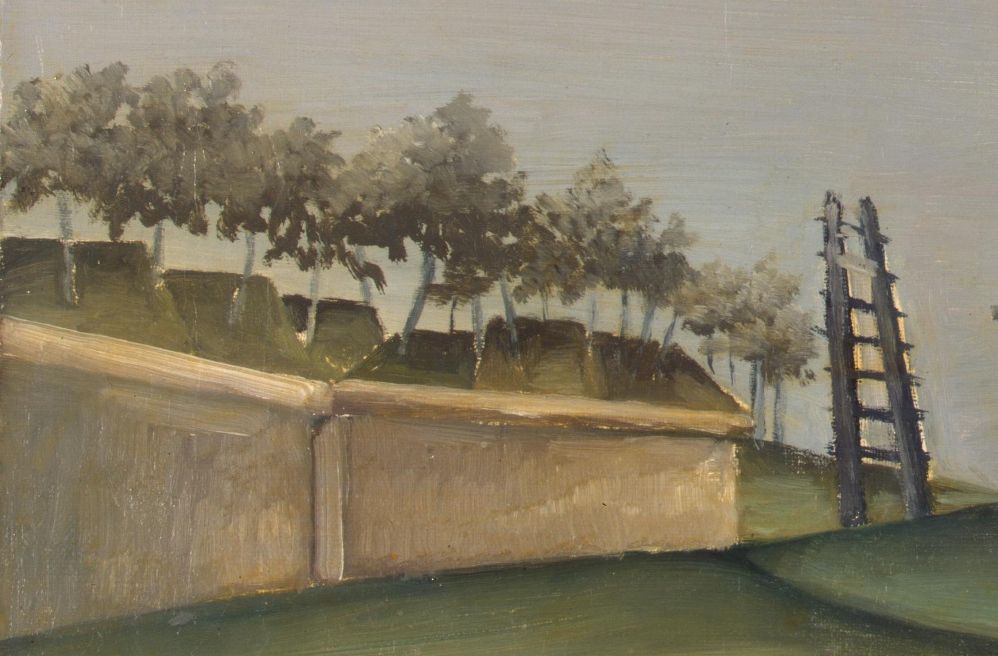
The fortification is most substantial at the lower left. A pale wall enters close to the viewer, turns at a projecting joint, then stretches towards the ladder. Its upper edge carries a narrow band of yellowish light. Below that edge, cooler grey and green tones make the upright face appear heavier, while the dark strip at its foot sets it against the foreground.
Small changes in direction do much of the work. The nearest stretch slopes down towards the central joint, and the next length appears to run more nearly across the picture. The projecting upright between them makes that turn readable. Farther back, the top of the structure becomes a sequence of dark angular masses under the trees. The eye moves from a broad continuous face to broken shapes, following the wall into the distance.
The wall's lower and upper boundaries behave differently. The face below is comparatively plain and uninterrupted; above, sloping green surfaces, dark recesses and pale trunks form an irregular fringe. This gives the structure both weight and variety. Its long side supplies a stable plane against which the foliage can appear delicate.
The wall also determines how much we can see. Its front face is fully exposed, while the ground behind it is screened. Tree trunks rise out of that partly concealed area, their crowns opening against the sky. The division creates a small puzzle of levels: a high planted strip on one side, an open foreground below it, and the ladder reaching between. Looking closely involves tracing those relationships rather than reconstructing a complete plan of the site.
A ladder and an answering post
The ladder attracts attention because it combines a dark outline with a repeated pattern of light openings. Its two long rails lean slightly, while the rungs divide the interior into short rectangles. Against the pale sky, even this narrow object has a strong presence. The repeated spaces between its crosspieces give the eye a sequence to count or climb.
Its position near the end of the wall matters as much as its shape. A large architectural mass has been dwindling towards this point; the ladder suddenly carries a sharply defined vertical form above it. At the bottom, the rails enter the darker ground. At the top, they stand freely against the open sky. It connects several zones of the painting without occupying much surface area.
A short distance to the right, a thinner upright bends into a horizontal arm. The shape is plainer and more widely spaced than the ladder's busy framework. Together they establish a rhythm: a slanting set of repeated bars, a pause of sky, then a single angular turn. The horizontal arm points back towards the ladder, encouraging the eye to compare them.
Their functions are less available to us than their outlines. Nothing in the picture clearly shows a person using the ladder or working with the neighbouring upright. That absence of action lets their silhouettes become especially prominent. We can follow the rails, rungs and bend with much greater confidence than we can supply a story about the work taking place here. The scene's interest survives that uncertainty because its spatial relationships remain so clear.
Two kinds of tree rhythm
Rousseau gives the two tree rows different characters. Those along the left side carry rounded clusters of foliage on pale trunks. Their crowns sometimes meet, making a low, almost continuous canopy. The repeating pale stems beneath it resemble slender supports, echoing the structure of the wall without matching its heavier divisions.
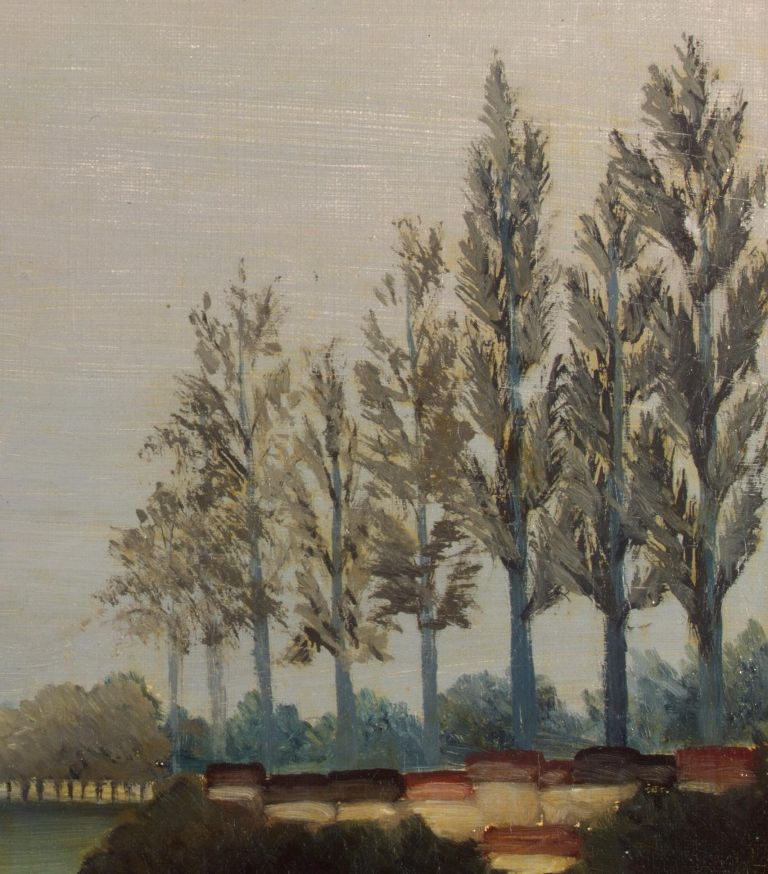
On the right, the trees are taller and more pointed. Dark branching trunks separate into fine sprays of leaves, with short marks reaching out on both sides. Considerable patches of sky remain visible between the branches. These openings keep the row airy even where the foliage grows thickest. The trees can therefore occupy a large part of the composition without forming an unbroken screen.
At their feet lie narrow bands of ochre, pale wall and reddish roof. Seen beneath the tall trunks, these low shapes make a horizontal accompaniment to the upward branching. The red accents are small enough to be discovered gradually. They warm the right side and separate its layers without competing with the taller silhouettes above them.
Closer to the viewer, the dark hedge has a much less transparent surface. Its upper outline rises and falls in compact humps, while its dense body conceals most of what lies behind. The contrast with the trees above is pronounced: open branching high in the air, an almost solid mass near the ground. Together they give the right side a strong vertical range, from the pale path at the bottom to the high tips of the leaves.
The path, the figures and the artist's name
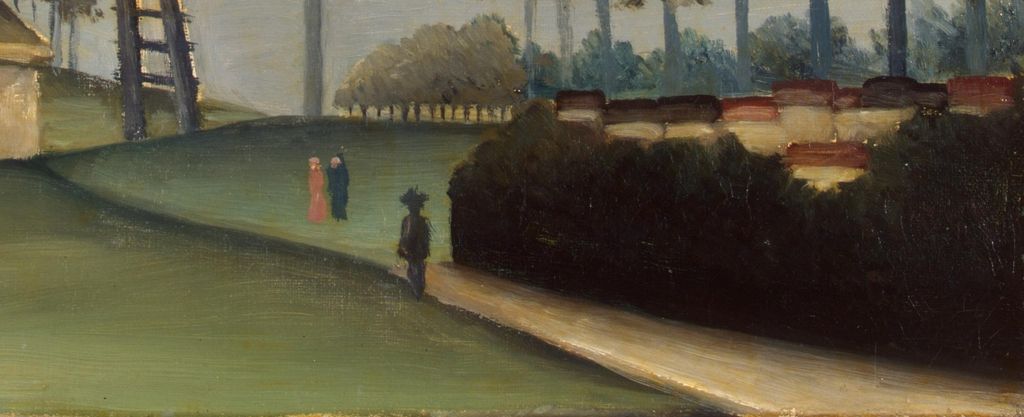
The narrow path enters from the lower right and curves towards the middle distance. Its pale colour makes it easy to follow beside the deep green hedge. As it recedes, it becomes a thinner strip and slips towards the central opening. The curve carries the gaze around a mass that would otherwise block access to that part of the picture.
Three figures punctuate the area beside it. The nearest is a small dark upright near the hedge's left edge. Farther back, a pale reddish figure and a darker companion stand close together. Their reduced scale makes the ladder seem unexpectedly large and the surrounding ground more extensive. A few short marks are enough to imply bodies without providing readable faces or an evident shared activity.
The gap between the nearest figure and the pair provides another measure of distance. We cross a patch of green before reaching the more distant people, then look beyond them towards the ladder and low trees. The figures help us read successive positions on a ground that is otherwise unusually spare. Their modest size asks for a slower kind of attention than a prominent central figure would command.
At the lower left, the sweeping name Henri Rousseau offers another kind of mark. Its large dark letters occupy the foreground with an assurance quite different from the tiny bodies across the path. The flourish beneath the name adds a loose curve to an area dominated by quiet green. Our gaze can travel from this broad inscription to the nearest person, then on to the distant pair, experiencing a striking reduction in scale across the bottom of the painting.
Annotated Details from View from the Porte de Vanves, Paris
The numbered points identify visible features discussed in this article. Return from each detail to the whole composition. Henri Rousseau, View from the Porte de Vanves, Paris, 1909. State Hermitage Museum, inventory 6535. Image: State Hermitage Museum, via Wikimedia Commons. Image source. Public domain. Numbers added to a separate resized overview. Details cropped directly from the published original without enlargement, sharpening, recolouring, cleaning or retouching.
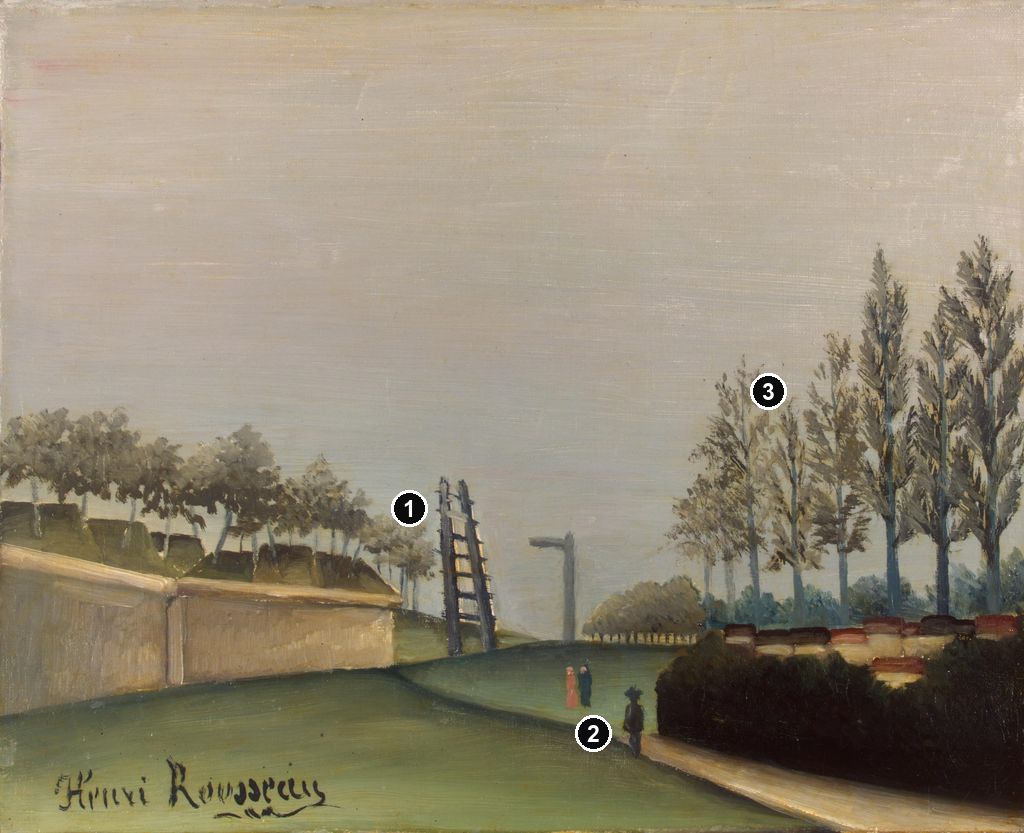
Details from VIEW FROM THE PORTE DE VANVES, PARIS
Compare the runged ladder with the small figures, then follow the changing scale from the path to the tall branches.
The wall meeting a runged ladder
The broad wall narrows towards a ladder whose light openings remain visible against the sky. Rounded tree crowns repeat above the wall’s angular banks.
Three figures beside a curving path
A dark figure stands near the hedge, with a smaller pair farther back. Their different sizes and the narrowing path give the open ground a measure of distance.
Tall branches over low roofs
Open branching rises above the low roof and wall strips. Gaps of sky distinguish this airy upper row from the compact dark hedge below.
A familiar place and its other views
A. G. Kostenevich connects the site with Rousseau's toll-collecting employment and proposes a nostalgic reading. The catalogue traces the picture through Vollard, around 1909–10, and S. I. Shchukin, in 1912, then the Museum of Modern Western Art, before its Hermitage acquisition in 1930. It also distinguishes a study formerly owned by Robert Delaunay, then unlocated, and a larger Hiroshima painting.[1]
The sparse figures and unoccupied foreground give a viewer room to imagine the experience of being here. Whether a viewer experiences that quiet as wistful, restful or faintly strange will depend on how those elements come together for them. The composition gives these responses a visible basis without making the painter's private feelings legible.
This particular view rewards attention to how much space separates its few events. The ladder has no surrounding bustle, the people remain small, and the tall trees stand clear above the low buildings. Each detail takes time to reach. Readers exploring Rousseau's style and technique can begin here with that measured distribution of forms: long plain surfaces, crisp silhouettes and small repetitions that make an ordinary urban edge absorbing to look at.
Henri Rousseau artworks directory
This directory brings together works covered on this site and other works documented in the cited museum records and catalogues. Alternate titles share one entry; distinct versions remain separate. Historical dates for works without an article follow the cited catalogues. This is not a catalogue raisonné.
Frequently Asked Questions
Follow the ladder up into the sky, then move across to the bent upright. From there, compare the low rounded trees on the left with the taller pointed row on the right. Their different heights organise the large open area above the landscape.
The picture does not show an activity that establishes its exact use. Its visible role is clearer: dark rails and pale openings create a conspicuous pattern beside the wall.
The path narrows, the left tree row diminishes, and the figures become smaller farther back. These changes allow the viewer to judge depth even though the foreground contains few descriptive details.
Discussion
Look again at the images and ideas explored in View of the Fortifications to the Left of the Gate of Vanves. These editorial prompts invite your observations.
Reader Insights
How would the scene change if the sky were reduced to half its present height?
Does your eye follow the path into the picture or move first along the wall? Which details determine that route?
What happens to your sense of scale when you compare the signature, the figures and the ladder?
Join the Conversation
Share a detail, comparison or question about View of the Fortifications to the Left of the Gate of Vanves below.
References
- A. G. Kostenevich, State Hermitage Museum. The State Hermitage: Treasures from the Museum's Collections, Volume 2, revised edition, 2014, entry 232, pp. 294–295; contributor key p. 8. View source.
- Philadelphia Museum of Art, Carnival Evening,1963-181-64,object59593. View source.
- Musée de l’Orangerie / Juliette Degennes, Henri Rousseau,L’ambition de la peinture: Un artiste dans son époque (in French). View source.
- National Gallery, Surprised!, NG6421. View source.
- Musée d’Orsay, La Guerre,RF19461 (in French). View source.
- MoMA, The Sleeping Gypsy. View source.
- Philadelphia Museum of Art, The Merry Jesters, 1950-134-176, object51097. View source.
- Musée d’Orsay, La Charmeuse de serpents, RF 1937 7 (in French). View source.
- Musée de l’Orangerie, La Carriole du Père Junier, RF 1960 26 (in French). View source.
- Solomon R. Guggenheim Museum / Cornelia Lauf, The Football Players,60.1583: current collection record. View source.
- MoMA, The Dream, 252.1954. View source.
- The Museum of Modern Art, Henri Rousseau: Essays (1985), selected catalogue entries, chronology and notes on early devotees. View source. Selected entries, chronology (pp.91–95) and early-devotee notes (pp.262–264) were consulted. Historical collection credits do not establish present ownership.
- Daniel Catton Rich, Henri Rousseau (The Museum of Modern Art, 1942), selected drawings and landscape studies; historical catalogue. View source. The dated 1942 publication is used for the two Quai d’Auteuil ink views; its Malakoff date differs from the 1985 catalogue.
- MANAS, Laval, Henri Rousseau, dit le Douanier, urban landscapes and preparatory study (in French). View source.
- National Gallery of Art, Self-Portrait (1895), pen-and-ink drawing, accession 1995.47.66. View source.
- The Museum of Modern Art, War (published January 1895), lithograph, accession 684.1943. View source.
- Barnes Foundation, Landscape and Four Young Girls, object 5521, BF855. View source.


 Henri Rousseau.jpg)


 Henri Rousseau.jpg)