



 by Tom Gurney
Tom Gurney BSc (Hons) is an art history expert with over 20 years experience
Published on June 19, 2020 / Updated on October 29, 2026
Email: tomgurney1@gmail.com / Phone: +44 7429 011000
Still Life with Flowers: Introduction
Two cream-coloured flowers turn towards the right, while dark purple blooms hold the left and centre of Henri Rousseau’s Still Life with Flowers. Small red blossoms rise above them on thin stems. Below, a yellow-gold vessel emerges from a heavy fringe of leaves, its bright surface drawing the eye down from the bouquet. A separate leafy stem stretches across the front of the table, bringing the arrangement almost to the viewer’s side of the picture.
At a Glance
- ArtistHenri Rousseau
- SubjectStill Life with Flowers
- ExploreA small painting with a strong presence; Four large flowers and a broken crown of red
This work across Henri Rousseau’s career
Carnival Evening
1886 [1]The Merry Jesters
1906 [7]The Snake Charmer
1907 [8]Contents
- A small painting with a strong presence
- Four large flowers and a broken crown of red
- Leaves that support and conceal
- The gold-coloured vessel and its uncertain surface
- A table edge that brings the picture forward
- What is known of its history
- Annotated details
A small painting with a strong presence
The Philadelphia Museum of Art dates the work to about 1905 and records its medium as oil on paper on canvas. It measures 33 × 24.1 cm and belongs to the Louis E. Stern Collection, accession number 1963-181-65.[6] Those modest dimensions suit the concentrated encounter offered here: flowers, container, table and a brown backdrop, brought close enough for their edges to matter.
The upright format gives the bouquet considerable height, but Rousseau leaves little sense of an encompassing room. No window, distant wall ornament or adjacent furnishing competes with the flowers. The table enters from the lower edges, and the background consists of broad vertical bands. This restricted setting makes a small change of direction unusually noticeable. A pointed leaf near the upper left seems to spring upwards; the lower pale flower opens towards us; a thin stem curls out to the right. The arrangement has several distinct gestures within its compact outline.
The eye can grasp the whole quickly and then slow down over its parts. Large flowers establish the principal colour masses, while finer stems and leaf veins interrupt them. The work rewards both distances. From farther away, it reads as a tall dark bouquet over a luminous base. Closer looking reveals that its apparently solid silhouette is crossed by little openings through which the brown background remains visible.
Four large flowers and a broken crown of red
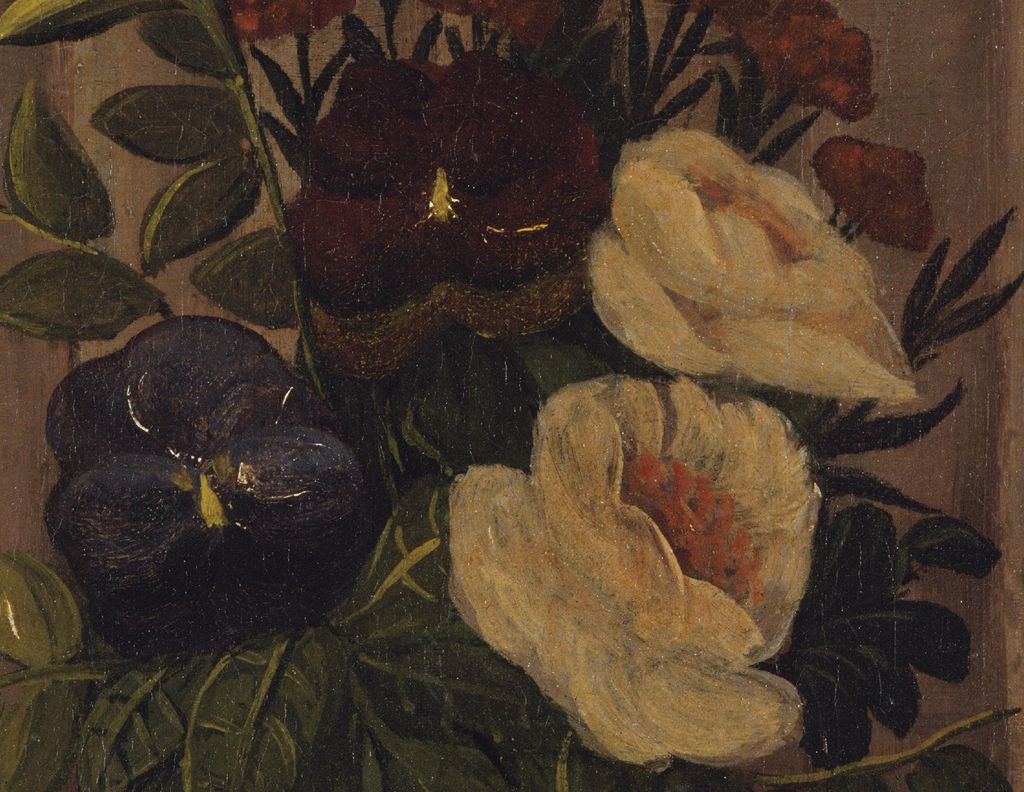
The two pale flowers are similar in colour yet different in posture. The upper one tilts upwards and towards the right. Its folded petals make a shallow, oblique bowl, with warm marks gathered inside. The flower below opens more broadly towards the viewer. Its outer petals spread around a reddish-orange centre, and the largest pale lobe projects across the darker foliage. Together they form a descending diagonal on the right side of the bouquet.
Across from them, the purple flowers seem heavier. One sits high near the middle, the other lower and farther left. Broad rounded petals close around small yellow centres. Because the purple lies near the darkness of the leaves, these blooms can initially merge with the surrounding mass. Their little yellow accents help the eye locate them, after which curved edges and changes of tone separate petal from petal. The pale flowers announce themselves immediately; their dark companions emerge more gradually.
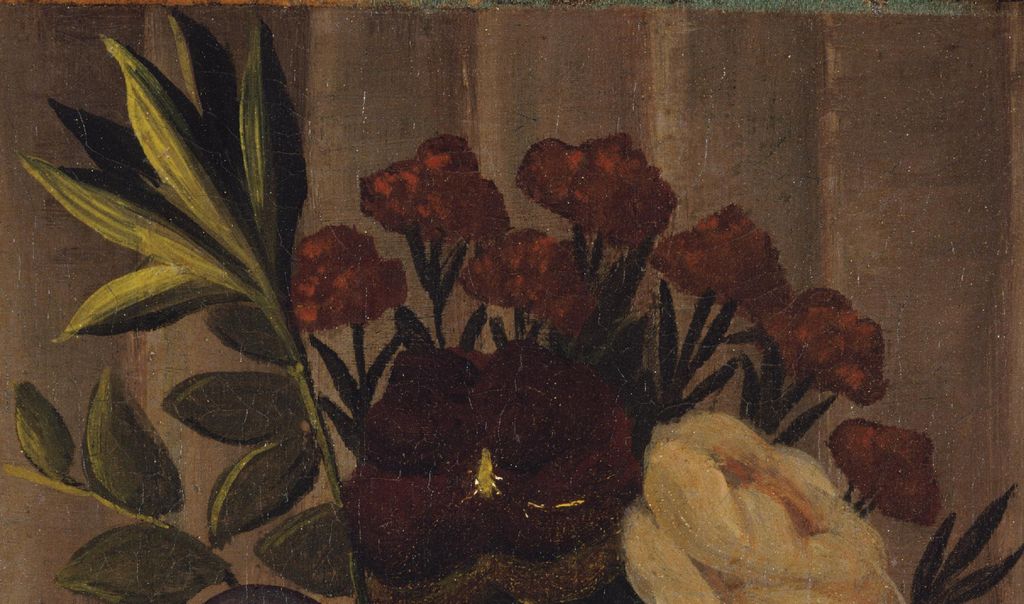
Above these four large heads, the red blossoms form an uneven arch. They are smaller, spaced more loosely and supported by narrow visible stems. Their size changes the rhythm of the upper half. Rousseau breaks the bouquet’s crown into a series of small rounded notes. Brown gaps between them keep this upper zone open. Their red is warm enough to be distinct, but subdued enough to remain part of the surrounding earth-coloured setting.
This distribution makes the bouquet asymmetrical without letting it tip visually to one side. Light attracts attention on the right; the tall leaf spray extends the left. The upper central purple flower helps join the two. The eye moves between the separate heads and the gaps around them, discovering a balance made from unequal parts.
Leaves that support and conceal
The upper left spray has long, pointed blades, some light along one edge and dark along the other. It brings a sharp, almost fanlike shape into a composition otherwise dominated by rounded petals. Lower down, broader leaves spread sideways before drooping around the vessel. Their veins supply fine internal divisions, so that even a dark leaf can retain its own direction within the overlapping green mass.
These leaves do more than fill the spaces between flowers. Around the centre of the picture they conceal the point where the stems enter the container. Several tips hang over its bright body. This overlap gives the foliage a forward position and makes the vessel appear to continue behind it. The bouquet consequently feels gathered together at a hidden point, even though its individual stems are only intermittently visible.
A thin branch reaches towards the right above the vessel, bending back against the larger leaf shapes. On the left, a looser spray extends towards the picture’s margin. Such extensions soften the boundary between bouquet and background. The flowers establish a few large centres of attention; these narrow outlying lines encourage the eye to wander beyond them. Their changing directions also prevent the arrangement from becoming a stack of separate horizontal tiers.
Pointed and rounded, upright and hanging, densely grouped and widely spaced: these visible differences provide the painting’s working vocabulary. The foliage gives the flowers something to rise from while keeping the lower half active in its own right.
The gold-coloured vessel and its uncertain surface
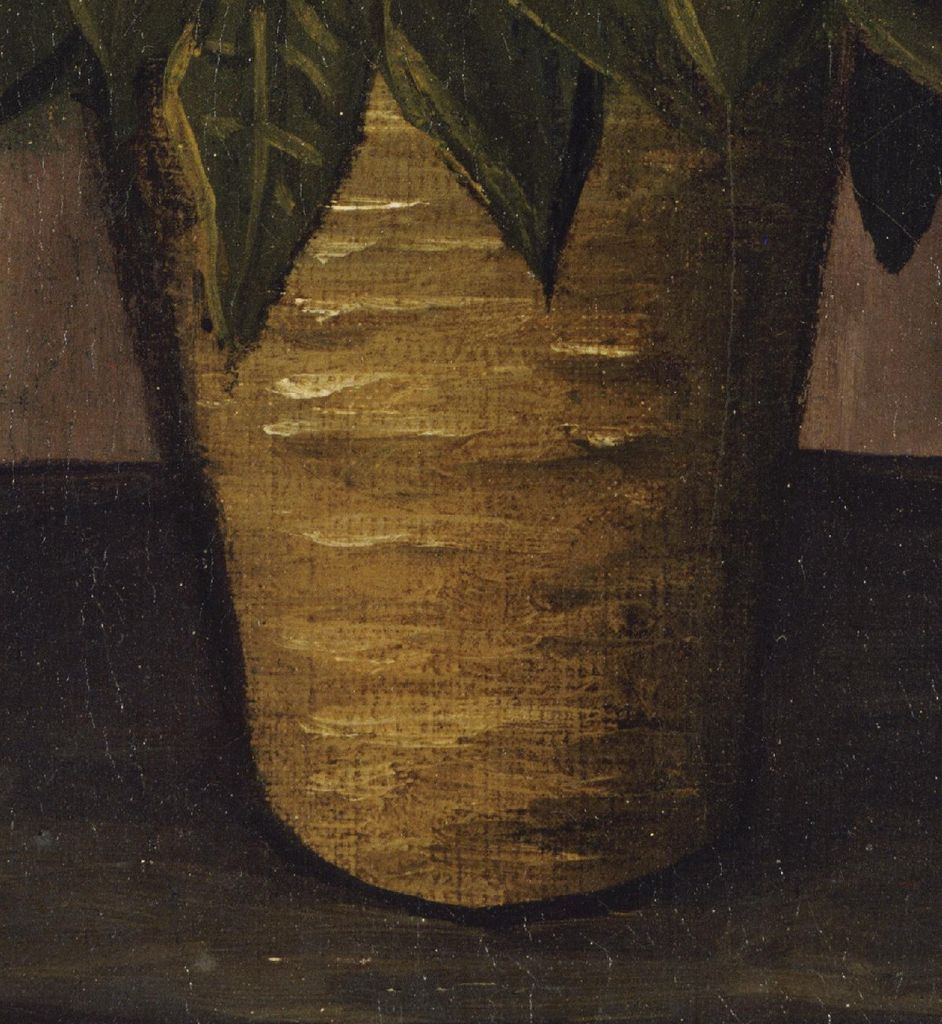
The container narrows towards the bouquet and broadens through its body before curving into a rounded base. Across it run short, broken horizontal strokes of yellow, ochre and brown. The marks suggest a ridged or woven-looking surface, yet the painted appearance alone cannot establish what the object was made from. Its yellow-gold colour is more secure than any identification of brass, pottery or basketry.
The strongest lights gather along the left and middle of the body. Towards the right, the vessel grows darker beneath the foliage, so the same horizontal pattern helps describe both surface and volume. Seen together, the strokes make a rounded object; examined individually, they remain conspicuously small strips of paint. That double reading gives the base an energy quite different from the broad, relatively continuous shapes of the pale petals above it.
Its brightness also provides a link through the picture. From the lower cream flower, the eye can descend across a hanging leaf to the yellow body and then continue towards the foreground leaves. The container anchors the arrangement, but its repeated light marks keep it from becoming an inert pedestal. Even where flowers and foliage are darkest, this compact area of warmth preserves a strong visual centre below them.
A table edge that brings the picture forward
The dark tabletop offers the vessel a stable resting place. Its left boundary runs diagonally back towards the brown backdrop, providing a clear cue to depth. Across the right side, the rear edge is much more nearly horizontal. These simple lines establish a ledge without requiring an elaborate account of the room. Much of the table remains bare, leaving enough space around the vessel for its rounded bottom to read clearly.
At the very front, a separate trailing stem carries broad, pointed leaves across the width. Its low, wandering line contrasts with the upright bouquet. The stem dips and rises; individual leaves turn at different angles, some showing a fuller face and others a narrower profile. Positioned below the vessel, this small garland makes the foreground a distinct zone of attention.
The narrow strip between the vessel and that trailing stem is especially useful. It allows the bouquet to stand back a little while the leaves at the bottom seem close to the edge. The partly cropped gold-coloured signature at lower left occupies the same near space. The arrangement thus extends down into a band where plant forms, lettering and the picture’s boundary meet.
Behind everything, the curtain-like brown verticals return the eye upwards. Their straightness sets off the rounded flowers and wandering stems. Gradations within those bands keep the background from looking entirely uniform, while its restricted colour lets pale petals and yellow paint remain prominent. The shallow space depends on overlaps and a few directional edges; the relationship between these devices is a useful entry into Rousseau’s style and technique.
Annotated Details from Still Life with Flowers
The numbered points identify visible features discussed in this article. Return from each detail to the whole composition. Henri Rousseau, Still Life with Flowers, c. 1905. Philadelphia Museum of Art, The Louis E. Stern Collection, 1963, 1963-181-65. Museum-derived reproduction published on Wikimedia Commons in 2022. Image source. Public domain. Numbers added to the overview; details cropped from the published original. No recolouring or retouching.
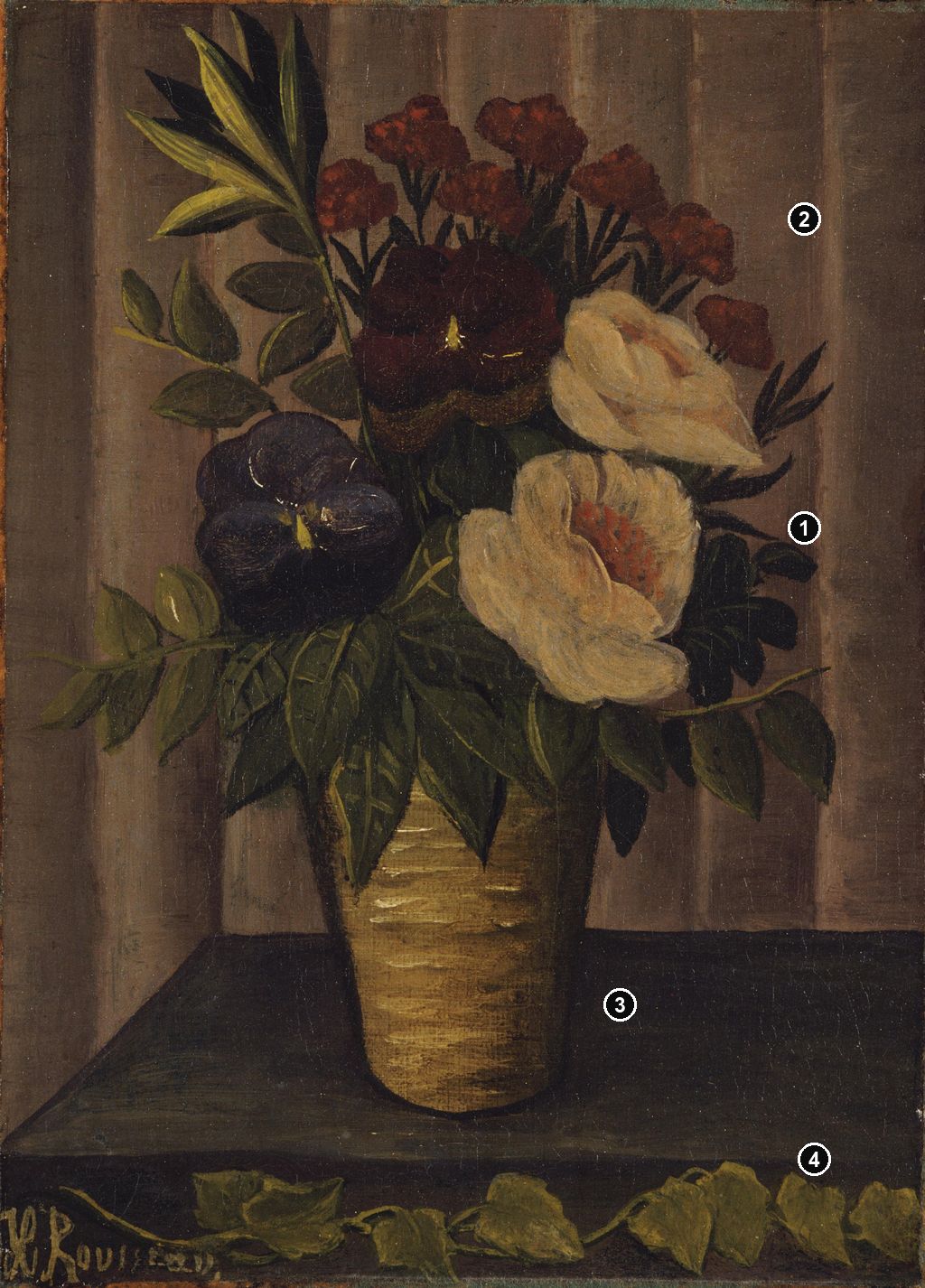
Details from STILL LIFE WITH FLOWERS
Compare the four large flowers, follow the broken red crown, then move down to the bright vessel and the trailing foreground stem.
Four large heads, unequal light
Two cream-coloured flowers open at the right, opposite two darker purple heads. Their small warm centres and curved petal edges become clearer when the pale and dark blooms are considered together.
A loose red crown and pointed leaves
Small red blossoms rise on narrow stems, leaving brown gaps between their heads. The long upper-left leaves supply a sharper shape against this uneven arch of rounded flowers.
Broken gold strokes beneath hanging leaves
Short yellow, ochre and brown strokes run across the vessel, gathering into a rounded body. Overlapping leaves hide its opening; the woven-looking markings do not establish what the container was made from.
A trailing stem at the front edge
A separate leafy stem wanders across the near edge of the table. Its low horizontal movement contrasts with the upright bouquet and makes the foreground a distinct layer of the small painting.

What is known of its history
The museum records the painting with the New York dealer Sam Salz by 1951, and its sale to Louis E. Stern on 9 June that year, citing a receipt copy in its curatorial file. Stern bequeathed it to Philadelphia in 1963. Suggested earlier ownership by Robert and Sonia Delaunay, and by “Farges,” remains unconfirmed in the museum’s provenance.[6]
That incomplete early history leaves the painted arrangement as the fullest account of the work available to the viewer. The pale flowers gather to one side, the small red heads spread above, leaves veil the container’s opening and a trailing stem lies below. Looking from one of these elements to the next reveals how much variety Rousseau has fitted into an intimate, tightly bounded scene.
Henri Rousseau artworks directory
This directory brings together works covered on this site and other works documented in the cited museum records and catalogues. Alternate titles share one entry; distinct versions remain separate. Historical dates for works without an article follow the cited catalogues. This is not a catalogue raisonné.
Frequently Asked Questions
Start with the two pale flowers on the right, then find the two dark purple heads opposite them. Follow the small red blossoms across the top before moving down to the vessel. This makes the bouquet’s unequal but balanced sides easier to see.
Its broken horizontal markings give it a woven-looking texture, but appearance alone does not establish its material. “Gold-coloured vessel” describes what is visible without making an unsupported identification.
The image provides no clear basis for assigning a single symbolic message. Their colours, sizes, postures and overlaps offer a firmer way to understand the arrangement than a fixed code attached to particular species.
Discussion
Look again at the images and ideas explored in Still Life with Flowers. These editorial prompts invite your observations.
Reader Insights
How does your sense of the bouquet change when you attend to the dark purple flowers rather than the cream-coloured ones?
What happens to the picture’s depth if you imagine removing the leafy stem at the front of the table?
Which has the greater effect on the arrangement’s balance: the tall leaves at upper left or the pale flowers on the right?
Join the Conversation
Share a detail, comparison or question about Still Life with Flowers below.
References
- Philadelphia Museum of Art, Carnival Evening,1963-181-64,object59593. View source.
- Musée de l’Orangerie / Juliette Degennes, Henri Rousseau,L’ambition de la peinture: Un artiste dans son époque (in French). View source.
- National Gallery, Surprised!, NG6421. View source.
- Musée d’Orsay, La Guerre,RF19461 (in French). View source.
- MoMA, The Sleeping Gypsy. View source.
- Philadelphia Museum of Art. Still Life with Flowers, c. 1905, object 59594, accession 1963-181-65; Object Details and Provenance, including notes 1–3. Accessed 23 October 2026. View source.
- Philadelphia Museum of Art, The Merry Jesters, 1950-134-176, object51097. View source.
- Musée d’Orsay, La Charmeuse de serpents, RF 1937 7 (in French). View source.
- Musée de l’Orangerie, La Carriole du Père Junier, RF 1960 26 (in French). View source.
- Solomon R. Guggenheim Museum / Cornelia Lauf, The Football Players,60.1583: current collection record. View source.
- MoMA, The Dream, 252.1954. View source.
- The Museum of Modern Art, Henri Rousseau: Essays (1985), selected catalogue entries, chronology and notes on early devotees. View source. Selected entries, chronology (pp.91–95) and early-devotee notes (pp.262–264) were consulted. Historical collection credits do not establish present ownership.
- Daniel Catton Rich, Henri Rousseau (The Museum of Modern Art, 1942), selected drawings and landscape studies; historical catalogue. View source. The dated 1942 publication is used for the two Quai d’Auteuil ink views; its Malakoff date differs from the 1985 catalogue.
- MANAS, Laval, Henri Rousseau, dit le Douanier, urban landscapes and preparatory study (in French). View source.
- National Gallery of Art, Self-Portrait (1895), pen-and-ink drawing, accession 1995.47.66. View source.
- The Museum of Modern Art, War (published January 1895), lithograph, accession 684.1943. View source.
- Barnes Foundation, Landscape and Four Young Girls, object 5521, BF855. View source.


 Henri Rousseau.jpg)


 Henri Rousseau.jpg)