


 by Tom Gurney
Tom Gurney BSc (Hons) is an art history expert with over 20 years experience
Published on June 19, 2020 / Updated on October 29, 2026
Email: tomgurney1@gmail.com / Phone: +44 7429 011000
Toll Gate: Introduction
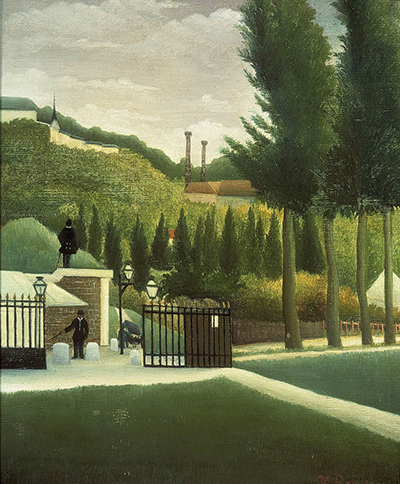
Henri Rousseau’s Toll Gate, painted about 1890, belongs to the Courtauld Gallery in London.[1] A pale path crosses a dark lawn towards an open iron gate, where three small figures occupy a compact cluster of walls, lamps and railings. Beyond them, closely packed trees stand before a rising green hill. The gate seems to offer a way into the landscape, yet its opening is less immediately legible than the broad path leading towards us. Looking through this entrance means following lines, weighing distances and finding people among the structures they attend.
At a Glance
- ArtistHenri Rousseau
- SubjectToll Gate
- ExploreThe open gate and the crossing paths; Tall trees and a crowded distance
This work across Henri Rousseau’s career
Carnival Evening
1886 [2]Toll Gate (current article)
c. 1890 [1]The Merry Jesters
1906 [7]The Snake Charmer
1907 [8]Contents
- The open gate and the crossing paths
- Tall trees and a crowded distance
- Three figures at the threshold
- A subject connected with Rousseau’s working life
- Looking beside Seurat
- The painting in the Courtauld collection
The open gate and the crossing paths
The foreground gives the eye room to move. An expanse of green fills the lower part of the picture, divided by the bright diagonal of the path. This strip widens as it approaches the right edge, making a strong connection between the gate and the space beyond the frame. Its angle provides the most emphatic movement in a scene otherwise dominated by objects standing upright. Before we attend to a face or a building, the path has drawn us towards the entrance.
At the gate, that movement encounters a much denser arrangement. Black iron bars, pointed railings, pale masonry and little glass lanterns crowd together. The long fence on the left is cut off by the picture’s edge, so the enclosure continues beyond what we can see. The gate occupies a more complete shape near the centre. Its repeating uprights and curved upper outline give the opening an ornamental presence, quite different from the path’s broad, uninterrupted surface.
The dark gate leaf stands clearly against the lighter ground, but the route through the entrance is harder to follow. The eye can distinguish a passage without being able to trace a single continuous road from the foreground into the distance. A further pale strip runs across the picture beneath the trees on the right. Its nearly horizontal course meets the foreground diagonal, creating a junction that is visually forceful even where its practical arrangement remains elusive.
The pale post and low wall help hold this junction in place. Their flat faces make a small block of architecture, with the prominent lanterns introducing further upright accents. Each lantern has a light central body beneath a dark cap. Their compact shapes catch the eye amid the much thinner bars of the fence. From the broad path to the masonry and then to these little lamps, Rousseau changes scale repeatedly within a small area. The entrance rewards close attention because its outline contains so many separate intervals and divisions.
Tall trees and a crowded distance
The right side of the painting rises abruptly. Four tall trunks stand along the lawn, their crowns extending beyond the upper edge. Their height makes the people at the gate look smaller still. The nearest foliage forms a dark mass against the sky, while the trunks leave narrow views through to the paler ground behind. Looking across them feels like looking through a second set of bars, wider spaced and less regular than the ironwork.
This repetition brings the trees into the entrance’s geometry. Gate bars, lamp supports and trunks all rise vertically, but they differ in thickness, colour and spacing. Farther back, a line of narrow, pointed tree crowns repeats the upward movement once again. The foreground trunks are individually separated; the distant trees gather into a serrated band. The transition allows us to read distance through changing patterns as much as through diminishing size.
Behind that band, the hill is a densely worked surface. Small changes of green give its vegetation a granular texture, very different from the broad, comparatively even lawn. The distinction is especially clear on the left, where the hill presses close to the pale building and wall. The eye can rest on the foreground grass, then become absorbed in the many small marks and edges farther away. These contrasting textures make the depth of the picture feel compressed: a spacious lawn faces a background with little empty ground left in it.
The skyline contains several interruptions. Pale architecture appears high on the left, with a slender pointed accent nearby. The pale wall along the upper-left ridge supplies a second sloping edge, carrying architecture into the hill’s outline. It catches the light far above the gate, keeping a distant structure legible against the foliage. Closer to the centre, a low roof lies beneath two thin chimneys. Their straight stems stand out among the green crowns, introducing a different kind of upright. These small built forms complicate the initial impression of a park. Even above and beyond the gate, the landscape continues to contain walls, roofs and structures.
Only a portion of the cloudy sky remains open. Its soft grey tones contrast with the sharply defined entrances, trunks and distant points. No dramatic burst of sunlight explains the scene’s brightness. Instead, light is concentrated in selected passages: the path, the gatepost, the upper-left wall and the narrow glimpses beneath the trees. The strongest contrast occurs close to the ground, where the pale diagonal cuts across the dark foreground. A seemingly quiet view gains much of its energy from that meeting of light and shade.
Three figures at the threshold
The people are easy to overlook on a first glance. One dark figure appears above or behind the pale wall at the left, isolated against the green distance. Two others stand at gate level. Their dark clothing, with a blue-black passage on the right-hand figure, links them to the railings and tree trunks around them. Pale faces and small touches of light distinguish their bodies from the surrounding shapes.
Their distribution gives the entrance a human scale. The elevated figure stands above the little roofed structure, while the lower pair occupy the narrow passage beside the masonry. The figures make us recognise how high the wall is and how large the gate would feel to someone approaching it. At the same time, their smallness allows the trees and hill to retain the greatest visual weight.
There is little readable action. No broad gesture binds the three people into an obvious exchange, and their positions leave their relationships uncertain. The stillness makes the open gate especially noticeable: the structure suggests passage, while the figures seem settled into their places. We can imagine arrival or departure, but the picture gives neither event a clear beginning. The scene remains poised around an entrance where something could happen.
Seen close to the ironwork, the figures also introduce irregularity into its pattern. Their bodies lean or widen where the bars remain narrow and straight. They keep the threshold from becoming a purely ornamental arrangement. Rousseau’s signature at the lower right provides another human presence, set apart from this small gathering within the landscape.
A subject connected with Rousseau’s working life
The Courtauld identifies this as the only known Rousseau painting that directly refers to his employment collecting taxes. That work supplied his nickname, Le Douanier, or customs agent. Toll gates around Paris were places where incoming goods were taxed. The museum describes this scene as imagined.[1]
The Fondation Beyeler’s 2010 guide reads the gate as a boundary between the orderly foreground and the thicker vegetation beyond. It observes that the controlled road is difficult to follow and interprets the entrance as a passage between domesticated and wild spaces.[12] This reading gives particular weight to the change of texture across the middle of the canvas. The contrast is visible without requiring the trees and buildings to form an exact map.
The gate’s location within the picture matters here. Although it is the named subject, it occupies a small portion of the canvas. The lawn stretches in front of it; the hill rises far behind it; the tallest trees overwhelm its height. The toll gate is embedded in a wider landscape whose different surfaces and scales draw our attention in turn. Readers exploring Rousseau’s treatment of ordinary surroundings can continue with The Banks of the Bièvre near Bicêtre. Here, the most revealing starting point remains the entrance itself: a small, intricate structure through which the larger view is organised.
Looking beside Seurat
In their 1985 essay, Carolyn Lanchner and William Rubin compared Toll Gate with Seurat’s Port-en-Bessin of 1888. They drew attention to controlled pictorial structures and to the unusual light shared by the artists’ work. They also explicitly stated that there was no evidence Rousseau had consciously been influenced by Seurat.[13]
The comparison encourages us to look at relationships between forms. In Toll Gate, the foreground diagonal answers the long fence; the little lanterns answer the taller trunks; the tiny people interrupt the repeated uprights. These connections can make the picture feel closely ordered even while its road system remains difficult to reconstruct. A painting can be clear in its rhythms and less clear as a description of where a traveller should go.
The composition also changes as we shift our attention. Following the path emphasises movement towards the gate. Following the trunks directs us upwards, away from the people. Following the pointed crowns takes us sideways across the distance. Each route through the image is available at once. Their balance accounts for the scene’s peculiar mixture of invitation and stillness: an open entrance lies within an arrangement that seems firmly held in place.
The painting in the Courtauld collection
The canvas measures 40.6 by 32.75 centimetres and is painted in oil. The Courtauld’s provenance lists Wilhelm Uhde, Dr Hartwich and Alfred Flechtheim before Samuel Courtauld bought it in 1926. It entered the collection through his 1948 bequest and bears the accession number P.1948.SC.349.[1]
Its small size makes the balance between broad and minute forms especially striking. The foreground can be taken in immediately, while the lamps, faces, iron points and distant chimneys ask for a closer look. The eye moves between those two speeds of attention. A few light surfaces establish the whole scene; scattered details continually draw us back towards the gate.
Henri Rousseau artworks directory
This directory brings together works covered on this site and other works documented in the cited museum records and catalogues. Alternate titles share one entry; distinct versions remain separate. Historical dates for works without an article follow the cited catalogues. This is not a catalogue raisonné.
Frequently Asked Questions
Three small figures can be distinguished: one above or behind the left wall and two at the level of the entrance. Their individual identities are uncertain.
Follow the pale foreground path towards the gate, then compare its diagonal with the fence, lanterns and tall tree trunks. Those contrasting directions organise the view.
Discussion
Look again at the images and ideas explored in Toll Gate. These editorial prompts invite your observations.
Reader Insights
Does the open gate make the scene feel welcoming, or do the railings and closely spaced trees make it feel enclosed?
How does your sense of distance change when you look from the smooth lawn to the densely textured hill?
Which gives the scene its strongest sense of order: the path, the fence or the trees?
Join the Conversation
Share a detail, comparison or question about Toll Gate below.
References
- Courtauld Gallery. The Toll Gate, P.1948.SC.349, current object record, label, metadata and provenance; accessed 23 October 2026. View source.
- Philadelphia Museum of Art, Carnival Evening,1963-181-64,object59593. View source.
- Musée de l’Orangerie / Juliette Degennes, Henri Rousseau,L’ambition de la peinture: Un artiste dans son époque (in French). View source.
- National Gallery, Surprised!, NG6421. View source.
- Musée d’Orsay, La Guerre,RF19461 (in French). View source.
- MoMA, The Sleeping Gypsy. View source.
- Philadelphia Museum of Art, The Merry Jesters, 1950-134-176, object51097. View source.
- Musée d’Orsay, La Charmeuse de serpents, RF 1937 7 (in French). View source.
- Musée de l’Orangerie, La Carriole du Père Junier, RF 1960 26 (in French). View source.
- Solomon R. Guggenheim Museum / Cornelia Lauf, The Football Players,60.1583: current collection record. View source.
- MoMA, The Dream, 252.1954. View source.
- Fondation Beyeler. Henri Rousseau: Saalheft, 2010, entry 17, “L’octroi,” printed p. 19. View source. (in German).
- Carolyn Lanchner and William Rubin. “Henri Rousseau and Modernism,” in Henri Rousseau: Essays, Museum of Modern Art, 1985, printed pp. 42–44, especially p. 43, fig. 6 (PDF pp. 47–49). View source.
- The Museum of Modern Art, Henri Rousseau: Essays (1985), selected catalogue entries, chronology and notes on early devotees. View source. Selected entries, chronology (pp.91–95) and early-devotee notes (pp.262–264) were consulted. Historical collection credits do not establish present ownership.
- Daniel Catton Rich, Henri Rousseau (The Museum of Modern Art, 1942), selected drawings and landscape studies; historical catalogue. View source. The dated 1942 publication is used for the two Quai d’Auteuil ink views; its Malakoff date differs from the 1985 catalogue.
- MANAS, Laval, Henri Rousseau, dit le Douanier, urban landscapes and preparatory study (in French). View source.
- National Gallery of Art, Self-Portrait (1895), pen-and-ink drawing, accession 1995.47.66. View source.
- The Museum of Modern Art, War (published January 1895), lithograph, accession 684.1943. View source.
- Barnes Foundation, Landscape and Four Young Girls, object 5521, BF855. View source.
 Henri Rousseau.jpg)
 Henri Rousseau.jpg)