



 by Tom Gurney
Tom Gurney BSc (Hons) is an art history expert with over 20 years experience
Published on June 19, 2020 / Updated on October 29, 2026
Email: tomgurney1@gmail.com / Phone: +44 7429 011000
The Ship in the Tempest: Introduction
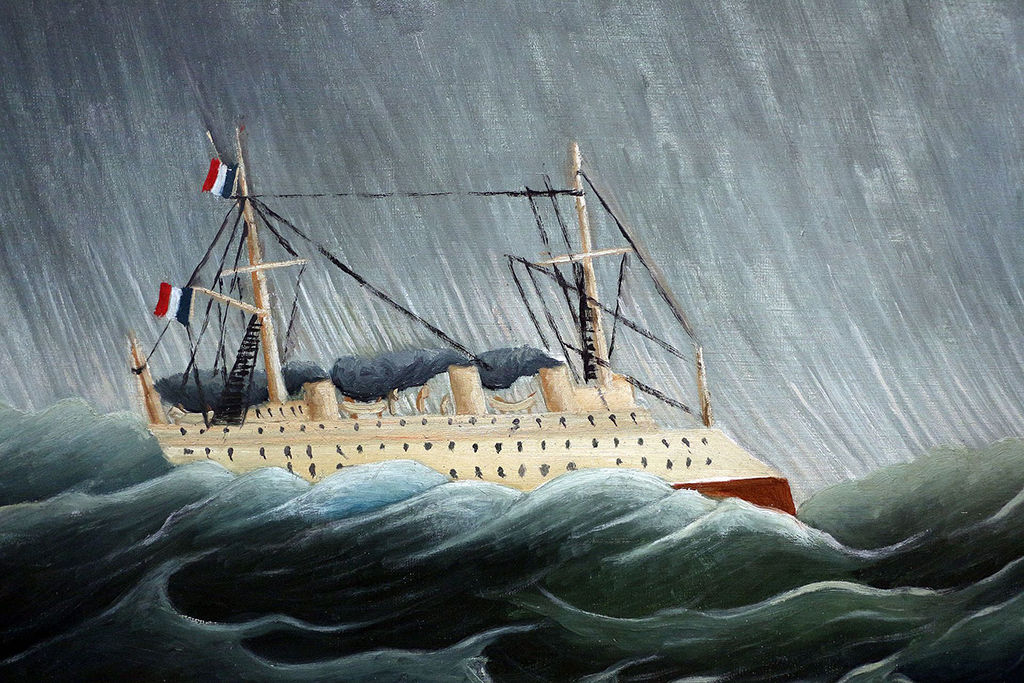
A pale steamship presses towards the right edge of Henri Rousseau’s The Ship in the Tempest, its orange prow almost meeting a rising wave. Rain fills the sky. Below the little vessel, the sea opens into dark hollows and curls back into overlapping ridges. The ship is packed with windows, funnels, ropes and flags, yet these careful details offer little reassurance: the water hides much of its hull, and the storm occupies nearly everything around it.
The Musée de l’Orangerie calls the painting Le Navire dans la tempête and dates it about 1899. It is an oil on canvas measuring 54 × 65 centimetres, inventory RF 1960 27.[1] Within that modest rectangle, Rousseau makes the encounter between a built object and moving water feel both intimate and unsettling.
At a Glance
- ArtistHenri Rousseau
- SubjectThe Ship in the Tempest
- ExploreA ship built from small marks; Funnels, masts and a web of rigging
This work across Henri Rousseau’s career
Carnival Evening
1886 [2]The Merry Jesters
1906 [7]The Snake Charmer
1907 [8]Contents
- A ship built from small marks
- Funnels, masts and a web of rigging
- Waves that overlap like moving walls
- A curtain of rain
- Warm colour in a cold setting
- What kind of ship is it?
- From private collections to the Orangerie
- Annotated details
A ship built from small marks
The hull gives the eye its first firm shape. It stretches across the lower middle of the picture, a warm, light band caught between the grey sky and the blue-green sea. Its length is easy to grasp, even though the waves repeatedly conceal its bottom edge. At the right, the vessel narrows into a low projecting bow. The orange-red tip provides an abrupt ending to the pale body, like a small blade pushed towards the next swell.
Rows of dark portholes punctuate the ship’s side. They are tiny beside the waves, but their repetition makes the vessel seem densely inhabited and minutely organised. Their spacing establishes a measured rhythm that the sea cannot share. Some openings sit higher than others, and the deck breaks into small changes of level. This is a machine assembled from parts, with the viewer invited to inspect each one while the surrounding water refuses to settle.
No individual passenger draws us into a personal story. At this scale, the ship itself becomes the vulnerable presence. We cannot enter its rooms or see how anybody responds to the weather. The distance gives us a broad view of the danger while withholding the experiences of those who might be aboard. The little dark openings suggest an interior that remains inaccessible, protected by a hull whose lower boundary is already disappearing behind water.
Funnels, masts and a web of rigging
Above the hull, three yellowish funnels interrupt the low line of the deck. Their dark smoke gathers into a broad, uneven band streaming towards the left. The funnels make a short series of upright shapes, while the smoke connects them across the picture. That connection draws attention away from any single chimney and towards the pressure of the weather passing over the whole vessel.
Two tall masts give the ship a second, much more delicate structure. Horizontal yards and slanting ropes form a web above the deck. The fine dark lines cross pale patches of sky, so that even the narrowest strands remain legible. Ladder-like rigging rises beside the masts. Looking from the blunt funnels to these taut, thin connections, we move between weight and fragility within the same small object.
The ropes also change the pace of looking. The hull can be understood in a glance; the rigging takes longer to follow. A diagonal descends towards a mast, meets another line, then returns the eye to the deck. These little triangles hold together visually even as the sea breaks into curves below. Their tension belongs to the ship’s construction, whereas the surrounding rain creates a much larger pattern that passes across its space.
Two small tricolours hang at different heights on the left mast. Their red, white and blue touches are conspicuous because so little strong colour interrupts the sky. The flags are recognisable signs within an otherwise uncertain setting. They also pull the eye upwards from the hull, making the mast feel unusually exposed. Small as they are, their sharp colour survives the surrounding grey.
The Ship in the Tempest — Henri Rousseau.
Waves that overlap like moving walls
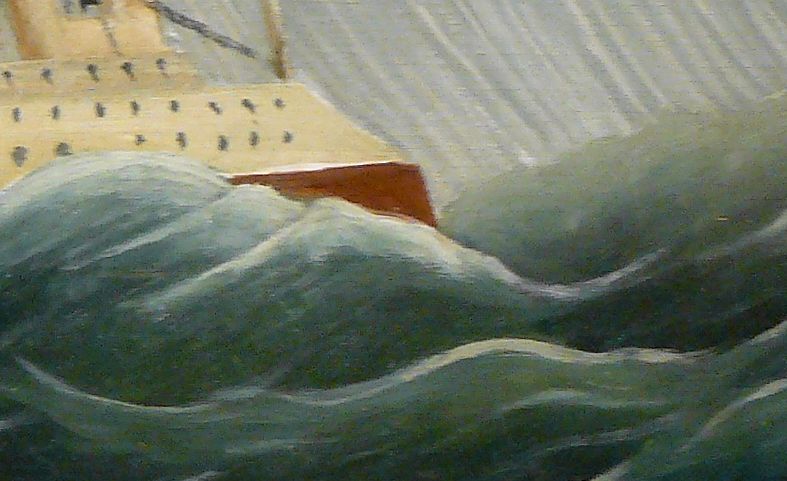
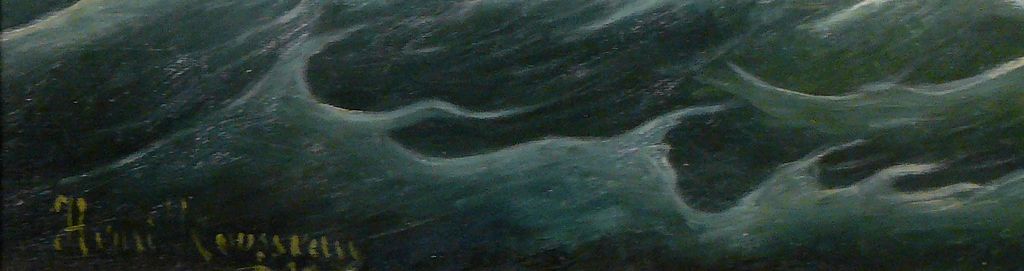
The nearest water has a mass the ship cannot match. Great dark shapes swell across the foreground, each bounded by a lighter, curling edge. One ridge rises immediately in front of the hull; another sweeps diagonally through the lower half of the painting. Between them are deep pockets of almost black green. These hollows give the water depth without opening a clear route through it.
Rousseau makes the waves distinct enough for us to trace their contours. Pale foam runs along a crest, broadens in places, then thins until it nearly disappears. Beneath it, strokes of green and blue follow the swelling form. The crests overlap, concealing the beginnings and endings of their neighbours. We can identify separate rolls of water, but cannot fit them into one stable surface.
This overlap matters at the ship’s bow. The orange tip sits low against the oncoming swell, with very little apparent space between them. The viewer can imagine the next moment of contact, yet the painting holds the two shapes apart. Elsewhere the waves mask the vessel’s base, making its full height impossible to judge. The sea repeatedly takes possession of the outline through which we recognise the ship.
The foreground also establishes our position. We look across water that rises between us and the vessel; there is no reassuring strip of shore underfoot. The closest waves are large enough to obscure what lies behind them. Their repeated curves keep drawing the eye downwards, away from the small, detailed ship and into the broad expanse of water. The picture lets us inspect the vessel’s equipment while making our own vantage feel precarious.
A curtain of rain
The sky occupies more than half the canvas. Its emptiness is deceptive: fine, slanting strokes carry the rain across that enormous area. These marks become especially visible against the lighter grey behind the right mast and bow. They join the upper edge of the picture to the water, leaving little sense of open air through which the ship might escape.
The rain has a more uniform direction than the sea. Its close parallel strokes make the weather feel continuous, while the waves turn through successive arcs. The rigging introduces further diagonals, but those lines belong to a bounded structure. Rain extends beyond them in every direction. Looking between the ropes and the downpour reveals two very different kinds of order: a small network assembled around the ship, and a great moving field that exceeds it.
Smoke adds a third motion. It streams back to the left, low above the deck, while the rain slopes down towards the right. The mast tops, smoke and wave crests therefore pull the eye along different paths. We do not need a meteorological explanation to feel the disturbance. The picture makes the storm active through the conflicting directions of visible marks.
There is scarcely a clear horizon to separate sky from sea. Behind the ship, the grey and green meet in a soft, unsettled band. That uncertainty removes a common point of orientation from the scene. The masts give us verticals and the hull offers a long horizontal, but neither can quiet the surrounding space. The ship supplies the bearings by which we read a world that appears to be losing its boundaries.
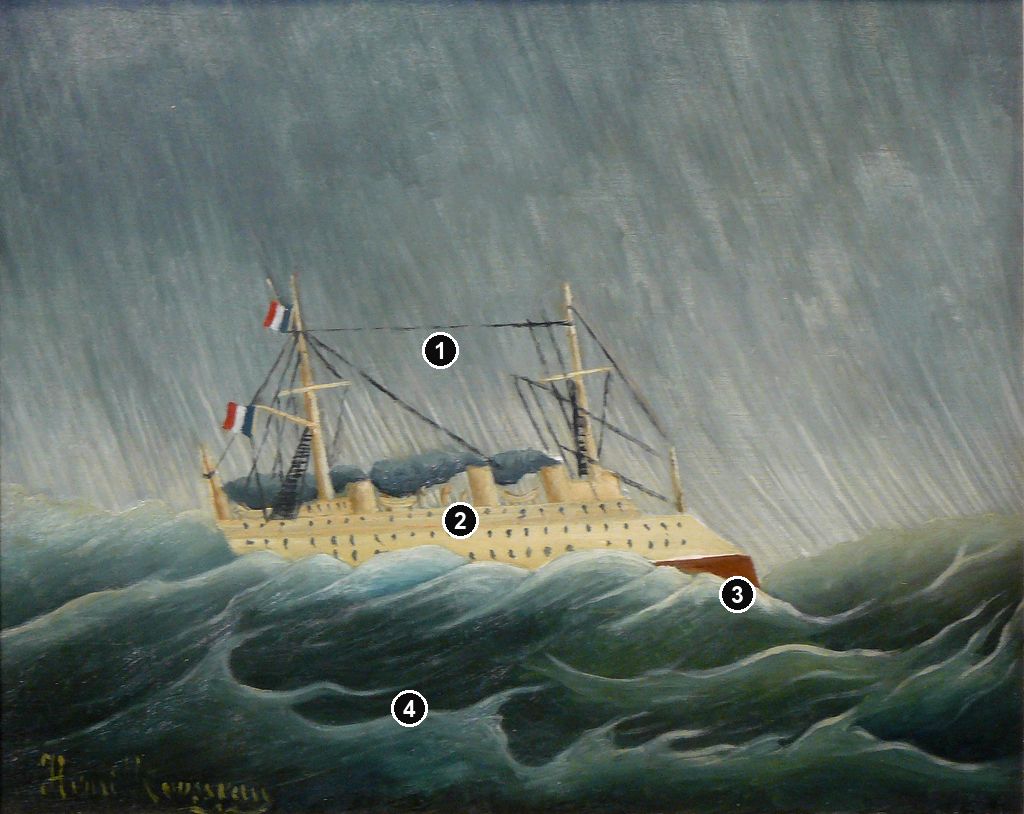
Annotated Details from The Ship in the Tempest
The numbered points identify visible features discussed in this article. Return from each detail to the whole composition. Henri Rousseau, Le Navire dans la tempête (The Ship in the Tempest), circa 1899. Musée de l’Orangerie, Paris, RF 1960 27. Photograph: Siren-Com, Wikimedia Commons. Image source. CC BY-SA 3.0. Numbered overview and cropped details adapted from Siren-Com’s photograph. The overview is resized and numbered; details are cropped. These adaptations are offered under CC BY-SA 3.0. No recolouring or retouching.
Details from THE SHIP IN THE TEMPEST
Move between the ship’s small repeated parts and the much larger curves of the waves surrounding it.
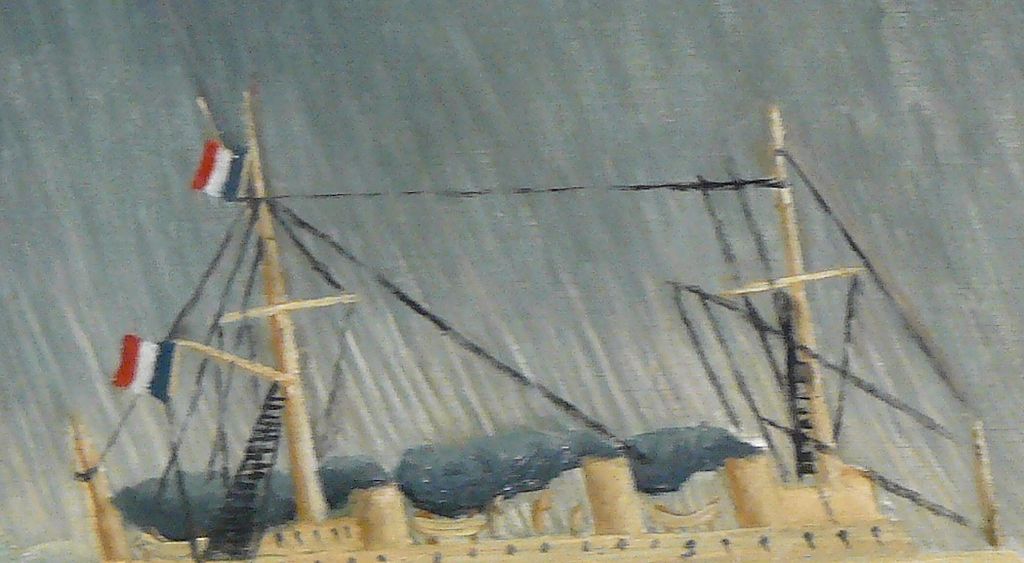
Two masts and a web of fine lines
Thin yards and sloping ropes connect the masts above the deck. Two small tricolours interrupt the pale sky on the left, while ladder-like rigging leads the eye down towards the ship.
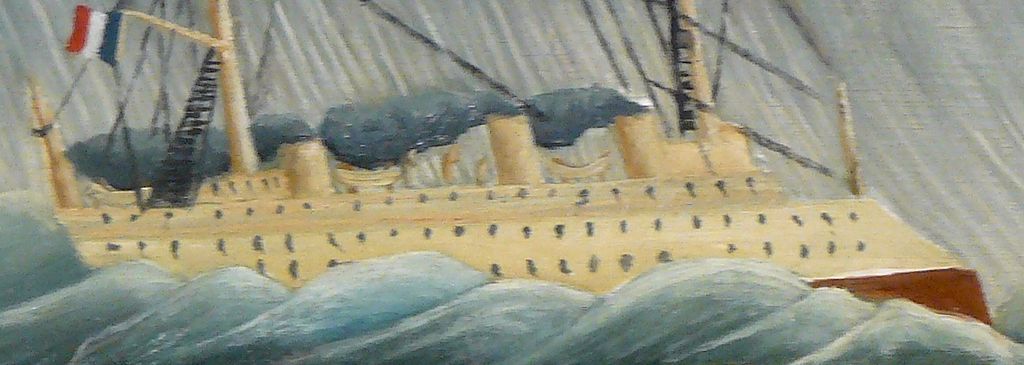
A pale hull and three funnels
Repeated dark openings punctuate the long yellow body. Three short funnels and a band of smoke give the compact vessel another rhythm above the crowded rows of portholes.
The bow approaches a rising wave
The warm projecting tip almost meets the next blue-green swell. Pale foam draws a curving boundary across the ship’s lower edge, leaving its full height uncertain.
Crests and dark foreground hollows
Light edges curl around the broad dark shapes of the nearest water. Their overlaps make a succession of ridges and hollows rather than a single stable surface.
Warm colour in a cold setting
The vessel’s pale yellow is essential to its visibility. Against a brighter sky it might dissolve; here it stands apart from the cold greens and greys on every side. The same warmth passes from the hull into the funnels and masts, joining many separate parts into a single object. Dark portholes and ropes then sharpen that unity with small, precise interruptions.
The orange bow and the red patches of the flags have a different effect. They are concentrated points, separated by the length and height of the ship. One holds our attention near the waterline; the others lift it into the rain. Following them draws an irregular path through the vessel, preventing its pale body from becoming merely a stripe across the middle distance.
The light foam gives the sea a comparable clarity. It outlines water without making it transparent. Beneath the crests, the dark green remains opaque, so we see the shape of the danger more readily than anything under its surface. This play of broad colour and exact contour is a useful way into Rousseau’s style and technique: here, even the smallest detail contributes to the relationship between the vessel and its surroundings.
What kind of ship is it?
The Orangerie describes a hybrid: liner-like portholes accompany a warship’s ram-shaped bow, features also found in contemporary toy boats. It suggests that the offset third funnel may recall the cruiser D’Entrecasteaux, launched in 1896.[1] These proposals help explain the vessel’s curious combination of delicate equipment and blunt, almost model-like solidity. They do not establish a single prototype.
The 1985 Rousseau catalogue reports Yann Le Pichon’s cruiser identification and proposes an illustrated newspaper, a fairground model ship or a diorama at the 1889 Paris World’s Fair as possible sources. It also compares the waves with Hokusai’s famous woodcut.[12] The comparison is a scholar’s analogy, rather than proof that Rousseau copied a particular print.
The stage-like effect is visible in the painting itself. Successive waves present strong edges, while the rain spreads across the sky like a continuous backdrop. The ship seems both precisely constructed and oddly isolated within that setting. Such qualities make the proposed popular-image sources worth considering, although the scene remains compelling without a settled account of how its components reached Rousseau.
From private collections to the Orangerie
The museum traces the painting through Ambroise Vollard, Paul Guillaume from 1931 and Domenica Walter. The French state bought it from Madame Jean Walter in 1959 with support from the Société des Amis du Louvre; its physical entry into the Orangerie followed in 1977.[1]
Seen today, the painting holds our attention through the unequal scale of its opposing forces. The vessel contains dozens of distinguishable parts; the storm needs only rain, smoke and a handful of great curves. As the eye moves between them, the careful little construction seems by turns sturdy and overwhelmed. Rousseau leaves its onward passage suspended at the very point where the bow approaches the next wave.
Henri Rousseau artworks directory
This directory brings together works covered on this site and other works documented in the cited museum records and catalogues. Alternate titles share one entry; distinct versions remain separate. Historical dates for works without an article follow the cited catalogues. This is not a catalogue raisonné.
Frequently Asked Questions
At the Musée de l’Orangerie in Paris.[1]
Look for the two flags on the left mast, the staggered portholes, the third funnel and the fine ladder-like rigging. Each introduces a different rhythm within the pale shape of the ship.
Discussion
Look again at the images and ideas explored in The Ship in the Tempest. These editorial prompts invite your observations.
Reader Insights
How does your sense of the ship change when you look first at its portholes and then at the nearest waves?
Follow the directions of the rain, smoke and ropes. Where do they lead your eye, and where do those movements conflict?
Does the crisp outline of each wave make the storm feel more immediate or more like a constructed spectacle?
Join the Conversation
Share a detail, comparison or question about The Ship in the Tempest below.
References
- Musée de l’Orangerie. Le Navire dans la tempête, RF 1960 27, commentary, metadata and provenance, updated 16 October 2026. View source. (in French).
- Philadelphia Museum of Art, Carnival Evening,1963-181-64,object59593. View source.
- Musée de l’Orangerie / Juliette Degennes, Henri Rousseau,L’ambition de la peinture: Un artiste dans son époque (in French). View source.
- National Gallery, Surprised!, NG6421. View source.
- Musée d’Orsay, La Guerre,RF19461 (in French). View source.
- MoMA, The Sleeping Gypsy. View source.
- Philadelphia Museum of Art, The Merry Jesters, 1950-134-176, object51097. View source.
- Musée d’Orsay, La Charmeuse de serpents, RF 1937 7 (in French). View source.
- Musée de l’Orangerie, La Carriole du Père Junier, RF 1960 26 (in French). View source.
- Solomon R. Guggenheim Museum / Cornelia Lauf, The Football Players,60.1583: current collection record. View source.
- MoMA, The Dream, 252.1954. View source.
- Museum of Modern Art. Henri Rousseau: Essays, 1985, catalogue entry 15, “The Boat in the Storm,” p. 132; colour plate p. 133. View source.
- The Museum of Modern Art, Henri Rousseau: Essays (1985), selected catalogue entries, chronology and notes on early devotees. View source. Selected entries, chronology (pp.91–95) and early-devotee notes (pp.262–264) were consulted. Historical collection credits do not establish present ownership.
- Daniel Catton Rich, Henri Rousseau (The Museum of Modern Art, 1942), selected drawings and landscape studies; historical catalogue. View source. The dated 1942 publication is used for the two Quai d’Auteuil ink views; its Malakoff date differs from the 1985 catalogue.
- MANAS, Laval, Henri Rousseau, dit le Douanier, urban landscapes and preparatory study (in French). View source.
- National Gallery of Art, Self-Portrait (1895), pen-and-ink drawing, accession 1995.47.66. View source.
- The Museum of Modern Art, War (published January 1895), lithograph, accession 684.1943. View source.
- Barnes Foundation, Landscape and Four Young Girls, object 5521, BF855. View source.


 Henri Rousseau.jpg)


 Henri Rousseau.jpg)