



 by Tom Gurney
Tom Gurney BSc (Hons) is an art history expert with over 20 years experience
Published on June 19, 2020 / Updated on October 29, 2026
Email: tomgurney1@gmail.com / Phone: +44 7429 011000
Flowers in a Vase II: Introduction
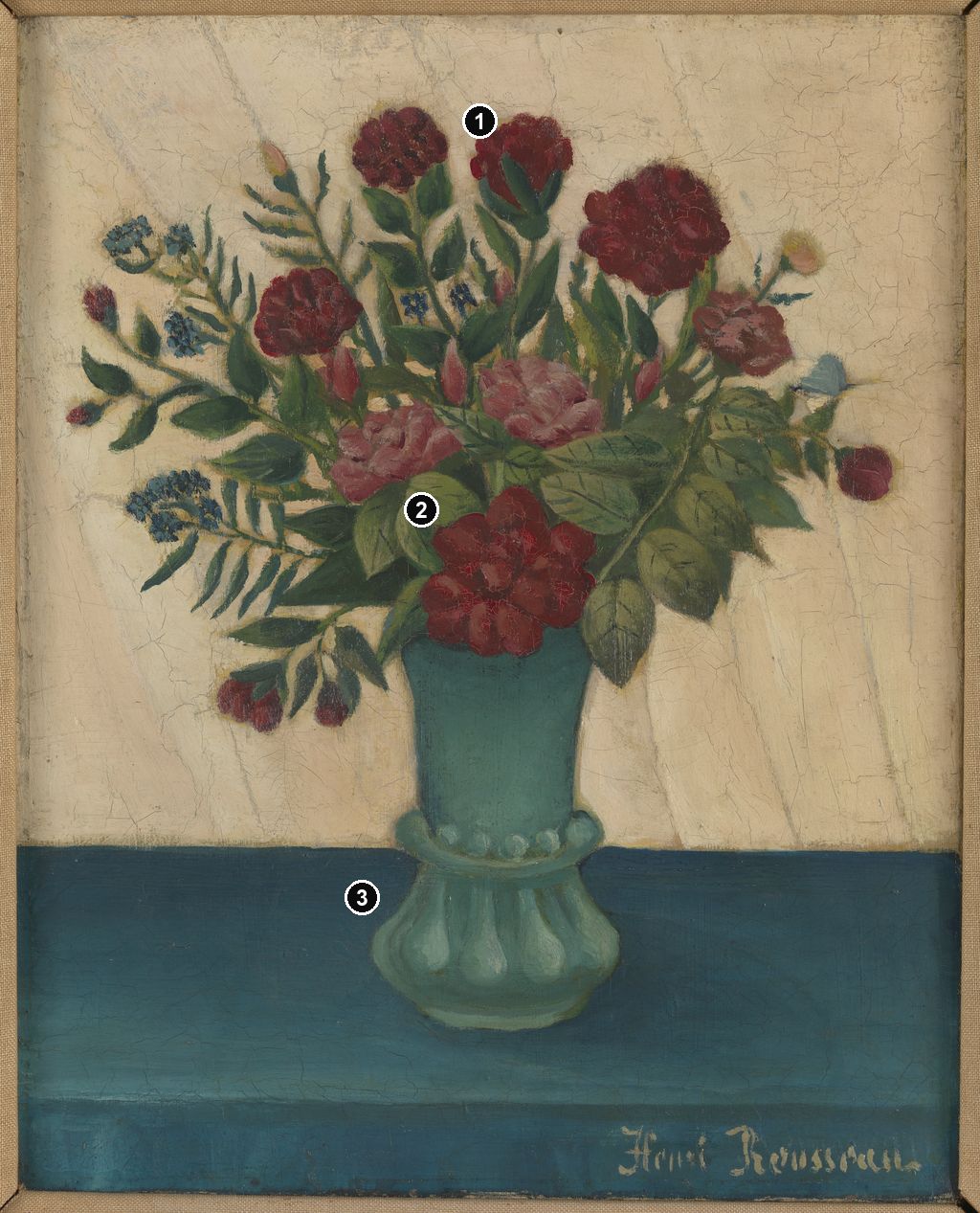
Red flowers spread across a pale background, their rounded heads rising above a crowded centre of pink petals and green leaves. Below them, a green vase narrows before opening into a broad, ornamented foot. In Henri Rousseau’s Flowers in a Vase, the bouquet seems to reach in several directions at once, while the vessel gathers its movement into a steady vertical shape. The blue-green table gives the whole arrangement a firm place to stand.
At a Glance
- ArtistHenri Rousseau
- SubjectFlowers in a Vase II
- ExploreThe painting in Providence; A fan of flowers
This work across Henri Rousseau’s career
Carnival Evening
1886 [1]Flowers in a Vase II (current article)
c. 1897–1899 [6]The Merry Jesters
1906 [7]The Snake Charmer
1907 [8]Contents
- The painting in Providence
- A fan of flowers
- Leaves, petals and the spaces between
- The vase and its ornament
- A room reduced to a few planes
- A small picture and its later owners
- Annotated details
The painting in Providence
The work known here as Flowers in a Vase II belongs to the RISD Museum in Providence, Rhode Island. The museum titles it Flowers in a Vase and dates it to about 1897–1899. An oil painting on canvas measuring 41.3 × 33.3 centimetres, it bears Rousseau’s signature at the lower right and has the object number 42.220.[6] The numeral in this page’s title distinguishes this bouquet from others bearing similar names; it should not be read as a numbered series supplied by the artist.
The flowers fill much of this small canvas. There is room to take in the bouquet at once, then return to the smaller interruptions along its edges: a pink bud near the upper left, a tiny blue cluster, the red flower hanging out towards the right. These details reward a close approach without dissolving the broad silhouette.
A fan of flowers
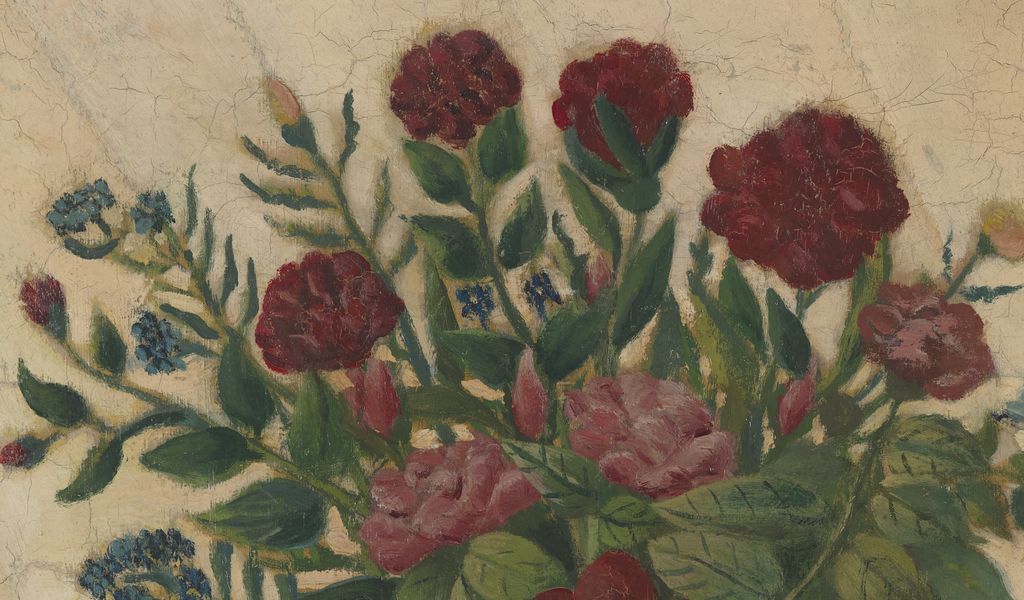
The bouquet opens out from the vase like an uneven fan. Two tall red heads occupy the upper centre, with another, larger bloom spreading to their right. Their stems and enclosing green forms remain visible against the cream ground. Further down, flowers overlap much more closely. The composition moves from these separated upper accents towards a dense middle in which stems, petals and leaves crowd together.
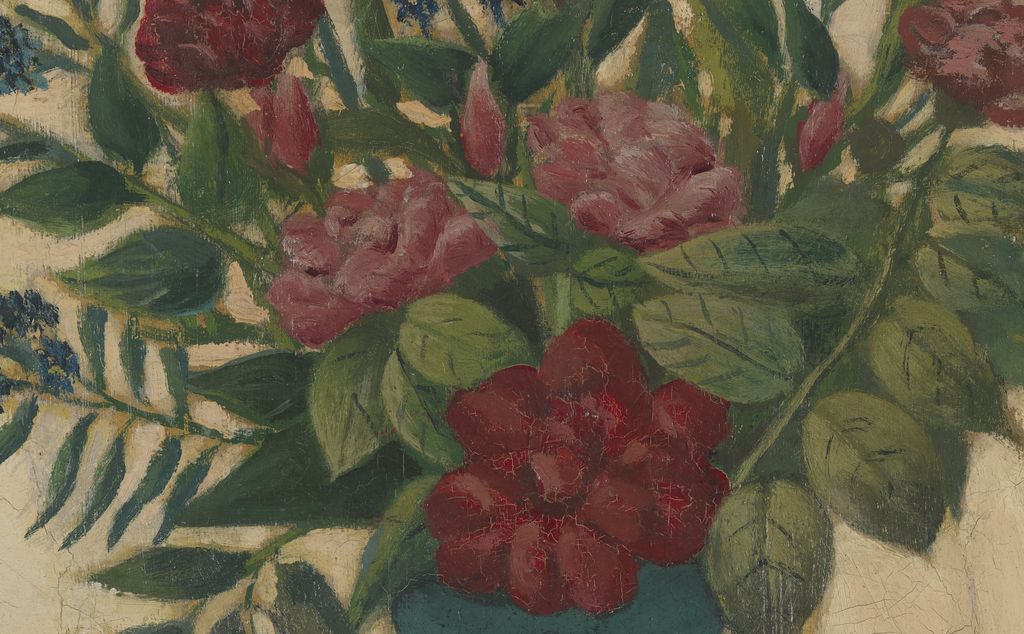
Pink flowers help articulate that middle. Their paler petals stand forward against the surrounding foliage, forming a loose diagonal across the bouquet. The red flower near the mouth of the vase brings the stronger colour down towards the vessel. Our attention can travel from the upper blooms, through the pink centre, to this lower red cluster, following a chain of rounded shapes. The bouquet has a clear overall direction even though its individual parts turn different ways.
The side branches complicate that descent. On the left, narrow leaves spread from a slanting stem, while small blue flowers punctuate the spaces between them. Lower down, another leafy branch drops towards two hanging red heads. At the right, a slender stem extends towards an isolated red bloom. These outlying forms make the bouquet wider than its tightly packed centre first suggests. They also leave small pockets of pale background within the arrangement, so that air seems to enter between the stems.
This irregular outline gives the flowers much of their character. A perfectly balanced bouquet would let the eye settle quickly on its centre. Here the high red heads, the outward-reaching branches and the low drooping buds keep shifting the balance. The vase remains central, but the living material above it never forms a rigid triangle.
Leaves, petals and the spaces between
Rousseau gives the leaves enough definition to make them active shapes in their own right. Broad leaves across the lower middle carry conspicuous dark veins. Narrower leaves turn into pointed silhouettes along the edges. Some stand upright beside the tall stems; others stretch sideways or bend downwards. Their different directions create a framework within which the more rounded flowers sit.
The greens also vary in weight. A pale leaf can read as a broad surface, while a darker one becomes almost an opening in the bouquet. Where several shapes overlap, following a single stem becomes difficult. The eye alternates between recognising a leaf and seeing an interlocking patch of colour. The arrangement remains legible as cut flowers, yet its intricate centre has the density of a pattern.
The blue clusters introduce another scale. Beside the larger red and pink heads, their small, closely grouped touches make a finer texture. They are especially effective towards the left, where the background surrounds them and makes each cluster easy to find. Blue also appears near the right edge, interrupting the warmer petals there. Across the bouquet, these scattered cool accents keep the red from becoming a single continuous mass.
The flowers do not all offer the same view of themselves. Some heads open towards us, others tilt, and the buds remain folded. This variety gives the arrangement a sense of abundance without requiring a deep recession into space. The different forms are gathered near the picture surface, where the relationships between their edges remain easy to inspect.
The vase and its ornament
The vessel makes a strong contrast with the bouquet’s branching structure. Its opaque green body contains the stems behind a continuous surface. A darkened side and lighter passages suggest its curved volume, while its upper edge is partly concealed by flowers and foliage. The bouquet seems to overflow the vessel before we can examine its opening closely.
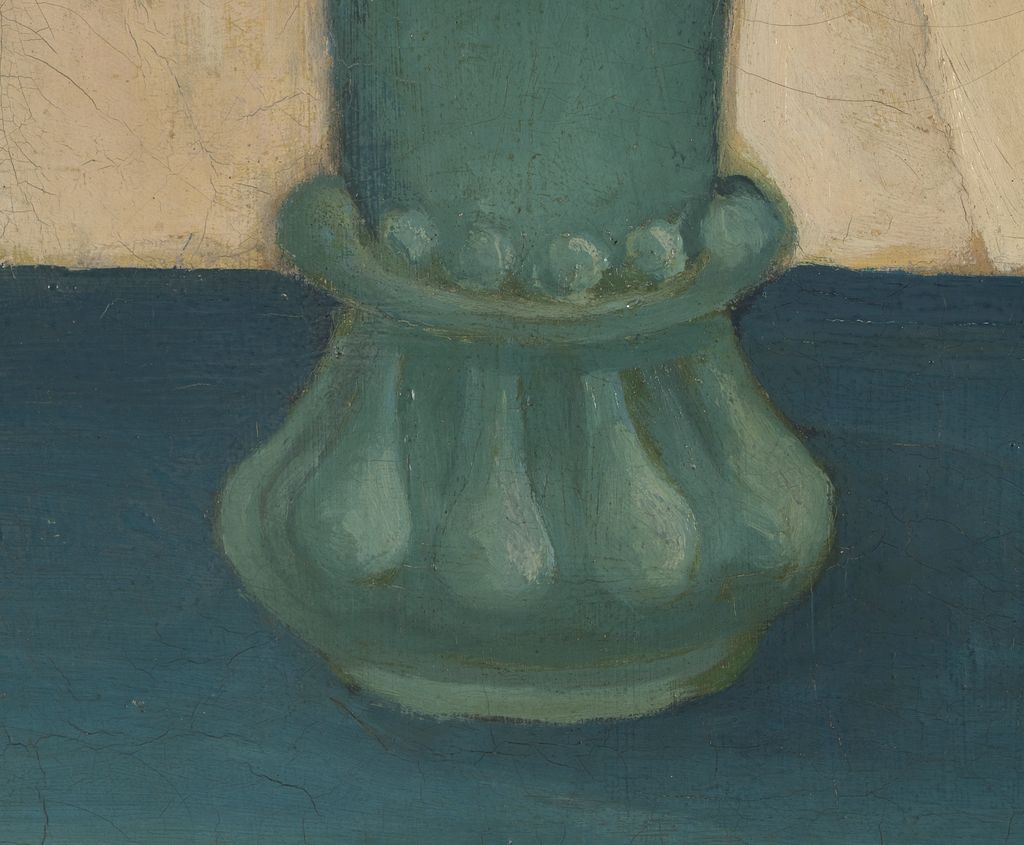
Below the tall body, a collar of rounded pale ornaments marks the transition to the spreading foot. Large, elongated forms decorate that lower section, their light centres and darker borders giving the base a fluted appearance. The repetition is clear enough to slow the eye after the more varied shapes above. The vase is an object worth looking at, with an ornamental rhythm of its own.
Its curves answer several features of the flowers. The small rounded forms at the collar recall the compact heads and buds; the swelling foot echoes the broader mass of the bouquet. Between them, the narrow waist creates a pause. The whole arrangement expands, contracts and expands again as the eye moves from the upper flowers to the bottom of the vessel.
Colour joins the vase to the tabletop. Both occupy the green-blue range, though the vase is lighter and more softly varied. Against the darker table, its foot remains distinct. Above the table’s horizon, the body stands out against cream. The same object therefore meets two different backgrounds, and each makes a different part of its silhouette clear.
Annotated Details from Flowers in a Vase II
The numbered points identify visible features discussed in this article. Return from each detail to the whole composition. Henri Rousseau, Flowers in a Vase, c.1897–1899. RISD Museum, Gift of Mrs. Murray S. Danforth, 42.220. Courtesy of the RISD Museum, Providence, RI. Image source. CC0 / Public domain. Numbers added to a separate resized overview retaining the museum image’s narrow outer linen rim. Three frame-free details cropped directly from the 300 dpi original without enlargement, recolouring, cleaning or retouching.
Details from FLOWERS IN A VASE II
Compare the bouquet’s different flower sizes, follow the leaves through its pink centre, then look at the repeated ornament of the vase.
Red heads and smaller blue clusters
The tall red blooms are spaced against the pale ground, while smaller blue clusters extend along the left-hand branches. Large rounded heads and fine groups of flowers give the bouquet several distinct scales.
Pink petals and strongly marked leaves
Pale pink flowers overlap across the bouquet’s middle. Broad green leaves below and beside them carry dark veins, setting their pointed, structured shapes against the softer curves of the petals.
The vase’s rounded collar and fluted foot
Rounded pale ornaments mark the collar above a broad, fluted foot. The table’s horizontal boundary passes behind the vessel near this transition, helping its changing silhouette remain clear.
A room reduced to a few planes
The setting is spare. A broad pale field rises behind the bouquet, crossed by faint vertical and diagonal changes that suggest folds. The table runs horizontally across the lower part of the canvas. There are no other household objects to compete with the vase, and no detailed room extending behind it. The arrangement occupies nearly all the space that has been described.
That simplicity makes the table’s horizontal boundary unusually effective. It passes behind the vase close to the collar, separating the light upper field from the darker lower one. The flowers belong mostly to the pale area, where their red and green edges are sharp; the ornamented foot belongs to the table, where its lighter colour holds it forward. A change of background helps organise the object as decisively as any drawn contour.
Near the bottom, a second horizontal change suggests the front edge of the table. Rousseau’s pale signature sits towards the right in this darker strip. The bouquet, vase and table are thus held between an irregular upper outline and a sequence of quiet horizontal divisions below. The eye can wander through the flowers and still return to a stable structure.
A small picture and its later owners
This canvas, little more than forty centimetres high, asks for little wall space. Its scale helps illuminate the Musée de l’Orangerie’s account of Rousseau’s search for customers: small decorative pictures brought his work within reach of artisans, shopkeepers and lower-middle-class buyers with modest budgets and interiors.[12] That context cannot identify this bouquet’s first purchaser. Among Rousseau’s paintings, it offers an encounter at the distance of a domestic object.
The RISD record establishes a later sequence of ownership. The picture was still in Paul Guillaume’s Paris collection in 1927. By September 1942 it was with Carroll Carstairs Gallery in New York, which sold it to Mrs. Murray S. Danforth of Providence. She gave it to the RISD Museum on September 1, 1942.[6] The published chain leaves the intervening years open. It supplies no basis for identifying the occasion on which Rousseau painted the bouquet.
Henri Rousseau artworks directory
This directory brings together works covered on this site and other works documented in the cited museum records and catalogues. Alternate titles share one entry; distinct versions remain separate. Historical dates for works without an article follow the cited catalogues. This is not a catalogue raisonné.
Frequently Asked Questions
The RISD Museum dates its Flowers in a Vase to about 1897–1899. An exact year is not established in its current record.[6]
It is in the RISD Museum in Providence, Rhode Island, object number 42.220. Mrs. Murray S. Danforth gave it to the museum in 1942.[6]
Start with the bouquet’s outline. Follow the tall red flowers down through the pink centre, then look outwards towards the hanging buds. Finally, compare those irregular movements with the repeated ornament around the vase’s base.
Discussion
Look again at the images and ideas explored in Flowers in a Vase II. These editorial prompts invite your observations.
Reader Insights
How does the pale background change your experience of the flowers’ irregular outline?
Which gives the arrangement more stability: the shape of the vase, the table’s horizontal lines, or the repetition of colour?
Join the Conversation
Share a detail, comparison or question about Flowers in a Vase II below.
References
- Philadelphia Museum of Art, Carnival Evening,1963-181-64,object59593. View source.
- Musée de l’Orangerie / Juliette Degennes, Henri Rousseau,L’ambition de la peinture: Un artiste dans son époque (in French). View source.
- National Gallery, Surprised!, NG6421. View source.
- Musée d’Orsay, La Guerre,RF19461 (in French). View source.
- MoMA, The Sleeping Gypsy. View source.
- RISD Museum. Flowers in a Vase, Henri Rousseau, ca. 1897–1899, object 42.220, current collection record, especially “Dimensions,” “Signature / Inscription / Marks,” “Credit / Object Number” and “Provenance”; accessed October 23, 2026. View source.
- Philadelphia Museum of Art, The Merry Jesters, 1950-134-176, object51097. View source.
- Musée d’Orsay, La Charmeuse de serpents, RF 1937 7 (in French). View source.
- Musée de l’Orangerie, La Carriole du Père Junier, RF 1960 26 (in French). View source.
- Solomon R. Guggenheim Museum / Cornelia Lauf, The Football Players,60.1583: current collection record. View source.
- MoMA, The Dream, 252.1954. View source.
- Musée de l’Orangerie. Henri Rousseau, l’ambition de la peinture, exhibition text, March 25–July 20, 2026, section “Variations et déclinaisons. À la recherche du marché”; accessed October 23, 2026. View source. (in French).
- The Museum of Modern Art, Henri Rousseau: Essays (1985), selected catalogue entries, chronology and notes on early devotees. View source. Selected entries, chronology (pp.91–95) and early-devotee notes (pp.262–264) were consulted. Historical collection credits do not establish present ownership.
- Daniel Catton Rich, Henri Rousseau (The Museum of Modern Art, 1942), selected drawings and landscape studies; historical catalogue. View source. The dated 1942 publication is used for the two Quai d’Auteuil ink views; its Malakoff date differs from the 1985 catalogue.
- MANAS, Laval, Henri Rousseau, dit le Douanier, urban landscapes and preparatory study (in French). View source.
- National Gallery of Art, Self-Portrait (1895), pen-and-ink drawing, accession 1995.47.66. View source.
- The Museum of Modern Art, War (published January 1895), lithograph, accession 684.1943. View source.
- Barnes Foundation, Landscape and Four Young Girls, object 5521, BF855. View source.


 Henri Rousseau.jpg)


 Henri Rousseau.jpg)