



 by Tom Gurney
Tom Gurney BSc (Hons) is an art history expert with over 20 years experience
Published on June 19, 2020 / Updated on October 29, 2026
Email: tomgurney1@gmail.com / Phone: +44 7429 011000
Statue of Diana in the Park: Introduction
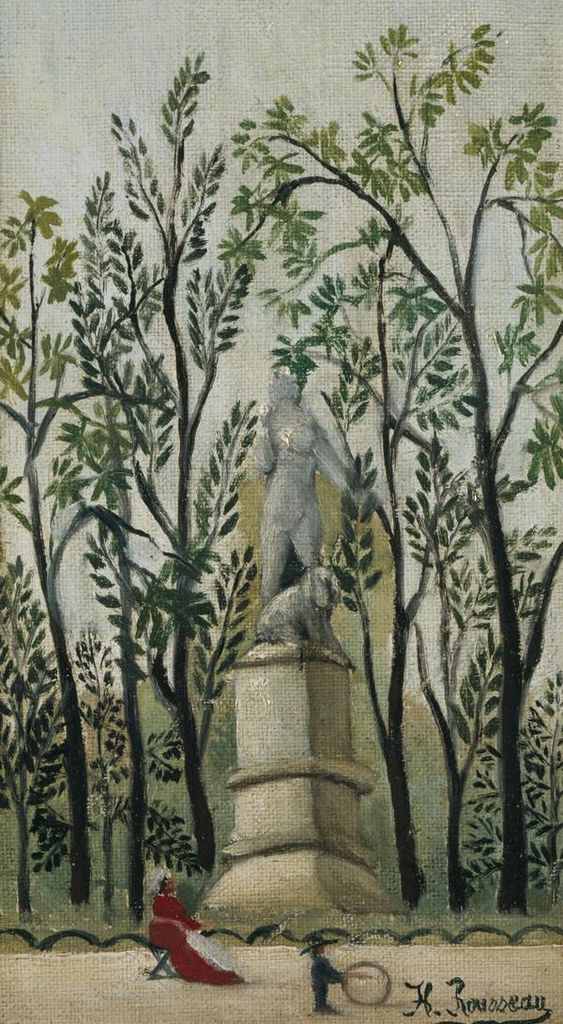
A pale statue rises among slender trees, with a seated woman and a child gathered into the small strip of ground beneath it. Henri Rousseau gives this quiet park scene an unusually tall, narrow frame. The branches climb far above the sculpture, then give way to open sky. At first the monument seems to command the whole picture; closer looking reveals how much its presence depends on the fragile lines, small circles and single red dress around it.
At a Glance
- ArtistHenri Rousseau
- SubjectStatue of Diana in the Park
- ExploreA small painting with a tall subject; Stone seen through branches
This work across Henri Rousseau’s career
Carnival Evening
1886 [1]The Merry Jesters
1906 [6]The Snake Charmer
1907 [7]Statue of Diana in the Park (current article)
c. 1909 (dating debated) [11]Contents
- A small painting with a tall subject
- Stone seen through branches
- A canopy of fine marks
- The woman, the child and the fence
- A view of the Tuileries
- Annotated details
A small painting with a tall subject
The National Galleries of Scotland holds the work as Statue de Diane au Parc, accession GMA 4078: oil on canvas laid on board, 23.5 × 11.2 cm, bequeathed by Gabrielle Keiller in 1995. Its catalogue date is about 1909. The painting is undated, however, and the museum acknowledges arguments for both the late 1880s and Rousseau’s final years.[11]
Those modest measurements make the composition especially striking. The image is more than twice as high as it is wide, and the pedestal carries the statue well above the people. The uppermost part, however, contains no object against which to judge distance. Its pale grey-blue expanse extends beyond the tips of the trees, leaving even the monument in the lower, inhabited portion of the picture. The sky prevents the narrow frame from feeling closed at the top.
The eye can enter by several routes. The red dress immediately attracts attention at the lower left. From there the stepped base leads upward through the stone support to the statue’s body and head. Alternatively, a dark tree trunk draws the gaze straight toward the branching canopy. These competing paths give the composition more movement than its still subject suggests. Looking rises through the picture while the figures remain close to its bottom edge.
Stone seen through branches
The statue occupies the centre without receiving an entirely clear space of its own. Leaves overlap its head and shoulders, and dark stems pass close beside its pale outline. From a distance, the body can seem to emerge from the same green-and-grey fabric as the surrounding trees. Its contours become easier to follow as the eye separates the cool stone from the yellowish green behind it. The sculpture has to be discovered within the planting.
Below it, the pedestal is much easier to read. Broad changes of tone distinguish its faces, while projecting ledges interrupt the upright form. The bottom spreads into a heavy, sloping base. Each tier gives the eye a resting place after the thin, restless strokes of the foliage. Rousseau makes the support feel solid through this sequence of widening and narrowing shapes; it can be read clearly even when the sculpture above becomes elusive.
A small animal shape rests beside the statue’s legs. Its low, rounded form adds another transition between the standing body and the broader stone beneath. It draws attention to the point where the figure meets its support. Above, the pale torso rises almost like another upright stem. Below, the pedestal gathers everything into larger, simpler masses. The meeting of body, animal and base provides a compact cluster of forms at the centre of the trees.
A canopy of fine marks
The tree trunks establish a loose enclosure around the monument. Some remain nearly vertical; others bend or split, sending diagonal limbs across the pale background. On the right, a long curved branch reaches inward and upward. Its arc helps frame the sculpture, but smaller offshoots break the curve into a more irregular pattern. The left side answers with a straighter, densely marked group of stems. The balance is easy to feel without being symmetrical.
The leaves change as the gaze moves through the picture. Narrow strokes cluster along some branches like small paired marks; elsewhere, broader green shapes spread outward in open groups. Darker foliage thickens the lower sides, while the upper branches carry fewer marks and leave more sky between them. This difference gives the trees a sense of height. It also allows the uppermost leaves to register individually against the light ground.
The spaces between the branches matter as much as their dark outlines. Small wedges and longer slivers of sky keep the planting transparent. The statue remains accessible through these openings, although no single gap neatly encloses its full silhouette. Our attention moves between leaves and stone, alternately following the surface pattern and looking into the garden. This shifting experience makes the picture rewarding at close range: a branch can interrupt the view, then become the line that leads the eye back toward the centre.
The green background is softer and less sharply divided than the foreground trees. It supplies a veil behind the sculpture and lets the nearer trunks stand out. Along the sides, almost black passages hold the structure together. Across the middle, lighter greens prevent the central figure from becoming a pale cut-out against an empty backdrop. The varying density of the foliage keeps the central area lighter than the crowded edges.
The woman, the child and the fence
The human figures inhabit a shallow foreground band. At the left, the seated woman’s red clothing spreads down and to the right from a tiny pale head. A dark angular support beneath her suggests the structure of a folding chair. Her dress is the strongest warm colour in the composition, and its broad shape holds attention even though the person herself is minute. Against the pale path, it forms a clear counterweight to the tall grey monument.
The child stands lower and nearer the centre, beside a large light-coloured hoop. The dark hat and clothing can be grasped in a few small marks. The hoop offers something quite different: a pale circular opening with very little weight. The child’s hand appears close to its edge, but the painting holds the encounter still. It leaves us to imagine the moments before or after this position, without supplying a definite action or a story connecting the two people.
Behind them runs a low boundary of repeated dark loops. These small curves make a horizontal rhythm across the picture, separating the light path from the planted ground. Their repetition contrasts with the single hoop, whose roundness becomes more conspicuous nearby. The fence also checks the upward sweep of the trees. For a moment, the eye travels sideways along its recurring humps before returning to the vertical forms above.
The path has comparatively few divisions. Its light ochre surface gives the figures a place to stand and sit, and its breadth allows their small gestures to remain visible. The dark signature at the lower right occupies this same clear strip. Its flowing strokes provide another form of line beside the hoop and fence, while its position helps balance the red shape on the opposite side. These marks remain distinct against the path beneath the more intricate garden.
Annotated Details from Statue of Diana in the Park
The numbered points identify visible features discussed in this article. Return from each detail to the whole composition. Henri Rousseau, Statue de Diane au Parc, about 1909 (undated; date disputed). National Galleries of Scotland, GMA 4078; bequeathed by Gabrielle Keiller, 1995. Image: National Galleries of Scotland, via Wikimedia Commons. Image source. Public domain. Numbers added to a separate resized overview. Details cropped directly from the published original without enlargement, sharpening, recolouring, cleaning or retouching.
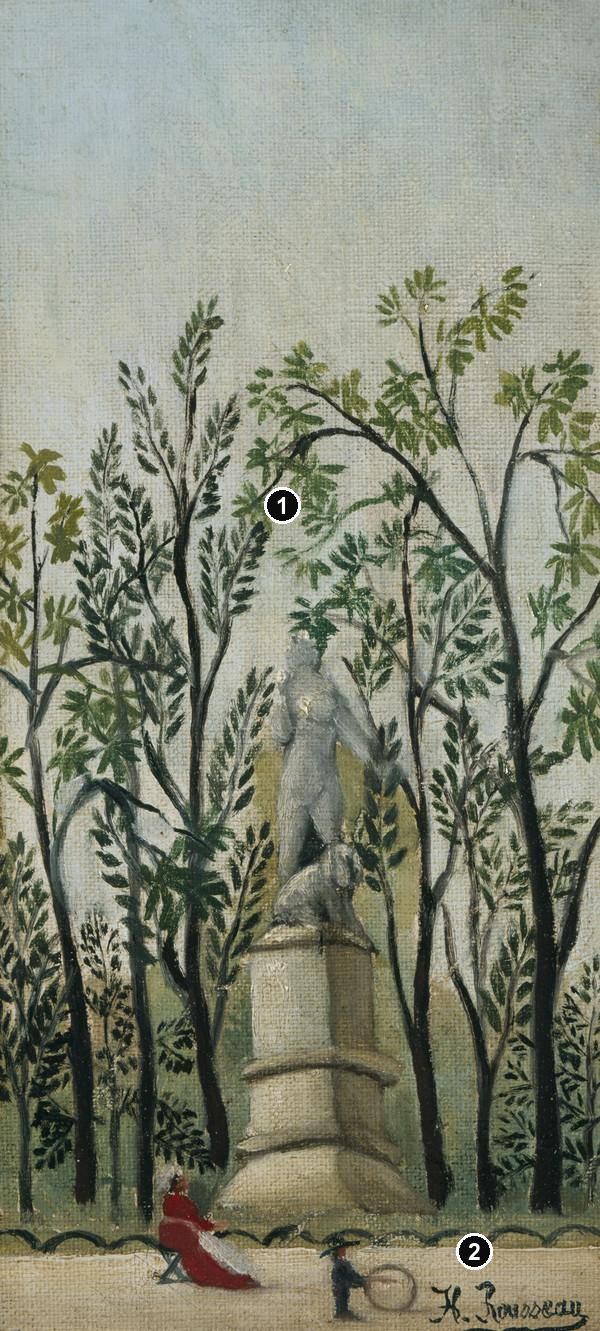
Details from STATUE OF DIANA IN THE PARK
Compare the tall monument and branching trees with the small people below. Follow the different kinds of line made by stems, pedestal ledges, fence and hoop.
A monument woven into the trees
Branches and scattered leaves pass around the pale statue and its heavier support. The pedestal’s ledges offer broad resting points within the more restless pattern of trunks and foliage.
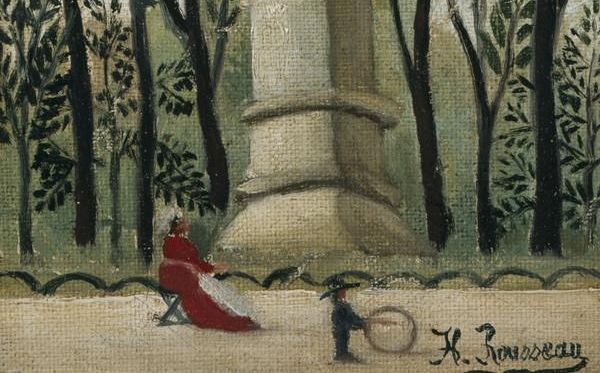
A red dress, a hoop and a low fence
The woman’s red clothing and the child’s pale hoop create two small centres of attention below the stone. Repeated loops carry the fence across the path, while the signature gives the clear foreground another flowing line.
A view of the Tuileries
The museum identifies the setting as the Tuileries gardens and the subject as Diana with a dog, almost certainly Louis Leveque’s statue, sculpted in 1866 and installed in 1872. It proposes a postcard or photograph as Rousseau’s probable source.[11] That possibility does not establish a particular source image or prove how this painting was made.
The scene itself offers a carefully restricted view. There is no broad prospect of avenues or buildings to explain the garden’s arrangement. Instead, the monument, a few trunks and the strip of path supply the entire setting. Their proportions determine our experience of the place: the people seem very small, the stone rises heavily, and the trees extend well beyond it. The result invites sustained looking within a small area rather than a search for distant landmarks.
The painting’s delicacy lies in precise relationships visible across its surface: broad pedestal against thin branches, red dress against pale ground, circular hoop beneath vertical trunks. Readers exploring Rousseau’s style and technique can follow those relationships here at an intimate scale. The open intervals around the branches allow each darker stroke to remain visible, even where the planting is thickest.
Henri Rousseau artworks directory
This directory brings together works covered on this site and other works documented in the cited museum records and catalogues. Alternate titles share one entry; distinct versions remain separate. Historical dates for works without an article follow the cited catalogues. This is not a catalogue raisonné.
Frequently Asked Questions
It belongs to the National Galleries of Scotland.[11]
The seated woman’s red dress stands out against the pale path. The child’s dark clothing and large hoop create a second, smaller focus near the lower centre.
The open area above the trees extends the upward movement and gives the narrow composition a sense of air. It also makes the fine upper leaves easier to distinguish.
Discussion
Look again at the images and ideas explored in Statue of Diana in the Park. These editorial prompts invite your observations.
Reader Insights
Does your eye reach the statue first through the red dress and pedestal, or by following a tree trunk?
How does the painting’s balance change when you cover the empty sky at the top?
Which seems more solid here: the statue’s body, its pedestal or the trees around it?
Join the Conversation
Share a detail, comparison or question about Statue of Diana in the Park below.
References
- Philadelphia Museum of Art, Carnival Evening,1963-181-64,object59593. View source.
- Musée de l’Orangerie / Juliette Degennes, Henri Rousseau,L’ambition de la peinture: Un artiste dans son époque (in French). View source.
- National Gallery, Surprised!, NG6421. View source.
- Musée d’Orsay, La Guerre,RF19461 (in French). View source.
- MoMA, The Sleeping Gypsy. View source.
- Philadelphia Museum of Art, The Merry Jesters, 1950-134-176, object51097. View source.
- Musée d’Orsay, La Charmeuse de serpents, RF 1937 7 (in French). View source.
- Musée de l’Orangerie, La Carriole du Père Junier, RF 1960 26 (in French). View source.
- Solomon R. Guggenheim Museum / Cornelia Lauf, The Football Players,60.1583: current collection record. View source.
- MoMA, The Dream, 252.1954. View source.
- National Galleries of Scotland. Statue de Diane au Parc (Statue of Diana in the Park), collection record GMA 4078, metadata and “About this artwork”; accessed 23 October 2026. View source.
- The Museum of Modern Art, Henri Rousseau: Essays (1985), selected catalogue entries, chronology and notes on early devotees. View source. Selected entries, chronology (pp.91–95) and early-devotee notes (pp.262–264) were consulted. Historical collection credits do not establish present ownership.
- Daniel Catton Rich, Henri Rousseau (The Museum of Modern Art, 1942), selected drawings and landscape studies; historical catalogue. View source. The dated 1942 publication is used for the two Quai d’Auteuil ink views; its Malakoff date differs from the 1985 catalogue.
- MANAS, Laval, Henri Rousseau, dit le Douanier, urban landscapes and preparatory study (in French). View source.
- National Gallery of Art, Self-Portrait (1895), pen-and-ink drawing, accession 1995.47.66. View source.
- The Museum of Modern Art, War (published January 1895), lithograph, accession 684.1943. View source.
- Barnes Foundation, Landscape and Four Young Girls, object 5521, BF855. View source.


 Henri Rousseau.jpg)


 Henri Rousseau.jpg)