



 by Tom Gurney
Tom Gurney BSc (Hons) is an art history expert with over 20 years experience
Published on June 19, 2020 / Updated on October 29, 2026
Email: tomgurney1@gmail.com / Phone: +44 7429 011000
Outskirts of Paris: Introduction
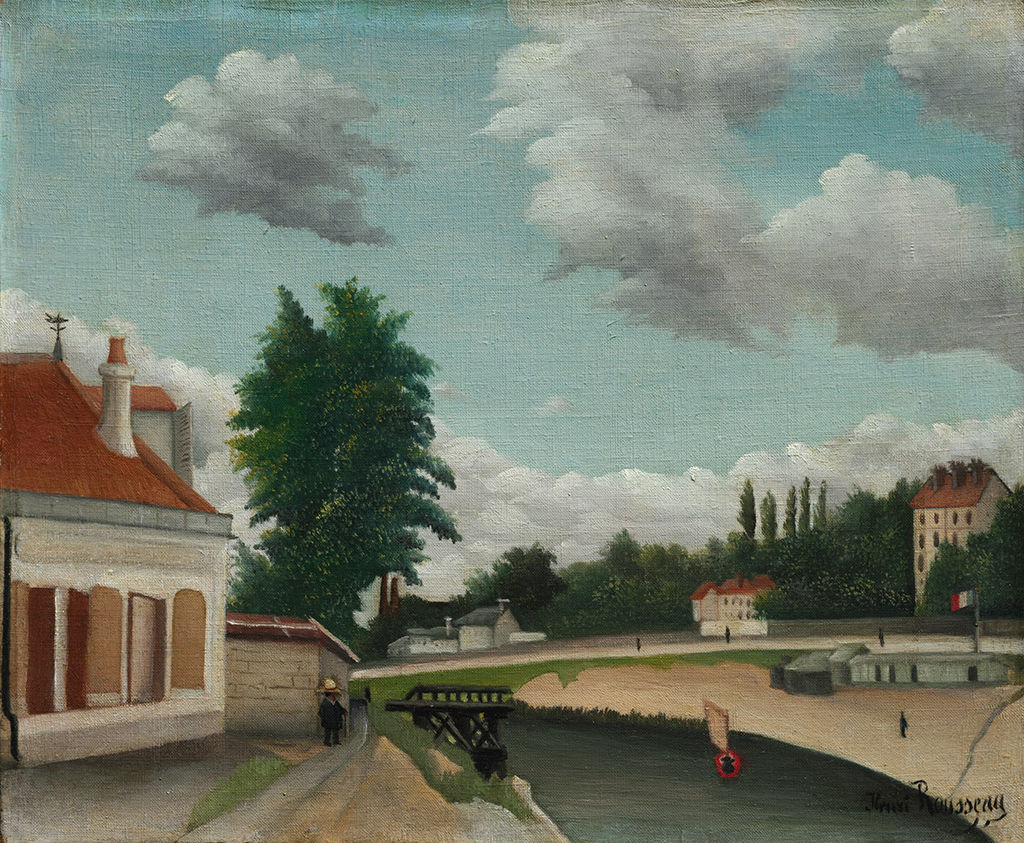
A narrow path squeezes past a house and turns beside dark water. Above it, immense grey and white clouds drift across a blue-green sky. Henri Rousseau gives this modest riverside scene two very different scales: the small world of shutters, roof tiles and solitary walkers below, and the broad movement of weather overhead. Outskirts of Paris belongs to the Cleveland Museum of Art, which dates it to about 1897–1905. Painted in oil on fabric, it measures just 37.8 × 45.8 cm without its frame.[1]
A house cut by the left edge brings us close to the bank, while distant buildings draw us around the bend. Between them, a black wooden structure projects over the water, its angular braces unusually conspicuous. The paths and buildings suggest a place in daily use, yet their arrangement makes familiar things look freshly assembled.
At a Glance
- ArtistHenri Rousseau
- SubjectOutskirts of Paris
- ExploreA house at the water's edge; The wooden structure and the bend
This work across Henri Rousseau’s career
Carnival Evening
1886 [2]Outskirts of Paris (current article)
c. 1897–1905 [7]The Merry Jesters
1906 [8]The Snake Charmer
1907 [9]Contents
- A house at the water's edge
- The wooden structure and the bend
- Across the bank and into the sky
- What is known about the place and its history?
- Annotated details
A house at the water's edge
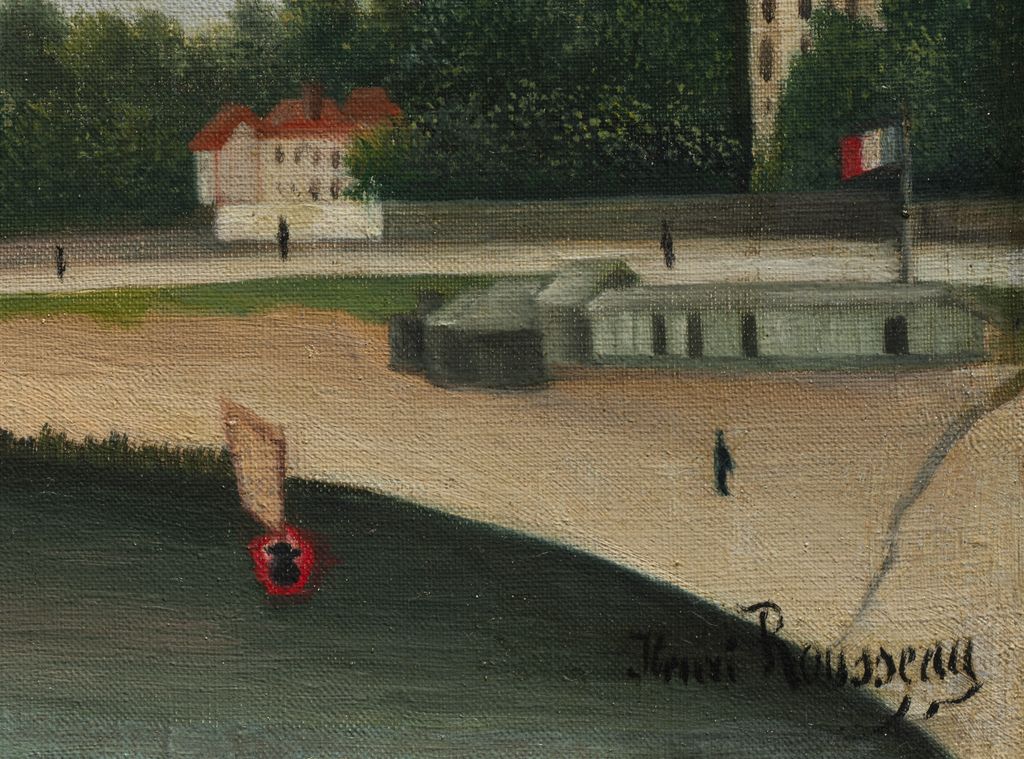
The nearest house occupies a strong position without being shown in full. Its cream wall reaches beyond the left edge; its red roof forms a steep, warm slope against the sky. A pale chimney with a red cap rises above the roof, and an upper window appears beside it. Below, a row of openings and brown shutters gives the wall a firm rhythm. Some shutters stand open at an angle, creating narrow slivers of shadow and making the facade more complicated than a flat rectangle.
The house's nearness matters. We cannot stand far enough away to survey it as an isolated building. Instead, we seem already to have reached it on our way along the bank. Its lower wall meets a broad grey strip, which in turn meets the path and a thin band of grass. These adjoining surfaces establish a small sequence of spaces underfoot. Their changes of colour and direction tell us how to move before any distant landmark comes into play.
A low outbuilding extends to the right of the house. Its sloping roof descends towards the path, narrowing the gap through which a dark-clothed, hatted figure passes. The figure's light hat catches the eye against the wall and tree. Another small dark figure appears farther along. Rousseau gives them enough presence to suggest a route in daily use, while keeping faces, occupations and destinations beyond our knowledge.
The path bends away from the foreground and disappears around the buildings and vegetation. Its brown centre and greyer margins are unequal strips, narrowing as they recede. This is an inviting movement because the route is partly concealed: the eye follows what it can see, then imagines the continuation. At the same time, the house blocks an easy view to the left and the water closes the way to the right. The foreground has the intimate proportions of a passage rather than the breadth of a public square.
Beside the outbuilding, a large tree rises into the open sky. Its crown is irregular, with lighter touches near the top and a much darker body lower down. It joins the weight of the house to the distant tree belt, but its height also divides the sky. Around its outer leaves, patches of blue and pale cloud make the silhouette especially legible. The building's measured edges and the tree's spreading outline hold each other in balance.
The wooden structure and the bend
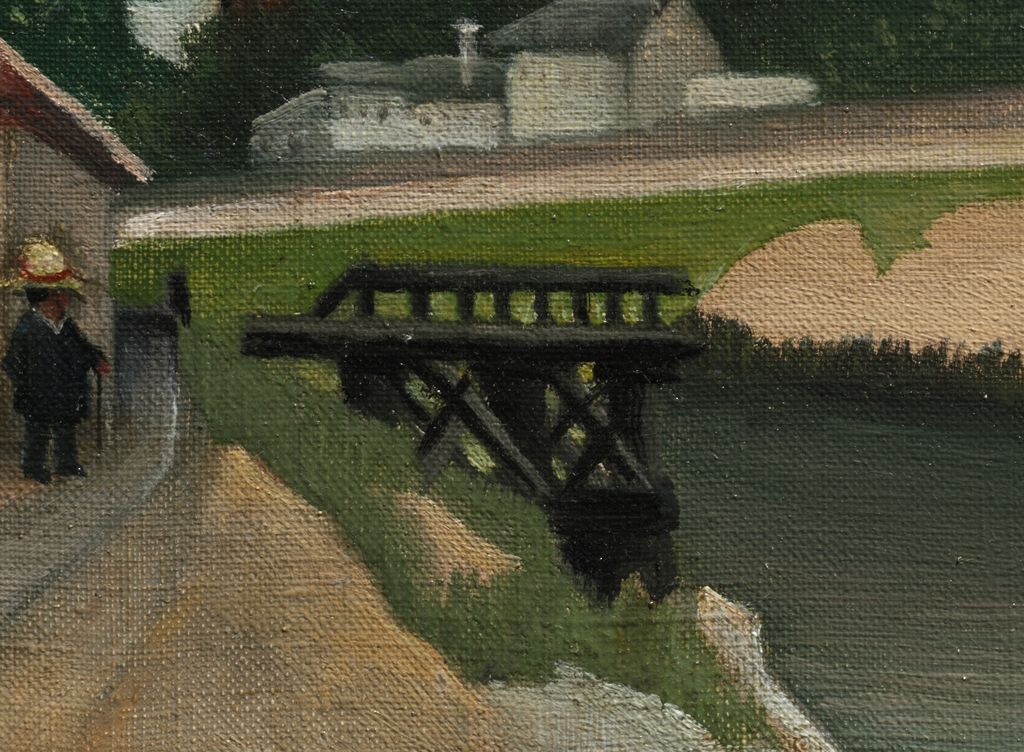
The black timber structure beside the path interrupts this gathering of soft greens and warm masonry. A horizontal top projects across the bank; below it, diagonal supports form a series of triangles. Small upright intervals along the upper edge repeat like a short railing. Its darkness makes these divisions easy to read, even though the precise purpose of the construction remains unclear. The visible shape is more certain than any name we might give its mechanism.
Those diagonals are among the most active lines in the lower half of the painting. The nearest house offers upright walls and a sloping roof; the timber frame compresses a similar vocabulary into a small, emphatic object. It sits at the point where the path, grass and water meet, turning a practical-looking riverside fixture into a hinge for the composition. Our attention stops there briefly before crossing to the opposite bank.
The water opens as a dark curved strip, spreading towards the lower right. A lighter, warm bank faces it across the bend. This contrast keeps the two shores distinct, with the green verge on the near side providing a narrow intermediate colour. The bend gives a sense of depth within a local turn of the waterway, enclosed by buildings and trees.
Near the lower part of the water, a small red ring hangs beneath a pale upright rectangular form. The bright red is easy to notice; the object's identity is harder to establish. Its visual effect is clear enough: a concentrated spot of colour rests within a broad area of dark green. Across the water, a long, low grey structure lies close to the far bank, with small dark openings and a French flag above it. Its low profile differs sharply from the tall house farther to the right.
These objects give the waterfront a practical character, though the painting leaves their particular uses open. The braced structure reaches out, the water turns away, and the grey building stretches sideways. Each directs the eye differently within a remarkably compact area.
Outskirts of Paris — Henri Rousseau.
Across the bank and into the sky
Beyond the water, a pale ochre strip runs almost horizontally through the scene. Tiny dark figures punctuate it at widely separated intervals. Their scale makes the foreground walker feel near, and their spacing gives the distant bank a measured, unhurried appearance. Behind them, a small pale building with a red roof stands against the trees. Farther right, a taller cream house rises above the greenery, its roof and dark windows repeating features seen in the nearest building.
Rousseau varies these repetitions carefully. The foreground house is large and cropped, its shutters turned out towards us. The middle-distance building is a compact pale accent. The house at the right is taller, more remote and partly screened by trees. Warm roofs link them across the canvas without making them interchangeable. The tiny red of the flag and the ring carries that colour farther down into the waterfront.
The trees behind the far bank form a broad dark boundary. A group of narrow, upright trees rises above it, while other crowns merge into an uneven band. This screen limits the landscape's depth. The eye reaches a leafy enclosure rather than a remote city panorama, and then moves upward into the much larger space of the sky. Almost everything on the ground seems gathered close together beneath the clouds.
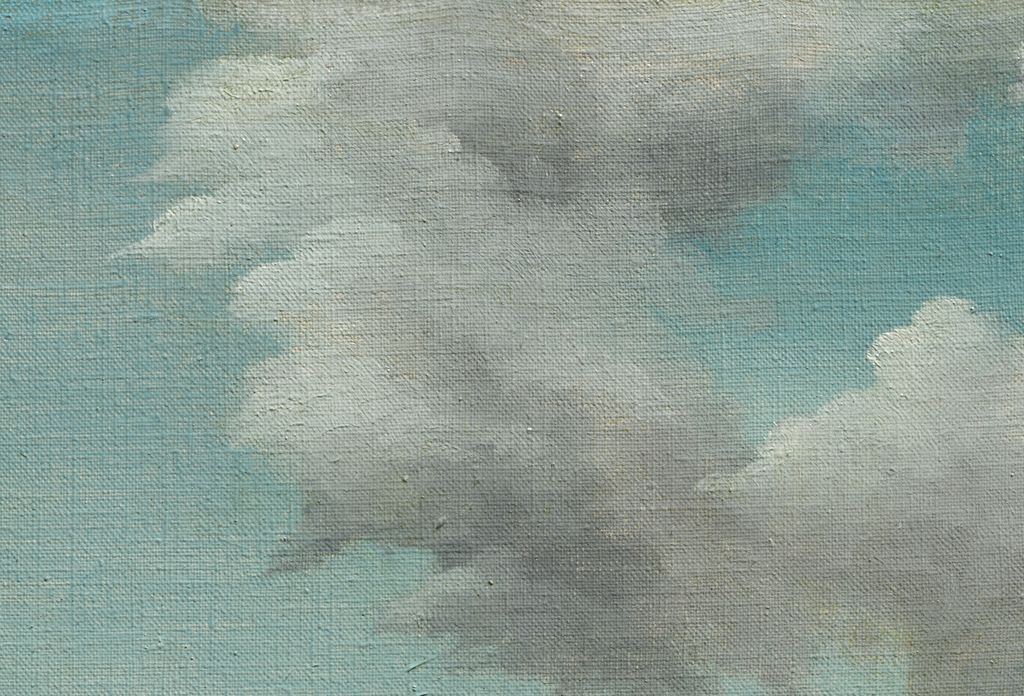
The largest cloud mass spreads across the upper right. White rounded lobes catch the light, with grey passages beneath them that suggest considerable volume. At the upper left, a separate cloud hangs above the nearest house and tree. The interval of blue between these masses gives the sky breathing room, while a lower procession of pale clouds gathers close to the tree line. These differing heights keep the sky from becoming a single decorative backdrop.
The Cleveland Museum of Art draws attention to the painting's blended modelling and comparatively free brushwork, while observing that Rousseau retains a sharp, detailed treatment of objects.[1] The clouds make that combination particularly clear. Their edges remain distinct, but their interiors turn gradually from light to shadow. A similar softness appears within the foliage and along parts of the pale buildings. Firm boundaries contain surfaces with more variation than a first glance suggests.
This helps explain the painting's quietness. The stillness comes partly from the clear placement of objects, yet the surfaces remain responsive to light. Shadows beneath the clouds, the shaded side of the tree and the warmer patches along the bank prevent the view from becoming diagrammatic. For a wider account of such relationships in Rousseau's painting, see his style and technique. Here, their effect depends on this particular meeting of crowded ground and expansive sky.
Annotated Details from Outskirts of Paris
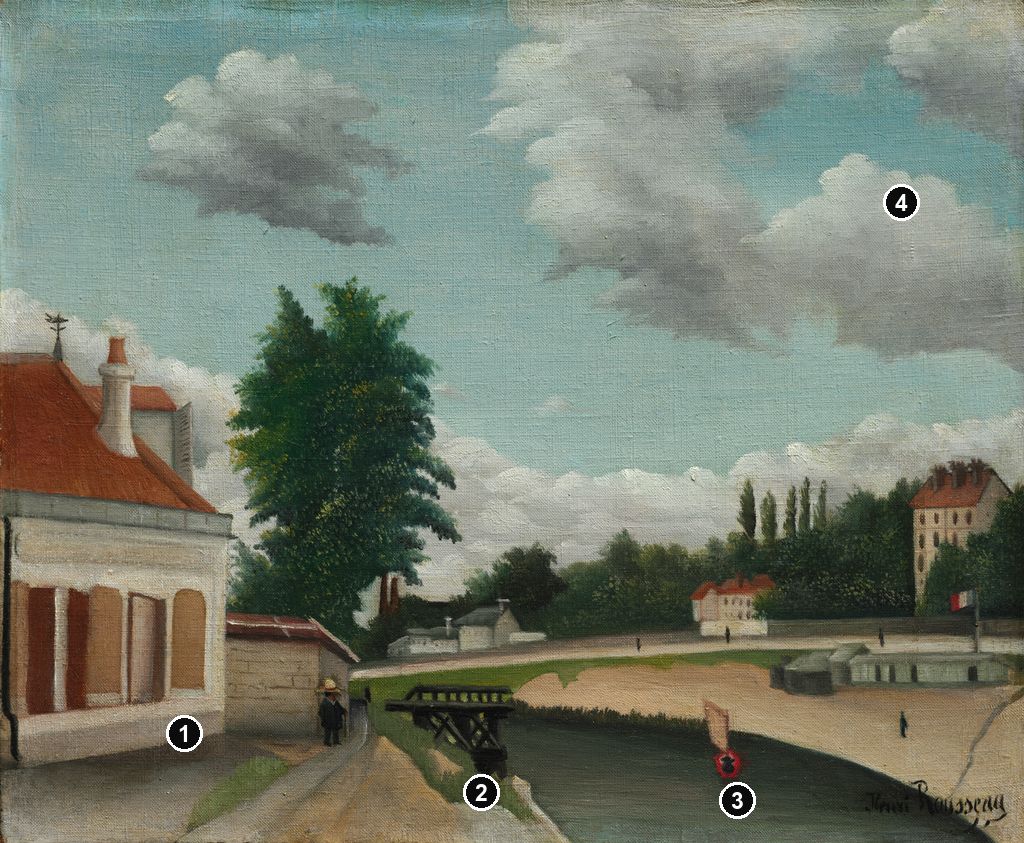
The numbered points identify visible features discussed in this article. Return from each detail to the whole composition. Henri Rousseau, Outskirts of Paris, c. 1897–1905. The Cleveland Museum of Art, 1929.951. Purchase from the J. H. Wade Fund. Image source. CC0 / Public domain. Numbers added to the overview; detail views cropped from the original. No recolouring or retouching.
Details from OUTSKIRTS OF PARIS
Look from the cramped passage and angular timberwork to the small red accent and the much broader movement of the clouds.
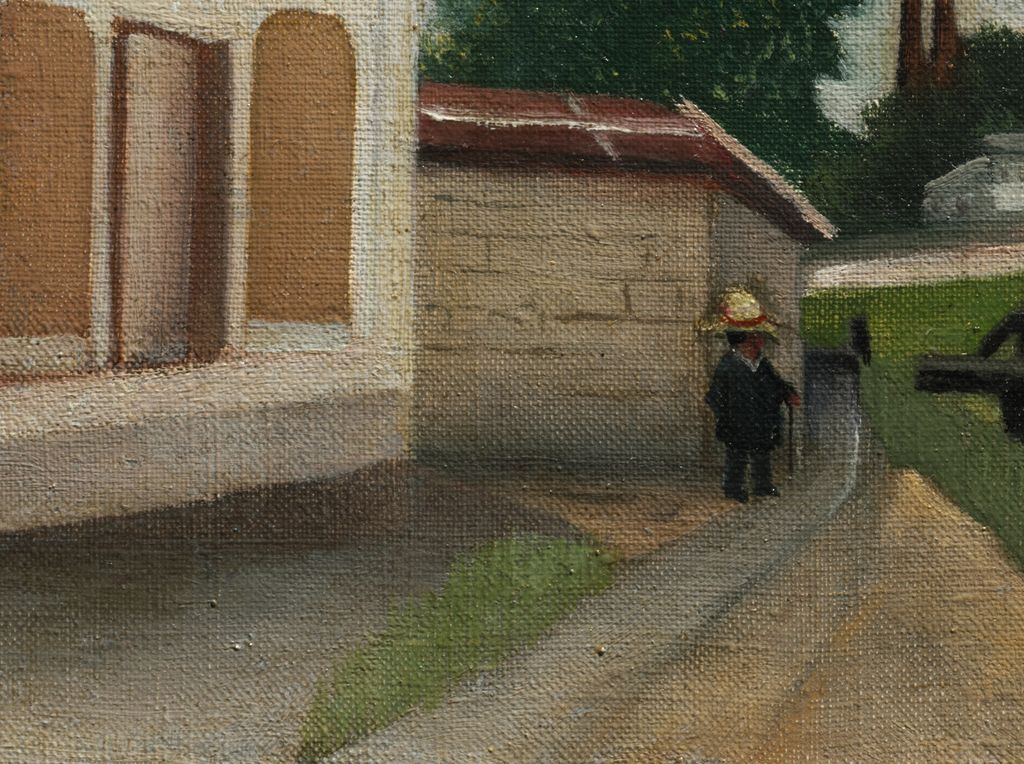
A narrow passage beside the house
The pale hat distinguishes the nearest walker from the shaded wall. Open shutters, the low outbuilding and uneven strips of path make the route feel narrow before it bends out of sight.
Triangles over dark water
Diagonal braces support a short dark structure beside the bank. Their sharp angles stand out against the softer greens and pale masonry; its exact practical purpose remains uncertain.
A red accent across the bend
A small red ring hangs below a pale upright form in the dark water. Beyond it, the low grey structure and a French flag establish a separate horizontal edge along the opposite bank.
Light and shade within the clouds
Pale rounded edges enclose broad grey shadows. The cloud mass has more softly blended modelling than the small buildings below, while intervals of blue keep the sky open.
What is known about the place and its history?
The museum describes the subject as a river or canal on the outskirts of Paris. It does not securely name the waterway in its present description. Its exhibition history does offer a possible more specific title: the painting was probably shown as La Seine à Meudon, number 7, at the 1911 Salon des Indépendants. Cleveland bases that connection on handwriting reported on the stretcher.[1] The qualification matters. Meudon remains a possible identification, rather than a settled location from which every building can be mapped.
The shifting titles also suggest how the scene has been understood. Outskirts of Paris directs attention to a kind of place: the loosely built waterfront beyond the dense city. La Seine à Meudon would specify a river and locality. The later sale title, Paysage de banlieue, again describes a suburban landscape more broadly.[1] In front of the painting, the house, path, water and opposite bank remain the strongest anchors. They provide a coherent setting even where the surviving names leave room for doubt.
According to Cleveland's provenance record, the picture belonged to M. Lefèbvre in Paris and appeared in his collection sale at Drouot on 3 March 1927. Listed as lot 117 under Paysage de banlieue, it sold for 55,000 French francs to Émile Level. The museum then records Level's consignment to the Valentine Gallery in New York during 1927–29, followed by the gallery's sale to Cleveland on 16 December 1929. The acquisition credit is Purchase from the J. H. Wade Fund.[1] These entries establish a useful sequence of collecting and transfer without supplying the circumstances of Rousseau's first sale of the work.
Cleveland also records the painting in French Art since Eighteen Hundred in 1929, and in the travelling Rousseau exhibition of 1942–43, whose venues included Chicago, New York, Boston and Toronto.[1] That later circulation gave this small suburban view a place in the artist's wider public reception. Its compact size can make it seem a private encounter, but the composition carries well: the pale house, dark timber frame and broad clouds remain distinct at a glance, then yield their smaller details as one comes closer.
Henri Rousseau artworks directory
This directory brings together works covered on this site and other works documented in the cited museum records and catalogues. Alternate titles share one entry; distinct versions remain separate. Historical dates for works without an article follow the cited catalogues. This is not a catalogue raisonné.
Frequently Asked Questions
The Cleveland Museum of Art dates its painting to about 1897–1905. It gives a range rather than a single established year.[1]
It belongs to the Cleveland Museum of Art, accession number 1929.951, purchased from the J. H. Wade Fund. The painting measures 37.8 × 45.8 cm without its frame.[1]
That identification is possible. Cleveland lists a probable appearance at the 1911 Salon des Indépendants as La Seine à Meudon, based on handwriting reported on the stretcher. The museum's present description more broadly calls the setting a river or canal on the outskirts of Paris.[1]
Begin with the passage beside the nearest house. Follow it past the hatted figure to the black wooden frame, then cross the water to the pale bank. Looking up from that compressed group of forms makes the scale and soft modelling of the clouds particularly striking.
Discussion
Look again at the images and ideas explored in Outskirts of Paris. These editorial prompts invite your observations.
Reader Insights
How does the cropped house change your sense of where you are standing in relation to the scene?
What happens to the balance of the painting if you cover the black wooden structure or the largest cloud mass?
Do the distant figures make this waterfront feel busier or quieter? Which details shape your response?
Join the Conversation
Share a detail, comparison or question about Outskirts of Paris below.
References
- Cleveland Museum of Art. Outskirts of Paris, accession 1929.951, current collection record and official public API record, metadata, description, provenance and exhibition-history fields, supplied record accessed 23 October 2026. View source 1. View source 2.
- Philadelphia Museum of Art, Carnival Evening,1963-181-64,object59593. View source.
- Musée de l’Orangerie / Juliette Degennes, Henri Rousseau,L’ambition de la peinture: Un artiste dans son époque (in French). View source.
- National Gallery, Surprised!, NG6421. View source.
- Musée d’Orsay, La Guerre,RF19461 (in French). View source.
- MoMA, The Sleeping Gypsy. View source.
- Cleveland Museum of Art, Outskirts of Paris,1929.951. View source.
- Philadelphia Museum of Art, The Merry Jesters, 1950-134-176, object51097. View source.
- Musée d’Orsay, La Charmeuse de serpents, RF 1937 7 (in French). View source.
- Musée de l’Orangerie, La Carriole du Père Junier, RF 1960 26 (in French). View source.
- Solomon R. Guggenheim Museum / Cornelia Lauf, The Football Players,60.1583: current collection record. View source.
- MoMA, The Dream, 252.1954. View source.
- The Museum of Modern Art, Henri Rousseau: Essays (1985), selected catalogue entries, chronology and notes on early devotees. View source. Selected entries, chronology (pp.91–95) and early-devotee notes (pp.262–264) were consulted. Historical collection credits do not establish present ownership.
- Daniel Catton Rich, Henri Rousseau (The Museum of Modern Art, 1942), selected drawings and landscape studies; historical catalogue. View source. The dated 1942 publication is used for the two Quai d’Auteuil ink views; its Malakoff date differs from the 1985 catalogue.
- MANAS, Laval, Henri Rousseau, dit le Douanier, urban landscapes and preparatory study (in French). View source.
- National Gallery of Art, Self-Portrait (1895), pen-and-ink drawing, accession 1995.47.66. View source.
- The Museum of Modern Art, War (published January 1895), lithograph, accession 684.1943. View source.
- Barnes Foundation, Landscape and Four Young Girls, object 5521, BF855. View source.


 Henri Rousseau.jpg)


 Henri Rousseau.jpg)