


 by Tom Gurney
Tom Gurney BSc (Hons) is an art history expert with over 20 years experience
Email: tomgurney1@gmail.com / Phone: +44 7429 011000
Henri Rousseau’s Style and Technique: Introduction
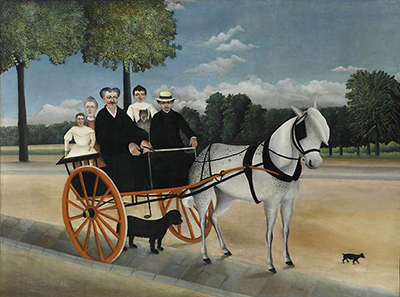
A white horse stands above a tiny dog; a much larger black dog occupies the space beneath the cart. In Henri Rousseau’s La Carriole du Père Junier, painted in 1908, scale makes the familiar scene feel extraordinary. The red wheels are sharply described, the passengers face us with unusual stillness, and the horse seems almost to balance on its hoof tips. Rousseau worked from a photograph, yet altered the arrangement and the proportions of its animals. His picture asks us to follow relationships established within the painting itself.[1]
That process of adjustment extends beneath the visible surface. Research described by Johanna Salvant, a physicist and chemist at the Centre de recherche et de restauration des musées de France (C2RMF), examined approximately forty paintings from the Orangerie, Orsay and Barnes collections. It revealed varied supports, a broader palette than previously identified, and compositions changed during execution. These findings give substance to a question prompted by looking: how did Rousseau build pictures whose individual parts are so clear, yet whose combined spaces can feel so improbable?[2]
At a Glance
- ArtistHenri Rousseau
- SubjectHenri Rousseau’s Style and Technique
- ExploreChanging a photograph into a painting; Contours, frontality and overlapping spaces
Contents
- Changing a photograph into a painting
- Contours, frontality and overlapping spaces
- Canvas and colour beneath a distinctive surface
- How researchers recover the working process
- Revising figures and removing objects
- Building a jungle from observed and printed motifs
- The artist’s changes and the conservator’s decisions
Changing a photograph into a painting
In La Carriole du Père Junier, the photographic source gave Rousseau a particular group and occasion to work with. The Orangerie explains that Junier was a friend of the painter, sold vegetables, and had recently acquired a horse of which he was proud. Rousseau owed him money, and a painting was agreed upon. The photograph belonged to this ordinary world of personal relationships; the finished canvas gives the outing an almost ceremonial presence.[1]
The changes documented by the museum are substantial. Rousseau removed a tree and adjusted the size and placement of all three dogs. A tree trunk divides the sky and establishes a strong upright. Removing a competing trunk changes how the eye travels between the passengers, the horse and the open air. The Fondation Beyeler’s 2010 gallery guide explains that omitting the trunk above the horse strengthened the remaining tree’s role as a compositional axis.[3]
Look next at the black dog. Its solid body sits between the red wheels, immediately below the cart’s dark compartment. The Orangerie describes it as giving depth to the vehicle; the Beyeler guide interprets it as anchoring the cart to the ground. Both readings help explain its visual importance. It occupies a gap which might otherwise leave the passengers suspended above a fragile structure. Its silhouette connects wheel, carriage and pavement even while its size unsettles the scene’s ordinary proportions.[1][3]
The miniature dog ahead of the horse has a complementary effect. Against that little dark body, the pale animal becomes enormous. Its legs remain slender and separated, its hooves barely touching the road, while the harness draws a crisp black network across its whiteness. The picture gives the horse weight through comparison and lightness through pose. The two effects coexist. They cannot be explained simply by labelling its proportions inaccurate.[1]
The museum also recounts Max Weber’s recollection of challenging Rousseau about the black dog’s size. In the reported exchange, Rousseau defended the proportion as something his canvas required. This is a remembered conversation, rather than a surviving transcript of the painter at work. Even with that qualification, it fits the documented alterations: the photographic arrangement was available for revision, and the balance of the resulting painting mattered.[1]
A photograph could supply likenesses, poses and an initial grouping without determining the final spatial logic. Rousseau’s adaptation involved subtraction as well as enlargement. The omission of a tree opened one area; changing a dog altered the weight of another. Seen this way, the picture’s odd scale becomes a practical issue of composition, with consequences that we can trace across the canvas. The museums document the differences from the source photograph; the visible painting alone cannot tell us which details were copied faithfully.[1][3]
Contours, frontality and overlapping spaces
Clear edges are among the pleasures of Rousseau’s painting. In The Wedding Party, faces emerge as distinct ovals, dark suits form upright masses, and the bride’s dress opens a broad pale shape at the centre. Leaves and trunks frame the group without dissolving into a soft background. The black dog sits upright on its hindquarters close to the lower edge, facing the spectator. The arrangement gives many small details a place within a few forceful shapes.
Portrait of Madame M. offers a different balance. The woman’s dark dress occupies most of the image, while plants crowd its edges. Her expanded sleeves spread towards the narrow trees; her head rises into an area of sky. Individual flowers, fingers and leaves retain their legibility, yet the figure’s bulk controls how we read them. Salvant identifies changes of scale in this portrait, evidence that the proportions were reconsidered during painting.[2]
These pictures invite us to distinguish depth from a fully consistent system of perspective. An object can overlap another and appear in front of it even when their sizes do not fit comfortably into a single measured space. In the Beyeler guide’s interpretation, Rousseau’s landscapes are assembled from separately described elements whose combination creates a kind of depth, while the flat surface of the painting remains strongly present.[3]
The guide makes this argument beside the two versions of The Chair Factory at Alfortville. In the larger composition, the building, walls and embankment divide the view into readily grasped areas. The factory’s pale front and roof are much more emphatic than the small figure below the dramatic clouds. The viewer can follow the riverbank into the distance while also seeing the scene as a pattern of adjoining shapes. Attend to each overlap and boundary before trying to make every part obey the same spatial rule.[3]
Canvas and colour beneath a distinctive surface
The materials research provides a valuable counterweight to assumptions prompted by Rousseau’s unusual forms. Salvant reports a preference for commercially prepared canvas with a medium weave. Such a support already carried a preparatory coating before the artist began painting. Across the roughly forty works examined, however, the researchers found differences in both the weaving and the nature of those preparations. Salvant connects that variety with purchases from different suppliers and selections of canvas.[2]
The range does not establish a complete list of the shops Rousseau used. It gives us a picture of material choices made across a body of work: an artist obtained prepared supports through the commercial trade, and those supports varied. His consistent visual character did not depend on every painting beginning with precisely the same fabric and ground.[2]
The same study found a palette of about ten colours, including both traditional pigments and newer ones. Earlier identifications had left Rousseau with only one known blue pigment and one green, a surprisingly restricted account of paintings filled with varied foliage. The newer research identified cerulean blue and Veronese green among his materials. These discoveries expand our knowledge of what he could use; they do not turn the many visible greens into a count of separate green paints.[2]
There is a similar distinction between a palette identified across a group and a recipe for an individual picture. We cannot assign all the pigments in Salvant’s account to every jungle, portrait or landscape. A colour seen in a reproduction is also insufficient evidence for naming its pigment. The study’s broad result is that Rousseau combined older and more modern materials in ways consistent with the practice of contemporaries. His visual independence existed within that shared material world.[2]
White paint makes this particularly tangible. The researchers confirmed both lead white and zinc white. Salvant notes that some contemporaries avoided zinc white because of concerns about drying and future preservation. She describes Rousseau’s apparent preference for it in touches made towards the final stage of a composition, possibly related to the pigment’s physical and chemical properties. The transcript associates this discussion with close examinations and X-ray fluorescence mapping of The Wedding Party. Its wording remains cautious: zinc seems to have been favoured for those later touches. It supplies no rule that zinc was always applied last, or that lead white served only an earlier stage.[2]
This evidence brings us closer to the act of painting. Two whites which can look similar belong to different materials; their distribution can help researchers distinguish decisions made as a composition developed. The broad white expanse of the wedding dress consequently has more than a visual role in this discussion. It is an area where examination of the paint contributes to an account of working procedure, alongside the changes in the dress’s shape.[2]
How researchers recover the working process
Different examinations answer different questions. Salvant names infrared reflectography, X-ray fluorescence in individual points or two-dimensional maps, and radiography as complementary approaches in the Rousseau research. She also notes that radiographs made during examinations in the 1980s had not then been exploited through the same material approach. An older image can acquire new value when researchers ask a different question of it.[2]
Infrared reflectography is particularly useful for carbon-based marks beneath paint. Some paint layers allow infrared radiation to pass through more readily than visible light, while carbon-rich lines absorb it and can become legible against a reflecting preparation. The result may reveal an earlier outline or change of position. Its success depends on the materials and thicknesses encountered. A concealed line which fails to appear is not proof that the artist made no preparatory drawing: the drawing or covering paint may not respond in the way needed for a readable image.[4]
X-ray fluorescence, commonly shortened to XRF, approaches the picture through its chemical elements. A measurement at one point gathers elemental information from that location; scanning across an area produces maps of where detectable elements occur. These maps can help investigate materials and changes, but they are not ordinary colour photographs. Nor does a measurement automatically separate all the paint layers beneath it. The C2RMF notes both limits in detecting light elements in air and uncertainty about layer order, because the signal can include material from the surface and below it. A map requires interpretation alongside other evidence.[5]
Radiography records variations in the absorption of X-rays passing through the work. Materials and thicknesses affect the resulting image. In paintings it can reveal aspects of the support, losses, changes of format, compositional alterations and the reuse of a canvas. These are physical traces, which still have to be related to the visible picture and its history.[6]
The distinction between these methods is useful when encountering a claim about a hidden image. An infrared outline, an elemental distribution and a radiographic form are different kinds of evidence. Together they can make an explanation stronger. None records the painter’s thoughts or, by itself, tells us why he preferred the later version. The secure starting point is the material change: something was drawn, enlarged, covered or replaced. Motivation needs an additional argument.
Revising figures and removing objects
The apparent stillness of The Wedding Party conceals a changing arrangement. Salvant reports that Rousseau altered the bride’s dress and links that alteration, with a degree of uncertainty, to the addition of the dog. This is an especially revealing example because the dog now looks so firmly installed in the foreground. The finished group gives little sense of the negotiation which brought its parts together.[2]
The revision gives us a practical way to look again. The dress extends the light central mass towards the ground; the dog establishes a dark, horizontal presence below it. Their shapes affect the balance between standing figures and open foreground. The material finding establishes that the dress changed and the animal was added. Looking at their relationship helps us understand the compositional issue without claiming to recover every step or the artist’s private explanation.[2]
Scale changes in Portrait of Madame M. similarly show that a figure’s proportions were adjustable during execution. The transcript does not provide enough detail to reconstruct a complete sequence of those alterations. It would be misleading to supply one from the final appearance alone. What joins this portrait to The Wedding Party is the documented willingness to change a composition on the canvas itself.[2]
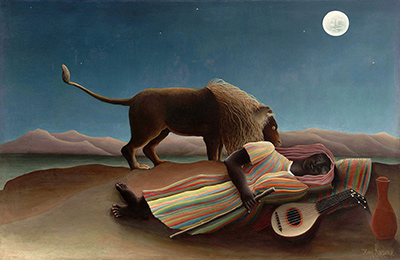
A different kind of alteration appeared during MoMA’s examination of The Sleeping Gypsy. The museum’s conservation account describes an X-ray revealing a vessel which is absent from the finished scene. The conservator explains that Rousseau covered the painted form with more paint; its outline can still be discerned from a suitable viewing angle once one knows where to look. The discovery concerns an additional, concealed vessel, rather than the clearly visible one beside the sleeping woman.[7]
That difference between covering and erasing is important to our understanding of oil painting. Here the earlier form remained physically present beneath the new surface. Its survival makes the revision accessible to examination, although its former existence does not tell us why Rousseau removed it. An earlier arrangement need not be treated as a truer expression of his intentions than the composition he left visible.[7]
Reworking could also extend to replacing a whole subject. The Orangerie’s booklet identifies a child’s portrait beneath the Barnes Foundation’s Portrait of a Woman in a Landscape. Its radiograph reveals a different composition under the visible one. This establishes the reuse of a painted canvas; it does not supply the child’s identity or explain why Rousseau abandoned that portrait. The scale of the change separates this example from an adjustment to a dress or the removal of a single vessel.[8]
Building a jungle from observed and printed motifs
Rousseau’s ways of adapting imagery extended beyond photographs. The Orangerie’s exhibition booklet identifies press illustrations, popular exotic imagery, and sketches made among the natural-history displays and glasshouses of the Jardin des Plantes in Paris. His jungles were constructed through such resources rather than observations made on a Mexican expedition. These sources offered separate plants, animals and poses which could be brought into new relationships.[8]
In Surprised!, narrow grasses, broad dark leaves and branching trees overlap in a dense sequence. The tiger is legible through its orange body and stripes, yet its feet are entangled in the vegetation. The National Gallery describes Rousseau’s completion of sections in sequence and the addition of semi-transparent silver-grey rain over the completed scene. That final network crosses plants and animal alike, drawing the different forms into a common storm.[9]
This is a named instance of working order, with a visible consequence. The diagonal rain remains distinct from the leaves beneath it while echoing their long strokes and the tiger’s stripes. It should not be expanded into an identical sequence for all Rousseau’s jungles. Nor does the layering visible to the eye identify every pigment or tell us whether each adjacent patch was dry before the next was applied.[9]
The National Gallery suggests possible affinities with Japanese prints for the rain and with reproduced animal imagery for the tiger. Those possibilities are useful avenues of comparison, rather than a complete inventory of proven source images. The firmer point is the constructed ensemble: recognisable motifs can meet in a place that has never existed. Precision in a single leaf or animal does not make the total environment a documentary view.[9]
The artist’s changes and the conservator’s decisions
Paint applied over paint can belong to several histories. A compositional revision made by Rousseau is different from retouching added to conceal damage after his death. The distinction affects both how we interpret a surface and how conservators treat it. Sometimes the evidence supports removal of a later intervention; sometimes uncertainty is a reason to retain it.
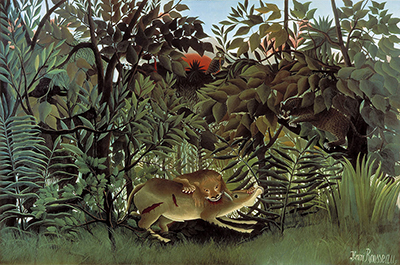
At the Fondation Beyeler, examination of The Hungry Lion Throws Itself on the Antelope addressed conspicuous areas of overpaint. Historical photographs were compared with the painting, and scientific examination found similarities of date and composition between those materials and the original paint. The museum concluded that Rousseau himself could have applied them. Although their altered colour made them noticeable, they were retained. Cleaning of the dirty surface used dry synthetic sponges; the reported material compatibility did not establish an unquestionable attribution for every added touch.[10]
MoMA faced a different history in The Sleeping Gypsy. Its conservation account describes at least three later varnish layers, discoloured materials and old restorations which no longer matched. Removing varnish exposed further overpainting, and the treatment addressed these later interventions. The conservators also distinguished their own small repairs from Rousseau’s oil paint by choosing removable restoration materials. The hidden vessel belongs to the artist’s developing composition; the varnishes and repairs belong to the subsequent life of the object.[7]
The Barnes Foundation’s account of Unpleasant Surprise is equally specific. Its FY25 annual report records high-resolution XRF scanning and a completed 2024 treatment which secured unstable paint, removed discoloured or mismatched retouching, reduced uneven and discoloured varnish, and filled and retouched losses. That report does not publish a pigment list or identify a hidden composition for this painting. Naming the examination is different from having its full results available.[11]
These cases sharpen the questions we bring to Rousseau’s pictures. Is an unusual patch part of a compositional change, a material alteration, or an old repair? Does the apparent flatness belong to the arrangement of forms, or has a later coating changed their relationships? A convincing answer joins close looking with evidence specific to the object. In La Carriole, the documented changes to the dogs let us see scale as an active part of construction. In The Wedding Party, a seemingly settled foreground emerges from revision. Their clarity is the visible outcome of decisions made and remade.[1][2]
Henri Rousseau artworks directory
This directory brings together works covered on this site and other works documented in the cited museum records and catalogues. Alternate titles share one entry; distinct versions remain separate. Historical dates for works without an article follow the cited catalogues. This is not a catalogue raisonné.
Frequently Asked Questions
Strong contours, frontal figures, distinct areas of colour and overlapping motifs are useful things to look for. Scale can shift within a single picture: in La Carriole du Père Junier, the contrasting sizes of the dogs change the apparent weight of the horse and cart.[1]
Yes. The Orangerie documents a photographic source for La Carriole du Père Junier, together with alterations to a tree and the sizes and positions of the dogs. The finished painting adapts its source rather than reproducing every detail.[1]
The C2RMF research described by Johanna Salvant found approximately ten colours across the group studied, including cerulean blue, Veronese green, lead white and zinc white. This group finding does not establish the complete palette of each painting.[2]
Discussion
Look again at the images and ideas explored in Henri Rousseau’s Style and Technique. These editorial prompts invite your observations.
Reader Insights
How would La Carriole du Père Junier feel different if its three dogs were closer in size?
In The Wedding Party, which shapes hold the group together most strongly?
Does knowing that Rousseau revised a seemingly still composition change the way you look at its surface?
Join the Conversation
Share a detail, comparison or question about Henri Rousseau’s Style and Technique below.
References
- Musée de l’Orangerie. La Carriole du Père Junier, current collection record, RF 1960 26, commentary and object metadata, updated 27 July 2026. View source. (in French).
- Johanna Salvant / C2RMF; musées d’Orsay et de l’Orangerie. Henri Rousseau, L’ambition de la peinture: Les analyses scientifiques, 2026, complete three-page French film transcript, especially pp. 1–2; work and research credits, pp. 2–3. View source. (in French).
- Fondation Beyeler. Henri Rousseau: gallery guide, 2010, German edition, p. 9, entry 6, “La carriole du père Junier” and “Bildfläche statt Bildraum”; p. 14, “Französische Landschaften” and entry 11. View source. (in German).
- C2RMF. Imagerie en Ultraviolet et Infrarouge: détecter les matériaux, sections “L’examen en infrarouge,” “La photographie infrarouge” and “La réflectographie infrarouge,” accessed 23 October 2026. View source. (in French).
- Éric Laval / C2RMF. ISTAR, 21 February 2025, sections explaining XRF, two-dimensional elemental mapping and limitations. View source. (in French).
- Elsa Lambert / C2RMF. Radiographie, 23 April 2025, sections “Comment est-ce que cela fonctionne?” and “Dans quel contexte l’utilise t’on?” View source. (in French).
- The Museum of Modern Art. Removing a century of treatments on Rousseau’s Sleeping Gypsy | Conservation Stories, official museum film, English captions, 2:00–4:25 (examination, X-ray, concealed vessel), 4:48–8:14 (varnish, overpaint and retouching). View source.
- Musée de l’Orangerie. Henri Rousseau, L’ambition de la peinture: gallery booklet, March 2026, PDF p. 7, “Un style à soi”; PDF p. 8, “La matérialité de l’œuvre d’Henri Rousseau,” Portrait de femme dans un paysage and its radiograph. View source. (in French).
- National Gallery, London. Henri Rousseau, Surprised!, NG6421, “In-depth” and audio-description transcript, accessed 23 October 2026. View source.
- Fondation Beyeler. Henri Rousseau: Dry surface cleaning, conservation account of Le lion, ayant faim, se jette sur l’antilope, accessed 23 October 2026. View source.
- Barnes Foundation. FY25 Annual Report, “Conservation and Exhibitions: Henri Rousseau,” printed p. 27 / PDF p. 15, examination and completed treatment of Unpleasant Surprise, BF281. View source.
- The Museum of Modern Art, Henri Rousseau: Essays (1985), selected catalogue entries, chronology and notes on early devotees. View source. Selected entries, chronology (pp.91–95) and early-devotee notes (pp.262–264) were consulted. Historical collection credits do not establish present ownership.
- Daniel Catton Rich, Henri Rousseau (The Museum of Modern Art, 1942), selected drawings and landscape studies; historical catalogue. View source. The dated 1942 publication is used for the two Quai d’Auteuil ink views; its Malakoff date differs from the 1985 catalogue.
- MANAS, Laval, Henri Rousseau, dit le Douanier, urban landscapes and preparatory study (in French). View source.
- National Gallery of Art, Self-Portrait (1895), pen-and-ink drawing, accession 1995.47.66. View source.
- The Museum of Modern Art, War (published January 1895), lithograph, accession 684.1943. View source.
- Barnes Foundation, Landscape and Four Young Girls, object 5521, BF855. View source.
 Henri Rousseau.jpg)
 Henri Rousseau.jpg)