


 Henri Rousseau.jpg)
 by Tom Gurney
Tom Gurney BSc (Hons) is an art history expert with over 20 years experience
Published on June 19, 2020 / Updated on October 29, 2026
Email: tomgurney1@gmail.com / Phone: +44 7429 011000
Self-Portrait (1900–1903): Introduction
A sweeping black moustache gives this small portrait an immediate flourish. Its pointed ends lift across the cheeks, while the mouth beneath it remains small and closed. To the left, a blue vase supports a crowded bouquet of pale flowers. Face and flowers share the narrow picture, bringing a formally dressed man into close company with a still life.
Brooklyn Museum’s record of 21 July 2010 identifies the painting as Henri Rousseau’s Self-Portrait, dated 1900–1903, in oil on canvas. It records dimensions of 18.7 × 14.6 cm, accession number 67.24.14, and the bequest of Laura L. Barnes.[1] Within that modest rectangle, Rousseau gives unusual weight to a few things: the outline of his head, the white opening of his shirt, and the little flowers beside his shoulder.
At a Glance
- ArtistHenri Rousseau
- SubjectSelf-Portrait (1900–1903)
- ExploreA close encounter in a small format; The face, from hairline to chin
This work across Henri Rousseau’s career
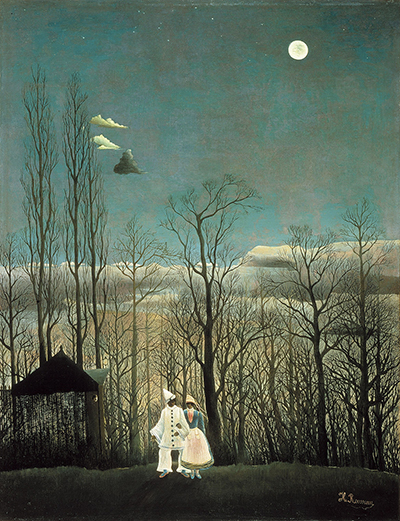
Carnival Evening
1886 [2]Self-Portrait (1900–1903) (current article)
1900–1903 (2010 record) [1]The Merry Jesters
1906 [7]The Snake Charmer
1907 [8]Contents
- A close encounter in a small format
- The face, from hairline to chin
- Formal dress in black and white
- The bouquet as a second centre
- Curtain, tabletop and the space between
- Reading the expression
- Annotated details
A close encounter in a small format
The head rises just to the right of centre. A strip of background remains above the hair, and the shoulders descend into the lower and right edges. This cropping brings the face forward before we have had time to take stock of the room. The flowers have their own narrow stretch of space at the left, with the vase resting on a grey-brown tabletop. We see enough furniture to locate the objects, but very little that would allow us to reconstruct an interior.
The recorded size matters to the encounter. At less than nineteen centimetres high, the painting asks for attention at close quarters.[1] A large reproduction can make the head seem imposing; imagining the whole image held within a small rectangle changes that impression. The moustache, eyebrows and bow tie become compact accents, each requiring a very small amount of space. The bouquet offers still finer divisions, with several blooms fitted into an area far smaller than the face.
The crop also concentrates what the portrait can tell us through visible things. There are no hands or tools to describe an activity. Dress, features and the arrangement of the immediate surroundings carry the picture. The man’s presence depends on his face and on the way his dark shoulders occupy their corner of the canvas.
The face, from hairline to chin
The forehead is broad and pale, enclosed by a receding dark hairline that curves over the crown. On either side, the hair spreads outward into thick, winglike shapes. The sweep on the right extends well beyond the ear, giving the head a distinctive silhouette against the subdued background. That outline can be followed almost continuously from the top of the skull, around the hair, and down towards the collar.
Inside it, the features are strongly separated. Heavy eyebrows arch above almond-shaped eyes, whose dark upper outlines make them particularly insistent. The nose runs down through the centre as a long, narrow structure, widening into shaded nostrils. Across it, the moustache supplies a second, more expansive movement. Its two halves spread away from the mouth, thick close to the nose and tapering towards their upward tips.
The mouth itself is easy to overlook. A little pink enters the lower part of the face between the moustache and chin, softening an area otherwise dominated by brown, grey and black. The chin has a broad, angular weight. A shadow along the right cheek and jaw gives the head some turning volume, while the lighter forehead and cheek remain large, relatively continuous areas. The face is slightly turned, yet both eyes retain a strong presence.
These differences prevent the features from becoming an even pattern. The eyes and brows are tightly drawn; the forehead has room to expand; the moustache reaches sideways; the chin settles heavily below. Looking slowly, we move between separate forms as well as recognising a single face. Rousseau’s style and technique can be explored through precisely such relationships between enclosing outlines and the areas of colour they hold.
Formal dress in black and white
The white collar makes a narrow, bright band under the jaw. Below it, a black bow tie stretches across the throat, its central knot almost lost among the neighbouring dark shapes. The shirtfront opens into a pointed white area between broad lapels. This descending triangle leads the eye from the face towards the lower edge, giving the costume a clear structure even where the coat’s details are difficult to distinguish.
The coat occupies a substantial part of the image. Its near-black mass gives the smaller, lighter shapes above it a firm base. Along the left shoulder, the edge slopes down beside the vase; on the right, the shoulder runs out of the frame. This unequal cropping makes the figure feel firmly placed without making him exactly symmetrical. The head sits above a body whose full width we cannot see.
Small variations within the dark paint suggest the lapels and fastening, but the strongest effect comes from the contrast with the shirt. The white narrows beneath the bow tie, then widens before closing to a point. Against it, the bow reads almost as a miniature version of the moustache: another dark shape spreading horizontally across a pale field. They differ in contour and scale, yet their alignment gives the centre of the portrait a quiet visual rhythm.
At the lower right, pale lettering crosses the dark coat. Brooklyn’s 2010 record transcribes the signature as “H. Rousseau”.[1] Its light strokes remain subordinate to the white shirtfront, becoming clearer as the eye moves down into the corner.
The bouquet as a second centre
The flowers give the left side of the picture its own intricate subject. Several rounded, pale peach blooms gather among smaller yellowish dots, reddish-brown passages and green leaves. Their petals form irregular concentric curves, especially in the low central blossoms. Higher up, finer stems and clustered small marks spread into the surrounding space. The bunch has a loose edge, with individual leaves projecting beyond its denser middle.
Below it, the vase narrows abruptly at the neck and swells into an elongated, rounded body. A light rim defines the opening, while another pale accent marks the base. The blue is deep enough to remain close in value to the coat, but its colour separates the vessel from the larger black shape beside it. The vase’s curve draws a slower line than the branching stems above. Together they make a compact sequence of changes: fine stems, narrow neck, broad body, small foot.
The highest stems rise close to eye level, so the flowers sit beside the features rather than merely below them. Their small pale circles catch the eye near the level of the nose and moustache. For a moment, they can hold attention away from the face. Then the larger eyes and stronger black lines draw it back.
This exchange gives the still life a substantial role in the portrait’s balance. The head is larger and heavier, but the bouquet contains more small interruptions. The flowers offer a busy surface beside the comparatively open cheek and forehead. The vase also answers the curves of the head: its rounded sides and narrowing neck introduce another upright form into a picture already organised around a bust. Its pale base anchors the left side near the bottom, balancing the broader spread of the coat.
Annotated Details from Self-Portrait (1900–1903)
The numbered points identify visible features discussed in this article. Return from each detail to the whole composition. Henri Rousseau, Self-Portrait, 1900–1903 according to Brooklyn Museum’s 2010 record. Brooklyn Museum, 67.24.14; bequest of Laura L. Barnes. Photo: Brooklyn Museum, 67.24.14.jpg; via Wikimedia Commons. Image source. Public domain. Numbers added to a separate resized overview. Details cropped directly from the published original without enlargement, sharpening, recolouring, cleaning or retouching.
.jpg)
Details from SELF-PORTRAIT (1900–1903)
Compare the broad outline of the head with the smaller vase, then follow the pale accents across flowers, collar, shirtfront and signature.
The head above a pale collar
The black hair spreads outward from the receding forehead, and the moustache lifts across the cheeks. The pale collar gives the head a clear lower boundary beside the nearby flowers.
 Detail 01 the-head-above-a-pale-collar.jpg)
A vase beside the shirtfront
The blue vase and pale bouquet occupy the left side beside the dark coat. The white shirtfront, black bow tie and small light signature give the lower part of the portrait another set of distinct accents.
 Detail 02 a-vase-beside-the-shirtfront.jpg)
Curtain, tabletop and the space between
Behind the figure, pale brown and grey vertical streaks suggest a hanging curtain. A stronger division runs down behind the flowers, separating a lighter strip at the left from the darker area behind the head. The setting supplies enough variation to keep the background active while leaving the face sharply legible. Its long downward marks also stand against the diagonals of the shoulders and lapels.
The tabletop is a low, shallow platform. Its upper edge emerges at the left and disappears behind the figure, with the vase standing close to that boundary. We can follow an intelligible overlap from background to flowers, vase and coat, although the picture gives little depth to explore beyond them. The result feels close and enclosed. Our attention stays near the surface, moving across neighbouring shapes.
One of the most useful places to look is the narrow interval between the bouquet and the face. The flower heads stop just short of the cheek; lower down, leaves approach the shoulder. These gaps let the two subjects remain distinct while keeping them close. If the flowers were farther away, the left side would loosen considerably. Here, their proximity makes the otherwise spare setting feel occupied.
Reading the expression
The eyes do not settle into an entirely easy direction. Their dark centres and enclosing lines give the impression of sustained attention, but slight differences between them make the gaze difficult to fix. The lifted moustache adds animation without turning the closed mouth into a smile. The formal collar and steady shoulders contribute a composed presence; the projecting hair and emphatic features make that composure more individual.
Such details allow several responses. A viewer may find the face reserved, intent or faintly theatrical. Those impressions arise from the painted arrangement, and can change as attention shifts from the eyes to the mouth or hair. Try following the sharply lifted end of the moustache back towards the tiny lips beneath it: the expansive curve and the restrained mouth give quite different impressions within a few centimetres of one another.
Henri Rousseau artworks directory
This directory brings together works covered on this site and other works documented in the cited museum records and catalogues. Alternate titles share one entry; distinct versions remain separate. Historical dates for works without an article follow the cited catalogues. This is not a catalogue raisonné.
Frequently Asked Questions
Brooklyn Museum’s 2010 record dates it between 1900 and 1903.[1]
The same record gives 18.7 × 14.6 cm.[1]
A dark blue vase holds a bouquet of pale rounded flowers, smaller clustered blossoms and green leaves. It stands on a tabletop at the left.
Discussion
Look again at the images and ideas explored in Self-Portrait (1900–1903). These editorial prompts invite your observations.
Reader Insights
How does the portrait change when you imagine it at its small recorded size?
Follow the dark shapes of the eyebrows, moustache and bow tie. How do their different curves affect the face and costume?
Does the bouquet draw your attention away from the sitter, or make you look more closely at him?
Join the Conversation
Share a detail, comparison or question about Self-Portrait (1900–1903) below.
References
- Brooklyn Museum. Self-Portrait, accession 67.24.14, institutional record dated 21 July 2010, original revision 41604340; object description, dimensions and credit. View source.
- Philadelphia Museum of Art, Carnival Evening,1963-181-64,object59593. View source.
- Musée de l’Orangerie / Juliette Degennes, Henri Rousseau,L’ambition de la peinture: Un artiste dans son époque (in French). View source.
- National Gallery, Surprised!, NG6421. View source.
- Musée d’Orsay, La Guerre,RF19461 (in French). View source.
- MoMA, The Sleeping Gypsy. View source.
- Philadelphia Museum of Art, The Merry Jesters, 1950-134-176, object51097. View source.
- Musée d’Orsay, La Charmeuse de serpents, RF 1937 7 (in French). View source.
- Musée de l’Orangerie, La Carriole du Père Junier, RF 1960 26 (in French). View source.
- Solomon R. Guggenheim Museum / Cornelia Lauf, The Football Players,60.1583: current collection record. View source.
- MoMA, The Dream, 252.1954. View source.
- The Museum of Modern Art, Henri Rousseau: Essays (1985), selected catalogue entries, chronology and notes on early devotees. View source. Selected entries, chronology (pp.91–95) and early-devotee notes (pp.262–264) were consulted. Historical collection credits do not establish present ownership.
- Daniel Catton Rich, Henri Rousseau (The Museum of Modern Art, 1942), selected drawings and landscape studies; historical catalogue. View source. The dated 1942 publication is used for the two Quai d’Auteuil ink views; its Malakoff date differs from the 1985 catalogue.
- MANAS, Laval, Henri Rousseau, dit le Douanier, urban landscapes and preparatory study (in French). View source.
- National Gallery of Art, Self-Portrait (1895), pen-and-ink drawing, accession 1995.47.66. View source.
- The Museum of Modern Art, War (published January 1895), lithograph, accession 684.1943. View source.
- Barnes Foundation, Landscape and Four Young Girls, object 5521, BF855. View source.
 Henri Rousseau.jpg)
 Henri Rousseau.jpg)