



 by Tom Gurney
Tom Gurney BSc (Hons) is an art history expert with over 20 years experience
Published on June 19, 2020 / Updated on October 29, 2026
Email: tomgurney1@gmail.com / Phone: +44 7429 011000
Village Street: Introduction
A pale road turns past a handful of houses beneath trees that seem large enough to shelter an entire town. Three dark figures occupy its open surface, each separated from the others by a stretch of empty ground. Henri Rousseau brings these modest ingredients together in Village Street, dated 1909–1910 by the Philadelphia Museum of Art.[1] The road leads us into the picture beneath an immense enclosure of greenery.
The museum records an oil painting on canvas measuring 43.5 × 35.9 cm, from the Louise and Walter Arensberg Collection, 1950.[1] Its upright shape matters to the experience of the scene. A narrow strip of street supports a great upward expansion of foliage and grey sky. The houses occupy comparatively little of this vertical world, although their pale fronts hold the eye near the ground.
At a Glance
- ArtistHenri Rousseau
- SubjectVillage Street
- ExploreTwo very different trees; A wall, a gateway and a row of houses
This work across Henri Rousseau’s career
Carnival Evening
1886 [2]The Merry Jesters
1906 [7]The Snake Charmer
1907 [8]Village Street (current article)
1909–1910 [1]Contents
- Two very different trees
- A wall, a gateway and a row of houses
- The broad road and its three figures
- Grey air and scattered red roofs
- A glimpse of its collecting history
- Annotated details
Two very different trees
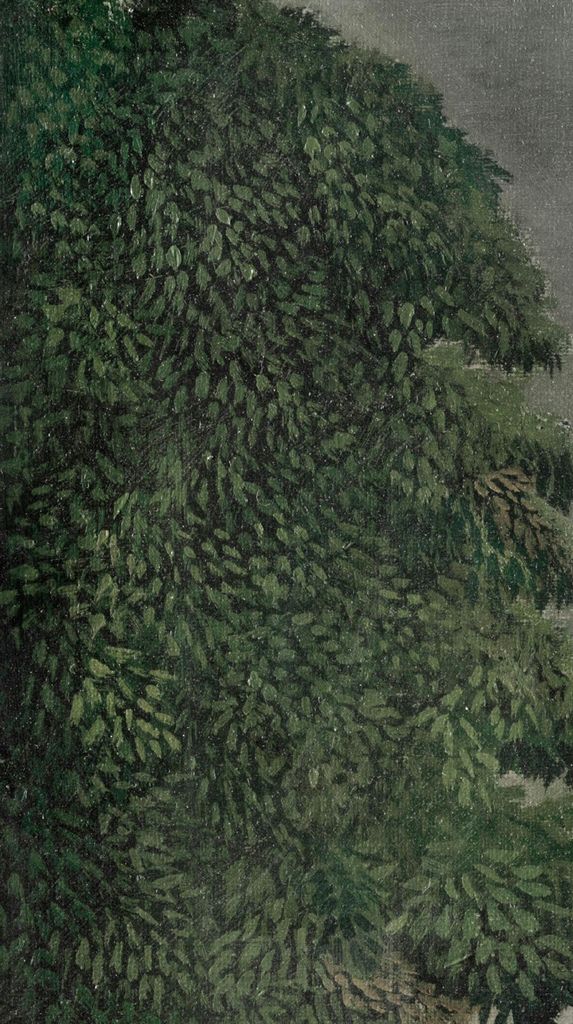
The largest leafy mass presses against the left edge. Its crown extends beyond the picture, while its lower branches bulge out over a wall and a little red-roofed building. From a distance it reads as one heavy green shape. Looking closer, the surface breaks into hundreds of separate leaves, some light enough to show their pointed ends and others swallowed by the dark intervals between them. The outer contour alternately advances and retreats, so that the tree seems to swell into the sky in successive rounded sections.
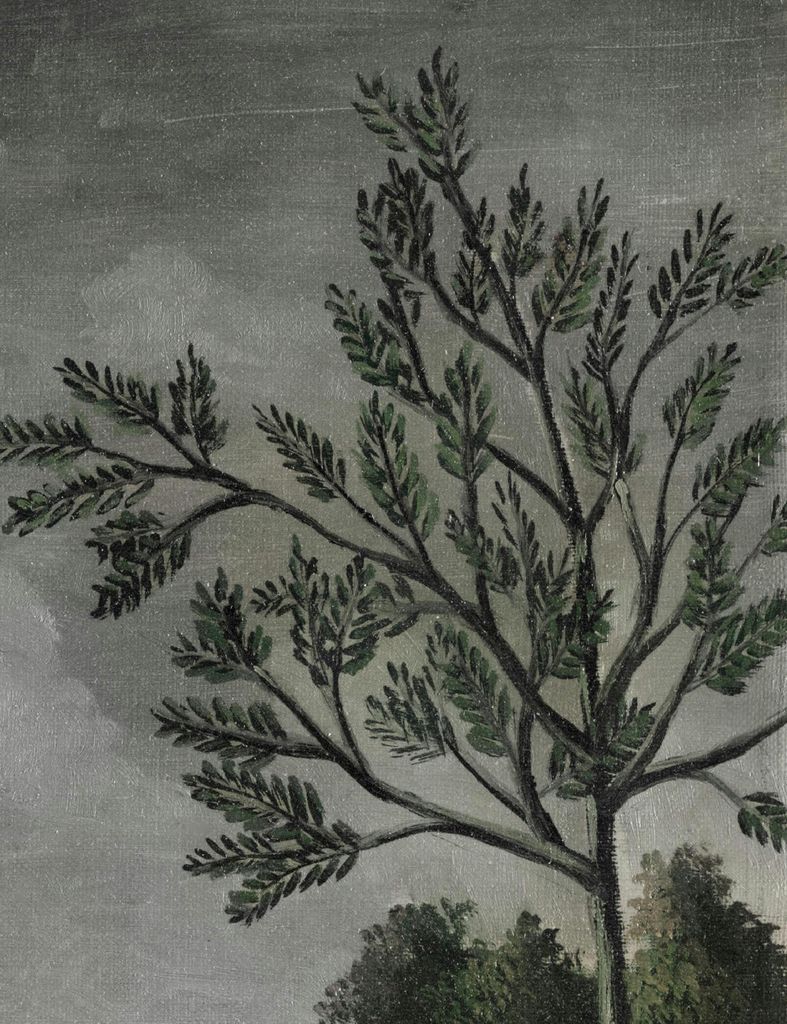
Across the road, a tall, slender trunk supports an altogether more open pattern. Dark branches fork against the grey, carrying small groups of leaves along their lengths. We can follow a branch almost from the trunk to its tip. The long limb reaching left enters the central sky like an extended arm, while higher shoots spread towards the top and right edges. Here the spaces between leaves are as conspicuous as the leaves themselves.
These trees do different kinds of work. The left one gives the scene weight and a firm boundary; the right one makes a network through which the sky remains visible. Their unequal shapes keep the composition from settling into a balanced avenue. We look from a dense surface to a branching structure, from a continuous edge to a series of openings. Beneath the open tree, another broad, dark canopy supplies the fullness missing from its upper branches, gathering the right side together near the houses.
A smaller cluster of plants rises at the lower left, with fine stems and narrow leaves. Their lighter, more delicate rhythm is squeezed between the great tree and the edge of the canvas. This change of scale rewards a slow look down the picture. Greenery that first appeared to be a single surrounding wall contains several distinct shapes, directions and densities.
A wall, a gateway and a row of houses
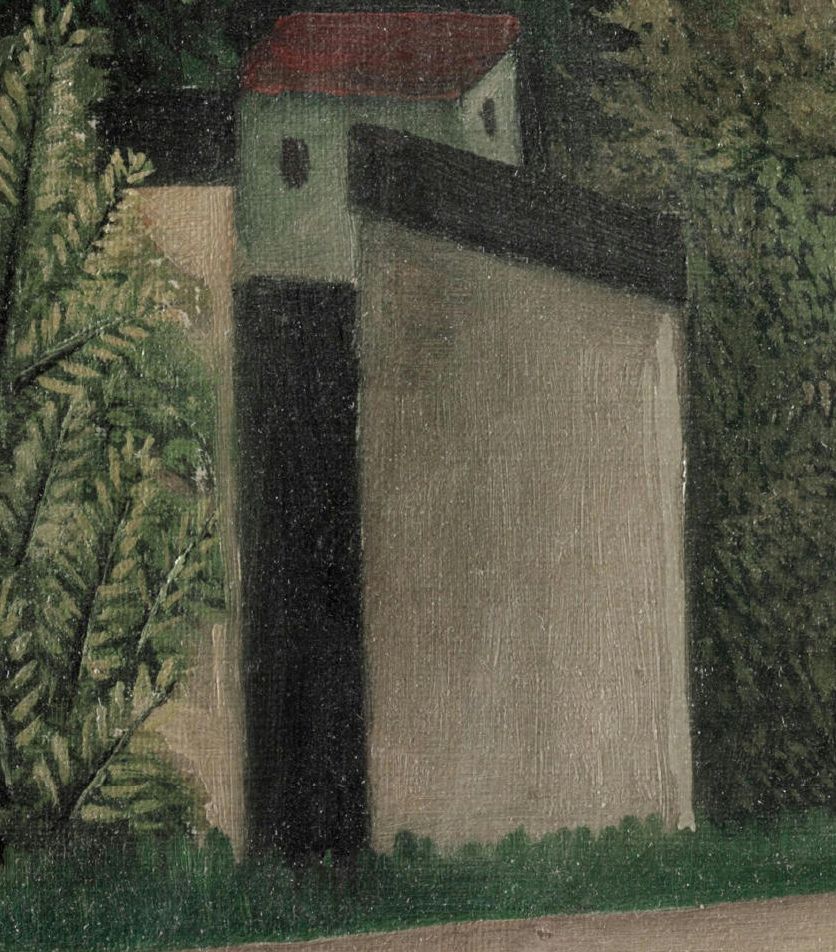
The pale wall on the left is an abrupt change from all that foliage. Its broad face is comparatively empty, and a dark cap runs along its sloping upper edge. Beside it stands a tall black opening. The opening and wall make a strong pair: a thin upright darkness next to an expanse of light. Their straight edges give the eye something definite to measure after the irregular leaves overhead.
Above the opening, a small pale building has a red roof and dark windows. It is tucked so closely into the greenery that only a compact part of it remains exposed. The roof introduces a warm patch low in the left tree, answering the red roofs farther along the street. The little building complicates our sense of size. The wall seems substantial beside the people, yet the vegetation rises far above both wall and roof.
The central houses form a descending sequence. A low red-roofed section meets a taller cream block under a dark roof; beyond it, the buildings become smaller and step towards the bend. Their windows are little dark marks, set in repeated rows. Against the restless leaf pattern, these openings establish a slower beat. They let us read separate storeys and façades even where the houses are crowded together.
Roof edges help distinguish the pieces. The red triangle of the low section points up towards the tall block, whose almost black roof gives it a heavier top. Further right, alternating pale walls and red slopes make the group turn away. The buildings remain quite distinct as shapes while also joining into one uneven strip. Following that strip is like moving a finger along a line that rises, drops and rises again before running out at the road.
There is little exposed ground between the houses and the greenery. Pale architecture appears fitted into gaps between dark growth. The green band at the foot of the façades makes the junction especially clear: walls stop, vegetation begins, and the road spreads out immediately in front. Each area keeps its own colour and character. Together they make a densely assembled place whose edges are unusually easy to trace.
The broad road and its three figures
At the bottom of the picture the road is much wider than the row of houses might lead us to expect. Its pale ochre surface reaches across the full width, then turns and narrows at the right. That turn carries the gaze behind the buildings, where the continuation of the street disappears. We can imagine following it, although we cannot see what lies around the corner.
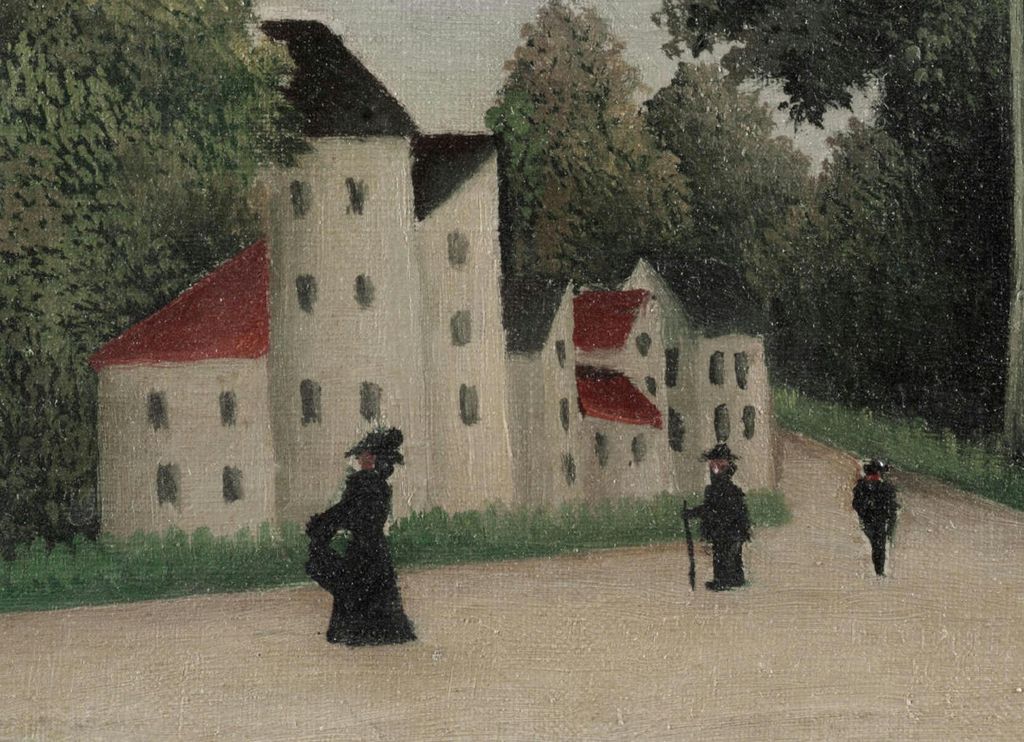
The open foreground gives the figures room to register separately. The nearest wears a long black garment and a dark hat. Its silhouette bends slightly, with an arm held close across the body, and the lower part spreads out towards the ground. The pale road exposes this small shape with remarkable clarity. Even without a readable face, the figure has a particular tilt and weight.
Farther right stands another dark figure, more upright, with a thin stick reaching to the road. A third is smaller and farther towards the curve. The gaps between them are unequal. The nearest figure is separated from the other two by a broad interval; the remaining pair stand closer together in the narrowing space. That spacing helps make the road feel deep without filling it with traffic or a crowd.
Their clothes and small gestures encourage us to imagine people going about their day, but no shared incident binds them visibly together. They neither gather at a doorway nor form a procession. Their separateness gives the street its unhurried rhythm. We encounter one person, then another, then the last, while the curve promises further space beyond all three.
The figures also provide a measure for everything around them. A window, a roof or a tree can be read first as a shape; beside a person, its size becomes more immediate. The nearest dark silhouette reaches only a short way up the houses. Compared with the long trunk at the right, all three people look exceptionally small. Everyday human scale survives within a setting dominated by trees.
Grey air and scattered red roofs
The sky is a large presence here. A darker upper area lies above softer, rounded cloud forms that descend through the centre. Between the two tall trees, an irregular channel of grey opens down towards the rooftops. Its width changes as the left crown pushes out and the right branches reach across it. The sky therefore has a contour of its own, shaped by the trees surrounding it.
Its subdued colour allows small warm accents to carry far. The red roofs are separated from one another, yet the eye can collect them into a loose chain from left to right. Their colour links buildings partly hidden by foliage with those facing the street. The warm road supplies a broader, quieter counterpart below. Between these areas, the cream walls keep the lower picture light enough to resist the surrounding greens.
Dark accents also connect distant parts of the scene. The gateway, window openings, roof of the tall house and human silhouettes repeat that darkness in different sizes. None needs a large shaded volume to be legible. A dark mark beside a pale surface can establish an opening, a figure or the top of a building. This economy makes the small village readable beneath the elaborate trees.
At the lower left, the sweeping signature has an unexpected share of the foreground. Its letters are large beside the nearest person's head and move laterally across the road's pale edge. After following the street into the distance, we meet this conspicuous writing at the surface of the picture. The flourish brings us back to the small painted rectangle in front of us.
Annotated Details from Village Street
The numbered points identify visible features discussed in this article. Return from each detail to the whole composition. Henri Rousseau, Village Street, 1909–1910. Philadelphia Museum of Art, 1950-134-178. The Louise and Walter Arensberg Collection, 1950. Museum-derived image published on Wikimedia Commons in 2022. Image source. Public domain. Numbers added to the overview; detail views cropped from the published original. No recolouring or retouching.
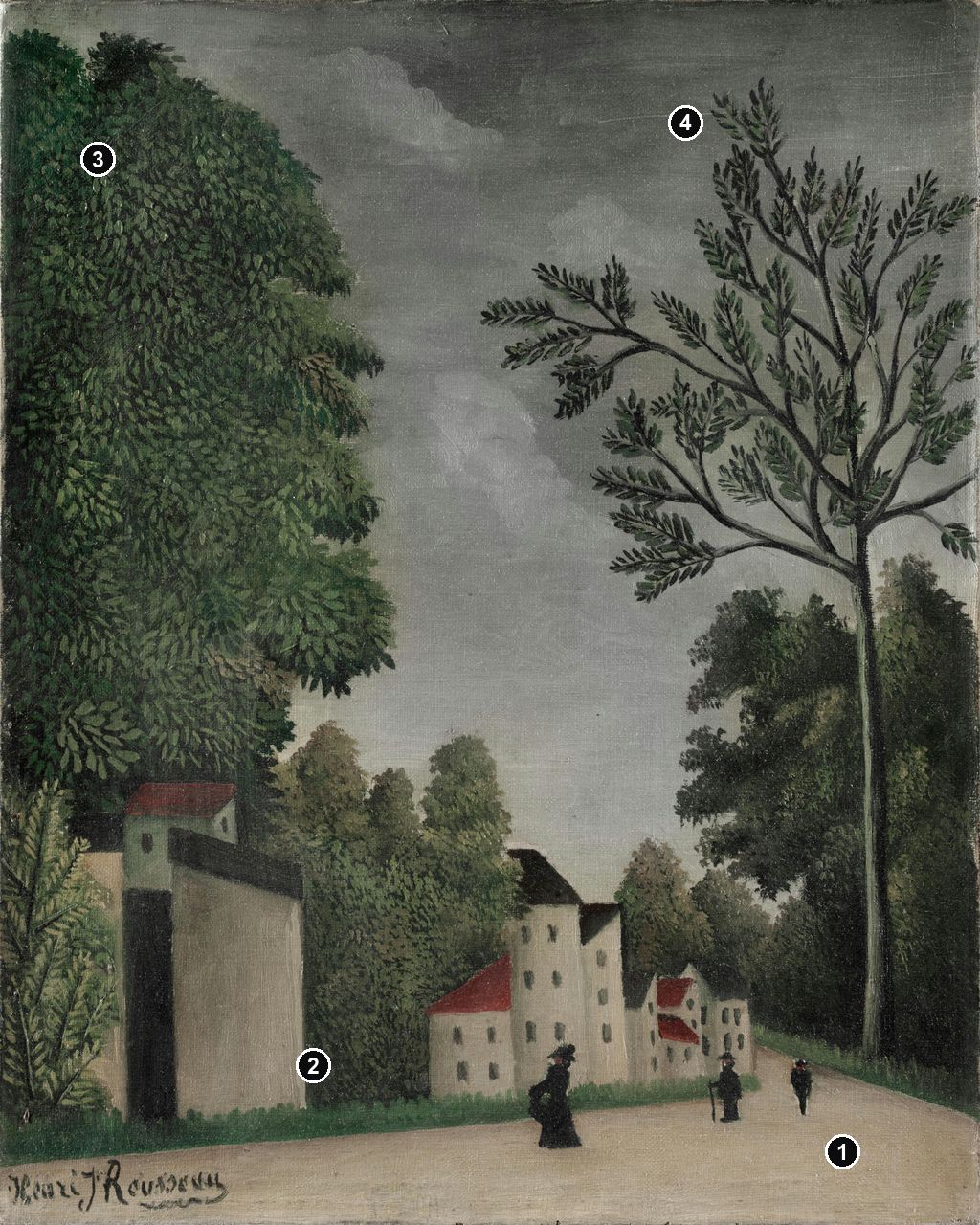
Details from VILLAGE STREET
Compare the walkers and compact buildings with the two very different patterns of leaves that rise above the street.
Three figures near the bend
The nearest dark silhouette bends slightly across the open road. Two more upright figures stand farther along, and the unequal spaces between them carry the eye towards the turn.
A dark gateway beside a pale wall
A tall black opening stands beside a broad pale wall with a sloping dark cap. Above it, the small red roof adds a warm accent beneath the much larger tree.
Dense leaves at the left
Light and dark pointed leaves gather into a great swelling crown. Its broken edge advances into the grey sky in successive rounded sections.
Branches open to the sky
Long dark limbs fork into small groups of leaves. The grey spaces between them make the tree feel more open than the dense mass on the opposite side of the street.
A glimpse of its collecting history
The Philadelphia Museum of Art reports that Village Street appears in Charles Sheeler's photograph of the Arensbergs' New York apartment, taken around 1918. The museum uses that photograph to establish their ownership by about that date.[1] The record offers a glimpse of the painting in a domestic collection, leaving its route from Rousseau to the Arensbergs unexplained.
The picture rewards close examination. First the huge trees and pale road declare themselves; then the little windows, roof changes and differences between the walkers emerge. Looking moves between these two scales. The enclosing greenery gives the scene its first force, while the smallest dark marks make its inhabited world convincing.
The bend is crucial to that experience. It gives the compact arrangement somewhere to go. Even after we have counted the people and followed the façades, the street continues out of sight, slipping between the houses and the trees. That small withheld distance keeps this quiet village from feeling like a closed display of separate objects.
Henri Rousseau artworks directory
This directory brings together works covered on this site and other works documented in the cited museum records and catalogues. Alternate titles share one entry; distinct versions remain separate. Historical dates for works without an article follow the cited catalogues. This is not a catalogue raisonné.
Frequently Asked Questions
The Philadelphia Museum of Art dates it 1909–1910.[1]
The title names no particular village. The visible buildings and road do not by themselves establish an exact location.
Three small dark figures are visible. Their changing size and spacing help carry the eye along the road towards its bend.
The contrast between the immense, densely leafed tree at the left and the open branching tree at the right. Together they surround a much smaller world of houses and pedestrians.
Discussion
Look again at the images and ideas explored in Village Street. These editorial prompts invite your observations.
Reader Insights
Follow the red roofs across the picture. How do they connect parts of the village that the trees separate?
Cover the three figures for a moment. How does their absence change the apparent size of the road and buildings?
Does the street feel more open or enclosed? Which edges of the picture shape your response?
Join the Conversation
Share a detail, comparison or question about Village Street below.
References
- Philadelphia Museum of Art. Village Street, object 51099, accession 1950-134-178, collection record and provenance. View source.
- Philadelphia Museum of Art, Carnival Evening,1963-181-64,object59593. View source.
- Musée de l’Orangerie / Juliette Degennes, Henri Rousseau,L’ambition de la peinture: Un artiste dans son époque (in French). View source.
- National Gallery, Surprised!, NG6421. View source.
- Musée d’Orsay, La Guerre,RF19461 (in French). View source.
- MoMA, The Sleeping Gypsy. View source.
- Philadelphia Museum of Art, The Merry Jesters, 1950-134-176, object51097. View source.
- Musée d’Orsay, La Charmeuse de serpents, RF 1937 7 (in French). View source.
- Musée de l’Orangerie, La Carriole du Père Junier, RF 1960 26 (in French). View source.
- Solomon R. Guggenheim Museum / Cornelia Lauf, The Football Players,60.1583: current collection record. View source.
- MoMA, The Dream, 252.1954. View source.
- The Museum of Modern Art, Henri Rousseau: Essays (1985), selected catalogue entries, chronology and notes on early devotees. View source. Selected entries, chronology (pp.91–95) and early-devotee notes (pp.262–264) were consulted. Historical collection credits do not establish present ownership.
- Daniel Catton Rich, Henri Rousseau (The Museum of Modern Art, 1942), selected drawings and landscape studies; historical catalogue. View source. The dated 1942 publication is used for the two Quai d’Auteuil ink views; its Malakoff date differs from the 1985 catalogue.
- MANAS, Laval, Henri Rousseau, dit le Douanier, urban landscapes and preparatory study (in French). View source.
- National Gallery of Art, Self-Portrait (1895), pen-and-ink drawing, accession 1995.47.66. View source.
- The Museum of Modern Art, War (published January 1895), lithograph, accession 684.1943. View source.
- Barnes Foundation, Landscape and Four Young Girls, object 5521, BF855. View source.


 Henri Rousseau.jpg)


 Henri Rousseau.jpg)