



 by Tom Gurney
Tom Gurney BSc (Hons) is an art history expert with over 20 years experience
Published on June 19, 2020 / Updated on October 29, 2026
Email: tomgurney1@gmail.com / Phone: +44 7429 011000
Young Girl in Pink: Introduction
A girl stands among broken grey rocks, her pale dress opening out against a forest of almost black trunks. The trees crowd around her shoulders and head, but she faces straight out of the picture. In Henri Rousseau’s Young Girl in Pink, that meeting of a clearly presented figure and an intricately obstructed setting gives the portrait its peculiar force. A small pale animal occupies the rocks beside her; another, darker creature almost disappears on the opposite side. Their miniature scale makes her full-length presence seem larger still.
At a Glance
- Date1906–1907
- MediumOil on canvas
- Size61 × 45.7 cm
- CollectionPhiladelphia Museum of Art
- Accession1938-38-1[1]
This work across Henri Rousseau’s career
Carnival Evening
1886 [2]The Merry Jesters
1906 [7]Young Girl in Pink (current article)
1906–1907 [1]The Snake Charmer
1907 [8]Contents
- A face held within the trees
- The geometry of the pink dress
- A forest made of crossings
- Rocks, boots and miniature animals
- The girl and the painting’s recorded history
- Annotated details
A face held within the trees
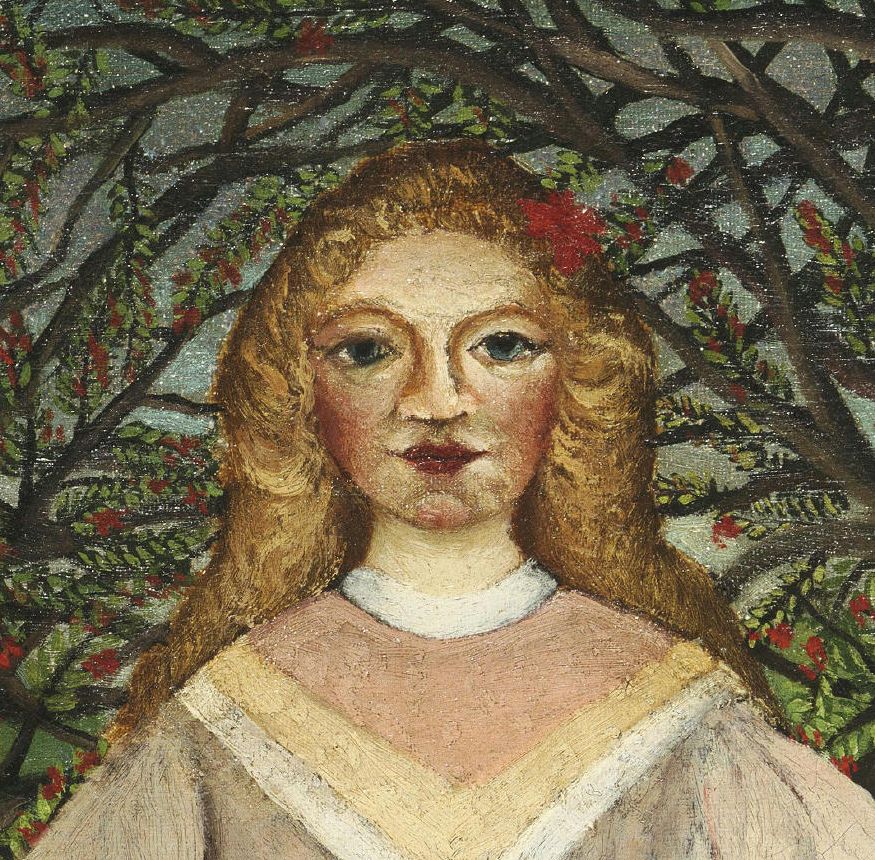
The girl’s face lies near the top of a long, broadening silhouette. Her golden hair falls in waves beside her cheeks and onto her shoulders, carrying a warm colour down to the collar. A red bow sits high on the right as we look at her. Against the interlocking brown and black branches, the hair makes a soft, irregular border around the pale face. Immediately above her head, crossing limbs interrupt small openings of sky.
Her eyes are widely spaced and strongly outlined. Dark brows, the narrow bridge of the nose and the small red mouth establish distinct features within the rounded face. Light and reddish shading give the cheeks some fullness, while the sharply marked contours keep each feature legible. The mouth is closed, and the gaze meets ours. These details make her recognisable as a particular presence without telling us what she is thinking. The surrounding density can feel strange to a viewer, but an expression alone cannot explain the girl’s feelings about her setting.
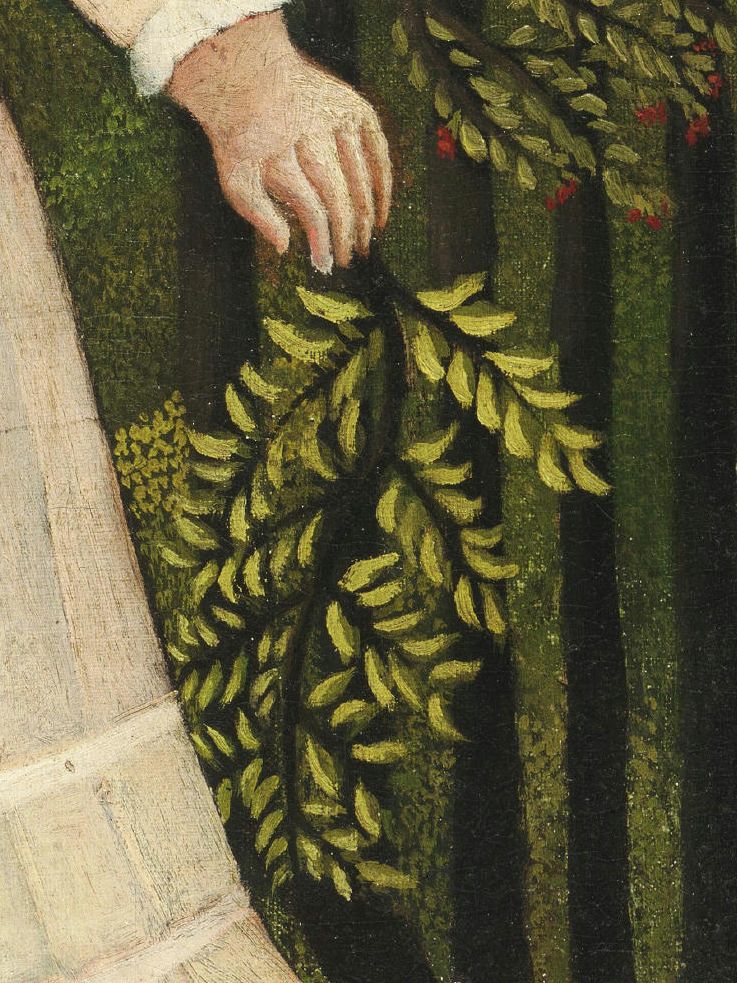
The pose is frontal through the head and body, yet the arms depart from its central alignment. On our left, an arm drops beside the skirt. Its fingers extend downward, repeating the direction of the long folds. On our right, the other arm reaches outward and bends, bringing the hand above a drooping bough of yellow-green leaves. That small difference opens the silhouette. It allows the forest’s branching movement to enter the space beside the dress and brings one piece of vegetation into direct contact with the figure.
The geometry of the pink dress
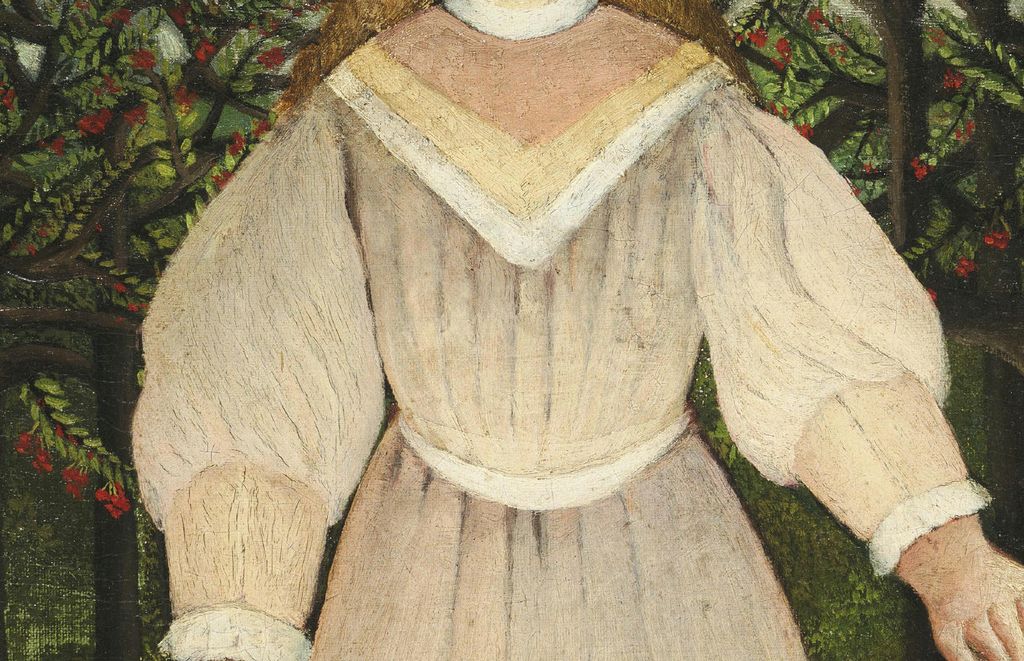
The dress occupies an enormous share of the painted surface. Its colour is delicate: pink is clearest across the upper chest, while the sleeves and skirt read as cream, pale rose and grey. Within that narrow range, lines and changes of tone do much of the work. The sleeves swell outward, narrow at the wrists and end in white, lightly scalloped cuffs. Their rounded volume contrasts with the straighter fall of the skirt below the waist.
At the neckline, nested shapes organise the upper body. A white neckband rests beneath the chin. Below it lies a pink triangular panel, edged by a wider yellow-cream V and then a white border. Each V points toward the centre of the chest, drawing attention back from the expansive sleeves. The design introduces a firm angular structure into a garment otherwise filled with curves and gathered fabric. The pointed collar also answers the many forks in the branches, although its broad, pale edges are far easier to follow.
A white belt crosses the waist and curves around the body. Below it, thin vertical folds spread through the widening skirt. Some are long and dark enough to register immediately; others are faint lines within the light fabric. The surface therefore alternates between a single pale shape, visible from a distance, and a field of smaller divisions that emerges as we look more closely. Rousseau gives the garment both a clear outline and an internal rhythm.
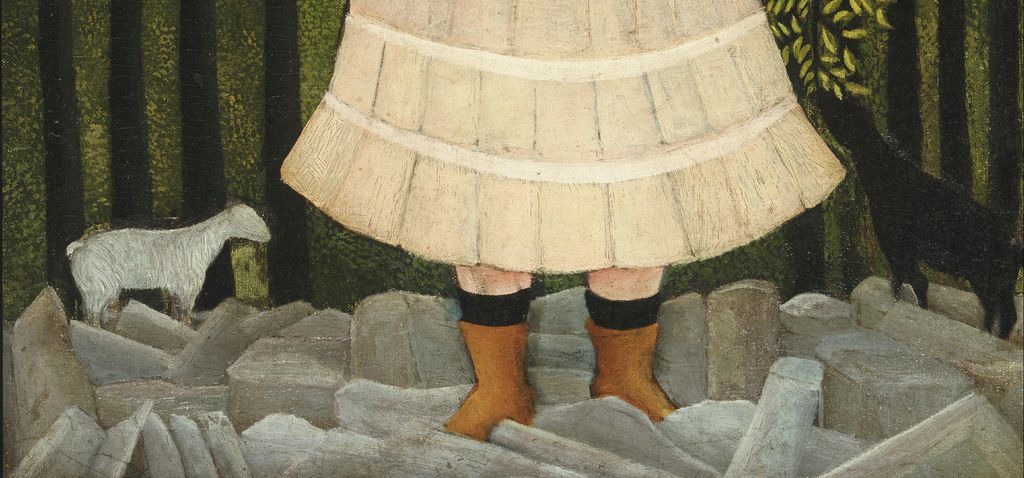
Near the bottom, two pale horizontal bands cross the downward flow of the folds. The lower portion ends in a broad ruffled hem, with many short lines turning around its curve. This layered edge stretches across the rocks like a shallow arc. The feet remain visible beneath it: dark stockings and mustard-coloured ankle boots form a compact pair below the wide skirt. Golden hair at the top and ochre footwear at the bottom place related warm colours at either end of the figure.
A forest made of crossings
Around the girl, the trees establish a different order. Several tall trunks rise almost vertically, while smaller branches spread horizontally and diagonally between them. At head height, these crossings become especially crowded. They weave behind the hair, pass around the shoulders and occupy the narrow spaces near the raised arm. The dark structure holds together across the whole width of the picture, even where the pale figure blocks our view of it.
Small green leaves cling to many of the finer stems. Red berry-like clusters appear at intervals, making brief points of colour in the dark network. The red bow belongs to this scattered pattern of accents as well as to the girl’s hair. The connection is visual: our eye can move from a cluster in the trees to the bow and back again. It supplies no certain explanation of why those objects were included.
The forest is also more open than its dark trunks first suggest. Narrow pale gaps survive between branches at the top, and green areas show through lower down. They offer glimpses of distance, but no broad path leads us into it. Looking through the trees requires picking out small openings one by one, whereas the girl’s dress can be grasped almost at once.
The bough beneath her hand provides a striking variation on this pattern. Its leaves are larger and brighter than most of the foliage behind her. They descend in several curved sprays, hanging beside the skirt rather than spreading across the upper forest. The hand marks a junction between the pale body and that loose cluster. Its downward sweep also extends the outward movement of the arm, creating an asymmetry beside the otherwise balanced figure.
Rocks, boots and miniature animals
Across the foreground, angular stones form a pale, uneven platform. Long slabs run obliquely across the bottom edge; smaller upright blocks rise behind them. Grey, white and muted green distinguish neighbouring planes. Some joints are deep and dark, while other edges are only lightly marked. The boots stand within this broken arrangement, surrounded by surfaces that tilt in several directions.
The dress’s rounded hem remains clear above these irregular forms. Their contrast helps us see the difference between hanging fabric and fractured stone: curves and closely repeated folds meet corners, wedges and abrupt changes of plane. The stones also interrupt the dark trunks at ground level. With the boots between pale rock faces, the figure has a definite point of contact with the foreground, even though her frontal presentation keeps the body visually close to the picture surface.
On our left stands a small, pale, goatlike animal in profile, facing toward the girl. Its back, short legs and extended head can be read against the darker trunks. Across the picture, a very dark goatlike form is much harder to distinguish behind the rocks. The two creatures create an uneven balance. One announces itself through its light colour; the other rewards a more searching look. Their difference repeats, on a tiny scale, the larger alternation of pale shapes and dark surroundings.
Their size is especially arresting beside the boots and skirt. Neither animal supplies a dependable measure of the girl’s height or the forest’s depth. Instead, the disparity makes us shift between two ways of looking: attending to the girl as a full-length portrait and exploring the surrounding scene for small inhabitants. The painting keeps them visibly present while leaving their relationship to the sitter unexplained.
Annotated Details from Young Girl in Pink
The numbered points identify visible features discussed in this article. Return from each detail to the whole composition. Henri Rousseau, Young Girl in Pink, 1906–1907. Philadelphia Museum of Art, 1938-38-1. Gift of R. Sturgis and Marion B. F. Ingersoll, 1938. Museum-derived image published on Wikimedia Commons in 2022. Image source. Public domain. Numbers added to the overview; detail views cropped from the published original. No recolouring or retouching.
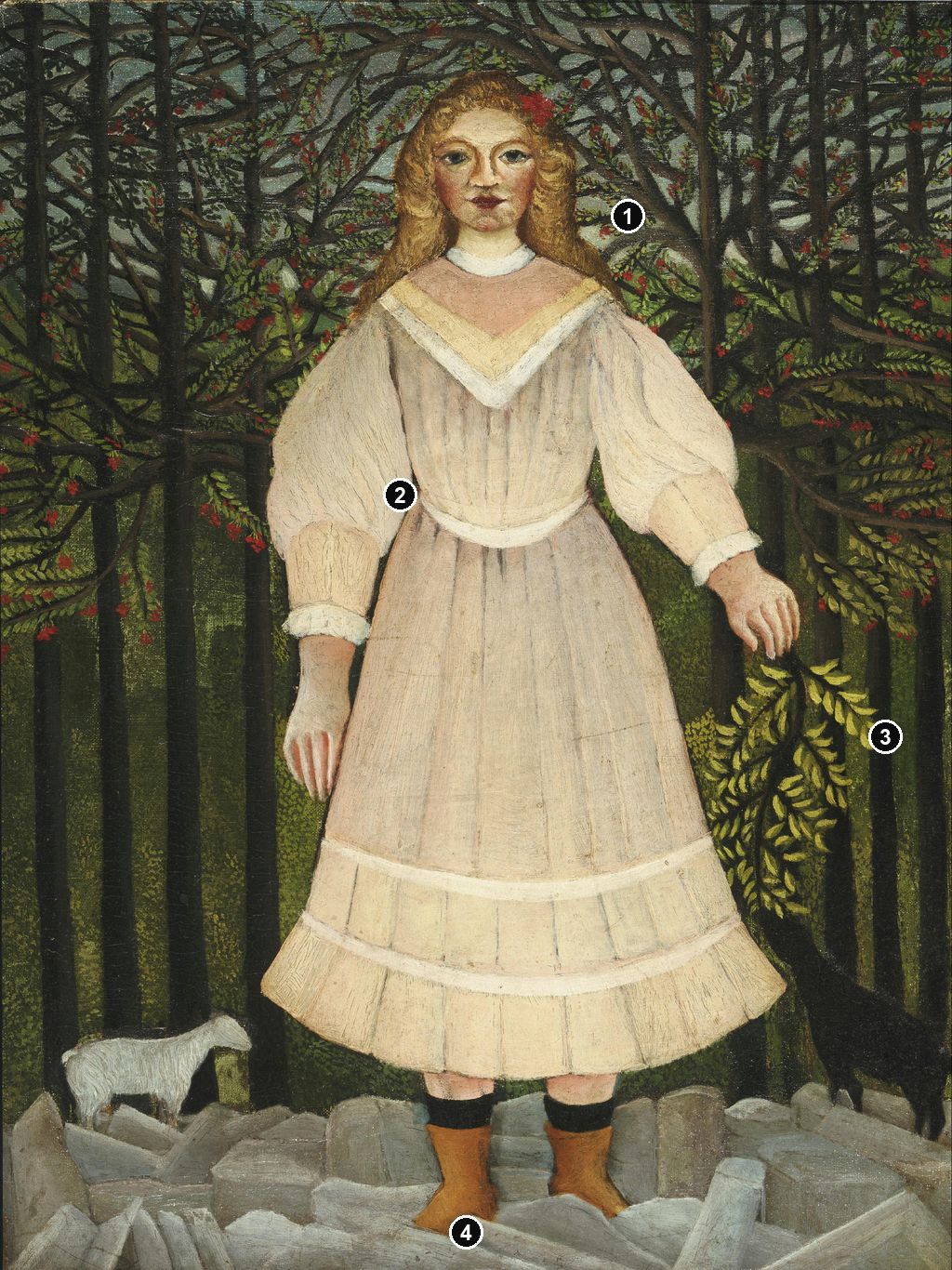
Details from YOUNG GIRL IN PINK
Compare the clear frontal face and layered clothing with the bright bough and miniature animals that complicate the figure’s surroundings.
Face, bow and crossing branches
Golden hair and a red bow frame the pale face. Strongly marked eyes and a closed mouth meet the viewer, while crossing branches interrupt the small openings of sky behind the head.
Layered collar and gathered sleeves
A pink panel, yellow-cream V and white border form nested angles across the chest. Broad sleeves and thin folds give the pale garment both rounded volume and a clear angular structure.
A hand above bright hanging leaves
The outward-reaching hand meets a drooping bough. Its larger yellow-green leaves stand out from the smaller, darker foliage behind, extending the arm’s asymmetry beside the skirt.
Small animals beside the boots
A pale goatlike animal stands at the left, while a much darker form blends into the trees at the right. Ochre boots and angular grey rocks make their unusually small scale conspicuous.
The girl and the painting’s recorded history
The Philadelphia Museum of Art identifies Charles Papouin as the model’s father and records Rousseau’s gift of the painting to him in 1906 or 1907. It gives no first name or age for the girl. Its provenance traces subsequent ownership through Serge Férat and Hélène d’Oettingen, then Oscar Miestchaninoff by 1923. The Marie Harriman Gallery sold it to R. Sturgis Ingersoll in 1931. R. Sturgis and Marion B. F. Ingersoll gave it to the museum in 1938.[1]
The coloured bow, layered collar, narrow belt and carefully separated fingers give the girl a highly particular appearance. Around her, the compressed forest and tiny animals keep the scene from settling into a straightforward account of a person outdoors. Looking from her face down to the rocky foreground brings both qualities into view: the sharply defined individual and the surrounding world whose proportions remain elusive.
Henri Rousseau artworks directory
This directory brings together works covered on this site and other works documented in the cited museum records and catalogues. Alternate titles share one entry; distinct versions remain separate. Historical dates for works without an article follow the cited catalogues. This is not a catalogue raisonné.
Frequently Asked Questions
Its light cream and grey passages occupy much more space than the stronger pink panel at the chest. The dark forest increases the contrast, making the whole garment appear especially pale. Thin folds and horizontal bands remain visible within that light shape.
The hand at the right of the image holds a drooping leafy bough. Its yellow-green sprays hang beside the skirt. The image does not establish a secure botanical identification.
Two small goatlike animals appear among the rocks. The pale animal on the left is easy to see; the much darker one on the right blends into the trees. Their exact species and their meaning are uncertain.
Discussion
Look again at the images and ideas explored in Young Girl in Pink. These editorial prompts invite your observations.
Reader Insights
How does the portrait change when you notice the dark animal after seeing the pale one?
Follow the pointed collar, rounded hem and angular rocks. Which shapes make the figure feel most firmly placed?
What happens to the apparent scale of the girl when you look from her boots to the small animals?
Join the Conversation
Share a detail, comparison or question about Young Girl in Pink below.
References
- Philadelphia Museum of Art. Young Girl in Pink, object 45670, accession 1938-38-1, object details and provenance. Accessed 23 October 2026. View source.
- Philadelphia Museum of Art, Carnival Evening,1963-181-64,object59593. View source.
- Musée de l’Orangerie / Juliette Degennes, Henri Rousseau,L’ambition de la peinture: Un artiste dans son époque (in French). View source.
- National Gallery, Surprised!, NG6421. View source.
- Musée d’Orsay, La Guerre,RF19461 (in French). View source.
- MoMA, The Sleeping Gypsy. View source.
- Philadelphia Museum of Art, The Merry Jesters, 1950-134-176, object51097. View source.
- Musée d’Orsay, La Charmeuse de serpents, RF 1937 7 (in French). View source.
- Musée de l’Orangerie, La Carriole du Père Junier, RF 1960 26 (in French). View source.
- Solomon R. Guggenheim Museum / Cornelia Lauf, The Football Players,60.1583: current collection record. View source.
- MoMA, The Dream, 252.1954. View source.
- The Museum of Modern Art, Henri Rousseau: Essays (1985), selected catalogue entries, chronology and notes on early devotees. View source. Selected entries, chronology (pp.91–95) and early-devotee notes (pp.262–264) were consulted. Historical collection credits do not establish present ownership.
- Daniel Catton Rich, Henri Rousseau (The Museum of Modern Art, 1942), selected drawings and landscape studies; historical catalogue. View source. The dated 1942 publication is used for the two Quai d’Auteuil ink views; its Malakoff date differs from the 1985 catalogue.
- MANAS, Laval, Henri Rousseau, dit le Douanier, urban landscapes and preparatory study (in French). View source.
- National Gallery of Art, Self-Portrait (1895), pen-and-ink drawing, accession 1995.47.66. View source.
- The Museum of Modern Art, War (published January 1895), lithograph, accession 684.1943. View source.
- Barnes Foundation, Landscape and Four Young Girls, object 5521, BF855. View source.


 Henri Rousseau.jpg)


 Henri Rousseau.jpg)