



 by Tom Gurney
Tom Gurney BSc (Hons) is an art history expert with over 20 years experience
Published on June 19, 2020 / Updated on October 29, 2026
Email: tomgurney1@gmail.com / Phone: +44 7429 011000
Bouquet of Flowers: Introduction
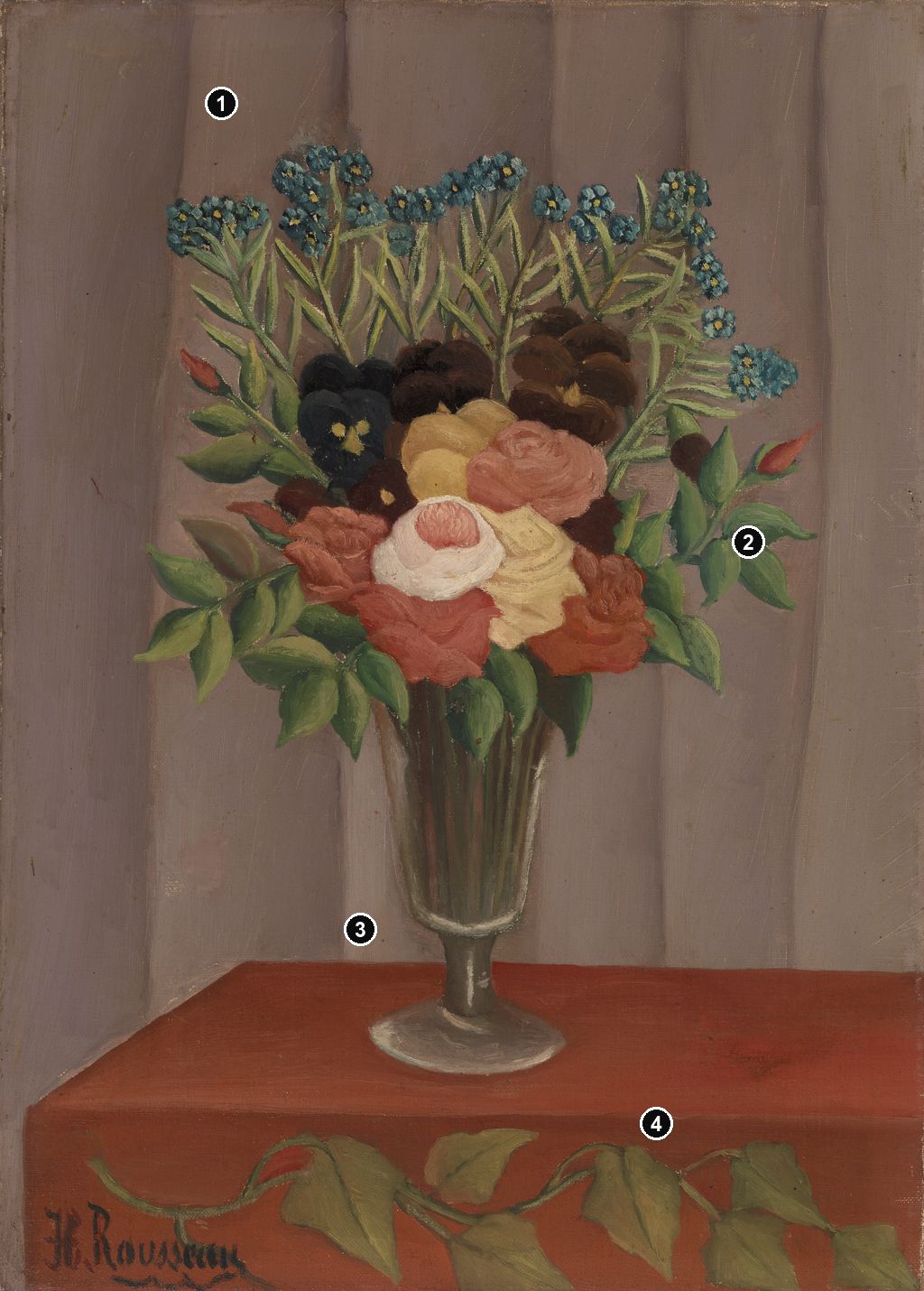
Henri Rousseau's Bouquet of Flowers rises from a slender glass vase in a carefully balanced tower of stems, leaves and blossoms. Small blue clusters crown the arrangement, while cream, pink and red flowers crowd its lower half. Below them, the transparent vessel draws the eye down to a red table and a loose trail of ivy. The Barnes Foundation dates this oil on canvas to about 1909–1910; measuring 47 × 33.5 cm, it is the painting catalogued as BF579.[1]
At a Glance
- ArtistHenri Rousseau
- SubjectBouquet of Flowers
- ExploreA bouquet in two registers; Light petals and dark centres
This work across Henri Rousseau’s career
Carnival Evening
1886 [2]The Merry Jesters
1906 [7]The Snake Charmer
1907 [8]Bouquet of Flowers (current article)
c. 1909–1910 [1]Contents
- A bouquet in two registers
- Light petals and dark centres
- Glass, weight and balance
- The ivy below the vase
- A small painting with a public history
- Annotated details
A bouquet in two registers
The first impression is of abundance held upright. The flowers spread widely above the narrow vessel, almost filling the upper portion of the canvas, yet a margin of quiet background keeps their outer leaves distinct. Their outline is irregular: a pointed bud extends towards either side, foliage reaches farther on the left, and the blue flower heads make an uneven crest. The central placement gives the arrangement its poise without turning it into an exact mirror image.
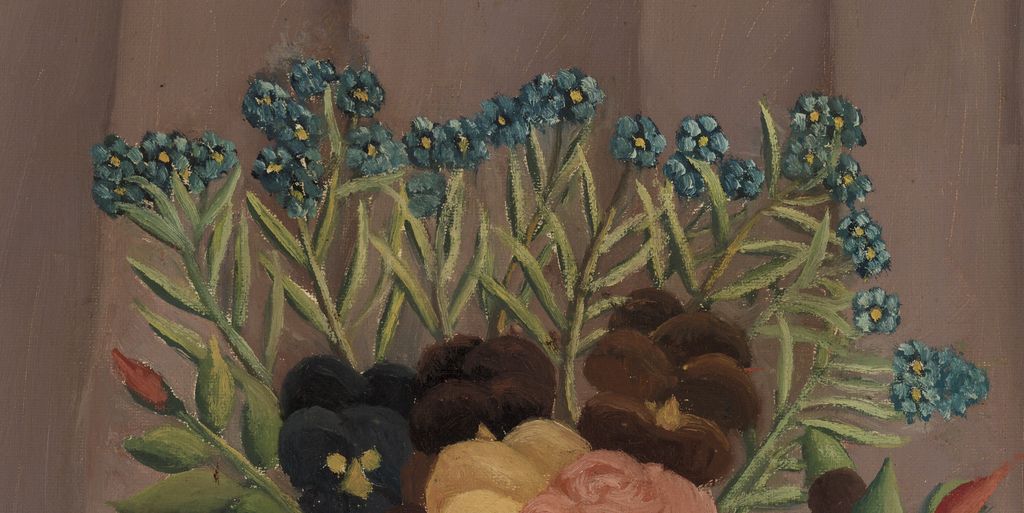
Rousseau divides the bouquet into two different kinds of growth. In the upper section, pale green stems branch and cross beneath small blue clusters. There is room to look between them. Their slender lines form an open framework through which patches of the brownish backdrop remain visible. Some heads stand higher than their neighbours; others bend outwards or descend along the right edge. That variety gives the top of the bouquet a lively, searching movement.
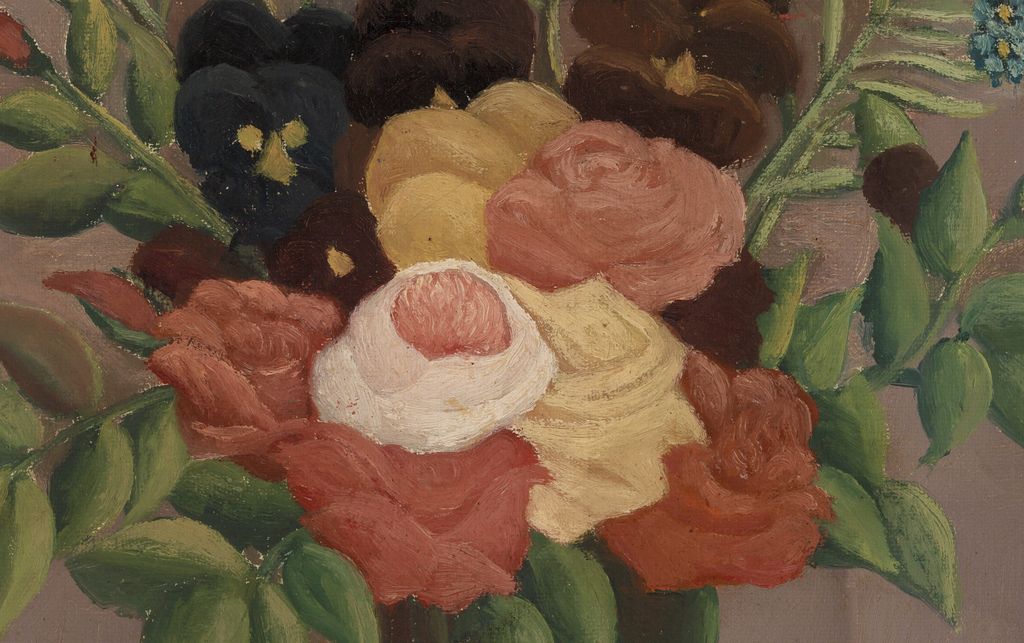
The lower flowers gather into a much denser mass. Rounded, rose-like blooms face the viewer in overlapping layers of cream, salmon pink and red. Near the centre, a pale flower with a pink interior opens above a large red bloom; to its right, a cream flower folds into a sequence of broad, curved petals. Dark, pansy-like flowers sit behind this bright group. Their nearly black and brown surfaces carry small yellow accents, conspicuous against the surrounding darkness.
These names describe resemblances rather than a secure botanical inventory. What matters most to the arrangement is the difference between the flower forms: tiny clustered dots above, broad curling petals below, and dark rounded faces behind. Each invites a different pace of looking. The blue heads resolve into many small marks, while the larger blossoms can be read as complete shapes from farther away. Their gathering together makes the bouquet feel both intricate and immediately legible.
Light petals and dark centres
The palest petals occupy the heart of the picture, where they meet some of its deepest tones. The cream and pink flowers seem to press forward from the dark blooms behind them. Their edges remain easy to follow even where several flowers overlap. This concentration of light does much of the work of giving the bouquet depth: the viewer reads a sequence of blossoms advancing and receding within a relatively shallow space.
Colour connects the flowers to the rest of the painting. Red recurs across the lower blossoms and then returns in the broad tabletop underneath. The upper blue clusters stand apart from those warmer passages, separated from them by the green stems and the dark flowers. The bouquet therefore has a clear colour structure as well as a change in density from top to bottom. Small cool accents lift its upper edge; larger warm shapes give weight to its centre and base.
Leaves bind those different passages together. Some spread sideways in pointed pairs, some turn their light surfaces towards us, and others hang down over the mouth of the vase. Yellow-green edges and veins make individual leaves readable within the darker foliage. Along the sides, the leaves interrupt the roundness of the flowers with sharp tips and oblique angles. At the bottom, their drooping shapes lead naturally towards the long vertical stems visible through the glass.
The painting offers many distinct surfaces without making them compete equally for attention. Petals curl, foliage tapers, stems run in fine lines, and the background stays comparatively broad and subdued. Looking across those differences helps explain the bouquet's clarity. Its abundance depends on the separation of small forms, with enough repetition of colour and shape to keep them part of one arrangement.
Glass, weight and balance
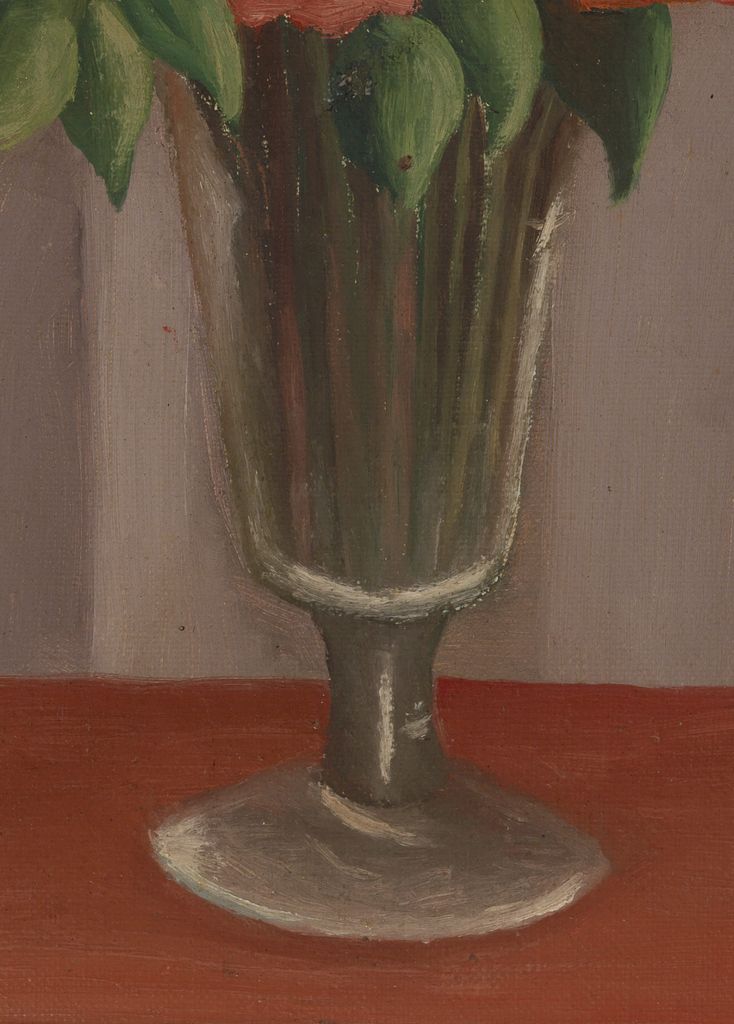
The vase is a delicate part of that balance. Its tall body narrows towards a short stem and an oval foot. Pale lines describe its sides, while a brighter curve gathers around the lower bowl. Inside, long greenish and brownish streaks suggest the crowded flower stems. The glass has enough transparency for these lines to remain visible, although it also gathers darker tones that give the vessel a definite presence against the backdrop.
The contrast between the vase and the flowers is striking. Above, the bouquet spreads outwards in a wide crown; below, its contents are drawn into a narrow channel. The foot then widens again, resting on the red surface in a pale ellipse. This sequence of expansion, contraction and renewed breadth carries the eye through the central axis. It also lets the thin glass sustain the visual weight of the flower heads above it.
The red table provides a firm base for such a fragile object. Its top extends to either side of the vase, and the angled left edge reveals a corner projecting towards the viewer. A darker band marks the front. These few lines establish the support without describing an entire room or adding neighbouring objects. The little still life has the intimacy of something placed close at hand: the flowers stand almost within reach, with little intervening space.
Behind them, broad vertical divisions run through the muted brown and mauve background. They can suggest folds or panels, but their exact material remains uncertain. Their chief visible effect is to give the curling, branching plants a steady upright setting. Differences of tone keep this surface from becoming blank, while its restrained colour allows the flowers and the red table to hold attention. The scene remains enclosed and quiet, with no view beyond the arrangement.
The ivy below the vase
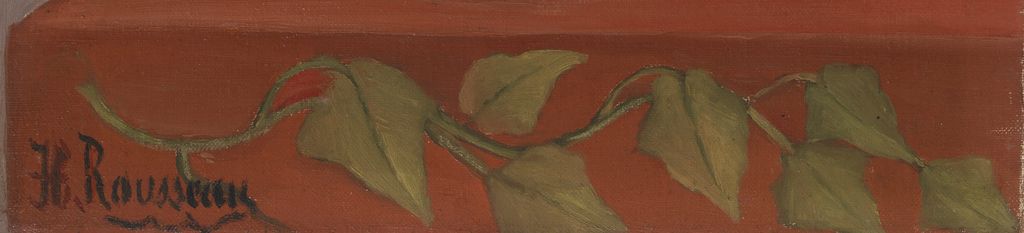
Along the lower edge, a length of ivy introduces a different direction. Its curving stem travels across the table front beneath the vase, carrying widely spaced leaves. It begins with a loose curl on the left and continues towards the right edge. The generous intervals between its leaves contrast with the crowded bouquet above, where blossoms and foliage overlap almost continuously.
This low garland changes how the picture is read. After following the central vase upwards into the flowers, the viewer can return to the foot and move sideways with the ivy. Its green leaves repeat the foliage of the main arrangement while opening it out into a broader rhythm. Rousseau's dark signature appears at the lower left, close to the curving stem. The table front becomes an active part of the composition, carrying both the leafy line and the artist's name.
The ivy also brings a new kind of leaf into close view. Its broader, lobed shapes differ from the narrower foliage framing the flowers. Set against the red band, those silhouettes are unusually clear. The passage offers a small study in variation: plants can supply a dense central cluster, a screen of branching lines, or a loose sequence of shapes across a surface. Here all three possibilities coexist within one compact canvas.
Annotated Details from Bouquet of Flowers
The numbered points identify visible features discussed in this article. Return from each detail to the whole composition. Henri Rousseau, Bouquet of Flowers, c. 1909–1910. BF579. Courtesy of the Barnes Foundation, Merion and Philadelphia, Pennsylvania. Museum image published on Wikimedia Commons in 2018. Image source. Public domain. Numbers added to the overview; details cropped from the published original. No recolouring or retouching.
Details from BOUQUET OF FLOWERS
Compare the open blue-tipped stems with the crowded central flowers, then follow the narrow glass and the sideways movement of the ivy.
Blue flowers on an open framework
Small blue heads rise above branching green stems. Quiet patches of background remain visible between the crossing lines, giving the upper bouquet a more open rhythm than the dense flowers below.
Pale petals before dark flowers
Cream and pink blossoms overlap in front of nearly black and brown, pansy-like forms. Small yellow accents distinguish the darker flowers, while broad curling petals bring the lighter group forward.
Stems seen through a footed glass vase
Long greenish and brown streaks remain visible inside the narrow bowl. Pale sides and a brighter lower curve give the glass a presence before the short stem widens into an oval foot.
Ivy and a signature across the table
A curving stem carries widely spaced lobed leaves across the red table front. The dark signature sits near its left-hand curl, turning the eye sideways beneath the upright vase.
A small painting with a public history
The intimate scale places this work within an important side of Rousseau's production. In its 2026 exhibition account, the Musée de l'Orangerie explains that he varied subjects and formats for customers including artisans, shopkeepers and the modest middle class. Bouquets and still lifes belonged to a decorative repertoire made on small canvases suited to limited budgets and domestic interiors. This is useful context for the Barnes picture's size and concentrated subject, although it does not identify a particular customer for it.[12]
The painting also acquired a place in the public history of independent art. The Barnes collection record lists it in the Société des Artistes Indépendants exhibition Trente ans d'art indépendant, held in Paris in 1926, as number 3187. The museum attributes that entry to Henry Certigny's later research.[1]
Henri Rousseau artworks directory
This directory brings together works covered on this site and other works documented in the cited museum records and catalogues. Alternate titles share one entry; distinct versions remain separate. Historical dates for works without an article follow the cited catalogues. This is not a catalogue raisonné.
Frequently Asked Questions
The Barnes Foundation currently dates BF579 to about 1909–1910. It is an oil painting on canvas measuring 47 × 33.5 cm.[1]
It belongs to the Barnes Foundation in Philadelphia and is catalogued as BF579, under the English and French titles Bouquet of Flowers and Bouquet de fleurs.[1]
The arrangement includes rounded rose-like blooms, dark pansy-like flowers and small blue clusters on tall branching stems. These are visual comparisons; the image alone does not establish every species or variety.
Look for the clear stemmed glass vase, the open framework of blue-tipped stems above the denser flowers, the red table and the ivy running across its front. Those features identify the composition discussed here more securely than its general title.
The guide to Rousseau's paintings brings together his still lifes, portraits, landscapes and jungle scenes.
Discussion
Look again at the images and ideas explored in Bouquet of Flowers. These editorial prompts invite your observations.
Reader Insights
How does the open network of stems above change your experience of the dense flowers below?
Where does the glass appear most transparent, and where does it seem most solid?
Follow the ivy across the lower edge. How does that sideways movement affect the upright arrangement?
Join the Conversation
Share a detail, comparison or question about Bouquet of Flowers below.
References
- Barnes Foundation. Bouquet of Flowers (Bouquet de fleurs), BF579, object 5520; current collection metadata and exhibition-history entry, accessed 23 October 2026. View source.
- Philadelphia Museum of Art, Carnival Evening,1963-181-64,object59593. View source.
- Musée de l’Orangerie / Juliette Degennes, Henri Rousseau,L’ambition de la peinture: Un artiste dans son époque (in French). View source.
- National Gallery, Surprised!, NG6421. View source.
- Musée d’Orsay, La Guerre,RF19461 (in French). View source.
- MoMA, The Sleeping Gypsy. View source.
- Philadelphia Museum of Art, The Merry Jesters, 1950-134-176, object51097. View source.
- Musée d’Orsay, La Charmeuse de serpents, RF 1937 7 (in French). View source.
- Musée de l’Orangerie, La Carriole du Père Junier, RF 1960 26 (in French). View source.
- Solomon R. Guggenheim Museum / Cornelia Lauf, The Football Players,60.1583: current collection record. View source.
- MoMA, The Dream, 252.1954. View source.
- Musée de l'Orangerie. Henri Rousseau, l'ambition de la peinture, exhibition texts, 25 March–20 July 2026, section “Variations et déclinaisons. À la recherche du marché”; accessed 23 October 2026. View source. (in French).
- The Museum of Modern Art, Henri Rousseau: Essays (1985), selected catalogue entries, chronology and notes on early devotees. View source. Selected entries, chronology (pp.91–95) and early-devotee notes (pp.262–264) were consulted. Historical collection credits do not establish present ownership.
- Daniel Catton Rich, Henri Rousseau (The Museum of Modern Art, 1942), selected drawings and landscape studies; historical catalogue. View source. The dated 1942 publication is used for the two Quai d’Auteuil ink views; its Malakoff date differs from the 1985 catalogue.
- MANAS, Laval, Henri Rousseau, dit le Douanier, urban landscapes and preparatory study (in French). View source.
- National Gallery of Art, Self-Portrait (1895), pen-and-ink drawing, accession 1995.47.66. View source.
- The Museum of Modern Art, War (published January 1895), lithograph, accession 684.1943. View source.
- Barnes Foundation, Landscape and Four Young Girls, object 5521, BF855. View source.


 Henri Rousseau.jpg)


 Henri Rousseau.jpg)