



 by Tom Gurney
Tom Gurney BSc (Hons) is an art history expert with over 20 years experience
Published on June 19, 2020 / Updated on October 29, 2026
Email: tomgurney1@gmail.com / Phone: +44 7429 011000
Green Flowers: Introduction
Three red-and-yellow flower heads spread across the right side of Henri Rousseau’s Green Flowers, their narrow petals radiating like small suns. A dark purple cup rises on the left, while a white vase gathers the stems beneath them. The painting belongs to the Barnes Foundation, which titles it Bouquet of Flowers with China Asters and Tokyos and dates it May–June 1910.[1] Against a green hanging, each bloom has room to display its distinctive outline.
At a Glance
- ArtistHenri Rousseau
- SubjectGreen Flowers
- ExploreThe painting behind the title; Following the flowers across the canvas
This work across Henri Rousseau’s career
Carnival Evening
1886 [2]The Merry Jesters
1906 [7]The Snake Charmer
1907 [8]Green Flowers (current article)
May–June 1910 [12]Contents
- The painting behind the title
- Following the flowers across the canvas
- A vase with a turning surface
- Green hanging, red table
- A domestic subject and an exhibition history
- Annotated details
The painting behind the title
Green Flowers is the short title associated with this image here. The Barnes’s fuller title, Bouquet of Flowers with China Asters and Tokyos (Bouquet de fleurs aux reines-marguerites et aux tokyos), identifies particular flowers within the arrangement. The work is oil on canvas, measures 55.2 × 45.7 cm, and carries the collection number BF580.[1] Those details distinguish this bouquet from Rousseau’s other floral still lifes, whose similar titles can obscure quite different compositions.
The dominant green belongs to the setting and leaves. Against it, Rousseau distributes red, white, yellow and near-black blossoms. A broad white vessel stands on a deep red tabletop, with ample clear space on either side of its base. Above it, the bouquet opens into an uneven fan. The tallest bloom leans the composition towards the left; the largest cluster of spreading petals carries it back towards the right. This shifting balance gives the arrangement movement while leaving the vase firmly planted.
Following the flowers across the canvas
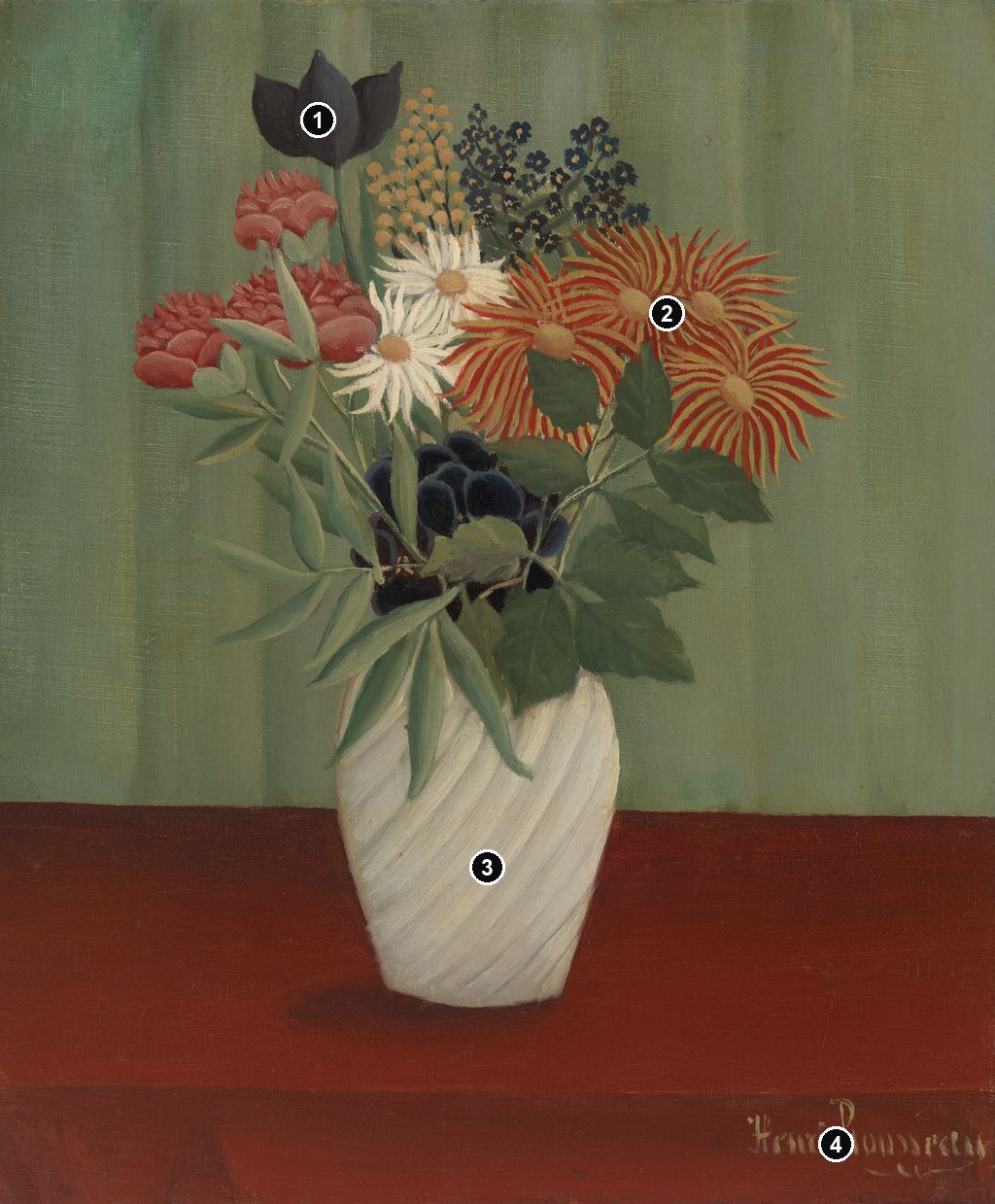
Begin at the upper left, where the dark purple flower encloses its centre within large, upright petals. Its cupped shape and almost solid darkness make a strong stopping point. Beneath it, softer red blossoms spread sideways in rounded folds. Their petals seem gathered and bunched, in contrast to the thin, sharply extended petals further across the bouquet. A long green stem links the high purple cup to the mass below, keeping the top of the arrangement from floating free.
The white blooms near the centre introduce another rhythm. Their pale petals separate into pointed strips around warm, round centres. Some turn upwards, some fall or twist sideways, and some disappear behind neighbouring forms. The irregular spacing matters: it leaves small passages of green visible between the petals, allowing each bright flower to retain an open, ragged edge. Their whiteness also prepares the eye for the much larger pale surface of the vase below.
On the right, three large red-and-yellow heads dominate the bouquet. Each has a dense circular centre surrounded by long rays. Their repeated shape produces a strong pattern, but their positions prevent the group from becoming a row of identical discs. One faces forward near the middle, another opens higher up, and the lowest turns at a different angle. Red runs along the extended petals, with yellow appearing between them and around the centres. From a distance, these alternating colours seem to vibrate against the quieter green.[1]
Smaller flowers complicate this bold upper outline. Golden yellow dots rise behind the white blooms, while tiny dark blue-black heads branch across the upper centre and right. Lower down, a cluster of deep violet blossoms gathers just above the vase. These darker flowers make a compact pocket within the arrangement. The eye can move between the widely opened heads above and this enclosed group below, finding different degrees of density within a single bouquet.
The museum’s title supplies the names China asters and Tokyos; the painting itself invites attention to how differently flowers can be shaped. Rounded, cupped, pointed and radiating forms sit beside one another. Rousseau gives each enough definition to be recognised as a separate presence, even where the stems and leaves become difficult to untangle.
A vase with a turning surface
The white vase provides the bouquet with a broad, stable body. Its sides swell outwards before narrowing towards the bottom. Across that oval form, pale diagonal flutes curve around the surface. Their repeated sweep suggests a slow turning movement, quite different from the abrupt outward thrust of the flower petals. These curves guide the eye through the large pale area below the flowers.
Soft grey and cream variations separate the flutes. They make the surface legible without overwhelming its overall brightness. The vase’s pale body answers the white flowers higher up, establishing two bright areas separated by dark blossoms and green leaves. Between them, long narrow leaves descend over the vase’s upper edge. Their pointed tips interrupt its smooth outline and carry the bouquet into the lower half of the picture.
Much of the opening is hidden. Broad leaves cover the neck on the right, while slender stems and drooping foliage cross it from the left. This overlap makes the meeting between flowers and vessel feel crowded, although the surrounding tabletop remains clear. The contrast concentrates attention on the place where the loose fan of flowers must gather into one container.
The foliage also creates a change of scale. Narrow leaves fall in long, tapering strokes on the left; broad, veined leaves spread across the right. Their visible central veins and angular edges distinguish them from the softly rounded red blooms. Green therefore has several jobs within the bouquet. It joins the flowers, divides their colours and extends the arrangement down over its support.
Annotated Details from Green Flowers
The numbered points identify visible features discussed in this article. Return from each detail to the whole composition. Henri Rousseau, Bouquet of Flowers with China Asters and Tokyos, May–June 1910. BF580. Courtesy of the Barnes Foundation, Merion and Philadelphia, Pennsylvania. Museum image published on Wikimedia Commons in 2018. Image source. Public domain. Numbers added to the overview; details cropped from the published original. No recolouring or retouching.
Details from GREEN FLOWERS
Compare the enclosed purple bloom with the radiating red-and-yellow flowers, then follow the leaves over the turning surface of the vase.
A dark cup above folded red petals
A nearly black purple bloom rises on a long green stem above rounded red flowers. The broad upright petals enclose its centre, contrasting with the folded, spreading shapes beneath.
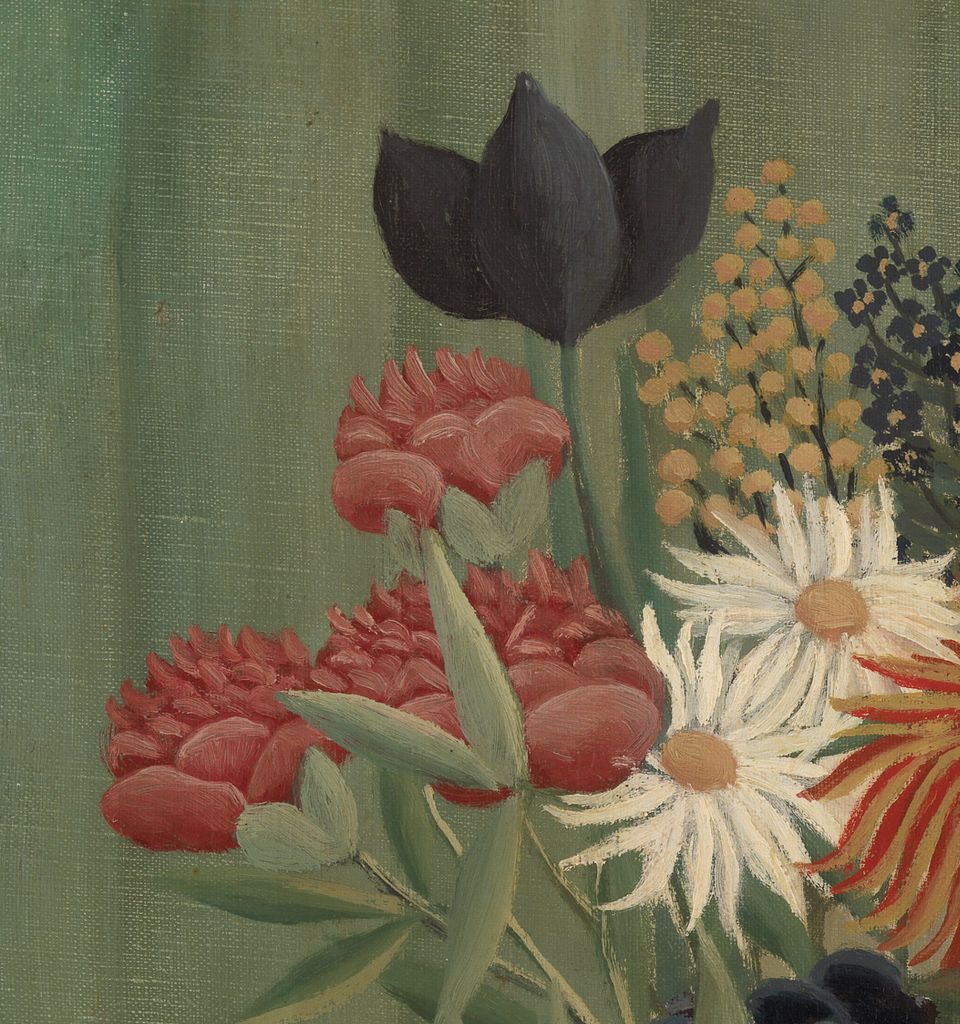
Rays of red and yellow
Long red petals spread around warm circular centres, with yellow showing between their rays. White flowers and small dark heads behind them introduce different scales and outlines.
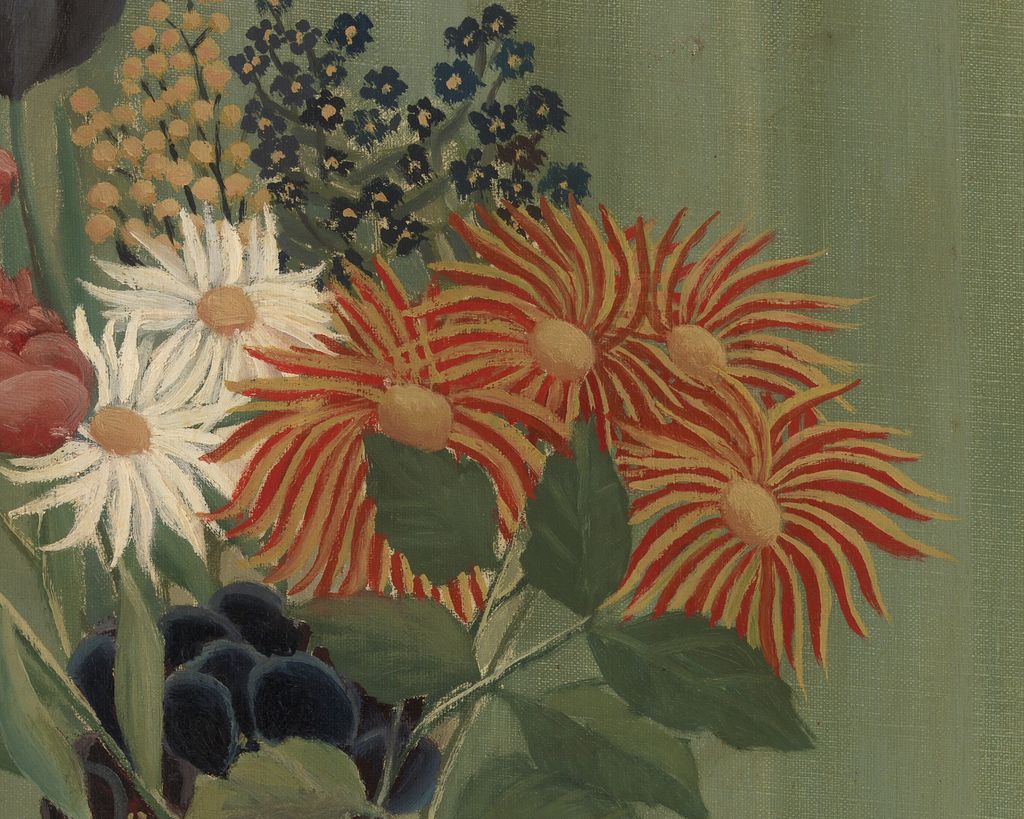
Leaves crossing a fluted white vase
Long pointed leaves descend across the vase's upper edge. Below them, pale diagonal bands curve around its swollen body, creating a slower turning rhythm beneath the sharply radiating flowers.
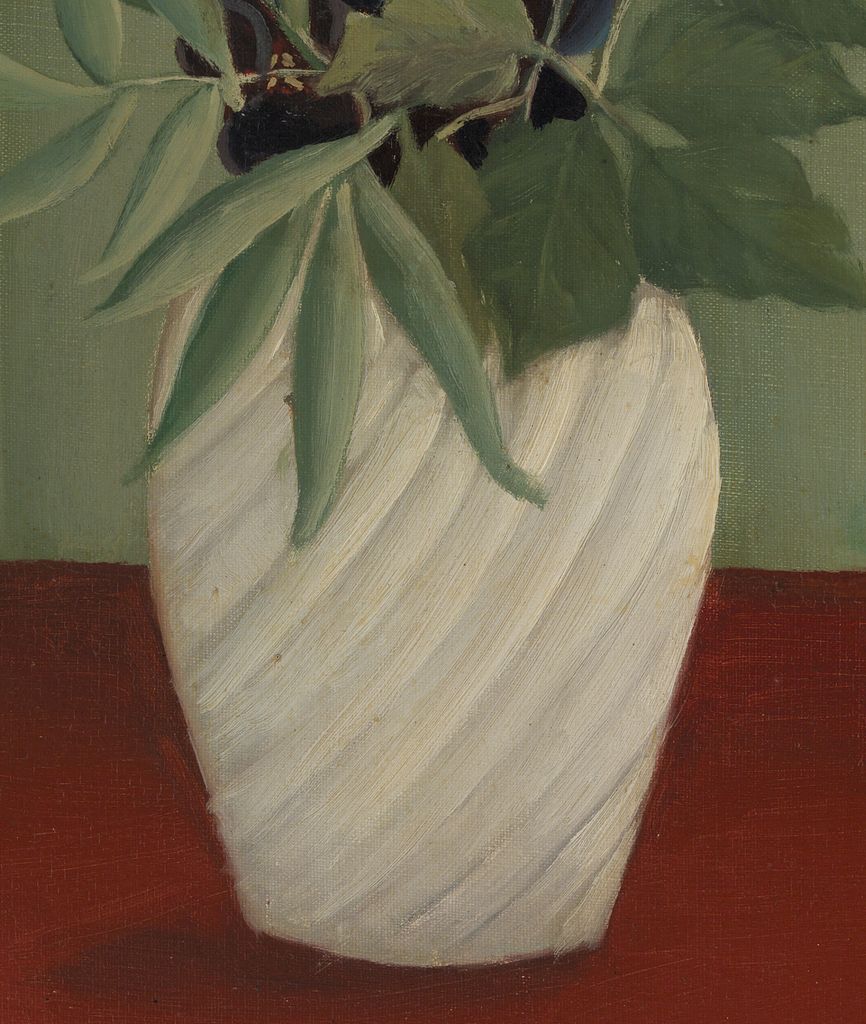
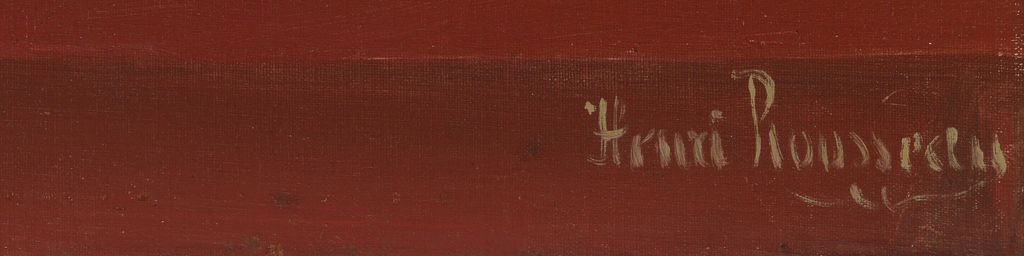
The signature on an open red table
A pale handwritten signature stretches across the lower-right red field. The broad tabletop leaves this small mark clear of the crowded stems and petals above.
Green hanging, red table
The backdrop resembles a green curtain or hanging, with broad vertical folds that continue behind the flowers. Its long, subdued bands make the bouquet’s complex outline easier to follow. The upright folds contrast with the diagonal curves of the vase and the nearly horizontal boundary of the table. Together these three directions give the composition a simple framework around its crowded centre.
The green varies from lighter olive passages to darker, cooler strips. Flowers and leaves sometimes stand out sharply against it; elsewhere, the greens approach one another and an edge becomes quieter. The arrangement consequently seems both distinct from its setting and held within it. The small gaps between stems are especially revealing, because the background remains visible through the bouquet rather than stopping at its outer edge.
Below, the deep red table forms a wide, largely uninterrupted field. A darker band towards the bottom suggests its front edge, and a soft shadow gathers beneath the vase. The red returns to a colour already present in the blossoms, linking the upper and lower parts of the picture. Its broad stillness gives the eye somewhere to rest after the many narrow petals. At the lower right, Rousseau’s pale handwritten signature occupies part of this open area.[1]
The clear tabletop is essential to the effect. All the small incidents belong to the bouquet: the crossing stems, flower centres, veins and petal tips. Around the vase, the space is comparatively spare. That difference allows the viewer to alternate between reading individual details and seeing the whole arrangement as one upright shape.
A domestic subject and an exhibition history
Within the wider range of Rousseau’s paintings, his flowers belong to a practice of making pictures suited to domestic rooms. The Musée de l’Orangerie’s exhibition Henri Rousseau, l’ambition de la peinture describes his small bouquets, still lifes and views as works adapted to the budgets and interiors of customers including artisans and shopkeepers. It places this varied production alongside his pursuit of more ambitious public pictures.[13] This provides a useful setting for the bouquet’s scale, although it does not identify a particular customer or commission for BF580.
The painting also has an exhibition history beyond that domestic scale. The Barnes lists it in the 1911 Rousseau retrospective at the Salon des Indépendants in Paris and in the 1912 Henri Rousseau exhibition at Galerie Bernheim-Jeune, citing Henry Certigny’s catalogue research for both appearances.[1] These recorded exhibitions place the bouquet among works through which Rousseau’s painting was presented to an audience soon after its making.
Henri Rousseau artworks directory
This directory brings together works covered on this site and other works documented in the cited museum records and catalogues. Alternate titles share one entry; distinct versions remain separate. Historical dates for works without an article follow the cited catalogues. This is not a catalogue raisonné.
Frequently Asked Questions
The Barnes Foundation titles the painting Bouquet of Flowers with China Asters and Tokyos, with the French title Bouquet de fleurs aux reines-marguerites et aux tokyos. Its collection number is BF580.[1]
The Barnes dates the painting May–June 1910. It is oil on canvas and measures 55.2 × 45.7 cm.[1]
It is in the Barnes Foundation collection in Philadelphia.[1]
Compare the red-and-yellow radiating flowers with the enclosed purple bloom at the upper left. Then follow the pale diagonal flutes around the vase and notice how their curves differ from the upright folds behind it.
Discussion
Look again at the images and ideas explored in Green Flowers. These editorial prompts invite your observations.
Reader Insights
Which holds your attention longer: the individual flower heads or the bouquet’s overall outline?
How would the arrangement feel if the red tabletop were crowded with other objects?
Where do the leaves merge with the green background, and where do they stand out most clearly?
Join the Conversation
Share a detail, comparison or question about Green Flowers below.
References
- Barnes Foundation. Bouquet of Flowers with China Asters and Tokyos (Bouquet de fleurs aux reines-marguerites et aux tokyos), May–June 1910, BF580. Current collection record and official image; identity fields, exhibition history and bibliography in the public object API, accessed 23 October 2026. Exhibition history cites Henry Certigny, Le Douanier Rousseau en son temps, vol. 1, 1984, p. 678. View source 1. View source 2.
- Philadelphia Museum of Art, Carnival Evening,1963-181-64,object59593. View source.
- Musée de l’Orangerie / Juliette Degennes, Henri Rousseau,L’ambition de la peinture: Un artiste dans son époque (in French). View source.
- National Gallery, Surprised!, NG6421. View source.
- Musée d’Orsay, La Guerre,RF19461 (in French). View source.
- MoMA, The Sleeping Gypsy. View source.
- Philadelphia Museum of Art, The Merry Jesters, 1950-134-176, object51097. View source.
- Musée d’Orsay, La Charmeuse de serpents, RF 1937 7 (in French). View source.
- Musée de l’Orangerie, La Carriole du Père Junier, RF 1960 26 (in French). View source.
- Solomon R. Guggenheim Museum / Cornelia Lauf, The Football Players,60.1583: current collection record. View source.
- MoMA, The Dream, 252.1954. View source.
- Barnes Foundation, Bouquet of Flowers with China Asters and Tokyos (Bouquet de fleurs aux reines-marguerites et aux tokyos), BF580. View source.
- Musée de l’Orangerie. Henri Rousseau, l’ambition de la peinture, exhibition 25 March–20 July 2026, section “Variations et déclinaisons. À la recherche du marché”; accessed 23 October 2026. View source. (in French).
- The Museum of Modern Art, Henri Rousseau: Essays (1985), selected catalogue entries, chronology and notes on early devotees. View source. Selected entries, chronology (pp.91–95) and early-devotee notes (pp.262–264) were consulted. Historical collection credits do not establish present ownership.
- Daniel Catton Rich, Henri Rousseau (The Museum of Modern Art, 1942), selected drawings and landscape studies; historical catalogue. View source. The dated 1942 publication is used for the two Quai d’Auteuil ink views; its Malakoff date differs from the 1985 catalogue.
- MANAS, Laval, Henri Rousseau, dit le Douanier, urban landscapes and preparatory study (in French). View source.
- National Gallery of Art, Self-Portrait (1895), pen-and-ink drawing, accession 1995.47.66. View source.
- The Museum of Modern Art, War (published January 1895), lithograph, accession 684.1943. View source.
- Barnes Foundation, Landscape and Four Young Girls, object 5521, BF855. View source.


 Henri Rousseau.jpg)


 Henri Rousseau.jpg)