 by Tom Gurney
Tom Gurney BSc (Hons) is an art history expert with over 20 years experience
Published on June 19, 2020 / Updated on October 14, 2026
Email: tomgurney1@gmail.com / Phone: +44 7429 011000
A banquet interrupted by a covered dish
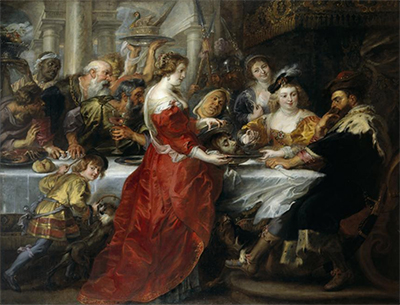
A young woman in red stands between two groups at a lavish table. She has lifted the cover of a dish to reveal a severed head. On the right, a richly dressed man leans away, his hand caught in the tablecloth. A woman beside him looks toward the dish and reaches forward with a fork. Behind the woman in red, other diners and attendants register the interruption in different ways. Rubens turns one terrible object into the centre of a room full of movement.
This is The Feast of Herod in the National Galleries of Scotland, accession NG 2193. The collection record[1] attributes it to Peter Paul Rubens, dates it about 1635–38, and identifies oil on canvas. The picture measures 208.3 × 271.5 centimetres, well over two metres high and nearly three metres wide. Its size matters: the figures at the table are larger than life, so a person standing near the canvas encounters the banquet almost as a physical event rather than a distant miniature scene.
The woman presenting the dish is Salome, the head is John the Baptist's, the man recoiling is Herod Antipas, and the seated woman using the fork is Herodias, according to the museum's identification. This is a late, large banquet painting. It is distinct from Rubens's much earlier Salome Presented with the Head of Saint John the Baptist, a smaller panel formerly in a private collection and associated with a different episode of his career. A shared subject does not make the two objects interchangeable.
At a Glance
- ArtistPeter Paul Rubens [1]
- DateAbout 1635–38 [1]
- MediumOil on canvas [1]
- Dimensions208.3 × 271.5 cm [1]
- CollectionNational Galleries of Scotland, NG 2193 [1]
- Preparatory drawingCleveland Museum of Art, 1954.2.a [2]
Where this work sits in Rubens's career
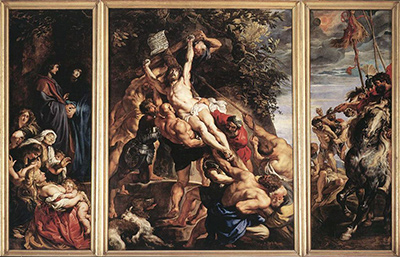
The Elevation of the Cross
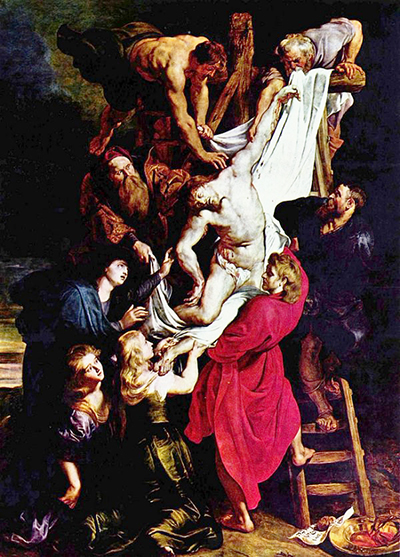
1609–10The Descent from the Cross
1611–14The Garden of Love
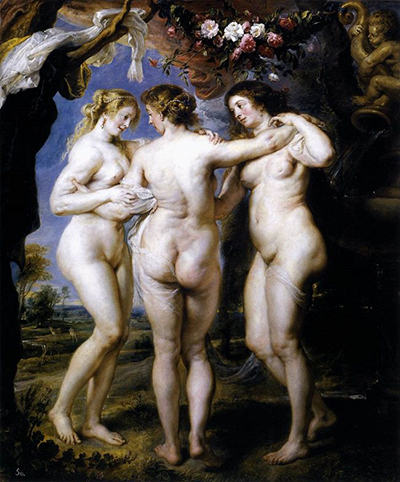
1630–35The Three Graces
1630–35The Feast of Herod
c. 1635–38Contents
- Why was John killed?
- Salome, Herod and Herodias
- Colour, scale and movement
- The Cleveland drawing and Rubens's decisions
- Naples and Gaspar Roomer
- From Naples to Edinburgh, and a distinct early Salome
Why was John killed?
The Gospel of Mark 6:17–29[4] and Matthew 14:3–12[5] recount the chain of events. John criticized Herod's marriage to Herodias. At Herod's birthday feast, Herodias's daughter danced before the company, and Herod promised to grant her a request. Prompted by her mother, she demanded John's head on a platter. Herod ordered the execution despite his reluctance in the Gospel narratives. The daughter then brought the head to her mother.
The Gospels call her Herodias's daughter in this passage without giving her the name Salome. The Scottish gallery's essay[1] says the name comes from tradition. Using “Salome” makes the familiar artistic identification clear, while distinguishing it from what the cited Gospel passages actually say. Rubens paints the consequence of the request, not the dance itself or the execution in prison.
The sequence explains the painting's tension. Herod has already granted a favour, and the deed he might have wished to avoid has happened. He is not being asked in this instant to decide whether John should live. The head has arrived at his own feast, making him confront the result of his promise. Herodias, who wanted John silenced, appears satisfied. Salome presents the evidence of what has been done. The people around them become witnesses to a ruler's failure of judgement and to an act of vengeance.
Rubens does not ask the viewer to mistake the scene for a reconstruction of a first-century room. The grand architecture, costumes, table setting and dense grouping create the theatre of a seventeenth-century history painting. The specific drama is biblical, but the means of engaging a viewer are painted bodies, colour, light and gesture. Understanding the text helps identify the figures; looking at the canvas shows how Rubens gives them different responses.
Salome, Herod and Herodias
Salome's red dress is the largest uninterrupted area of colour in the foreground. Its broad folds run toward the bottom edge, making her standing body a strong vertical anchor. She holds the cover away from the platter rather than hiding what is beneath it. The painting catches the moment of revelation, when a table meant for food is forced to receive the head of the prophet. The dish is small relative to the figures, yet everyone near it is drawn into its orbit.
Herod, at the right, recoils in his chair. The National Galleries of Scotland's extended essay[1] notes his grip on the tablecloth, bulging eyes and twisting body. Those details matter because they make revulsion bodily, not merely facial. He leans away from the thing he authorized, but the table and the drapery keep him inside the encounter. A viewer can follow the diagonal from the head on its dish to the king's white-lined clothing and startled face.
Herodias offers the contrast. In the museum's account, she prods John's tongue with a fork. That tiny action gives the head a cruel specificity. John was punished for speaking against her marriage; touching the tongue turns the organ of speech into an object of mockery. Her expression remains relatively composed beside Herod's alarm. The fork is a banquet utensil turned into an instrument of humiliation, joining the ordinary business of eating to the violence that has interrupted it.
Behind Salome, an older woman peers toward the dish. Other faces are partly hidden or caught between figures. They expand the event beyond the three named actors. The crowded left side contrasts with Herod's prominent seat on the right, while the red dress links the groups. No single reaction controls the whole painting. Curiosity, horror, satisfaction and service coexist, making the feast a social scene rather than a simple illustration of a Bible verse.
The arrangement also makes the viewer's position uneasy. We stand at the front edge of the table, close enough to see the head and the hands surrounding it. Rubens places the revelation where a serving dish ought to be. The confrontation is therefore not confined to the characters: the dish has been turned so that the beholder must register it too. That interpretation follows the painting's staging; it is not a claim that Rubens recorded a particular viewer's historical reaction.
Colour, scale and movement
The Scottish gallery describes the picture's rich colours, bold light-and-shadow contrasts and broad visible brushwork. In the retained reproduction, the red of Salome's gown and the white of the tablecloth lead the eye across a field of darker greens, golds and browns. Bright fabric attracts attention before the grisly centre becomes clear. The painted luxury does not soften the violence; it sharpens the contrast between courtly plenty and the abuse of power.
The tablecloth is especially active. Herod clutches it as he twists away, so an ordinary textile records a sudden movement. The fork, platter and cover form a cluster of small objects where the main story is concentrated. Such details are not decorative afterthoughts. They translate an event involving an absent prisoner into something visible in the banqueting room. John himself is present only as the head on the charger; the people responsible for his death take up almost all the canvas.
At this scale, the figures can be read in sequence across the width of the picture. The eye enters through the crowd at left, meets Salome's red figure, then crosses the white cloth to Herod. Yet the reactions push against that simple route. A face in the background pulls attention back; the fork draws it downward; Herod's recoiling body moves it outward. The painting does not settle into a static row of diners. Rubens makes the narrative out of conflicting directions.
The museum calls attention to the expressive potential of oil paint here: broad brushstrokes and colours that seem to run into one another support the theatrical effect. A small web image can show the principal composition and colour balance, but it cannot reliably demonstrate every passage of handling on a canvas nearly three metres wide. Descriptions of brushwork are therefore grounded in the holding museum's close account rather than claimed solely from this reproduction.
The Cleveland drawing and Rubens's decisions
The Cleveland Museum of Art[2] holds a preparatory drawing for the Edinburgh painting, accession 1954.2.a, dated about 1637–38. It combines pen and brown ink with black and red chalk and touches of white gouache on paper. At 27.2 × 47.2 centimetres, it is far smaller than the finished canvas. It is not a second oil version. Its quick lines let a viewer see how Rubens tested the grouping around Herod, the dish and the women.
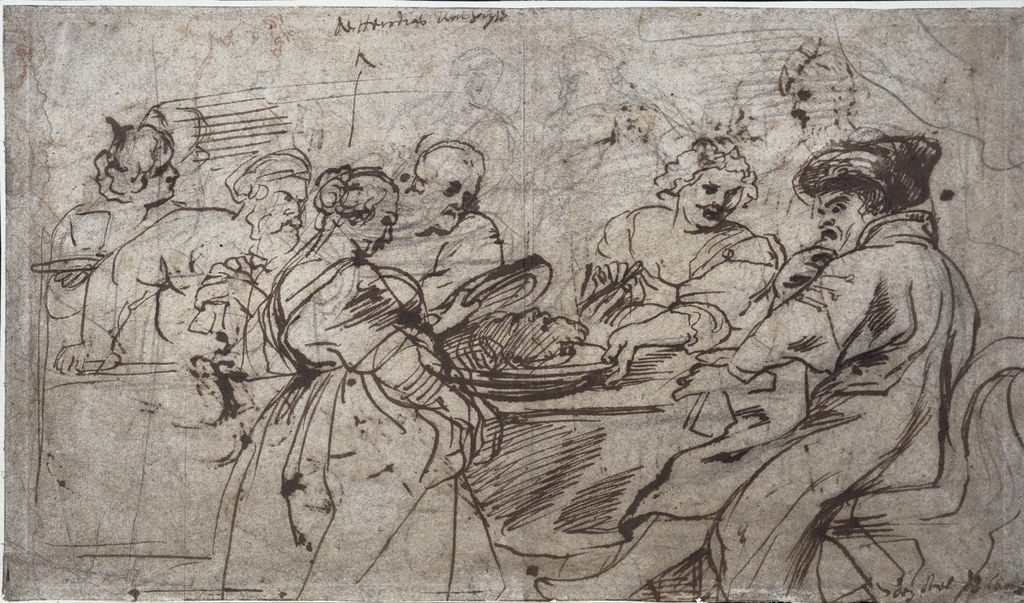
In the drawing, Herod wears a large cap and withdraws from the platter. Herodias already reaches toward it with a fork. Cleveland notes a written instruction near the top, usually interpreted as asking for Herodias to be somewhat higher. That note matters because it records a decision about the relative place of a figure, not merely a finished appearance. The drawing gives access to Rubens's process of organizing the shocked king and the vengeful queen before the large canvas fixed their relationships in paint.
The other side of the same sheet bears a sketch for Tomyris with the Head of Cyrus, another violent story involving a severed head. Cleveland identifies both subjects and the distinct inscriptions on the two sides. Their physical presence on one sheet makes a comparison possible, but it does not prove that both paintings were commissioned by the same patron or meant to hang together. The illustrated front is the side connected to Edinburgh NG 2193.
Naples and Gaspar Roomer
The Scottish gallery says the painting was probably commissioned by Gaspar de Roomer, a wealthy Flemish merchant based in Naples who regularly visited Antwerp. The word “probably” is important. The available museum text offers a persuasive patronage context, not a reproduced signed contract. It says the painting had arrived in Naples by 1640 and attracted attention among artists there. That arrival gives a firmer limit for the painting's circulation than any guess about the precise date a patron first proposed it.
Roomer's collection connected works made in northern Europe with artists working in southern Italy. In the National Galleries of Scotland's account of its 2008 Reunited: Rubens–Ribera display[3], Rubens's Feast and Jusepe de Ribera's Drunken Silenus are said to have hung together in Roomer's palace in the mid-seventeenth century. The museum temporarily brought those two paintings together again in Edinburgh. That historical pairing gives a more concrete picture of the collection than a vague claim that Roomer liked dramatic art: two large, intense works by artists from different settings were encountered in one Neapolitan home.
The museum also says Rubens's colour and movement influenced a generation of Neapolitan artists. Influence here is a curatorial account of reception in the city, not a list of documented copies by every painter who saw the canvas. The painting's arrival by 1640 made it available as an example of a forceful northern treatment of a violent biblical subject. The local artistic response may have varied from one painter to another. The evidence supports Naples as an important site of the picture's early life without requiring a single, universal style change.
The 2008 press notice used a wider date label, about 1635–40, for the Edinburgh canvas, whereas the current collection entry gives about 1635–38. Both are approximate late-career dates; for this page's object facts, the current catalogue range is used. The Cleveland drawing's circa 1637–38 date fits within that broad sequence, though the public entries do not give the day the drawing was made or the day the canvas was finished.
From Naples to Edinburgh, and a distinct early Salome
The National Galleries of Scotland[1] records the painting's purchase in 1958, its accession as NG 2193, and its present collection. Its public essay is strongest on the subject, formal reading and Roomer period. It does not provide a complete list of owners from the seventeenth century to the 1958 acquisition. That gap should remain visible rather than be filled with an assumed direct transfer from Roomer's descendants to Edinburgh.
The subject has caused a different kind of confusion. Rubens also painted an earlier, smaller Salome Presented with the Head of Saint John the Baptist, dated around 1608–09 in an auction catalogue[6]. That is an oil-on-oak panel measuring 94 × 101.8 centimetres and has its own ownership history, including a documented 2023 sale. The early panel and the late Edinburgh canvas both show the severed head, but they differ in scale, medium, composition and date. Edinburgh's NG 2193 is the crowded, wide banquet reproduced on this page.
Even the two inherited site images labelled Feast of Herod and Feast of Herod in Detail should be read as reproductions of this same Edinburgh composition, not as two separate Rubens paintings. The main image here shows the whole banquet. A detail view can be useful for the platter, hands and reactions, but the full image is needed to follow how Salome links the crowded figures on the left to Herod on the right.
The painting's future display may change. The stable way to identify it is through the institutional title, object number, medium, measurements and distinct composition. Those facts also keep Cleveland's preparatory sheet in its proper role: evidence for Rubens's planning, displayed alongside the finished picture, rather than a substitute for it.
Rubens artworks directory
Frequently Asked Questions
Salome has uncovered the severed head of John the Baptist at Herod's banquet. Herod recoils, while Herodias reaches toward the head with a fork. The painting shows the result of the execution, not the dance or the killing itself.
The cited passages in Mark 6 and Matthew 14 call her Herodias's daughter without naming her. “Salome” is the traditional name used by the holding museum and by many later artworks.
The National Galleries of Scotland dates the oil-on-canvas painting about 1635–38. It does not identify an exact day or place of execution in the public object record. The work was in Naples by 1640.
The Scottish gallery says he probably did. It places the painting in his Neapolitan collection and describes its effect there, but the online essay does not present a signed commission document.
No. Cleveland 1954.2.a is a small pen, ink and chalk study on paper for the composition. Edinburgh NG 2193 is the large finished oil painting on canvas.
No. The early panel is much smaller, is painted on oak, and has a separate provenance. The Edinburgh painting is the large late banquet scene acquired by the National Galleries of Scotland in 1958.
Discussion
Look closely at the different reactions to the dish at the banquet.
Share an observation about the painting or a reliable source that adds to its history.
Reader Insights
How do Salome's dress and the tablecloth guide your eye to the head?
What changes between the Cleveland drawing and the finished canvas?
What does the documented Naples history tell us about its early viewers?
Join the Conversation
Add your reading below, keeping observations specific and evidence clear.
References
- National Galleries of Scotland, The Feast of Herod , NG 2193. View source
- Cleveland Museum of Art, Rubens's preparatory Feast of Herod drawing, recto, 1954.2.a. View source
- National Galleries of Scotland, 2008 Reunited: Rubens–Ribera display notice. View source
- Gospel of Mark 6:17–29, New American Bible Revised Edition. View source
- Gospel of Matthew 14:3–12, New American Bible Revised Edition. View source
- Sotheby's, distinct early Salome Presented with the Head of Saint John the Baptist panel. View source