by Tom Gurney
Tom Gurney BSc (Hons) is an art history expert with over 20 years experience
Published on June 19, 2020 / Updated on October 14, 2026
Email: tomgurney1@gmail.com / Phone: +44 7429 011000
The other face of the closed altarpiece
Catherine of Alexandria steps forward in a luminous dress and holds the long palm of a martyr. Eligius stands beside and partly behind her, robed as a bishop. Above them an angel moves through the dark upper space. Together they occupy one exterior side of Peter Paul Rubens’s monumental Elevation of the Cross. When the triptych is closed, this pair faces across the join toward Amandus and Walburga on the companion wing. When it opens, the viewer sees a Passion scene instead.
The Cathedral of Our Lady in Antwerp[1] dates the work to 1609–10, calls it oil on panel, and gives each finished wing as 460 × 150 centimetres. The painting is therefore not a cabinet-size portrait of two saints. It was designed for an altar and for a changeable way of viewing: a tall pair of full-size figures on the closed exterior and dramatic narrative panels within. The small study in Dulwich names Catherine before Eligius; both name orders refer to the same pair of saints.
The RKD’s scholarly catalogue[3] describes the closed wings as the triptych’s everyday side. That functional term keeps the outer paintings from being treated as mere backs. For much of the year, the congregation could encounter saints associated with Antwerp and the former church of St Walburga. The interior’s raising of Christ’s Cross was not the only religious message the large structure was made to carry.
At a Glance
- ArtistPeter Paul Rubens [1]
- Date1609–10 [1]
- MediumOil on panel [1]
- DimensionsWing 460 × 150 cm [1]
- CollectionCathedral of Our Lady, Antwerp [1]
- Image scopeFinished exterior wing [1]
Where this work sits in Rubens's career
Saints Catherine and Eligius
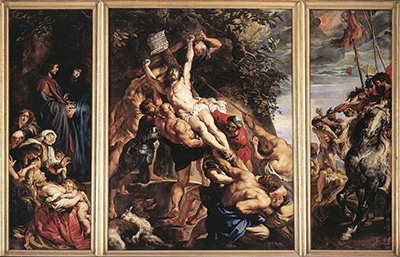
1609–10The Elevation of the Cross
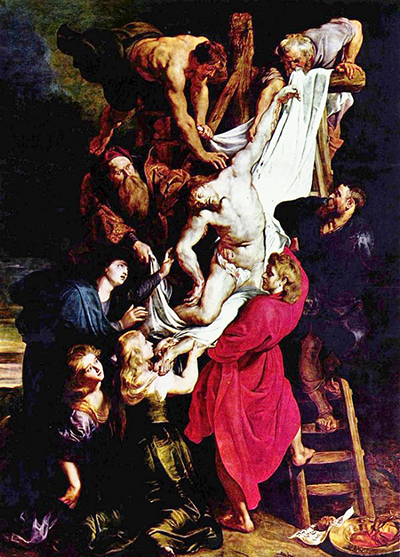
1609–10The Descent from the Cross
1611–14The Garden of Love
1630–35The Three Graces
1630–35Contents
- Catherine’s palm and Eligius’s staff
- The small study and the finished change
- From St Walburga’s church to the cathedral
- A commission with several stages
- Why the saints were once given other names
Catherine’s palm and Eligius’s staff
Catherine’s palm is the familiar sign of a Christian martyr. The Dulwich Picture Gallery’s account[2] explains that she was traditionally said to have been condemned to a spiked wheel and later beheaded. A wheel is part of her broader iconography, but the most immediately legible attribute in the finished wing shown here is the long palm. Her face turns upward, and her light dress makes a strong shape against the dark field.
Eligius, also called Eloy, was a bishop associated with bringing Christianity to the region. The RKD[3] also identifies him as a patron of goldsmiths and notes a hammer in the imagery. His bishop’s staff and heavy clothing announce an ecclesiastical role. His more shadowed position, beside Catherine’s brighter form, keeps the narrow wing from becoming a simple stack of two equivalent portraits. The figures share the field but do different visual work: Catherine directs the eye upward; Eligius anchors it at the side.
The angel above intensifies that upward movement. In the finished panel its action is connected with a bishop’s mitre rather than with a halo for Catherine. Rubens gives the top of the tall rectangle a purposeful event, so the viewer’s eye can travel from the figures to the heavenly recognition above them. The angel, saints and architectural base form a vertical design suited to the scale and height of the original high altar. A small reproduction makes the pair available to inspect, but it can understate the physical force of figures more than four metres high.
The four exterior saints had a local role within a universal Christian story. The RKD study[3] connects Amandus, Eligius and Walburga with the Christian history of the Antwerp region and describes a local tradition relating Catherine to the church. Those connections explain why these figures, rather than an arbitrary selection of saints, could occupy the outer wings. They do not prove that Rubens wrote a separate symbolic programme for each gesture visible in the picture.
The small study and the finished change
Rubens’s small preparation for this pair survives at Dulwich Picture Gallery[2] as DPG040b, about 1610, oil on panel, 66.6 × 25 centimetres. It is a modello: a painting in which an artist works out or presents a proposal for a larger commission. The Dulwich gallery also holds the matching Amandus–Walburga sketch, DPG040a. They have the same slim proportions as the cathedral wings but are separate objects with separate histories and measurements.
The completed Antwerp exterior alters the sketch’s upper action. Dulwich[2] observes that the small paintings put haloes over the female saints, whereas in the large wings angels focus on crowning the male saints with their bishops’ mitres. The RKD[3] notes further changes, including Eligius’s figure. These are not defects in the preparation; they show Rubens revising the visual balance as the commission developed. The gallery suggests a patron may have prompted the change, but does not produce an instruction that would let us state that as fact.
The comparison also prevents a common caption error. The small study’s 66.6 × 25-centimetre dimensions and Dulwich number belong to a London oil sketch. The cathedral’s 460 × 150-centimetre measurements belong to the large wing shown here. Both portray Catherine and Eligius, yet their angels and figure arrangements differ. A page about the finished altarpiece should not use the London sketch’s image or object number as if they described what remains in Antwerp.
The RKD catalogue[3] also records that the Dulwich sketches were once joined and separated around the middle of the twentieth century. That is part of the smaller objects’ collecting and conservation history. The two large exterior panels are joined by their place on the triptych, not because they are fragments of the Dulwich sheet. Keeping these material histories apart makes the evidence for Rubens’s process easier to understand.
From St Walburga’s church to the cathedral
Rubens made the triptych for the high altar of St Walburga’s church in Antwerp. The church’s future demolition led to the work’s move to the cathedral in 1816, according to the Antwerp church heritage account[4]. That transfer changed the building and the surrounding works a viewer sees, although the exterior painting still belongs to the same hinged structure. Today the cathedral preserves both the famous open Passion composition and the saints who appeared when it closed.
The heritage account[4] explains why Rubens made the whole structure exceptionally large: St Walburga’s choir was high and far from worshippers in the nave. The triptych had to remain readable across that distance. This helps explain Catherine’s pale, broad figure and the bishop’s strongly outlined staff. In the original setting, the closed wing was not inspected at arm’s length as a framed museum picture. It formed part of a high altar whose saints needed to command attention during ordinary worship.
That altar once included three smaller paintings below the main triptych. Antwerp’s 2004 exhibition account[5] describes a scene of angels carrying the body of Saint Catherine on one side and Walburga’s miracle on the other, with Christ on the Cross between them. The RKD[3] lists the Catherine scene as a separate predella painting whose present location is unknown. Its subject reinforced Catherine’s presence above, but it was not part of the tall Eligius–Catherine wing itself. The old altar arrangement ended when a new altar was built in the eighteenth century.
The companion wing matters to this page. Amandus and Walburga, on the other side, complete a four-saint ensemble; Catherine and Eligius cannot be fully explained as an isolated double portrait. The saints connect church, city and regional memory to the Passion images inside. The physical act of opening or closing moved the viewer between those subjects. In an online photograph the hinge is absent, so the article must restore that basic orientation in words.
The RKD[3] suggests that the finished emphasis on the male bishops may reflect the patrons’ Counter-Reformation priorities. This is a plausible historical reading of the documented change from sketch to altarpiece. It is not a stated motive from Rubens or a surviving contract clause. The strongest evidence is the work itself: saints placed on a closed altar wing, a preparation that shows a different emphasis, and a finished painting made for an Antwerp church around 1610.
A commission with several stages
The RKD catalogue places the commission in a more precise working sequence than the finished date alone suggests. A contract for the altar was signed in June 1610. The central Passion scene was installed that year, but the exterior saint wings still had to be painted. The catalogue proposes that Rubens finished the whole structure in the winter of 1610 and records a final payment in 1613. These dates describe contract, installation, likely completion and settlement, not four separate altarpieces. The cathedral's broader 1609–10 date remains the concise object dating; the RKD narrative helps explain how a large commission could pass through several stages.
The RKD reports a 2,600-guilder bill, apparently paid largely by the Antwerp merchant and collector Cornelis van der Geest, who had connections with St Walburga's. The word “apparently” matters: the catalogue is reconstructing a financial history, not quoting a surviving instruction in which this patron specifies every saint and attribute. Funding and design were related, but a payment record does not settle why an angel's gesture changed between the Dulwich model and the completed wing. The cathedral's image can be read with knowledge of its patrons without pretending to hear their unrecorded conversation with Rubens.
The original installation involved more than the three hinged panels that now define the work in many photographs. The RKD lists painted figures and a gilded pelican above, and three predella paintings below. When a new altar was built in 1733, parts of the older arrangement, including the predella and crowning elements, were dispersed. This explains why a present-day view of the triptych, however impressive, does not reproduce the full first altar. A lower painting concerning Catherine reinforced her identification on the upper wing, while Walburga's marine miracle strengthened the companion side. These related scenes had their own supports and later histories, so they should not be described as pieces cut from the saint panels.
Why the saints were once given other names
The present identification of Catherine and Eligius is not merely a modern convention copied from a label. The RKD's catalogue history shows that earlier Dulwich listings called the four figures Ambrose, Gregory, Catherine and Theresa. Even when earlier scholars recognised some of the correct names, they sometimes exchanged the positions of Eligius and Amandus. The catalogue reports that Burchard correctly identified the two pairs in a 1947 catalogue. Such changes matter because a mistaken name changes the claimed connection between the wing and St Walburga's church.
Attributes and setting provide stronger evidence than a historical sale description alone. On this wing Catherine's sword and palm mark her martyrdom, although she lacks the wheel more familiar from other representations. Eligius's episcopal clothing and hammer connect him with his role as bishop and patron of goldsmiths. Across the hinge, Amandus and Walburga complete the local group. The separate predella subjects give additional context. The identification is therefore supported by a pattern of visual and church evidence, not by assuming that every old catalogue used the right names.
The RKD also records a 1588 St Eligius triptych made for Antwerp's smiths' guild, now in the city's fine-arts museum. It is a different commission by another painter, not an earlier version of Rubens's exterior wing. Its existence shows that Eligius already had a meaningful local visual presence. Rubens's choice of him for a church altarpiece could speak to regional devotion, while the cathedral wing remains a distinct work with its own size, date and role. Keeping that comparison separate is as important as distinguishing the Dulwich modello from the finished painting.
Rubens artworks directory
Frequently Asked Questions
Eligius (Eloy), a bishop, and Catherine of Alexandria, a martyr. Their companion exterior wing shows Amandus and Walburga.
No. Dulwich owns a small preparatory panel, DPG040b. The reproduction here depicts the finished exterior wing in Antwerp Cathedral.
The finished angel imagery stresses the bishops’ mitres instead of the female saints’ haloes shown in the modelli. The precise reason for that change is unknown.
The outer wings were the altarpiece’s ordinary closed view. They brought locally meaningful saints into the daily setting of the church; the Passion narrative appeared when the triptych was opened.
Discussion
Look closely at Catherine and Eligius on the closed triptych.
Share an observation grounded in the painting or its sources.
Reader Insights
How do their attributes identify each saint?
What changed between the Dulwich sketch and the cathedral wing?
How does this wing relate to the opposite pair of saints?
Join the Conversation
Add your reading below, keeping observations specific and evidence clear.
References
- Antwerp Cathedral, Rubens, The Elevation of the Cross. View source
- Dulwich Picture Gallery, Rubens, Saints Catherine of Alexandria and Eligius , DPG040b. View source
- RKD Studies, Dulwich catalogue of the paired modelli and Cathedral wings. View source
- Antwerp church heritage, history of the triptych and its transfer. View source
- Antwerp 2004 heritage account of the original altar arrangement. View source