


 by
Tom Gurney
Tom Gurney BSc (Hons) is an art history expert with over 20 years experience
Published on June 19, 2020 / Updated on October 22, 2026
Email:
tomgurney1@gmail.com
/ Phone:
+44 7429 011000
Bat (formerly attributed to Dürer): Introduction
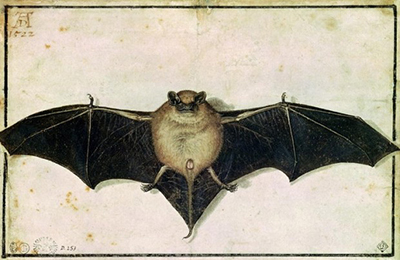
The bat opens its wings across almost the full width of the picture. Its pale, rounded belly catches the eye between two dark expanses of membrane, while the tiny face looks straight towards us. Few details interrupt this concentrated encounter: a rectangular border, an inscription in the upper left corner and small marks along the foot of the sheet. Long associated with Albrecht Dürer, this Bat belongs to the Musée des Beaux-Arts et d’Archéologie in Besançon. In 2024 the museum reported that renewed study had assigned it to an anonymous draughtsman of the “Dürer Renaissance”, the revival of his art around 1600. [1]
Besançon’s 2017 loan list identifies the watercolour as inventory D.257, then described as attributed to Dürer. Its familiar association with the artist remains part of its history. The revised attribution opens a further enquiry into how his reputation shaped the work of later artists. [2]
At a Glance
- Current attribution Anonymous artist of the Dürer Renaissance, around 1600 [1]
- Collection Musée des Beaux-Arts et d’Archéologie, Besançon [1]
- TypeDrawing [1]
This work across Albrecht Dürer’s career
Young Hare
1502Praying Hands
1508Melencolia I
1514Four Apostles
1526Contents
- Wings, fur and a small face
- What the image can tell us
- The date and the Dürer Renaissance
- Other bats associated with Dürer
- A continuing life in public
- Frequently Asked Questions
Wings, fur and a small face
The composition is built around a striking difference in surfaces. The wings appear almost black, with narrow lighter lines radiating from the raised joints along their upper edges. These lines divide the broad membranes into irregular compartments. Below, the outline rises and falls through a succession of curves and points, giving each wing a complicated, scalloped edge. The pale fur of the body breaks into much smaller touches. Against the smooth, stretched-looking darkness on either side, the belly seems soft and thick.
This change of texture gives the animal substance. Its body has a rounded front and shaded flanks; the wings spread comparatively flat across the picture. Small feet project to either side beneath the fur. Between them, a dark triangular membrane narrows downwards, ending in a long, slightly hooked tip. That descending form acts as a central anchor. Without it, the expansive wings might seem to lift the animal out of the composition; with it, the body is held firmly on a vertical axis.
The apparent symmetry becomes more interesting on a closer look. The two wings share a general arrangement, yet their angles and lower contours do not mirror one another exactly. The face is also too particular to function as a simple emblem: dark eyes, small ears and a blunt muzzle gather into a remarkably compact space. The larger pattern announces a bat at once, while these uneven details keep attention moving through the individual creature.
There is generous empty ground above the animal, but very little room beside the wing tips. The dark border sharpens that imbalance. At the sides, the wings seem to push across its limits; towards the top, the line encloses a comparatively quiet expanse. This is an arresting way to present a small subject. The body occupies only a modest part of the image, yet its extended wings control the entire rectangle.
The pose also makes the animal available for inspection. There is no landscape to explain its surroundings and no sequence of movements to suggest a passing instant. We can follow the branching lines across each wing, return to the fur and then inspect the feet. The image holds all these parts together in one frontal presentation. Its stillness encourages a kind of looking that would be difficult in an encounter with a moving animal.
What the image can tell us
The drawing’s descriptive force has attracted readers outside art history. Yves Tupinier reproduced this exact Besançon bat in his 2001 study of the history of European bat descriptions. His caption makes a revealing qualification: despite the drawing’s realism, the animal’s genus cannot be established. The distinction matters. A convincing representation can communicate weight, texture and bodily structure without preserving the particular features needed for a secure zoological identification. [13]
It is tempting to turn such a meticulously presented creature into an account of how the artist worked. The spread wings might suggest a specimen arranged for examination. The facing head might make the animal seem alert. Neither impression establishes whether the model was alive, dead, preserved or mediated through an earlier image. The visible arrangement tells us what the draughtsman wanted to show; it leaves the circumstances of that showing open.
The date and the Dürer Renaissance
The upper-left inscription includes Dürer’s familiar AD monogram and the date 1522. Read alongside the museum’s later attribution, these marks become part of the question the drawing poses. An inscribed year cannot automatically be treated as the year in which an anonymous later artist made the sheet. Nor does the monogram, by itself, establish Dürer’s authorship. The 2024 announcement gives the revised conclusion, but does not set out a detailed technical argument about this bat’s materials or inscriptions. [1]
The period identified by the museum has a character of its own. Artists and collectors around 1600 returned to Dürer’s work, producing repetitions, variations and new compositions in his manner. The Germanisches Nationalmuseum’s 2022 exhibition on Hans Hoffmann explains how access to the Imhoff collection in Nuremberg enabled close study of Dürer drawings. Hoffmann made precise copies as well as independent works, and used both his own initials and Dürer’s monogram according to the intended audience. [14]
That context helps make an anonymous nature study intelligible. A carefully described animal could appeal through its subject, through the skill it displayed and through its association with a celebrated artistic model. Copying and invention could operate within the same artistic career. Hoffmann is a useful example of that culture, although the Besançon announcement does not identify him as the maker of this sheet. The bat’s individual author remains unnamed.
Seen in this setting, the extraordinary attention paid to a small animal takes on another historical dimension. Later artists could study both nature and the ways Dürer had taught viewers to admire its representation. The Besançon picture makes a strong visual claim through its contrasted textures and commanding wingspan. Its place within the Dürer Renaissance invites us to consider that achievement as the work of a later draughtsman with an exacting pictorial ambition.
Other bats associated with Dürer
Two museum drawings offer useful comparisons, provided they are kept distinct. The ALBERTINA in Vienna owns a Bat , inventory 3188, currently assigned to an anonymous imitator of Dürer at the end of the sixteenth century. It measures 9.3 by 20.5 centimetres and combines black pen with watercolour. In that drawing the animal is set on a pronounced diagonal. One wing rises towards the upper left while the other extends lower to the right. The brown body is broader and darker than the light belly of the Besançon animal, and fine marks cover much of the wing surface. [15]
The Louvre’s RF 3505 recto presents a different arrangement again: a large bat with open wings and a smaller, folded-wing animal below and to the left. Formerly attributed to Dürer himself, the sheet is currently catalogued as a copy after him. Its materials include black and brown pen ink, black brushwork and white heightening; it measures 15.6 by 25 centimetres. The paired views draw attention to the change between the animal’s compact, closed form and its extensive spread-wing silhouette. [16]
Together, the three sheets show how much can change within an apparently narrow subject. The Besançon bat confronts us with a pale central body and a nearly horizontal span. Vienna introduces a conspicuous tilt; Paris sets two bodily arrangements against one another. Their separate collection records also preserve different attribution histories. These comparisons reveal related pictorial interests, while the records cited here do not establish a direct sequence of copying from one of these particular sheets to another.
A continuing life in public
The Besançon bat has continued to find audiences through very different kinds of presentation. The museum lent D.257 to Hamburg’s Animals: Respect/Harmony/Subjugation , held from November 2017 to March 2018. That exhibition brought artworks into conversation with natural-history objects and questions about relations between humans and animals. The loan placed this small study within a much broader enquiry into how people look at other creatures. [2] [17]
A more unexpected encounter was planned in Besançon in April 2019. The theatre Les 2 Scènes announced that the museum would bring the drawing to a presentation with director Célie Pauthe, connected with her production of Johann Strauss’s Die Fledermaus . In January 2022, the museum also programmed a discussion of the bat with its graphics curator Amandine Royer and students from the Institut supérieur des beaux-arts. These occasions brought the sheet into the company of performance and contemporary artistic education. [18] [19]
Its continuing appeal is easy to understand in front of the image. The outstretched wings give an immediate impression of scale, but the rounded belly and little face reward a slower, more intimate scrutiny. The unfamiliarity of the creature is part of the attraction. Held in this frontal arrangement, it becomes available to prolonged attention, from the longest sweep of a wing to the smallest visible curl of fur.
Frequently Asked Questions
Artworks directory
These 187 records include individual works, reverse sides, detail views, paired panels and reconstructed arrangements. Three additional catalogue images repeat works already listed. Related views are not counted as separate originals; qualified attributions and published dating are retained.
Discussion
Look again at the images and ideas explored in Bat (formerly attributed to Dürer). These editorial prompts invite your observations.
Reader Insights
Which detail or idea in Bat (formerly attributed to Dürer) most changed your reading, and why?
How does the discussion of “Wings, fur and a small face” affect your understanding?
What comparison would you bring to the discussion of “A continuing life in public”?
Join the Conversation
Share a detail, comparison or question about Bat (formerly attributed to Dürer) below.
References
- Musée des Beaux-Arts et d’Archéologie , Besançon, Made in Germany: peintures germaniques des collections françaises (1500–1550) , press dossier, 2024, pp. 5 and 7. French. View source .
- Musées du Centre de Besançon , Programme culturel, octobre 2017–janvier 2018 , PDF p. 13, loan list: Chauve-souris , D.257. French. View source .
- ALBERTINA, Selbstbildnis als Dreizehnjähriger, inv. 4839 (German). View source.
- Metropolitan Museum, Four Horsemen from The Apocalypse, 19.73.209 (English). View source.
- Bayerische Staatsgemäldesammlungen, Selbstbildnis im Pelzrock, inv. 537 (German). View source.
- ALBERTINA, Feldhase, inv. 3073 (German). View source.
- ALBERTINA, Das große Rasenstück, inv. 3075 (German). View source.
- Metropolitan Museum, Adam and Eve, 19.73.1 (English). View source.
- ALBERTINA, Betende Hände, inv. 3113 (German). View source.
- Metropolitan Museum, Knight, Death, and the Devil, 43.106.2 (English). View source.
- Metropolitan Museum, Melencolia I, 43.106.1 (English). View source.
- Bayerische Staatsgemäldesammlungen, inventory 545: current collection record (German; descriptive citation). View source.
- Yves Tupinier , “Historique de la description des espèces européennes de Chiroptères”, Le Rhinolophe 15 (2001), pp. 1–140, especially p. 9, fig. 1 and caption. French. View source .
- Germanisches Nationalmuseum , Hans Hoffmann. Ein europäischer Künstler der Renaissance , exhibition press release, 10 May 2022, pp. 1–3. German. View source .
- ALBERTINA , Vienna, Fledermaus , inventory 3188, collection record, last edited 5 February 2026. German. View source .
- Musée du Louvre , Une chauve-souris les ailes déployées, une autre les ailes repliées , RF 3505 recto, collection record, updated 25 September 2024. French. View source .
- Museum für Kunst und Gewerbe Hamburg , Animals: Respect/Harmony/Subjugation , exhibition, 3 November 2017–4 March 2018. English. View source .
- Les 2 Scènes , La Chauve-souris , programme, April 2019, PDF p. 3, “Lever de rideau avec Célie Pauthe”. French. View source .
- Musée des Beaux-Arts et d’Archéologie , Besançon, “Samedi piétons / Le 8 janvier”, event listing, 8 January 2022. French. View source .
- Germanisches Nationalmuseum, Barbara Dürer (German and English). View source.
- Web Gallery of Art, Tucher–Rieter reverse (English). View source.
- National Gallery of Art, Portrait of a Clergyman (English). View source.
- Dürer Art, Portrait of a Man (English). View source.
- Hessen Kassel Heritage, Elsbeth Tucher (German). View source.
- Web Gallery of Art, Hans Tucher (English). View source.
- Germanisches Nationalmuseum, Emperor Maximilian I (German and English). View source.
- National Gallery of Art, Lot and His Daughters, reverse (English). View source.
- Bayerische Staatsgemäldesammlungen, Glim Lamentation (German). View source.
- Museo Nacional del Prado, Portrait of a Man (Spanish). View source.
- Bayerische Staatsgemäldesammlungen, Madonna of the Carnation (German). View source.
- Städel Museum, Job on the Dungheap (German). View source.
- Wallraf-Richartz-Museum, Piper and Drummer (German). View source.
- Italian Ministry of Culture / Uffizi, Head of Saint James (Italian). View source.
- Klassik Stiftung Weimar, Dresden Altarpiece (German). View source.
- Staatliche Museen zu Berlin, Girl with a Red Beret (German and English). View source.
- Dresden State Art Museums / Roland Enke, Bernhard von Reesen (German). View source.
- Royal Collection Trust, Burkhard von Speyer (English). View source.
- Dresden State Art Museums, Seven Sorrows of the Virgin (English). View source.
- Bayerische Staatsgemäldesammlungen, Mater Dolorosa (German). View source.
- Bayerische Staatsgemäldesammlungen, Lucretia (German). View source.
- Städel Museum, Young Woman with Her Hair Down (English). View source.
- ALBERTINA, Portrait of a Young Man (German). View source.







