


 by
Tom Gurney
Tom Gurney BSc (Hons) is an art history expert with over 20 years experience
Published on June 19, 2020 / Updated on October 22, 2026
Email:
tomgurney1@gmail.com
/ Phone:
+44 7429 011000
Nutcracker: the Louvre Bird Study: Introduction
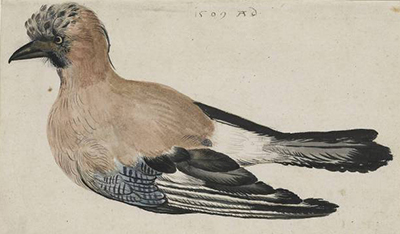
The bird turns its head to the left, its dark beak projecting beyond a bristling crown of feathers. Behind this alert profile, the body extends across the sheet in quieter bands of brown, white and black. A small area of blue, crossed by dark bars, catches the eye near the lower edge. The drawing commonly called Nutcracker brings these different textures together without supplying a perch, a landscape or even the bird's legs. The Louvre catalogues it as Oiseau dit casse-noix —“Bird called a nutcracker”—under Albrecht Dürer's name, inventory 17 DR/ Recto. [1]
That wording leaves room for a question which the picture itself invites. Its pinkish-brown plumage, black facial marking and blue wing panel suggest a jay. The familiar English title is useful for finding the image, but it should not prevent us from looking at the particular bird and the unusually selective way it has been represented.
At a Glance
- Museum title Oiseau dit casse-noix [1]
- Collection Louvre, Paris; 17 DR/ Recto [1]
- Date qualification The record supplies no execution date; 1509 is an inscription [1]
- TypeDrawing [1]
This work across Albrecht Dürer’s career
Nutcracker: the Louvre Bird Study (current article)
Execution date not establishedYoung Hare
1502Praying Hands
1508Melencolia I
1514Four Apostles
1526Contents
- Looking across the plumage
- Why a jay appears under the name Nutcracker
- The inscription and the question of date
- A bird in collectors' portfolios
- Frequently Asked Questions
Looking across the plumage
The head is the most compact and forceful part of the study. The beak makes a hard, pointed silhouette, while the eye appears as a light ring set into a dark surround. Small feather shapes rise and curl over the crown. Their black centres and pale edges make the surface seem ruffled; the contour is broken into individual projections. Below the beak, a dark patch links the face with the throat. These concentrated accents give the head a visual weight quite different from the softly coloured neck.
Over the breast, curved pen strokes remain clearly visible through and beside the brown colour. They descend in loosely grouped rows, changing direction as they follow the rounded form. The individual marks are economical: a few strokes can suggest a tuft, while a longer bend describes the swelling body beneath it. Looking from head to breast, one passes from densely articulated detail to a more open account of volume. The bird holds together because the strokes respond to its changing surfaces.
The wing introduces a second rhythm. Rounded dark feathers overlap like short scales above the longer, narrow forms running towards the right. White intervals and fine dark lines divide these lower feathers, giving them a crispness absent from the breast. The blue patch is particularly absorbing. Its repeated black bars create a small grid within the otherwise flowing plumage. Colour and line have different jobs here: blue distinguishes the patch, while the bars give it an internal structure.
Farther back, the white area and long dark tail stretch the composition horizontally. Some of the white passages contain light linear indications, while the strongest black shapes draw an emphatic outer boundary. The eye can follow the bird's outline from the crown down the curved breast and along the wing, then return through the long upper contour. This gives a coherent silhouette to a study whose internal degree of finish varies considerably.
The empty surroundings matter to that coherence. There is no branch to explain the bird's position and no ground shadow to anchor its weight. Nothing distracts from the transitions between soft body feathers, barred blue plumage and the firm edges of the longer feathers. At the same time, the missing legs interrupt the expectation of a complete standing animal. We see a concentrated study of head, body and plumage, with the pose left less fully explained.
Why a jay appears under the name Nutcracker
The resemblance to a Eurasian jay can be explained through specific features. The British Trust for Ornithology identifies the jay, Garrulus glandarius , by its pinkish plumage and blue-and-black wing barring. The Wildlife Trusts also describe its black tail, white rump, black facial “moustache” and black-and-white wings. Several of those features are conspicuous in the Louvre drawing. This comparison supports describing the bird as jay-like, while keeping the museum's recorded title visible. [12] [13]
Bird names have their own history. In 1771, the Dictionnaire de Trévoux used casse-noix for a spotted bird and also recorded the name for a kind of jay, giving the Latin term graculus alpinus . Such older vocabulary does not identify the Louvre bird or explain when its title was attached. It does show why a historical label cannot always be translated directly into a modern species determination. The words jay , nutcracker and their continental equivalents need to be checked in the particular source in which they occur. [14]
Here the identification question also improves our view of the drawing. Instead of treating the blue as a decorative flourish, we recognise it as part of a distinctive arrangement of plumage. The brown body and relatively small blue panel have to be considered together. A title can lead us to a picture; the distribution of marks and colours gives us a more precise understanding of what the artist chose to record.
The inscription and the question of date
Above the bird is a faint inscription reading 1509, followed by an AD mark. The Louvre's current record supplies no execution date. It is therefore safest to describe the visible inscription without turning it into a securely established year for the drawing. [1]
There is a particularly relevant warning in nineteenth-century scholarship. Charles Ephrussi's Albert Dürer et ses dessins , published in 1882, lists a jay with its feet hidden, worked in black ink and watercolour, in the collection of the late C. S. Bale in London. Ephrussi expressly regards both its monogram and its date of 1509 as apocryphal. The combination of bird, absent feet, materials and inscription is strikingly close to the Louvre sheet. It makes his description a plausible historical counterpart, although his short notice alone does not establish an uninterrupted provenance to the present inventory. [15]
Moriz Thausing's Albert Dürer: His Life and Works , in its English edition of the same year, likewise discusses an unfinished watercolour of a jay formerly owned by Bale and calls its 1509 date spurious. He draws attention to its comparatively broad handling. These are historical scholarly judgements about the Bale drawing, rather than a modern technical examination of the Louvre inscription. They nevertheless provide a substantial reason to resist the easy habit of dating this image from the numerals alone. [16]
The distinction is useful when looking at the sheet's uneven finish. Open breast strokes and more fully coloured wing passages can tell us about the effects the drawing presents. They cannot, by themselves, tell us the year in which each passage was made, who added the writing, or whether the artist intended to take the image further. No documented painting or print destination is supplied by the Louvre entry. The surviving sheet leaves that practical purpose open.
A bird in collectors' portfolios
A still earlier record helps to place the historical jay within nineteenth-century collecting. The Burlington Fine Arts Club's 1869 exhibition catalogue included, as number 137b, a study of the body of a jay, dated 1509 and lent by C. S. Bale. It described the work as highly finished in colour. That phrase differs in emphasis from Thausing's later description of an unfinished watercolour. Both can be understood as responses to a sheet combining elaborate passages with more lightly treated areas, but the catalogue has no illustration or measurements in the entry to settle the identification on its own. [17]
The securely documented modern history is more concise. The Louvre records the drawing in the Collection Edmond de Rothschild, acquired by gift in 1935. It measures 13.9 by 21.7 centimetres and is catalogued in pen and black ink with watercolour. The museum also records its preservation in Rothschild's portfolio III until 2022. That last date concerns its portfolio history; it is separate from the museum's acquisition year. [1]
Its small physical scale is worth remembering when viewing an enlargement. The repeated bars, pale feather margins and curves around the eye occupy tiny areas. Broad brown passages give the bird substance without requiring every feather to receive the same treatment. Close looking reveals this balance more clearly than the familiar title does: the study alternates between an encompassing shape and particular points of intense attention. The light breast strokes remain visible beside the dense wing, allowing us to follow those changes of attention across the bird.
Frequently Asked Questions
Artworks directory
These 187 records include individual works, reverse sides, detail views, paired panels and reconstructed arrangements. Three additional catalogue images repeat works already listed. Related views are not counted as separate originals; qualified attributions and published dating are retained.
Discussion
Look again at the images and ideas explored in Nutcracker: the Louvre Bird Study. These editorial prompts invite your observations.
Reader Insights
Which detail or idea in Nutcracker: the Louvre Bird Study most changed your reading, and why?
How does the discussion of “Looking across the plumage” affect your understanding?
What comparison would you bring to the discussion of “A bird in collectors' portfolios”?
Join the Conversation
Share a detail, comparison or question about Nutcracker: the Louvre Bird Study below.
References
- Musée du Louvre , Oiseau dit casse-noix , 17 DR/ Recto, current collection record, updated 25 March 2025. French. View source .
- ALBERTINA, Selbstbildnis als Dreizehnjähriger, inv. 4839 (German). View source.
- Metropolitan Museum, Four Horsemen from The Apocalypse, 19.73.209 (English). View source.
- Bayerische Staatsgemäldesammlungen, Selbstbildnis im Pelzrock, inv. 537 (German). View source.
- ALBERTINA, Feldhase, inv. 3073 (German). View source.
- ALBERTINA, Das große Rasenstück, inv. 3075 (German). View source.
- Metropolitan Museum, Adam and Eve, 19.73.1 (English). View source.
- ALBERTINA, Betende Hände, inv. 3113 (German). View source.
- Metropolitan Museum, Knight, Death, and the Devil, 43.106.2 (English). View source.
- Metropolitan Museum, Melencolia I, 43.106.1 (English). View source.
- Bayerische Staatsgemäldesammlungen, inventory 545: current collection record (German; descriptive citation). View source.
- British Trust for Ornithology , Jay: Garrulus glandarius , BirdFacts Species, current undated page, accessed 19 October 2026. View source .
- The Wildlife Trusts , Jay , current undated species account, accessed 19 October 2026. View source .
- Dictionnaire de Trévoux , sixth edition (Paris: Compagnie des libraires associés, 1771), vol. II, p. 304, “Casse-noix ou casse-noisette”, historical text transcribed on Wikisource. French. View source .
- Charles Ephrussi , Albert Dürer et ses dessins (Paris: A. Quantin, 1882), pp. 78–79, digitised original. French. View source .
- Moriz Thausing , Albert Dürer: His Life and Works , translated from German, English edition edited by Fred. A. Eaton (London: John Murray, 1882), vol. II, pp. 53–54, digitised original. View source .
- Burlington Fine Arts Club , Albert Dürer and Lucas van Leyden: Catalogue (London: Whittingham and Wilkins, 1869), p. 16, no. 137b, digitised original. View source .
- Germanisches Nationalmuseum, Barbara Dürer (German and English). View source.
- Web Gallery of Art, Tucher–Rieter reverse (English). View source.
- National Gallery of Art, Portrait of a Clergyman (English). View source.
- Dürer Art, Portrait of a Man (English). View source.
- Hessen Kassel Heritage, Elsbeth Tucher (German). View source.
- Web Gallery of Art, Hans Tucher (English). View source.
- Germanisches Nationalmuseum, Emperor Maximilian I (German and English). View source.
- National Gallery of Art, Lot and His Daughters, reverse (English). View source.
- Bayerische Staatsgemäldesammlungen, Glim Lamentation (German). View source.
- Museo Nacional del Prado, Portrait of a Man (Spanish). View source.
- Bayerische Staatsgemäldesammlungen, Madonna of the Carnation (German). View source.
- Städel Museum, Job on the Dungheap (German). View source.
- Wallraf-Richartz-Museum, Piper and Drummer (German). View source.
- Italian Ministry of Culture / Uffizi, Head of Saint James (Italian). View source.
- Klassik Stiftung Weimar, Dresden Altarpiece (German). View source.
- Staatliche Museen zu Berlin, Girl with a Red Beret (German and English). View source.
- Dresden State Art Museums / Roland Enke, Bernhard von Reesen (German). View source.
- Royal Collection Trust, Burkhard von Speyer (English). View source.
- Dresden State Art Museums, Seven Sorrows of the Virgin (English). View source.
- Bayerische Staatsgemäldesammlungen, Mater Dolorosa (German). View source.
- Bayerische Staatsgemäldesammlungen, Lucretia (German). View source.
- Städel Museum, Young Woman with Her Hair Down (English). View source.
- ALBERTINA, Portrait of a Young Man (German). View source.







