 by
Tom Gurney
Tom Gurney BSc (Hons) is an art history expert with over 20 years experience
Published on October 22, 2026 / Updated on October 22, 2026
Email:
tomgurney1@gmail.com
/ Phone:
+44 7429 011000
The Four Horsemen of the Apocalypse by Albrecht Dürer: Introduction
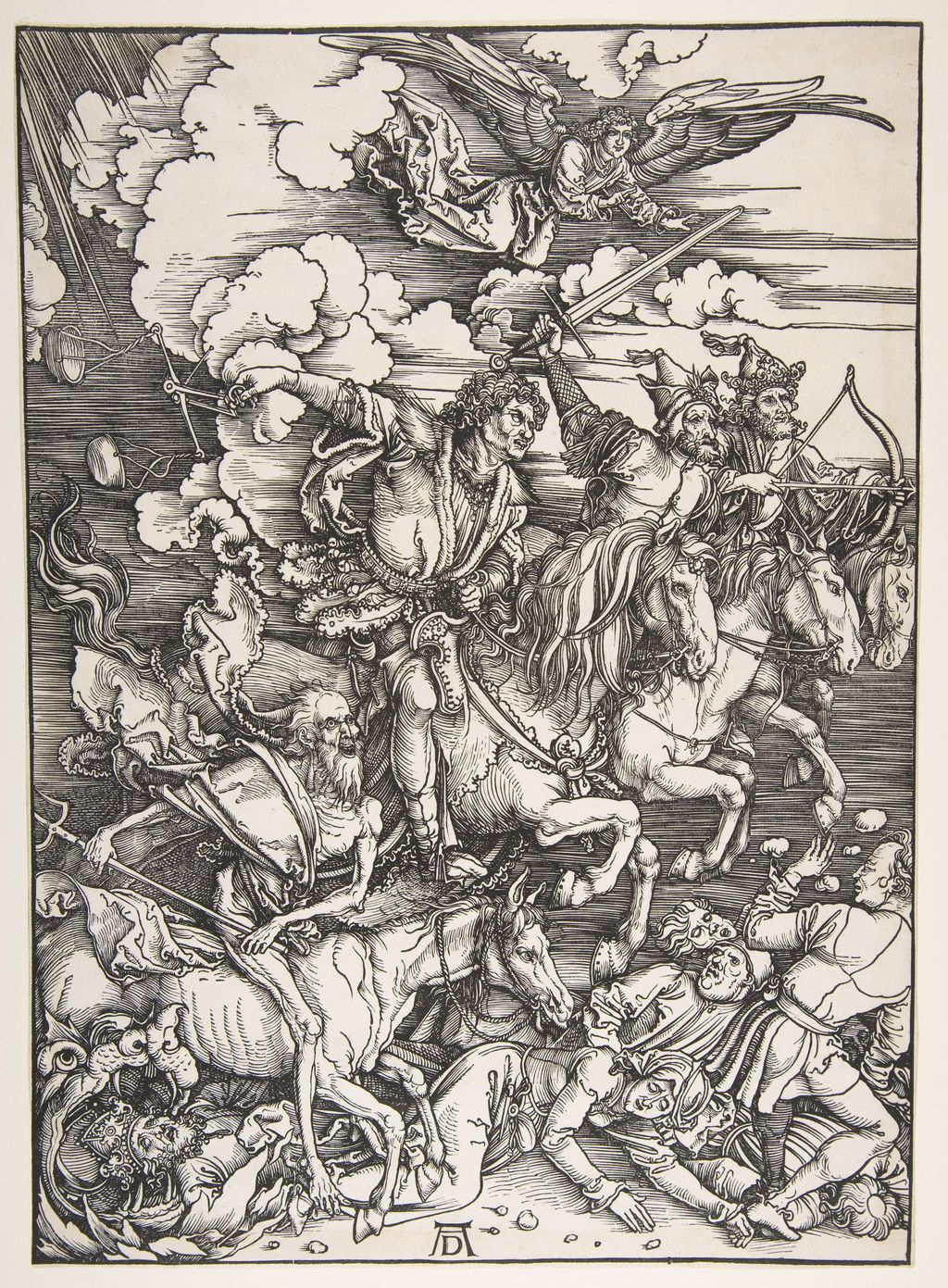
A pair of scales hangs at the left of Dürer's Four Horsemen . One pan is seen almost edgeways, the other opens towards us like a small empty bowl. Follow their suspension cords to the hand that holds them, and an ordinary measuring instrument leads into the middle of a catastrophe. Beside it are a raised sword and a drawn bow; below it, Death rides across a heap of people. The equipment remains individually recognisable even where the bodies crowd together.
Published in the Apocalypse in 1498, this is a woodcut. The Metropolitan Museum's impression, 19.73.209, measures 38.8 × 29.1 cm as a sheet and 38.7 × 27.9 cm as an image. Its upright rectangle accommodates four riders, their horses, fallen people, a monster and an angel. The little AD monogram occupies a clear patch near the bottom. Even this small space has neighbours: pebbles, a hoof and the hem of a collapsing person's clothes. [8]
At a Glance
- Book publication 1498 [8]
- Process Woodcut [8]
- Example impression Metropolitan Museum of Art, 19.73.209 [8]
- British Museum impression, 1895,0122.576391 × 282 mm [20]
This work across Albrecht Dürer’s career
Young Hare
1502Praying Hands
1508Melencolia I
1514Four Apostles
1526Contents
- What the four riders carry
- Looking from crown to trident
- Movement and the patterned surface
- People at the bottom of the image
- How the woodcut holds its lines
- Turning the page
- The design and the surviving sheets
- Frequently Asked Questions
What the four riders carry
The subject is Revelation 6:1–8. The Lamb opens a seal, a living creature calls, and a white horse appears. Its rider has a bow and receives a crown; his action is conquest. At the next opening comes a red horse. Its rider receives a great sword and permission to remove peace, so that people kill one another. A black horse follows the third seal, bearing a rider with balances. A voice announces quantities of wheat and barley for a price, then orders that oil and wine be spared. The fourth horse is pale, and its rider is named Death, with Hell following. [7]
Only Death receives a name in these verses. Conquest, War and Famine are convenient interpretive labels for the other three. The British Museum calls the bowman the Conqueror; its Google Arts & Culture account calls him Pestilence, as does the Met. These differing labels identify readings of the figure. The passage itself gives him a bow, a crown and a conquering action, leaving the reader to distinguish those explicit particulars from a later name. [20] [21] [8]
For an English comparison, the King James wording is available in Oxford's 1833 reprint of the 1611 translation. It postdates Dürer. Its distinction between a rider's possessions and his powers is particularly helpful here: the second rider carries a sword, but the violence he releases is also people killing one another. The disaster exceeds a single mounted attack. Likewise, the third rider's scales belong beside a spoken announcement about provisions, which a silent image cannot reproduce directly. [7]
Dürer gathers the separate appearances into one image. To recover their scriptural order, look from the crowned bowman at the back towards the foreground Death: between them come sword and scales. The four horse colours belong to the biblical text. In an uncoloured impression, they must be understood through reading; the black lines do not constitute a literal white, red, black and pale colour scheme. Their different positions and bodies nevertheless keep the group legible. [7]
The Latin edition of 1511 offers an unusually direct way of checking that relationship. On the reverse of the Horsemen sheet in the SLUB Dresden copy, a heading directs the reader to the third figure, followed by chapter VI. The text names a white horse and a bow, then crown, red horse, sword, black horse and balance. Beside the pale horse appear the words identifying its rider as Death. At the fifth seal, a new direction assigns the text to the fourth figure. [22]
Thus a single printed page makes a distinction that an isolated reproduction can obscure. The Horsemen cover the first four seals, while the vision under the altar and the disturbances of sun, moon and stars belong to the next image. The whole of chapter six is larger than this woodcut's subject. Even an image that feels comprehensive is a selection from a continuing account. [22]
Looking from crown to trident
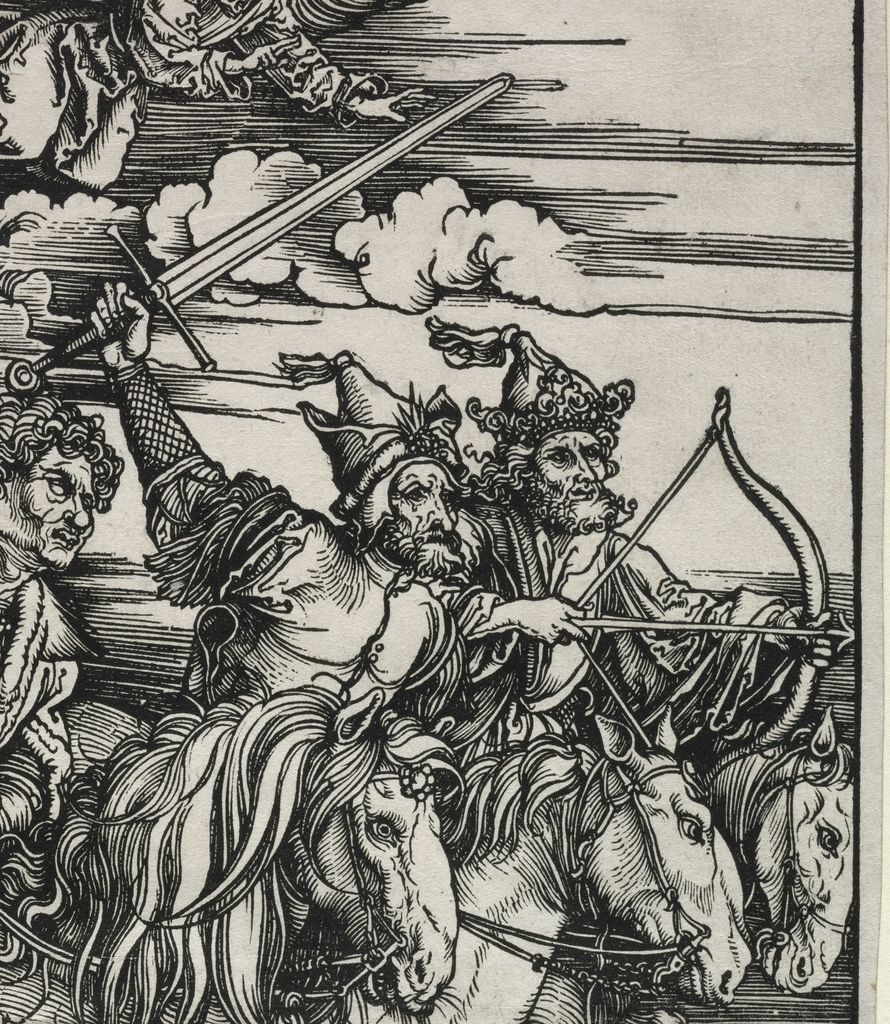
At the right, the bowman's crown is an elaborate openwork structure above a curling beard. His hands and the bow occupy a narrow strip beside the border. The horse beneath him is partly concealed by the other animals, yet its long nose and bridle remain visible. Dürer allows very little unoccupied space around this most distant rider. Identifying the bow requires looking into the crowded edge of the design.
The swordsman's raised hand is easier to find. The sword's circular pommel sits beside his fist; a little crosshatched area at his forearm separates the hand from the larger folds of his sleeve. His pointed cap ends in a loose tuft, and his bearded face turns across the neighbouring bowman's shoulder. The two heads are close, but their different hats, facial angles and weapons prevent them from merging.
The scales-bearer offers another contrast. His head is framed by dense curls, and the front of his tunic is bordered by fur. Small fastenings descend along his chest. Below the belt, fur and patterned fabric turn outward over the saddle. His horse's harness includes a large circular ornament and scalloped edging. These details give him an appearance of material abundance beside the instrument associated with scarcity.
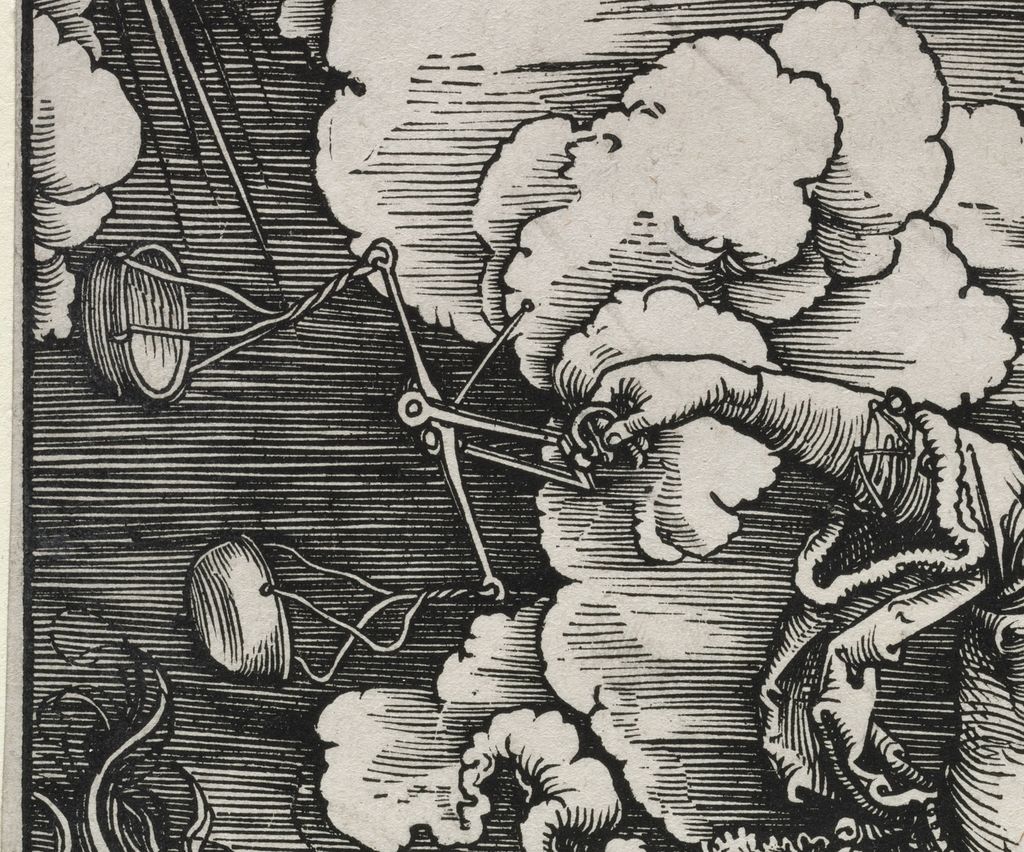
His extended hand holds the balances well away from his chest. Looking closely at the two pans, their different apparent shapes help establish that the object has turned in space. The triangular arrangements of fine cords remain comprehensible against the cloud behind them. Their delicacy is especially striking beside the thickness of the rider's sleeve and the heavy body of his horse. Dürer gives a small implement enough clarity to identify a whole figure.
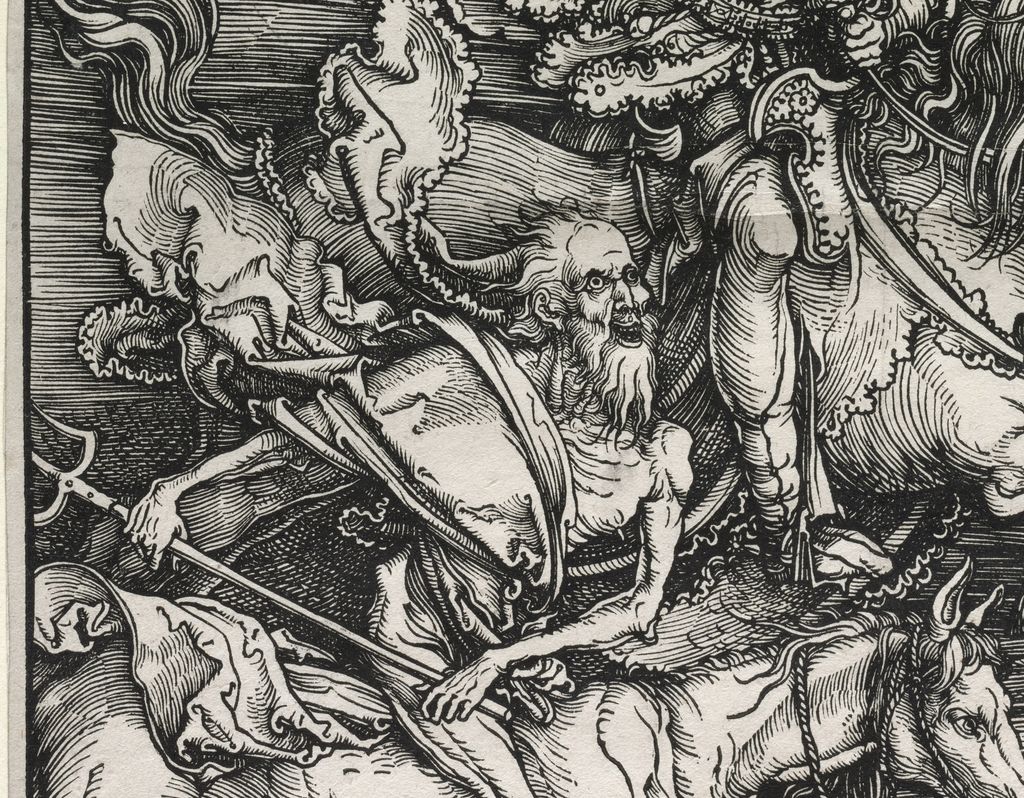
Death is the only rider without an elaborate costume. The ridges of his ribs and the hollows around his shoulders are visible beneath skin; a long beard hangs below his open mouth. He is a wasted, fleshed old man, rather than a completely bare skeleton. A cloth passes behind him, spreading into broad pale folds before narrowing into a long, twisting end. His arms reach down to the shaft of a trident.
The weapon crosses the near horse's neck and points towards the lower left. Death's fingers clasp it at two separated places. His mount has hollows along the neck, a pronounced shoulder and a lowered head, with a bridle still fitted to its gaunt face. It is distinctly different from the fuller animals above. The contrast lies within the drawing of the bodies themselves; it does not depend on adding colour or supplying an explanatory caption.
Annotated Details from The Four Horsemen of the Apocalypse
Follow the balances, the crowded heads and weapons, and the gaunt rider in the foreground.
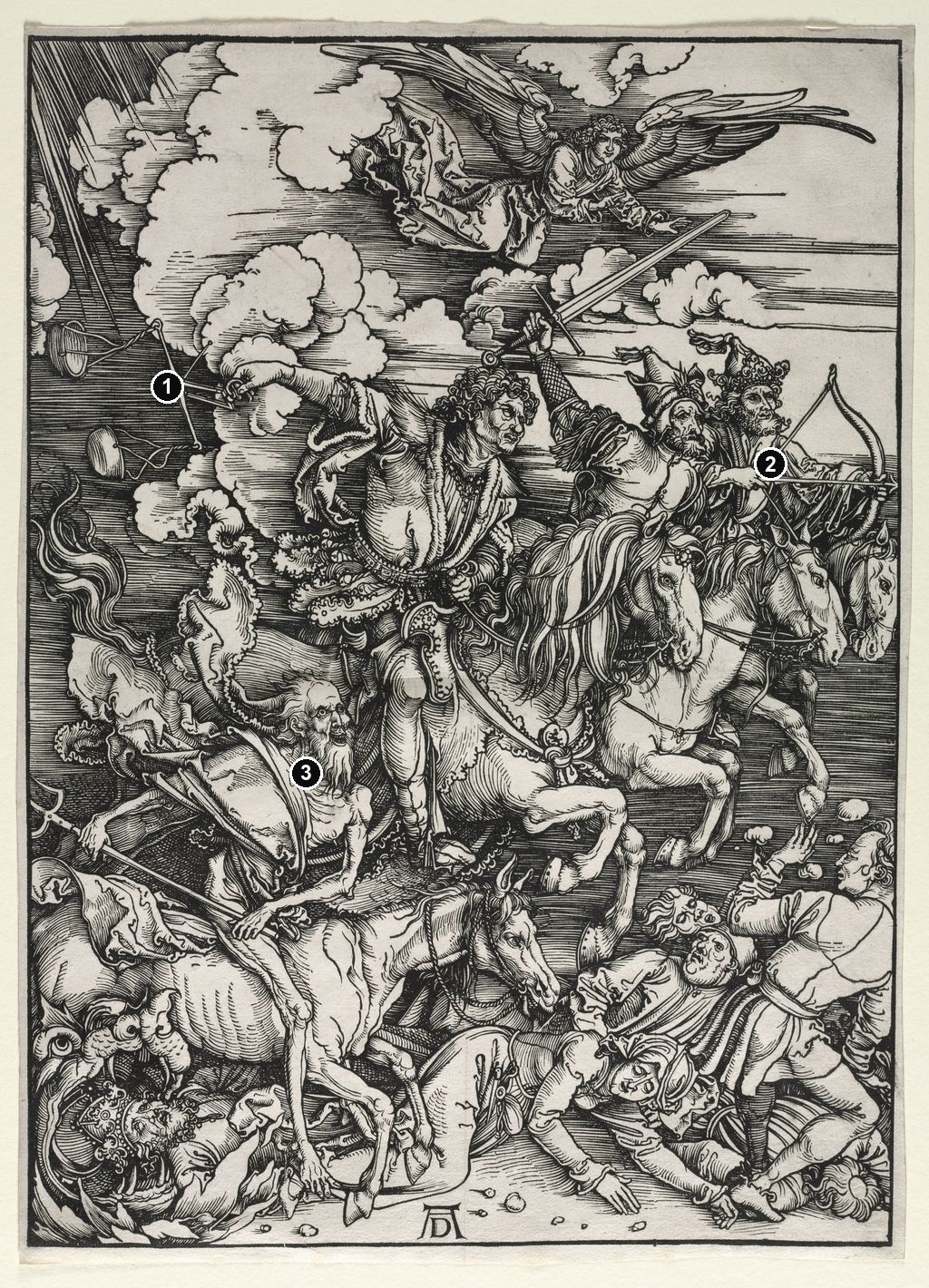
Details from THE FOUR HORSEMEN OF THE APOCALYPSE
Open the details to compare fine cords, patterned clothing and exposed limbs.
The balances and their cords
The two pans face in different directions. Thin cords connect them to the long bar, which angles back towards the hand emerging from a broad, fur-edged sleeve.
Crowded heads and raised weapons
A pointed cap and an openwork crown distinguish neighbouring heads. The raised sword cuts across the sky above them; farther right, the curved bow encloses a smaller patch of pale paper.
The bare torso and long beard
Dark curves follow the ribs beneath the hanging beard. The thin arms extend towards the long shaft, while broad folds of cloth stream behind the head and shoulder.
Movement and the patterned surface
An early account of the print helps explain why these particulars remain readable. In the 1908 edition of Die Kunst Albrecht Dürers , Heinrich Wölfflin describes the riders as a continuous formation that traverses the image and crushes what lies below. He also finds the scene's agitation in the distribution of light and shade and in its cloud edges, feathers, flying cloth, manes and horse legs. His emphasis extends the action beyond the subject of galloping: the whole printed surface participates. [3]
Wölfflin's broader discussion of the Apocalypse makes a useful connection between modelling and pattern. He attends both to strokes that describe a form and to the organisation of light and dark across an entire sheet. Applied to the Horsemen, those two ways of seeing work together. A dark passage may explain the underside of a horse while also holding its pale neighbour clear. The marks can produce a body and help organise the rectangle at the same time. [3]
Take the largest horse's mane near the centre. Long locks fall over the neck in separate bands. Each contains smaller lines, while dark intervals divide one lock from another. The pale face emerges between this hair and the narrow bridle. Looking from face to chest, curved strokes change direction with the form. Seen from farther away, those minute changes combine into the broad light mass that separates the animal from the sky.
The horses' heads form a descending series towards the right border. Beneath them, lifted knees and bent fetlocks create another set of repeated forms. In places there is a dark interval between two limbs; elsewhere a contour is interrupted by a nearer leg. We can trace the animals separately, though parts of their bodies remain hidden by their companions.
G. Kislykh's Pushkin Museum essay stresses the pace created by crossing diagonals, threatened strokes, disturbed clothing and the people beneath the hooves. The sword rising across the upper half and Death's trident descending across the lower half provide clear examples. The arm carrying the scales reaches behind the horses. These different directions keep the formation from reading as a static row of four symbols; its equipment occupies the space around it as well as identifying its members. [23]
At the upper left, closely packed slanting lines meet horizontal bands behind the clouds. Towards the right, some horizontal strokes extend into comparatively open paper. Cloud edges alternate between small curls and larger rounded bulges. There is no distant town to establish a familiar horizon. Apart from the stony strip at the bottom, the setting consists of these changes between marked and unmarked areas.
The angel occupies the largest opening above the riders. Its two wings spread in unequal directions, with long upper feathers projecting beyond the shorter overlapping ranks below. One hand is extended, the other draws closer to the body. The figure's position is clear, but the gesture alone does not establish a precise theological office. Its face and fingers deserve the same careful distinction between visible description and interpretation as the attributes below.
The angel also introduces another scale of detail. Individual feathers can be counted and followed, while the spread wings form a broad shape above the narrow cluster of human heads. Below, curls, cords, chains and garments require a closer view. Wölfflin's interest in the relationship between a sheet's overall pattern and its separate forms remains productive here: the viewer can move between the large arrangement and the smaller structures from which it is made. [3]
People at the bottom of the image
At the lower right, a standing or stumbling figure turns a face back towards the riders and raises a hand. Immediately below, other people are already down. One outstretched hand presses against the ground, its fingers opening towards the bottom edge. A neighbouring head tips back beneath a mass of hair. The clothes contain their own small fields of shading, but their edges are repeatedly interrupted by another body, a hoof or the border.
The changing positions matter. Dürer has not repeated one schematic falling person. There are turned faces, bent knees, unsupported arms and a torso nearly horizontal above the ground. A strip of clear paper around the monogram provides a particularly sharp measure of the crowding elsewhere. The people have scarcely any comparable open space in which to arrange themselves.
In the opposite corner a monstrous head devours an elaborately dressed victim. The British Museum identifies his headgear as a bishop's mitre combined with an emperor's crown. The ornament makes rank visible in helplessness, without establishing a named contemporary portrait. [20]
Revelation's brief statement that Hell follows Death has here acquired teeth, an eye and a cavity large enough to receive a person. In the King James comparison, the fourth rider's destructive powers are shared with the following Hell. The print makes their relationship spatial: the gaunt rider occupies the foreground, while the devouring mouth occupies the corner behind him. Scripture supplies the association; Dürer provides the bodily encounter. [7]
Other clothing in the foreground is less conspicuously splendid. Different hats, uncovered heads and differently cut garments sit close together. The image allows a broad social reading, although it cannot be treated as an exact inventory of every rank. Chapter six later names kings, powerful people, the wealthy, enslaved people and free people among those seeking refuge. That list belongs to the sixth seal. It can illuminate the breadth of Revelation's threatened humanity without being silently transferred into a literal identification of everyone beneath these four horses. [7]
This distinction preserves the force of the foreground. Its victims need not become a catalogue of social types before their danger is intelligible. Faces and hands are present at a scale that rewards attention; the horses conceal some of them and press others against the margins. The ornament on a crown and the separated fingers of an ordinary hand remain equally available to the viewer's eye.
How the woodcut holds its lines
In woodcut, the inked lines stand in relief; the wood around them is removed. The Met contrasts this with engraving, where printable lines are incised into metal. Preserving a black cord means clearing beside it; a light interval corresponds to removed wood. [24]
Friedrich Lippmann's 1906 handbook describes the different action of the engraving burin: pressure from the hand drives its point forwards through the copper. The plate may be turned to meet the stroke. That account helps explain why calling the Horsemen an engraving loses a meaningful distinction. Similar-looking black strokes can reach paper through different kinds of worked surface. In the woodcut, the black network is the part left standing, not the furrow opened by the burin. [25] [24]
Wölfflin's attention to the character of separate lines comes into focus at the scale of texture. The fur on the scales-bearer's collar has a broken, hooked edge; his sleeve contains longer parallel curves. On the largest horse's chest, hatching turns with the rounded muscle. In the swordsman's forearm covering, two sets of diagonals form a little mesh. These local patterns do different descriptive work while sharing the same printed black and the same underlying paper. [3]
Look also at the empty areas inside the forms. A broad pale strip along the sword makes its blade seem distinct from the clouds. Small light intervals separate feather from feather and curl from curl. The near horse's eye is surrounded by short marks whose scale differs from the hatching down its neck. Dürer varies the amount of information as well as the kind of line, allowing relatively bare passages to sit beside intricate ones.
Shinfuji Atsushi notes the longstanding debate about Dürer's own block carving. The impression demonstrates the precision required, but cannot identify the cutter. [26]
Turning the page
The Horsemen follow the martyrdom of John, his vision of Christ among the candlesticks, and his encounter with God and the elders. The Society of Antiquaries preserves these four early narratives together. In the Dresden 1511 book, their different settings are tangible: the Elders image opens above a deep landscape, while the Horsemen replace that prospect with the crowded bodies and horizontally marked sky. [27] [22]
The sequence explains the numbers attached to the design. The ALBERTINA's title calls it Figure III . The original Latin book corroborates that system in its directions to the third figure. Count the introductory martyrdom and it becomes the fourth narrative image; count the illustrated 1511 title as well and it is the fifth image encountered. The title shows John with the Virgin and Child beneath large ornamental lettering. It introduces the book before the narrative counting begins. [28] [22]
The Dresden copy also makes page turning part of the experience. The text facing the Horsemen continues chapters four and five, ending with a direction announcing the third figure. Turn the Horsemen leaf and chapter six appears on its reverse, while the next picture faces it. Matching passage and illustration can therefore require returning to the image just seen. A detached sheet preserves the picture beautifully, but removes this particular succession of reading, looking and turning. [22]
Dürer published German and Latin editions in 1498; the 1511 Latin edition involved Hieronymus Höltzel. Shinfuji relates the cycle to Cologne and Koberger Bible illustrations and to expressive gestures in Italian Renaissance prints. Those are useful connections to inherited imagery and new pictorial resources, rather than evidence of a single compulsory prototype. [26]
The biblical narrative continues beyond the Horsemen's devastation. Revelation seven promises that the great multitude before the throne will no longer hunger or thirst. Chapter twenty-one describes a new heaven and earth and the end of death, mourning and pain. Read beside the riders, these passages make their horror a stage within a larger account of judgement and deliverance. They also give particular force to the hungry world evoked by the balances: the deprivation of chapter six has a later answer. [7]
The dates impose a further boundary. Both 1498 and 1511 precede Luther's Reformation. The crowd's vulnerability and the conspicuous headgear can carry religious and social meaning without establishing a Protestant programme. Nor does the print itself name a particular plague outbreak as its cause. Any explanation in those terms needs evidence beyond the calendar and the subject.
The design and the surviving sheets
The Met's sheet is one impression of the design. The British Museum's 1895,0122.576 is another: 391 × 282 mm, without text, with an imperial-orb watermark and Meder's before-text b classification. Adelaide's 084G1126 is a Latin 1498 impression, with a sheet measuring 39.4 × 27.4 cm; it entered the Art Gallery of South Australia through David Murray's 1908 bequest. [20] [29]
Tokyo dates the design c.1497/98; its G.2020-0146 is a Latin 1511 impression, 39.6 × 27.9 cm, with reverse text and a tower-and-crown watermark; it was purchased on 1 March 2021. Shinfuji identifies the set's Morocco binding as modern and proposes historical coherence from paper evidence, without establishing an original binding. [26]
These measurements describe particular surviving objects. A design can recur while its sheets differ in margins, reverse text and collecting history. Lippmann's handbook likewise distinguishes the engraved work from the impressions taken from it. In the Dresden volume, AD recurs in the printed designs, including the Elders and Horsemen. Those repeated block marks differ from a separately written signature. The image and the piece of paper each have a history, and a collection label can tell us about both. [25] [22]
The British Museum connects Dürer's 1505 charcoal Death Riding , 1895,0915.971, with the Horsemen: its crowned rider has a sickle and skeletal horse, providing a specific later variation. [30]
In the woodcut, return to the small balances. Their pans are empty, but the space around them is full of precisely differentiated marks. The eye can follow a cord into a hand, a sleeve into a body, a bridle towards a horse's mouth. The same attention that disentangles the company reveals the people below it. Dürer gives catastrophe an overwhelming scale while retaining those small points of recognition through which it becomes humanly apprehensible.
Frequently Asked Questions
Artworks directory
These 187 records include individual works, reverse sides, detail views, paired panels and reconstructed arrangements. Three additional catalogue images repeat works already listed. Related views are not counted as separate originals; qualified attributions and published dating are retained.
Discussion
Look again at the images and ideas explored in The Four Horsemen of the Apocalypse by Albrecht Dürer. These editorial prompts invite your observations.
Reader Insights
Which detail or idea in The Four Horsemen of the Apocalypse by Albrecht Dürer most changed your reading, and why?
How does the discussion of “What the four riders carry” affect your understanding?
What comparison would you bring to the discussion of “The design and the surviving sheets”?
Join the Conversation
Share a detail, comparison or question about The Four Horsemen of the Apocalypse by Albrecht Dürer below.
References
- Charles Ephrussi, Albert Dürer et ses dessins (Paris:A.Quantin,1882), pp.2,14–16,20,78–80,86,103,107,109,111–112,120,153,178,188,202,298,302; index pp.399,403,405–406,409–410. French. View source.
- S. R. Koehler, A Chronological Catalogue of the Engravings, Dry-Points and Etchings of Albert Dürer (New York: Grolier Club, 1897). Original English edition Selected pp. 5, 14, 17–18, 32, 37, 42, 44, 51, 58, 60, 63, 81. View source.
- Heinrich Wölfflin , Die Kunst Albrecht Dürers , second enlarged edition (Munich: Bruckmann, 1908), pp. 40–44, 48 and Horsemen illustration. German. View source .
- Campbell Dodgson, Catalogue of Early German and Flemish Woodcuts Preserved in the Department of Prints and Drawings in the British Museum, vol.I (London:Trustees of the British Museum,1903), introduction p.1; Apocalypse,p.260; catalogue of individual woodcuts. English. View source.
- Johann Carl Sigmund Kiefhaber, ed., Nachrichten zur ältern und neuern Geschichte der freyen Reichsstadt Nürnberg: ein Beytrag zur Geschichte der Reichsstädte in Teutschland, vol.1 (Nuremberg: Lechner, 1803), first quarter, pp.6–9,14–16. Original German historical edition of correspondence and inventory. View source.
- T. Sturge Moore, Albert Dürer (London: Duckworth and Co.; New York: Charles Scribner’s Sons, 1905), part III, portrait discussion and caption of the 1500 Munich self-portrait. Original English edition. View source.
- The Holy Bible , Oxford reprint (1833), vol. 2, Revelation 6–7 and 21:1–5. English; reprints the 1611 Authorized Version. View source .
- Metropolitan Museum of Art , The Four Horsemen , 19.73.209. English. View source .
- Moriz Thausing, Albert Dürer: His Life and Works, edited by F. A. Eaton, vol. II (London: John Murray, 1882), pp. 16–18. English edition. View source.
- Albrecht Dürer, family chronicle and father’s death accounts, in William Martin Conway, Literary Remains of Albrecht Dürer (Cambridge University Press, 1889), pp. 34–35, 37, 40–41. Historical English translation; manuscript transcripts and notes by Lina Eckenstein. View source.
- ALBERTINA, Selbstbildnis als Dreizehnjähriger, inv.4839. Heinz Widauer, entry1, in Klaus Albrecht Schröder and Maria Luise Sternath, eds., Albrecht Dürer (Vienna:ALBERTINA; Ostfildern-Ruit:Hatje Cantz,2003), p.116. German. View source.
- Bayerische Staatsgemäldesammlungen, Selbstbildnis im Pelzrock, inv. 537 (German). View source.
- ALBERTINA, Feldhase, inv. 3073 (German). View source.
- ALBERTINA, Das große Rasenstück, inv. 3075 (German). View source.
- Metropolitan Museum, Adam and Eve, 19.73.1 (English). View source.
- ALBERTINA, Betende Hände, inv.3113. Heinz Widauer, in Klaus Albrecht Schröder, ed., Die großen Meister der Albertina (Petersberg:Michael Imhof,2008), no.10. German. View source.
- Metropolitan Museum, Knight, Death, and the Devil, 43.106.2 (English). View source.
- Metropolitan Museum, Melencolia I, 43.106.1 (English). View source.
- Bayerische Staatsgemäldesammlungen – Alte Pinakothek München, Vier Apostel: Hll. Johannes Ev. und Petrus,1526, inv.545. German. View source.
- British Museum, Four Horsemen,1895,0122.576. Giulia Bartrum, Albrecht Dürer and His Legacy: The Graphic Work of a Renaissance Artist (London:British Museum Press,2002), no.271. English. View source.
- British Museum , Four Horsemen , Google Arts & Culture. English. View source .
- Albrecht Dürer , Apocalipsis cum figuris (1511), SLUB Dresden, S.B.80, digitised pages 3, 5, 7, 9–13. Latin; coloured copy. View source .
- G. Kislykh , “Albrecht Dürer and His Prints”, Pushkin Museum. English translation; Russian original. View source .
- Suzanne Boorsch and Nadine M. Orenstein , The Print in the North: The Age of Albrecht Dürer and Lucas van Leyden , Metropolitan Museum of Art Bulletin 54, no. 4 (1997), pp. 3–4. English. View source .
- Friedrich Lippmann , Engraving and Etching , revised by Max Lehrs, translated by Martin Hardie (New York, 1906), pp. 1–2. English from German. View source .
- Shinfuji Atsushi , “Apocalypsis cum figuris”, NMWA Bulletin 55 (2022), pp. 12–14; G.2020-0146. Japanese/English. View source 1 . View source 2 .
- Society of Antiquaries , four Apocalypse woodcuts, KM255. English. View source .
- ALBERTINA , Die apokalyptischen Reiter (Apokalypse, Figur III) , DG1994/14/5. German/English. View source .
- Art Gallery of South Australia , Four Horsemen , 084G1126. English. View source .
- British Museum , Death Riding , 1895,0915.971. English. View source .
- Burlington Fine Arts Club, Exhibition of Early German Art (London: Burlington Fine Arts Club, 1906). Original English catalogue P.24, no.38. View source.
- Joseph Heller, Das Leben und die Werke Albrecht Dürer's, vol.II, part1 (Bamberg:C.F.Kunz,1827), catalogue of paintings and drawings. German. View source.
- Maud Cruttwell, Andrea Mantegna, London: George Bell and Sons, 1901, pp. 110–112. View source.
- Moriz Thausing, Dürer: Geschichte seines Lebens und seiner Kunst (Leipzig: E. A. Seemann, 1876). Original German edition Selected pp.303, 306, 308–309. View source.
- Hans W. Singer, Drawings of Albrecht Dürer (London: G. Newnes; New York: C. Scribner’s Sons, 1906), p. 8; Little Owl (Schönbrunner and Meder no. 829). Original English edition. View source.
- Germanisches Nationalmuseum, Katalog der im Germanischen Museum befindlichen Gemälde (Nürnberg: Verlag des Germanischen Museums, 1893), pp.34–35, nos.206–209. Original German catalogue. View source.
- Friedrich Winkler, Die Zeichnungen Albrecht Dürers, vol.III:1510–1520 (Berlin:Deutscher Verein für Kunstwissenschaft,1938), p.102, no.702. German. View source.
- Germanisches Nationalmuseum, Barbara Dürer (German and English). View source.
- Web Gallery of Art, Tucher–Rieter reverse (English). View source.
- National Gallery of Art, Portrait of a Clergyman. Associated catalogue: John Oliver Hand, with Sally E.Mansfield, German Paintings of the Fifteenth through Seventeenth Centuries (Washington:National Gallery of Art,1993). English. View source.
- Dürer Art, Portrait of a Man (English). View source.
- Hessen Kassel Heritage, Elsbeth Tucher (German). View source.
- Web Gallery of Art, Hans Tucher (English). View source.
- Germanisches Nationalmuseum, Emperor Maximilian I (German and English). View source.
- National Gallery of Art, Lot and His Daughters, reverse (English). View source.
- Bayerische Staatsgemäldesammlungen, Glim Lamentation (German). View source.
- Museo Nacional del Prado, Portrait of a Man (Spanish). View source.
- Bayerische Staatsgemäldesammlungen, Madonna of the Carnation (German). View source.
- Städel Museum, Job on the Dungheap (German). View source.
- Wallraf-Richartz-Museum, Piper and Drummer (German). View source.
- Italian Ministry of Culture / Uffizi, Head of Saint James (Italian). View source.
- Klassik Stiftung Weimar, Dresden Altarpiece (German). View source.
- Staatliche Museen zu Berlin, Girl with a Red Beret (German and English). View source.
- Dresden State Art Museums / Roland Enke, Bernhard von Reesen (German). View source.
- Royal Collection Trust, Burkhard von Speyer (English). View source.
- Dresden State Art Museums, Seven Sorrows of the Virgin (English). View source.
- Bayerische Staatsgemäldesammlungen, Mater Dolorosa (German). View source.
- Bayerische Staatsgemäldesammlungen, Lucretia (German). View source.
- Städel Museum, Young Woman with Her Hair Down (English). View source.
- ALBERTINA, Portrait of a Young Man (German). View source.