


 by
Tom Gurney
Tom Gurney BSc (Hons) is an art history expert with over 20 years experience
Published on June 19, 2020 / Updated on October 22, 2026
Email:
tomgurney1@gmail.com
/ Phone:
+44 7429 011000
The Lion: Introduction
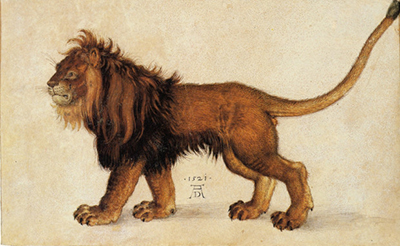
A raised tail sweeps towards the top corner, balancing the dark weight of a magnificent mane. Below it stands a compact, broad-footed lion, facing left with its mouth closed and its eye directed beyond the edge of the picture. This small coloured drawing belongs to the ALBERTINA in Vienna, where it is catalogued as Albrecht Dürer's Löwe , or Lion , inventory 3173. The museum currently dates it to about 1495–1500, with a question mark, although the inscription beneath the animal reads 1521. [1]
The discrepancy is part of the sheet's interest. So is the animal's peculiar presence: its fur looks carefully particularised, while its stance has the firm, assembled quality of an emblem. The lion offers an unusually clear opportunity to look at how convincing surface detail and a convincing bodily structure can pull in different directions. It also has a history in which copying, collecting and changing judgements about authorship have shaped what viewers think they see.
At a Glance
- Current museum date About 1495–1500, with a question mark [1]
- Collection ALBERTINA, Vienna; 3173 [1]
- Inscribed date 1521; distinct from the museum’s execution date [1]
- TypeDrawing [1]
This work across Albrecht Dürer’s career
The Lion (current article)
c. 1495–1500 (?)Young Hare
1502Praying Hands
1508Melencolia I
1514Four Apostles
1526Contents
- A body built from different textures
- Colour, parchment and scale
- A date and a disputed attribution
- A lion that circulated through other images
- The separate lions of 1521
- Frequently Asked Questions
A body built from different textures
The mane provides the most dramatic passage. Long reddish strands descend beside the face and bend over a much darker mass at the chest. Above the forehead, the hair rises in a cluster of separate curling points. Along the shoulder, the pointed ends break the outline against the pale background. The darkness gives the animal its visual weight; the thin, lighter strands prevent that darkness from becoming a flat silhouette. The effect depends on the interval between individual hairs and the large shape they collectively describe.
Across the back and flank, the handling changes. Short strokes lie close to the surface, following the body's rounded forms. The warm brown of the torso is lighter than the mane, allowing the curve of the hindquarter and the indentation above the rear leg to register clearly. Under the belly, longer hairs interrupt the otherwise compact outline. These changes make several kinds of coat visible within a single animal. Simply covering the entire body with equally fine strokes would have produced a much less differentiated creature.
The head is small against its surrounding hair. A pale muzzle, darker nose, whiskers and a sharply marked eye establish a face within the mane's broad frame. Its closed mouth gives the image a watchful stillness. The artist has not supplied an encounter to explain that expression: there is no prey, keeper or approaching human figure. Looking at the lion, we can follow its attention towards the left without knowing what has attracted it.
Below, the feet seem disproportionately emphatic. Their spread toes and dark claws punctuate the lower edge of the body. The front legs angle forward, while the rear legs bend down into a closely grouped pair of supports. All four paws are presented with unusual clarity. This makes the stance easy to read, but also slightly stiff: the weight seems arranged across a sequence of separate feet. Following the contour from the bulky chest to the narrow joints explains why the anatomy has attracted scrutiny as well as admiration.
The tail supplies the composition's release. It extends almost horizontally from the rump before turning sharply upwards, carrying the eye away from the heavy forequarters. Its tip comes very close to the border. The space above the back consequently becomes part of the design: the tail encloses a large pale opening, answering the darker, more crowded forms at the left. Below the belly, the inscription occupies another opening. These areas of apparently empty support help hold the animal together as a picture.
Colour, parchment and scale
The sheet measures 17.7 by 28.8 centimetres. The ALBERTINA identifies watercolour and opaque colour, applied with brush and pen, on exceptionally fine, smoothed and polished parchment. It also records traces of preliminary drawing at the legs, leaving the precise instrument uncertain. Those measurements make the minute differentiation of hair more striking. This is an intimate object whose small touches reward inspection at close range. [1]
The pale surrounding field remains largely unarticulated. A subdued grey passage beneath the feet suggests contact with a surface, without developing into a continuous landscape. The lion's body is therefore more fully described than the world it occupies. Its coat contains different temperatures, densities and directions of colour, while the setting asks very little attention. A thin dark border encloses the image. Within that enclosure, the upward tail and forward head stretch the animal across nearly the full width.
In reproduction, the warm support can seem to belong to the animal's colouring. Looking more closely separates the two: the unpainted-looking field around the lion is broadly continuous, while the ochres and browns of its coat are worked into distinct forms. That relationship contributes to the drawing's coherence. The surrounding warmth softens the contrast at the outline; the much darker mane establishes the strongest internal division. The result is a concentrated display of colour and texture, even though its palette is relatively restrained.
A date and a disputed attribution
The black 1521 and AD monogram are clearly visible below the belly. Their presence should be distinguished from the museum's present proposed execution date, about 1495–1500(?). An account that simply calls this a securely dated study of 1521 conceals a real question. The inscription is evidence to examine alongside the object, its style and its history; it does not make those other forms of evidence unnecessary. [1]
An early published objection shows how pointed that examination could become. A report in Kunstchronik , in the volume catalogued as 1911, records Harry David discussing Dürer's animal representations at a Berlin meeting. David doubted the authorship of the ALBERTINA's lion, identifying it by the older catalogue number Lippmann 567. He criticised the paws and the heavy execution, questioned whether it had been made from nature, and proposed that it was a forgery. He also connected details with a print by Wenceslaus Hollar, suggesting that Hollar might have worked from a similar false attribution. [12]
This was an argument based on comparison and perceived quality. In the preceding discussion, David traced lion types across other artists' works, including Cranach, and considered how images could carry anatomical peculiarities from one representation into another. His suspicion about the coloured lion belonged to that larger investigation of inherited forms. It gives a historical reason to attend to the stance and feet, rather than accepting the carefully painted coat as sufficient proof of direct study from a living animal. [12]
The ALBERTINA nevertheless presents the sheet today under Dürer's name. David's verdict belongs to its critical history, not to its current museum label. His objections can sharpen our looking without obliging us to repeat his conclusion. We can see the distinction he was making between elaborate finish and convincing construction; determining authorship requires a broader assessment than one conspicuous feature. Equally, the current attribution does not require us to imagine a documented sitting, a known menagerie or an identified lion behind the picture. [1]
A lion that circulated through other images
Hollar's Standing Lion offers a useful later comparison. The Rijksmuseum holds an etching dated 1649, made in Antwerp, credited on the object to Hollar after a drawing by Dürer and published by Cornelis Galle II. Its lion also faces left and displays a substantial mane, a long torso and clearly exposed feet. The resemblance establishes a related visual type, while the differences are considerable. It would be misleading to describe the print as a mechanically exact facsimile of the Vienna parchment. [13]
In Hollar's image, the tail drops and curls downwards, ending close to the ground. The animal has more room around its head and back; a densely worked patch of earth supports it. The coat is translated into a sustained network of dark lines and lighter intervals. The light muzzle and waves of the mane remain legible, but the coloured drawing's strong division between almost black chest and orange-brown flank becomes a more continuous tonal body. Comparing the two makes the change of medium tangible: colour relationships have become relationships between marks and the paper left between them.
The enthusiasm for Dürer's animals had already supported another kind of repetition. Hans Hoffmann had access to the Imhoff collection, copied Dürer closely and also developed variations and independent nature studies. The Germanisches Nationalmuseum's 2022 exhibition examined this range of activity. Such work helps explain how a privately collected sheet could remain artistically productive for later painters. A copy might preserve a model, demonstrate skill or create a fresh composition for another collector. [14]
Ksenija Tschetschik-Hammerl's study of Dürer's imitated monogram supplies a particularly relevant example: Hoffmann's Lion and Lioness , dated 1577, were copies after Dürer bearing Hoffmann's own initials. More broadly, she argues that his imitation involved a complicated assertion of artistic identity. She also distinguishes evidence of dishonest selling by a later Imhoff descendant from proof that the earlier collector had commissioned fraudulent works. This distinction matters for the Vienna lion's reception. The existence of copies and imitated signatures explains the need for careful attribution; it cannot establish that every repeated animal, or every artist involved in repetition, was fraudulent. [15]
The separate lions of 1521
There is firmer evidence for Dürer drawing lions during his Netherlandish journey. Berlin's Two Seated Lions , dated 1521, is a silverpoint drawing on lightly prepared paper, formerly part of his travel sketchbook. Hans Mielke relates it to the artist's account of seeing lions in Ghent and drawing one with his metalpoint. Mielke suggests that the two views may represent the same animal. That connection concerns a different object, with a different medium and a different documentary setting. [16]
The comparison is revealing even without identifying a common specimen. In the Berlin sheet, one head turns to the side while the other faces us. The forepaws extend towards the lower edge, and the lightly drawn bodies merge into the surrounding paper. The coloured standing lion is much more firmly bounded and self-contained. One drawing invites us to compare views of an animal; the other concentrates attention on a complete, emphatically outlined figure. Their different effects remain worth seeing even while the chronology of the coloured sheet stays qualified.
The ALBERTINA traces its parchment lion through Willibald Imhoff's collection, where a lion on parchment appears in the 1588 list, then to Rudolf II that year, the imperial treasury, the court library in 1783 and Duke Albert in 1796. The object has thus survived both as a particular painted surface and as an image repeatedly judged through other images. Its raised tail, bright flank and extraordinary dark mane still provide the immediate attraction. The questions around it encourage a slower pleasure: looking closely enough to see how that attraction has been made. [1]
Frequently Asked Questions
Artworks directory
These 187 records include individual works, reverse sides, detail views, paired panels and reconstructed arrangements. Three additional catalogue images repeat works already listed. Related views are not counted as separate originals; qualified attributions and published dating are retained.
Discussion
Look again at the images and ideas explored in The Lion. These editorial prompts invite your observations.
Reader Insights
Which detail or idea in The Lion most changed your reading, and why?
How does the discussion of “A body built from different textures” affect your understanding?
What comparison would you bring to the discussion of “The separate lions of 1521”?
Join the Conversation
Share a detail, comparison or question about The Lion below.
References
- ALBERTINA , Vienna. Löwe , inventory 3173. Current object record, including materials, inscription, dating, bibliography and provenance. German. View source .
- ALBERTINA, Selbstbildnis als Dreizehnjähriger, inv. 4839 (German). View source.
- Metropolitan Museum, Four Horsemen from The Apocalypse, 19.73.209 (English). View source.
- Bayerische Staatsgemäldesammlungen, Selbstbildnis im Pelzrock, inv. 537 (German). View source.
- ALBERTINA, Feldhase, inv. 3073 (German). View source.
- ALBERTINA, Das große Rasenstück, inv. 3075 (German). View source.
- Metropolitan Museum, Adam and Eve, 19.73.1 (English). View source.
- ALBERTINA, Betende Hände, inv. 3113 (German). View source.
- Metropolitan Museum, Knight, Death, and the Devil, 43.106.2 (English). View source.
- Metropolitan Museum, Melencolia I, 43.106.1 (English). View source.
- Bayerische Staatsgemäldesammlungen, inventory 545: current collection record (German; descriptive citation). View source.
- “D.” Report of the Kunsthistorische Gesellschaft meeting in Berlin , including Harry David's lecture “Dürers Tierdarstellungen,” Kunstchronik , Neue Folge 22 (1910/11), no. 6, 18 November 1910, cols. 124–125, in the report continuing through col. 126. Beginning, col. 124; lion discussion, col. 125. German. View source 1 . View source 2 .
- Rijksmuseum , Amsterdam. Wenceslaus Hollar after Albrecht Dürer, Staande leeuw , 1649, RP-P-1963-259. Dutch. View source .
- Germanisches Nationalmuseum , Nuremberg. Hans Hoffmann. Ein europäischer Künstler der Renaissance , press release, 10 May 2022, especially pp. 1–3. German. View source .
- Ksenija Tschetschik-Hammerl. “Das Dürer-Monogramm als Gegenstand der Nachahmung im 16. und frühen 17. Jahrhundert,” kunsttexte.de , 3/2018, pp. 1–5 and p. 18, especially note 12. German. View source .
- Hans Mielke / Kupferstichkabinett , Staatliche Museen zu Berlin. Two Seated Lions , 1521, KdZ 33 verso. Museum collection text and metadata. English. View source .
- Germanisches Nationalmuseum, Barbara Dürer (German and English). View source.
- Web Gallery of Art, Tucher–Rieter reverse (English). View source.
- National Gallery of Art, Portrait of a Clergyman (English). View source.
- Dürer Art, Portrait of a Man (English). View source.
- Hessen Kassel Heritage, Elsbeth Tucher (German). View source.
- Web Gallery of Art, Hans Tucher (English). View source.
- Germanisches Nationalmuseum, Emperor Maximilian I (German and English). View source.
- National Gallery of Art, Lot and His Daughters, reverse (English). View source.
- Bayerische Staatsgemäldesammlungen, Glim Lamentation (German). View source.
- Museo Nacional del Prado, Portrait of a Man (Spanish). View source.
- Bayerische Staatsgemäldesammlungen, Madonna of the Carnation (German). View source.
- Städel Museum, Job on the Dungheap (German). View source.
- Wallraf-Richartz-Museum, Piper and Drummer (German). View source.
- Italian Ministry of Culture / Uffizi, Head of Saint James (Italian). View source.
- Klassik Stiftung Weimar, Dresden Altarpiece (German). View source.
- Staatliche Museen zu Berlin, Girl with a Red Beret (German and English). View source.
- Dresden State Art Museums / Roland Enke, Bernhard von Reesen (German). View source.
- Royal Collection Trust, Burkhard von Speyer (English). View source.
- Dresden State Art Museums, Seven Sorrows of the Virgin (English). View source.
- Bayerische Staatsgemäldesammlungen, Mater Dolorosa (German). View source.
- Bayerische Staatsgemäldesammlungen, Lucretia (German). View source.
- Städel Museum, Young Woman with Her Hair Down (English). View source.
- ALBERTINA, Portrait of a Young Man (German). View source.







