


 by
Tom Gurney
Tom Gurney BSc (Hons) is an art history expert with over 20 years experience
Published on October 22, 2026 / Updated on October 22, 2026
Email:
tomgurney1@gmail.com
/ Phone:
+44 7429 011000
Dürer’s Life of the Virgin: Introduction
A newborn almost disappears among the visitors to a bedroom. An elderly couple embrace beneath an ornamented arch. A mother rides through thick woodland while her husband leads their donkey towards a bridge. Albrecht Dürer’s Life of the Virgin gives sacred history a succession of places to inhabit, each with its own demands on the people passing through it. Its rooms contain furniture, utensils and other people’s business; its journeys require someone to carry a child and negotiate the ground. [1]
Published in Nuremberg in 1511, the book joins twenty woodcut designs to Latin verse by Benedictus Chelidonius. Its title, Epitome in Divae Parthenices Mariae Historiam , announces Mary’s history presented in pictures by Dürer, with Chelidonius’s verses attached. A surviving copy in the Vatican Library allows the whole visual sequence to be followed, from the nursing Virgin on the title page to the final gathering of saints and angels. [1]
This was a substantial object. The Metropolitan Museum of Art records its separate Life of the Virgin volume, accession 19.73.252, at 43.9 × 30.1 × 1.1 centimetres. Those measurements describe that bound book, not the smaller printed images. [2]
Most designs date from about 1501–05, with the Death and Assumption of 1510 and the title of 1511. The closing Veneration , about 1501–02, shows how making and narrative order differ. [3] [1]
At a Glance
- Book publication Nuremberg, 1511 [1]
- Text Latin verse by Benedictus Chelidonius [1]
- Design chronology Mostly about 1501–1505, with later additions through 1511 [3]
Contents
- Following Mary’s history
- Parents and a birthroom
- A greeting, and the work of a household
- Leaving, and the last gathering at a bed
- The earthly story opens into devotion
- Latin poetry and the material book
- Frequently Asked Questions
Following Mary’s history
The twenty designs comprise the title, eighteen narrative pictures and the closing Veneration , also called the Glorification of the Virgin . Counting nineteen scenes and a cover includes that devotional conclusion among the scenes. The sequence itself makes the distinction clear: Mary’s heavenly coronation completes the forward movement of her life; the last picture returns her to the company of the infant Christ. [1]
Before Mary appears, three images establish the story of her parents. Joachim’s offering is rejected in the Temple; an angel visits him among the shepherds; he meets Anne at the Golden Gate. Then come Mary’s birth, her presentation in the Temple and her betrothal to Joseph. The Annunciation and Visitation lead into Christ’s Nativity, Circumcision, the Adoration of the Magi and his Presentation in the Temple. The Flight and the family’s stay in Egypt precede Christ among the Doctors and his farewell to Mary. Her death and Assumption follow. Reading through the pictures gives us a daughter, a wife and a mother, before the last stages of her own life. [1]
The Gospels give only part of this history. In Caxton’s English Golden Legend , Joachim’s childlessness brings humiliation when he offers at the Temple. He withdraws to his herdsmen, and an angel promises that Anne will bear Mary. Their meeting at the gate fulfils the sign given to each parent, making reunion a recognition after separation and shame. [4]
The same legendary account explains Mary climbing the Temple steps and the flowering rod associated with Joseph’s selection as her husband. Dürer gives this past visible duration: Mary has parents and a childhood before becoming Christ’s mother. These are religious narratives with developing traditions, extending beyond the canonical Gospels. [4]
Selected sheets from the Life of the Virgin
Parents and a birthroom
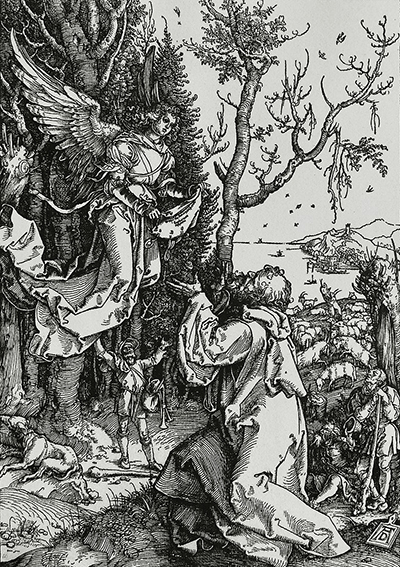
In the Angel Appearing to Joachim , a ribbon held by the messenger stretches across the space above the kneeling man. Its pale surface stands out against foliage, feathers and the angel’s densely folded clothes. Joachim’s upturned head answers the angel’s downward glance. Near his knee, a small shepherd looks towards the encounter; farther away, another raises an arm beside the flock. The same announcement seems immense to the person receiving it and almost private within the larger landscape. [1]
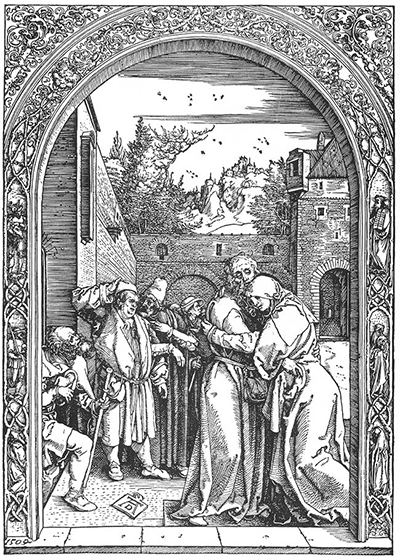
The Golden Gate picture offers a different sort of encounter. The arch’s ornament runs continuously around the top and down both sides, enclosing a rectangular print within a rounded opening. Inside it, Joachim and Anne bend together, their hands reaching around each other’s backs. The witnesses have individual ways of looking: one woman peers past the couple, while a man beside her lifts his hand. Beyond them a wall, an open gate and a hilltop castle keep the town from becoming a flat backdrop. [1]
G. Kislykh, writing for the Pushkin Museum, emphasises the meeting’s contemporary urban familiarity beneath its grand architectural frame. Dürer allows the heavy clothes and awkwardness of an embrace between older people to remain part of the ceremony. [5]
The subject also acquired associations with the Immaculate Conception: Mary’s conception free from original sin. That belief concerns Mary herself, and is distinct from Christ’s conception and virgin birth. The National Gallery notes the association of Joachim and Anne’s embrace with the doctrine, while explaining that conception through the embrace itself was not adopted by the Church. Scherbaum interprets the Golden Gate as Immaculist, linking it to Anne’s growing cult; Dürer’s intentions still require interpretation. [6] [3]
The Birth of the Virgin replaces the street with a room full of women. Anne rests in the curtained bed at the back right. In the foreground left, an attendant holds the infant, her small head turned towards us. Nearby, two women bend close together; another stands with a tall vessel. At the opposite side, a seated woman handles cloth beside a bucket. Dürer distributes the labour and sociability of a birth across the whole lower half of the picture. [1]
The room has sharp little reminders of life beyond the principal event. Keys hang beside an open door. Vessels stand on a shelf. An upper opening and a stair suggest parts of the house that we cannot fully see. These objects make the interior feel available for further use: people could leave by that door or climb those stairs after this particular gathering has dispersed. The space is much more extensive than the patch occupied by the newborn. [1]
Above the bed, an angel swings a censer from a cloud. The angel’s broad wings and the cloud’s curling edges occupy an area nearly as large as the bedchamber below them. This is a conspicuous heavenly presence, while the women continue with their separate tasks. The eye travels between levels because the dark smoke and curtains almost meet. Household attendance and angelic attendance fill different parts of one room. [1]
Chelidonius’s accompanying poem gives the birth a second setting. It begins by measuring the approach of the event through the moon, describes the women gathering around the expectant mother, and introduces heavenly music for the newborn. Reading those verses beside Dürer’s image brings sound and elapsed time into a scene held still on paper. The poet’s arrival of celestial song and the artist’s great hovering angel offer different ways of making the birth extraordinary. [1]
A greeting, and the work of a household
In the Visitation , Mary and Elizabeth meet before a long view of mountains. Their hands rest on shoulders and arms, giving their greeting a precise bodily shape. A man at the doorway holds his hat, while three women wait beneath the trees opposite. At ground level, a dog sniffs beside scattered stones. Its lowered head supplies a small, wonderfully unceremonious counterpoint to the people’s attentive faces. [1]
The ALBERTINA’s reversed pen design, about 1503, measures 25.8 × 20.5 centimetres, in grey with black additions. Compared with it, the print lowers the horizon and removes a farm. The embrace remains, while its middle distance opens out. [3]
The finished print rewards attention to the contrast between the people and their surroundings. Long, clear folds define the standing women. Farther back, curved clusters distinguish tree crowns from the hard ridges of the mountain. The wall at the left has short marks scattered across its otherwise pale surface, while the doorway contains close horizontal lines. Different kinds of mark make the building, the people and the far country belong together without giving them an identical texture. [1]
Such variety persists when Mary becomes a mother. The Nativity occupies a broken building with exposed timbers. The Magi assemble beneath masonry and a spreading roof; their gifts and elaborate clothes crowd the foreground. In the Presentation of Christ, a huge column rises so near the viewer that it partly interrupts the people beyond. Each setting gives the small child a different public or private world, with different ways for others to approach him. [1]
The Flight into Egypt puts the family in motion. Mary sits sideways on the donkey, the child held close. Joseph takes a broad step towards a little bridge, leaning under the pole that carries his belongings. The donkey lowers its head towards the uneven path. A rough handrail crosses the bottom left corner, then gives way to roots, stones and the bridge’s exposed arch. The travellers’ route is assembled from specific obstacles and supports. [1]
The vegetation changes scale around them. A palm trunk and its long leaves fill the left edge; dense trees crowd behind Mary; the high crown of another strange tree closes the right. Small angels appear above, where the branches break against cloud. Across the sheet, coarse bark, short animal hair and the longer curves of cloth receive different patterns of black marks. Looking slowly means continually adjusting from one surface to another. [1]
In the apocryphal Gospel of Pseudo-Matthew , the family rests beneath a palm on the third day of its journey. Mary wants its fruit, but the branches are too high. At the child’s command the tree bends down, then a spring opens at its roots. This legendary palm offers both food and water. The story gives a tree a part to play in the family’s survival, beyond providing the scene with an unusual silhouette. [7]
The following Sojourn in Egypt exchanges the path for a working yard. Joseph bends over a long piece of timber, while small winged helpers carry and gather material around his feet. Mary sits beside a cradle, with an angel behind her. Tools, offcuts and a basket fill the foreground; a stair climbs towards the dark entrance of the building. The open gateway at the back leads out again, but for the moment everyone has work close at hand. [1]
Here Chelidonius’s poem travels farther than the woodcut. Its opening names the Nile and Memphis and evokes Egypt’s pyramids. Joseph’s skill extends to bronze, ivory and marble; Mary’s care includes feeding the child, his first speech and steps, and textile work. Dürer’s yard offers wood, tools and busy helpers in a setting that we can examine at close range. The poem supplies an expansive imagined Egypt and a household developing through time. Their shared subject leaves room for distinct choices of detail. [1]
Leaving, and the last gathering at a bed
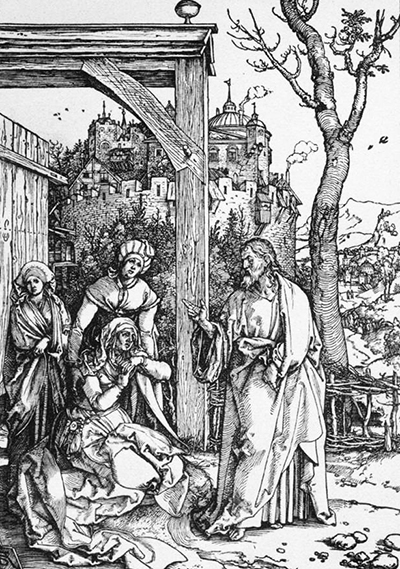
After Christ among the Doctors, the farewell makes Mary’s distress occupy the foreground. She has sunk down, her clasped hands raised towards her face, with a woman standing behind to support her. Christ stands beyond a heavy timber post and lifts one hand towards the group. His other hand rests near his body. Their exchange has the painful restraint of two people who can still see and address each other, although one is about to leave. [1]
The setting contains several smaller separations. A fence closes off the tree at the right; another passage runs behind the women; the town beyond rises in successive walls and roofs. Between Christ and Mary, the broad post almost touches their gestures. Dürer has given the farewell an actual place at which bodies must stop, turn and part. The vertical grain of its timber remains visible beside the folds of their clothes. [1]
Mary’s clasped hands differ from the arms enclosing her in the Visitation, or those of her parents around one another at the Golden Gate. The cycle invites us to remember one gesture when we encounter another. Reunion, greeting and distress have their own bodily language. It is possible to follow much of this changing emotional history through hands alone. [1]
The Death of the Virgin , with its date of 1510, brings together another set of hands and objects. Beside Mary’s pillows, an attendant helps with the candle that she holds. Elsewhere fingers rest on books or close in prayer. At the left, a reader leans over his open volume; at the right, a seated apostle bends forward, his elbow and hand supporting the weight of his head. Each person has a distinct task or posture within the common vigil. [1]
Small material details prevent the room from becoming an abstract emblem of mourning. The chest beside the seated man has a metal handle. The bedstead bears ornament and a projecting ledge. Fringes hang beneath the canopy, whose gathered curtains have been tied back. A tall cross rises past its edge, while a hanging vessel occupies the shadow at the left. Some objects are held, some stand beside the bed, and others hang above the gathering. The different heights spread the vigil through the room. [1]
The birthroom had given us visitors talking and working around a baby. Here the household gathering has become a sustained attendance upon death. Yet the two images do not duplicate one another: the earlier room is full of women’s conversation and practical care; this room contains books, ritual equipment and absorbed male attendants. Dürer changes the people and the action as well as Mary’s age. The return indoors carries the memory of the first room without making the last one feel inevitable from the beginning. [1]
The earthly story opens into devotion
In the Assumption and Coronation , also dated 1510, the tomb takes the place of the bed. Mary kneels above it between Christ and God the Father, with the dove overhead. Below, the apostles look upwards or remain absorbed beside the open grave. Te Papa’s impression records this design at 20.9 centimetres wide by 29.5 high, measurements of its image rather than a bound book. [8]
Dürer makes the cloud broad enough to fill nearly the whole width of the upper scene. Its scalloped lower edge cuts across the forest behind the apostles, while rays spread from the heavenly figures towards the corners. The men below have bare feet, heavy robes and room to stand around a solid tomb. Above them, Mary’s robe streams across the cloud and the three principal figures form a compact gathering around the crown. The sheet holds two very different kinds of support for a human body. [1]
The last Veneration brings the infant Christ back to Mary’s lap. A harp player stands at her side; saints crowd behind and beside her; small winged figures handle objects along a foreground ledge. Large columns and an ornate overhead structure surround the company. A figure holding tablets appears high above them. The chronological story has finished, and this busy, assembled company offers another kind of attention: a gathering around Mary and her child. [1]
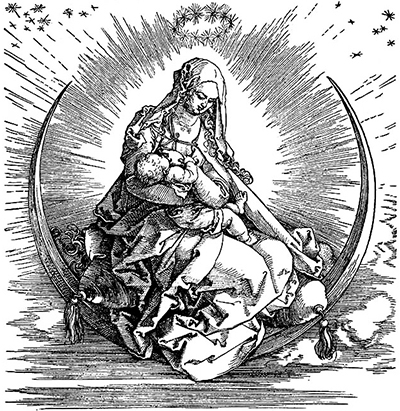
The nursing Virgin of the title supplies the other end of the book. Her body rests within a crescent moon whose points rise beside her. The child reaches towards her breast; the fabric across her lap falls in deep, angular folds. Stars, rays and a crown hover around that act of nourishment. Before we have followed Mary through any house or town, Dürer has already joined bodily intimacy to an immense celestial setting. [1]
The title’s short poem speaks in Mary’s voice to people troubled by fortune, wrongdoing or approaching death. She offers to intercede with the child at her breast. Near the conclusion, a supplication asks for her protection and help, followed by the poet’s dedication to Caritas Pirckheimer, abbess of Nuremberg’s St Clare’s. These printed appeals give the reader a role beyond watching events unfold. Having looked through a life, the reader is also invited to ask for assistance. [1]
Latin poetry and the material book
The verse occupied an important part of the publication. Chelidonius was a Benedictine poet associated with Nuremberg’s St Egidien. Hieronymus Höltzel printed the texts, while Dürer published the book and supplied its visual designs. In 1511 he also issued the Large and Small Passions and a new edition of the Apocalypse . Woodcut prints the raised lines left when surrounding wood is removed. Responsibility for cutting these blocks remains less certain than the identification of their designer. [9] [10]
Scherbaum relates the poems to Baptista Mantuanus’s Parthenice Mariana ; whether Chelidonius wrote on Dürer’s commission remains uncertain. Arwed Arnulf disputes the description of the poems as an abridgement of Mantuanus’s epic. He emphasises their different verse form and their correspondence with the selected episodes. His account treats poetry and picture as distinct representations that a reader could contemplate alongside one another. [3] [11]
The poems use Antiqua type. The Vatican copy makes the encounter between text and picture tangible. A page of Latin faces a full woodcut on the right. The poems form narrow, generously spaced columns, their alternating line lengths visible before a word has been read. Their open, rounded letters have a different texture from the compact hatching of the pictures. The Birth poem and image, or the Egyptian household and its facing verses, can each be considered separately before the eye moves across the opening again. [3] [1]
Turning the leaf changes the relationship. The reverse of the picture carries the text that faces the next woodcut. A narrative leaf therefore belongs to more than one encounter: it has one image on its front and prepares another on its back. Broad blank margins keep the printed areas distinct. On some scans, the faint reversed outlines showing through the paper remind us that these are two sides of a physical leaf, not twenty isolated images placed beside unrelated poems. [1]
Below the final Veneration , an imprint names Nuremberg, Dürer the painter and 1511. A warning invokes an imperial grant against reproducing and selling the images. Its descending, narrowing lines occupy the space beneath the woodcut almost like another carefully shaped printed object. The image of devotional assembly consequently shares its last page with an emphatic assertion of the maker’s publishing interests. [1]
The Life of the Virgin also had a life outside this particular sequence of page turns. Many designs circulated as separate impressions before the complete book appeared. Other volumes joined it to the Great Passion and Apocalypse , as in the Met’s distinct accession 41.1.229. A reader encountering the three together could move from Mary’s history into two further extended visual narratives. [8] [12] [2]
Dürer’s Netherlands diary records another encounter with the book. He gave a Life of Our Lady to Ambrosius Hochstetter and received a drawing of his ship in return; the entry survives in William Martin Conway’s 1889 English translation. The exchange sets a copy among the objects that people offered one another, alongside the practical business of travel and meeting. The designed book had become something that could be carried, presented and answered by another image. [13]
Seen alone, a woodcut offers a complete arrangement of bodies, light and place. Seen through the book, its gestures acquire neighbours and its setting becomes one place among many. A birth, a greeting, a journey, work and loss each call for a different response. Dürer gives those differences enough physical detail to sustain our attention, while Chelidonius’s poems introduce their own voices, memories and expanses of time. Together they make Mary’s history a work to move through, return to and read again. [1]
Frequently Asked Questions
Artworks directory
These 187 records include individual works, reverse sides, detail views, paired panels and reconstructed arrangements. Three additional catalogue images repeat works already listed. Related views are not counted as separate originals; qualified attributions and published dating are retained.
Discussion
Look again at the images and ideas explored in Dürer’s Life of the Virgin. These editorial prompts invite your observations.
Reader Insights
Which detail or idea in Dürer’s Life of the Virgin most changed your reading, and why?
How does the discussion of “Following Mary’s history” affect your understanding?
What comparison would you bring to the discussion of “Latin poetry and the material book”?
Join the Conversation
Share a detail, comparison or question about Dürer’s Life of the Virgin below.
References
- Albrecht Dürer and Benedictus Chelidonius, Epitome in Divae Parthenices Mariae Historiam ab Alberto Durero Norico per figuras digestam cum versibus annexis Chelidonii (Nuremberg: Albrecht Dürer, 1511); Vatican Library, Cicognara.IX.2022, scans 7–46, including all twenty designs, facing texts and final imprint. Latin. View source.
- Metropolitan Museum of Art , Life of the Virgin , 19.73.252, 1511. View source .
- Anna Scherbaum, Heimsuchung Mariae (Vorzeichnung zum „Marienleben“, Blatt 9), 3078; Klaus Albrecht Schröder and Maria Luise Sternath (eds.), Albrecht Dürer (Vienna: ALBERTINA; Ostfildern-Ruit: Hatje Cantz, 2003), no. 79, pp. 284–294; current ALBERTINA metadata. German. View source.
- Jacobus de Voragine , “The Nativity of Our Blessed Lady”, Golden Legend , William Caxton’s 1483 English translation; parental and childhood narrative. View source .
- G. Kislykh , “Albrecht Dürer and His Prints”, Pushkin Museum. View source .
- National Gallery , “Immaculate Conception of the Virgin”. View source .
- The Gospel of Pseudo-Matthew , chapter 20, Alexander Walker’s 1886 English translation, revised by Kevin Knight for New Advent. View source .
- Mark Stocker , Assumption and Coronation , Te Papa, 1971-0028-4, December 2016. View source .
- University Library Regensburg , “Die drei großen Bücher Dürers” and “Der Dichtermönch Benedictus Chelidonius”. German. View source 1 . View source 2 .
- Suzanne Boorsch and Nadine M. Orenstein , The Print in the North: The Age of Albrecht Dürer and Lucas van Leyden , Metropolitan Museum of Art Bulletin 54, no. 4, Spring 1997, pp. 3–4, 25. View source .
- Arwed Arnulf , “Dürers Buchprojekte von 1511: Andachtsbücher für Humanisten”, Marburger Jahrbuch für Kunstwissenschaft 31, 2004, pp. 152–154. German. View source .
- Metropolitan Museum of Art , The Life of the Virgin, Great Passion, and Apocalypse , 41.1.229, 1511. View source .
- Albrecht Dürer, Netherlands diary, in William Martin Conway (ed.), Literary Remains of Albrecht Dürer (Cambridge: Cambridge University Press, 1889), p. 116; manuscript transcripts and notes by Lina Eckenstein. Historical English translation of German. View source.
- S. R. Koehler, A Chronological Catalogue of the Engravings, Dry-Points and Etchings of Albert Dürer (New York: Grolier Club, 1897). Original English edition Selected pp. 5, 14, 17–18, 32, 37, 42, 44, 51, 58, 60, 63, 81. View source.
- Charles Ephrussi, Albert Dürer et ses dessins (Paris: A. Quantin, 1882), selected pp.2,14–16,20,78–80,107,109,120,153,178,188,298,302; index pp.399,403,405–406,409–410. Original French edition. View source.
- Campbell Dodgson, Catalogue of Early German and Flemish Woodcuts Preserved in the Department of Prints and Drawings in the British Museum, vol. 1 (London: British Museum, 1903). Original English edition Selected pp. 246, 260, 262, 272, 274, 288, 290, 294–296, 299–300, 302, 307. View source.
- Heinrich Wölfflin, Die Kunst Albrecht Dürers, second enlarged edition (Munich: F. Bruckmann, 1908), pp. 110, 298. Original German edition. View source.
- Burlington Fine Arts Club, Exhibition of Early German Art (London: Burlington Fine Arts Club, 1906). Original English catalogue P.24, no.38. View source.
- Moriz Thausing, Albert Dürer: His Life and Works, translated from German, edited by Fred. A. Eaton, vol. II (London: John Murray, 1882), pp. 16–18. Original English edition. View source.
- Joseph Heller, Das Leben und die Werke Albrecht Dürer's, vol. II, part 1 (Bamberg: C. F. Kunz, 1827), p. 118, no. 138; pp. 160–162, Florence entry 13; pp. 196–197, Munich entry 17. Original German edition. View source.
- Johann Carl Sigmund Kiefhaber, ed., Nachrichten zur ältern und neuern Geschichte der freyen Reichsstadt Nürnberg: ein Beytrag zur Geschichte der Reichsstädte in Teutschland, vol.1 (Nuremberg: Lechner, 1803), first quarter, pp.6–9,14–16. Original German historical edition of correspondence and inventory. View source.
- Maud Cruttwell, Andrea Mantegna, London: George Bell and Sons, 1901, pp. 110–112. View source.
- Albrecht Dürer, family chronicle and father’s death accounts, in William Martin Conway, Literary Remains of Albrecht Dürer (Cambridge University Press, 1889), pp. 34–35, 37, 40–41. Historical English translation; manuscript transcripts and notes by Lina Eckenstein. View source.
- Moriz Thausing, Dürer: Geschichte seines Lebens und seiner Kunst (Leipzig: E. A. Seemann, 1876). Original German edition Selected pp.303, 306, 308–309. View source.
- T. Sturge Moore, Albert Dürer (London: Duckworth and Co.; New York: Charles Scribner’s Sons, 1905), part III, portrait discussion and caption of the 1500 Munich self-portrait. Original English edition. View source.
- Hans W. Singer, Drawings of Albrecht Dürer (London: G. Newnes; New York: C. Scribner’s Sons, 1906), p. 8; Little Owl (Schönbrunner and Meder no. 829). Original English edition. View source.
- Germanisches Nationalmuseum, Katalog der im Germanischen Museum befindlichen Gemälde (Nürnberg: Verlag des Germanischen Museums, 1893), pp.34–35, nos.206–209. Original German catalogue. View source.
- Joachim von Sandrart, L’Academia Todesca della Architectura, Scultura & Pittura: oder Teutsche Academie der Edlen Bau- Bild- und Mahlerey-Künste (Nuremberg, 1675), II, book 3, p. 224. Original German edition; facsimile and transcription. View source 1. View source 2.
- Stijn Alsteens and Freyda Spira, with Maryan W. Ainsworth, Dirk H. Breiding, George R. Goldner, Guido Messling, Marjorie Shelley and Joshua P. Waterman, Dürer and Beyond: Central European Drawings in The Metropolitan Museum of Art, 1400–1700 (New York: Metropolitan Museum of Art; New Haven and London: Yale University Press, 2012), p. 15, fig. 2, Three Studies of a Left Hand, ALBERTINA 26327. English. View source.
- Friedrich Winkler, Die Zeichnungen Albrecht Dürers, II (Berlin: Deutscher Verein für Kunstwissenschaft, 1937), no. 357, pp. 73–74. German. View source.
- Germanisches Nationalmuseum, Barbara Dürer (German and English). View source.
- Web Gallery of Art, Tucher–Rieter reverse (English). View source.
- National Gallery of Art, Portrait of a Clergyman (English). Associated catalogue: John Oliver Hand, with Sally E.Mansfield, German Paintings of the Fifteenth through Seventeenth Centuries (Washington: National Gallery of Art,1993). View source.
- Dürer Art, Portrait of a Man (English). View source.
- Hessen Kassel Heritage, Elsbeth Tucher (German). View source.
- Web Gallery of Art, Hans Tucher (English). View source.
- Germanisches Nationalmuseum, Emperor Maximilian I (German and English). View source.
- National Gallery of Art, Lot and His Daughters, reverse (English). View source.
- Bayerische Staatsgemäldesammlungen, Glim Lamentation (German). View source.
- Museo Nacional del Prado, Portrait of a Man (Spanish). View source.
- Bayerische Staatsgemäldesammlungen, Madonna of the Carnation (German). View source.
- Städel Museum, Job on the Dungheap (German). View source.
- Wallraf-Richartz-Museum, Piper and Drummer (German). View source.
- Italian Ministry of Culture / Uffizi, Head of Saint James (Italian). View source.
- Klassik Stiftung Weimar, Dresden Altarpiece (German). View source.
- Staatliche Museen zu Berlin, Girl with a Red Beret (German and English). View source.
- Dresden State Art Museums / Roland Enke, Bernhard von Reesen (German). View source.
- Royal Collection Trust, Burkhard von Speyer (English). View source.
- Dresden State Art Museums, Seven Sorrows of the Virgin (English). View source.
- Bayerische Staatsgemäldesammlungen, Mater Dolorosa (German). View source.
- Bayerische Staatsgemäldesammlungen, Lucretia (German). View source.
- Städel Museum, Young Woman with Her Hair Down (English). View source.
- ALBERTINA, Portrait of a Young Man (German). Embedded essay credited to Eva Michel, no. 48, p. 98, fig. 48, in Sabine Haag, Christiane Lange, Christof Metzger and Karl Schütz (eds.), Dürer – Cranach – Holbein. Die Entdeckung des Menschen: Das deutsche Porträt um 1500 (Munich: Hirmer, 2011), inv. 3122. View source.







