by
Tom Gurney
Tom Gurney BSc (Hons) is an art history expert with over 20 years experience
Published on June 19, 2020 / Updated on October 22, 2026
Email:
tomgurney1@gmail.com
/ Phone:
+44 7429 011000
Two Seated Lions by Albrecht Dürer: Introduction
One lion turns its head towards the edge of the paper; the other faces us, its broad muzzle set above two enormous paws. Their manes nearly join, filling the small sheet with waves of hair. The familiar title, Two Seated Lions , makes them sound like a pair posing together. Looking at the drawing as a page of studies opens another possibility: Dürer may have drawn the same animal twice, preserving a change of view on a single surface.
The drawing dates from 1521 and belongs to Berlin's Kupferstichkabinett. It is the reverse, or verso, of a leaf numbered KdZ 33. Berlin's 2023 exhibition list calls it Zwei liegende Löwen —two reclining lions—and records silverpoint on paper prepared with a white ground on both sides. The sheet measures only about twelve by seventeen centimetres. Its intimacy matters. The heads that look monumental in an enlarged reproduction originally occupied part of a travelling artist's small working page. [1]
At a Glance
- Date 1521 [1]
- Material Silverpoint on white prepared paper [1]
- Collection Kupferstichkabinett, Berlin; KdZ 33 verso [1]
This work across Albrecht Dürer’s career
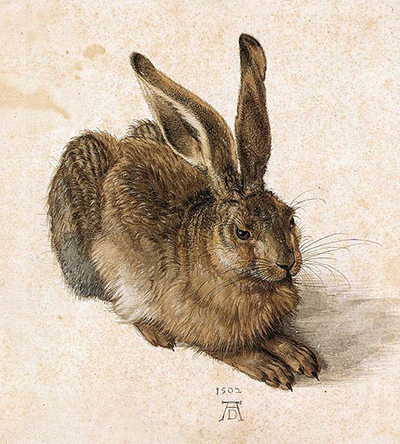
Young Hare
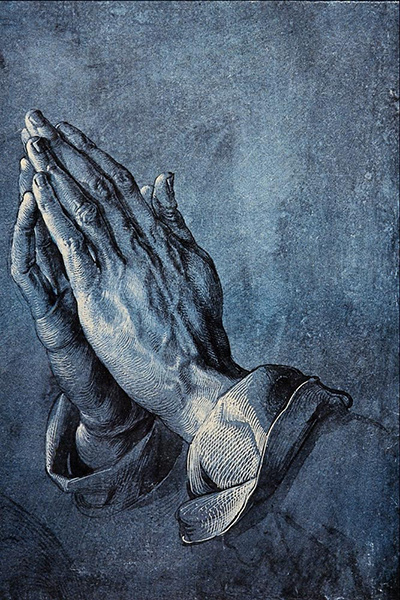
1502Praying Hands
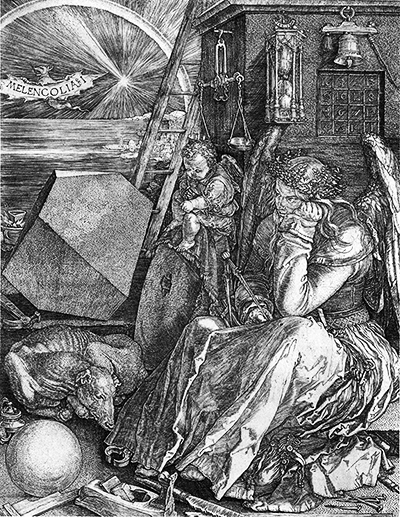
1508Melencolia I
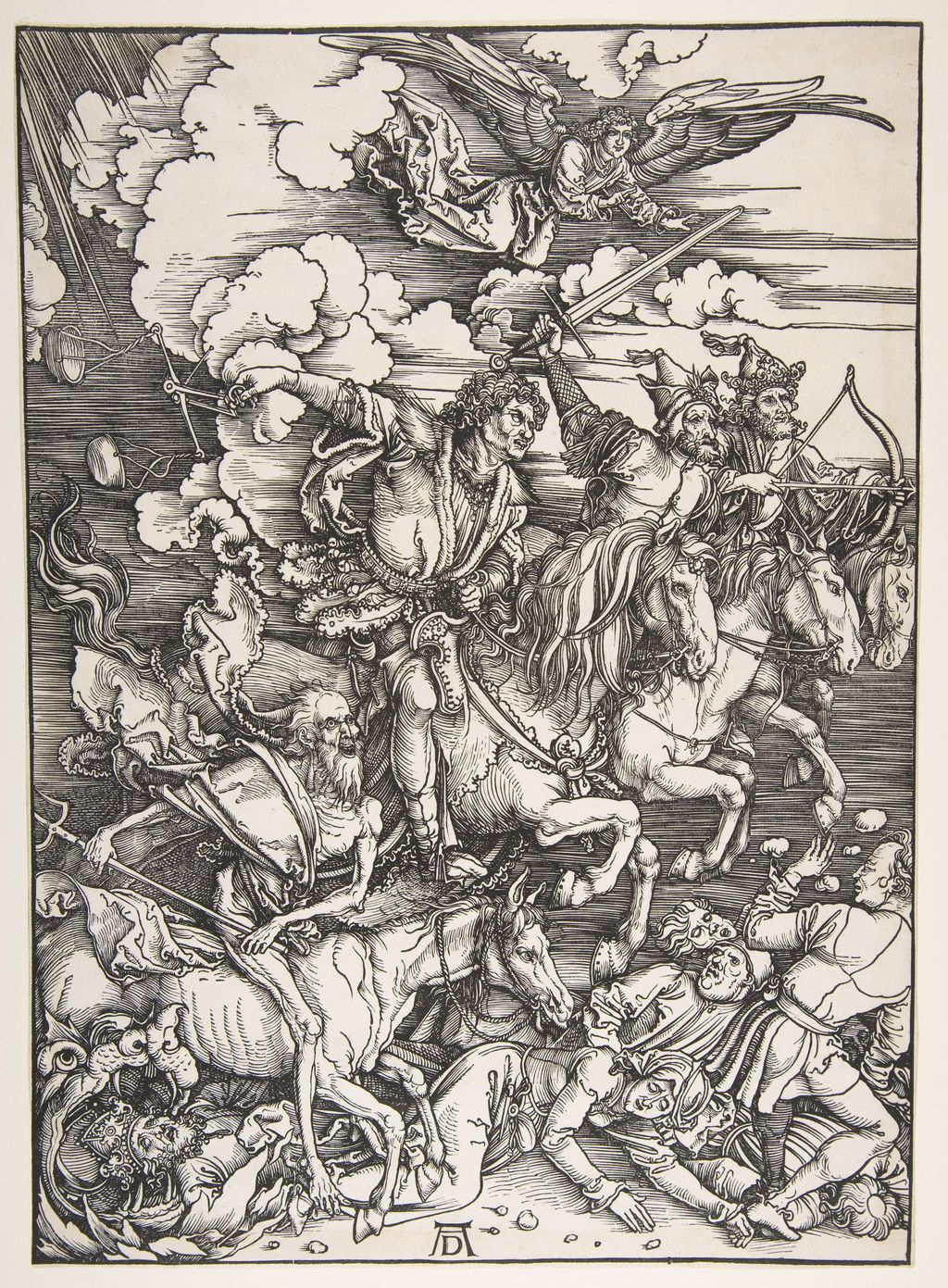
1514Four Apostles
1526Contents
- Looking from the side and the front
- How silverpoint builds the mane
- A day among Ghent's sights
- A leaf used across the journey
- Frequently Asked Questions
Looking from the side and the front
The left study gives the muzzle a projecting profile. A sloping forehead leads towards the nose, while the mouth and chin make small, sharper interruptions below. An ear emerges among the looping locks higher up. The head is carried above a heavy curtain of mane, whose strands descend towards the forelegs. Much of the animal's body lies beyond the attention of the drawing: the head, chest and paws supply the information Dürer wanted to retain.
Beside it, the frontal head changes the problem. The nose becomes a central shape, the muzzle spreads to either side, and the eyes sit beneath a strongly marked brow. The outer mane frames the face, but its two sides do not mirror one another exactly. Loose tufts rise above the forehead and break the silhouette. Below, long curls widen and divide around the chest. These irregularities keep the animal from settling into a simple decorative pattern.
The paws make a useful comparison with the hair. Their rounded toes are described with relatively short contours and small areas of shading. The long strands above them repeatedly change direction. Within a restricted range of colour and tone, Dürer makes these two surfaces feel different: fur streams and folds; the paws press forward with a compact, blunt weight. The darker hair around the chest also helps the pale paws stand out.
There is little setting. A few horizontal strokes run out beside the right study, but no enclosure establishes a measurable space around the animals. The closeness of the two manes consequently need not describe two bodies touching. Each view can be read separately, as an answer to a different question about the head's shape. Hans Mielke's catalogue entry connects the sheet with Dürer's recorded encounter with lions at Ghent and proposes that its two studies represent one animal. The proposal fits the page, although neither their arrangement nor the written account can establish the animal's identity beyond doubt. [12]
How silverpoint builds the mane
Silverpoint uses a metal tip on a specially prepared surface. The ground provides an abrasive texture that takes tiny particles from the point as it moves. This produces a fine line; darker modelling depends largely on bringing strokes together and building up hatching. The National Galleries of Scotland's account of metalpoint explains why changing pressure has less effect on the darkness of the line than it does in chalk drawing. [13]
That process helps explain the extraordinary amount of visible movement in these manes. Dürer repeatedly steers individual strokes around the form. At the left shoulder the lines turn in extended curves; under the frontal head they descend, bunch together and sweep sideways. Even where a passage becomes dark, its component strands remain legible. The drawing's softness comes from an accumulation of distinct marks.
Some lines do two jobs at once. A curling stroke describes a lock of hair while also suggesting the swelling volume beneath it. Where many such curves converge, the mane looks deeper and thicker. Where they spread apart, the light surface opens through them. Dürer can therefore describe the animal's mass without drawing a firm boundary around every section of fur. The edge of the mane is often a fringe of separate tips.
The faces receive another kind of attention. Around the muzzle and eyes, small changes of direction carry more information than the long rhythms of the mane. A short line can turn a cheek, narrow an eyelid or separate the lip from the chin. Looking between these passages reveals the discipline of the sheet: Dürer adjusts the scale and direction of his marks to the part of the animal he is describing. Nothing requires us to imagine that he completed every hair during one uninterrupted sitting.
A day among Ghent's sights
Dürer's travel diary gives the lions a place in an unusually vivid day's looking. In the English translation published by the Merrymount Press in 1913, he describes leaving Bruges on a Tuesday, after drawing the painter Jan Prevost in silverpoint. At Ghent the dean of the painters and other leading artists welcomed him and shared his evening meal. The next morning they took him up the tower of St John's, where he surveyed the town. He then admired the great painting associated with Jan van Eyck before recording the animal encounter: “Then I saw the lions and drew one of them in silverpoint”. [14]
The sequence gives the study a human setting without supplying an eyewitness description of its execution. Within a short visit, Dürer moved between an elevated view of the city, close attention to another painter's work and observation of a living animal. Drawing belonged among the activities of the excursion. The diary also records a combined tip of three stivers to the sacristan and the lions' keeper, and says that the painters continued to dine with him and paid his expenses. On Thursday he left for Antwerp. [14]
The lions belonged to Ghent's princely menagerie at the Prinsenhof. Historians Daniel Lievois and Baudouin Van den Abeele reconstruct this establishment from archival records. Around Dürer's visit, it was an actively maintained court institution: repairs to cages and sleeping places are recorded in 1519, while earlier work included ropes for operating sliding doors. Guillaume Pingion was responsible for the lions during this period. Animals were also sent between rulers, giving the menagerie a place within courtly exchange. [15]
That setting changes how we approach the empty paper surrounding the studies. The calm reclining poses came from an encounter with captive animals maintained by keepers. Dürer selected their heads, hair and forequarters; he did not include the apparatus of their confinement. His silence about the exact drawing arrangements leaves those circumstances open. We cannot recover his distance from the lion, how long it remained still or the order in which he drew the two views.
A leaf used across the journey
The Ghent connection is strengthened by another silverpoint lion in Vienna's Albertina, inscribed zw gent , meaning “at Ghent”. The museum dates that encounter to 10 April 1521. In the Vienna drawing the reclining animal's body stretches across the page, with its hindquarters at the left and a great frontal head rising nearer the right. The Berlin sheet concentrates the comparison more tightly around the mane and forequarters. Both drawings find ample subject matter in an animal at rest. [16]
The Berlin leaf belonged to the now dispersed silverpoint sketchbook used on Dürer's Netherlandish journey. Its other side holds a man's portrait and a landscape associated with Andernach on the Rhine. Mielke relates the landscape to the homeward journey in July, after the Antwerp portrait had been drawn. One piece of paper thus brought together subjects encountered at different places and times. [12]
Turning the leaf over also changes the rhythm of the drawing. The man occupies the left foreground beneath a broad hat. Behind and beside him, a much smaller landscape spreads across the available space. His face and clothing receive close hatching; the hillside is worked more lightly, with short marks for vegetation and long slopes defining the terrain. The disparity of scale allows the two subjects to share the page without asking us to imagine the sitter standing in that particular landscape.
The portrait's identity remains tentative. Berlin currently titles it Männliches Brustbild (Aert Bruyn?) und Landschaft bei Andernach , retaining the question mark after the proposed name. The uncertain sitter need not distract from the leaf's more secure evidence: portrait, landscape and lions coexist on its two prepared faces. As the journey continued, the available paper could receive another subject. Seen together, the two sides make the portable working life of the sheet unusually tangible. [17]
Berlin acquired the drawing in 1877 from the collection of Ambroise Firmin-Didot. Seen on its own, the lion side makes a complete picture, yet the larger leaf remains worth remembering. Mielke also records a copy in Nuremberg. The page could serve later viewers as an image to preserve and repeat, even after its immediate place in Dürer's travels had passed. [17] [12]
What holds attention within the lion studies is the movement between two ways of seeing. The profile offers the projecting muzzle and the long fall of hair behind it; the frontal view makes the breadth of the face and the weight of the paws unmistakable. Read as successive observations, the two views let us look around the animal. Read together, their interwoven manes give the sheet its remarkable density. A small page carries both the patience of close study and the changing attention of a traveller.
Frequently Asked Questions
Artworks directory
These 187 records include individual works, reverse sides, detail views, paired panels and reconstructed arrangements. Three additional catalogue images repeat works already listed. Related views are not counted as separate originals; qualified attributions and published dating are retained.
Discussion
Look again at the images and ideas explored in Two Seated Lions by Albrecht Dürer. These editorial prompts invite your observations.
Reader Insights
Which detail or idea in Two Seated Lions by Albrecht Dürer most changed your reading, and why?
How does the discussion of “Looking from the side and the front” affect your understanding?
What comparison would you bring to the discussion of “A leaf used across the journey”?
Join the Conversation
Share a detail, comparison or question about Two Seated Lions by Albrecht Dürer below.
References
- Kupferstichkabinett , Staatliche Museen zu Berlin, Dürer für Berlin: Werkliste , exhibition 12 May–27 August 2023, p. 14, no. 81, KdZ 33 verso. German. View source .
- ALBERTINA, Selbstbildnis als Dreizehnjähriger, inv. 4839 (German). View source.
- Metropolitan Museum, Four Horsemen from The Apocalypse, 19.73.209 (English). View source.
- Bayerische Staatsgemäldesammlungen, Selbstbildnis im Pelzrock, inv. 537 (German). View source.
- ALBERTINA, Feldhase, inv. 3073 (German). View source.
- ALBERTINA, Das große Rasenstück, inv. 3075 (German). View source.
- Metropolitan Museum, Adam and Eve, 19.73.1 (English). View source.
- ALBERTINA, Betende Hände, inv. 3113 (German). View source.
- Metropolitan Museum, Knight, Death, and the Devil, 43.106.2 (English). View source.
- Metropolitan Museum, Melencolia I, 43.106.1 (English). View source.
- Bayerische Staatsgemäldesammlungen, inventory 545: current collection record (German; descriptive citation). View source.
- Hans Mielke , revised by Ursula Mielke, catalogue entry 73, in From Schongauer to Holbein: Master Drawings from Basel and Berlin , National Gallery of Art, Washington, 1999, p. 172 and illustrations p. 171. English edition of the German exhibition catalogue. View source .
- National Galleries of Scotland , “Metalpoint”, especially “How does it work?” and “Metalpoint in the Italian Renaissance”. View source .
- Albrecht Dürer , Records of Journeys to Venice and the Low Countries , edited by Roger Fry, translated by Rudolph Tombo, Boston: Merrymount Press, 1913, “Visit to Bruges and Ghent, April 6–11, 1521”, pp. 77–80; translation credit p. 99. View source .
- Daniel Lievois and Baudouin Van den Abeele , “Une ménagerie princière entre Moyen Age et Renaissance: La Cour des Lions à Gand de 1421 à 1641”, Reinardus 24 (2012), pp. 77–107, especially pp. 93–96. French. View source .
- ALBERTINA , Vienna, Liegender Löwe (aus dem Silberstiftzeichenbuch der Niederländischen Reise) , 1521, inv. 22385v; collection record and Matthias Mende's catalogue discussion. German, with English introduction. View source .
- Kupferstichkabinett , Staatliche Museen zu Berlin, Männliches Brustbild (Aert Bruyn?) und Landschaft bei Andernach , KdZ 33, recto, current collection record. German. View source .
- Germanisches Nationalmuseum, Barbara Dürer (German and English). View source.
- Web Gallery of Art, Tucher–Rieter reverse (English). View source.
- National Gallery of Art, Portrait of a Clergyman (English). View source.
- Dürer Art, Portrait of a Man (English). View source.
- Hessen Kassel Heritage, Elsbeth Tucher (German). View source.
- Web Gallery of Art, Hans Tucher (English). View source.
- Germanisches Nationalmuseum, Emperor Maximilian I (German and English). View source.
- National Gallery of Art, Lot and His Daughters, reverse (English). View source.
- Bayerische Staatsgemäldesammlungen, Glim Lamentation (German). View source.
- Museo Nacional del Prado, Portrait of a Man (Spanish). View source.
- Bayerische Staatsgemäldesammlungen, Madonna of the Carnation (German). View source.
- Städel Museum, Job on the Dungheap (German). View source.
- Wallraf-Richartz-Museum, Piper and Drummer (German). View source.
- Italian Ministry of Culture / Uffizi, Head of Saint James (Italian). View source.
- Klassik Stiftung Weimar, Dresden Altarpiece (German). View source.
- Staatliche Museen zu Berlin, Girl with a Red Beret (German and English). View source.
- Dresden State Art Museums / Roland Enke, Bernhard von Reesen (German). View source.
- Royal Collection Trust, Burkhard von Speyer (English). View source.
- Dresden State Art Museums, Seven Sorrows of the Virgin (English). View source.
- Bayerische Staatsgemäldesammlungen, Mater Dolorosa (German). View source.
- Bayerische Staatsgemäldesammlungen, Lucretia (German). View source.
- Städel Museum, Young Woman with Her Hair Down (English). View source.
- ALBERTINA, Portrait of a Young Man (German). View source.