


 by
Tom Gurney
Tom Gurney BSc (Hons) is an art history expert with over 20 years experience
Published on June 19, 2020 / Updated on October 22, 2026
Email:
tomgurney1@gmail.com
/ Phone:
+44 7429 011000
The Stork: Introduction
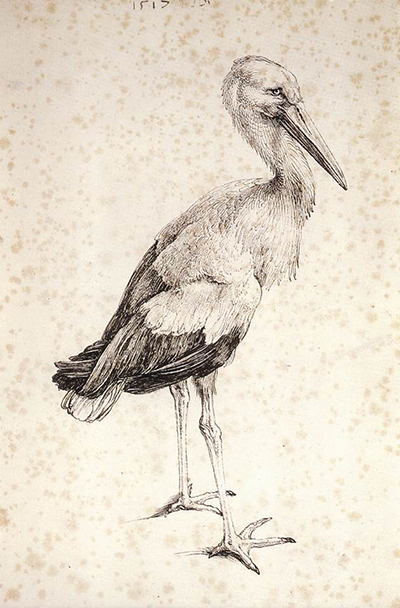
A stork stands on two long, thin legs, its body turned sideways and its head angled towards us. The closed beak points down; the eye, set in a small dark patch, seems unusually attentive. Nothing competes with the bird. A few strokes beneath its feet suggest the ground, while the rest of the sheet is left open. In this pen drawing, Dürer makes the differences between feathers, beak and legs carry almost the entire interest of the image.
Known in French as La Cigogne , the drawing belongs to the Musée d’Ixelles in Brussels, whose current history dates it to about 1500–1505. The museum’s 2021 exhibition documentation identifies it as a pen drawing on paper, measuring 27.5 × 18 cm, with the inventory number JBW 136. That identity matters because the date written above the bird, 1517, has often encouraged a different chronology. The inscription and the making of the drawing need to be considered separately. [1] [2]
At a Glance
- Current museum date About 1500–1505 [1]
- Material Pen on paper [2]
- Collection Musée d’Ixelles, Brussels; JBW 136 [2]
This work across Albrecht Dürer’s career
The Stork (current article)
c. 1500–1505Young Hare
1502Praying Hands
1508Melencolia I
1514Four Apostles
1526Contents
- A bird built from pen strokes
- The date above the head
- Observation and possible use
- A drawing in a public collection
- Frequently Asked Questions
A bird built from pen strokes
The stork almost fills the height of the narrow sheet, its compact body held high above the feet. The extended legs supply much of its stature. Above them, the folded wings form a rounded mass, while the long neck rises and curves forward to support the head. The beak completes that curve with a much straighter, sharper descent. Seen as a silhouette, the drawing balances the rounded body against these slender projections.
The two feet make that balance convincing. They stand at different levels, with the nearer foot spread prominently across the lower part of the page. The toes reach in several directions, and the legs are not drawn as a pair of identical upright lines. Small changes of angle interrupt their length. These slight irregularities give the bird a stance that feels sustained by its own weight.
Across the wings, dark passages alternate with broad pale areas. The overlapping shapes of the feathers can be followed without every feather receiving an equally emphatic boundary. Some edges are scalloped and soft; others gather into narrow points. The longest dark feathers sweep down and backwards towards the left, setting up a diagonal that crosses the vertical movement of the legs. Their closely grouped lines make this part of the bird look denser than the breast above.
At the front of the body, the marks loosen and the edge becomes more ragged. Tiny strokes project from the breast and neck instead of enclosing them in a single smooth outline. Around the head, the pen works on a still smaller scale. The distinction is especially clear beside the beak, where long, nearly continuous lines establish a hard taper. Moving between these areas, the eye registers changes in surface through changes in the artist’s touch.
The lightest feathers depend on the paper remaining visible between the marks. This is one reason the drawing holds together when viewed from a distance. The darker wings read as a single strong shape, while the pale shoulder, breast and head stay connected across much more lightly worked passages. Look more closely and those pale areas divide into smaller structures. Dürer gives the bird a readable overall form and then rewards a slower examination of its surface.
The surrounding brown spots belong to our experience of the surviving sheet, too. They extend into the empty areas around the bird and can initially resemble a patterned background. They are particularly conspicuous above the back and beside the legs. The drawing itself supplies no landscape there: no water, reeds, nest or horizon. Its concentration remains on one standing animal.
The date above the head
The inscription has long presented a problem. In her 1971 study of the drawing, the art historian Lydia De Pauw-De Veen described the date 1517 and the interlaced AD monogram as apparently not autograph, suggesting Hans von Kulmbach as a possible author of the additions. She also reported earlier datings proposed by Lippmann, Flechsig and Winkler, ranging from the later 1490s to the first years of the sixteenth century. Her own argument favoured an early date on stylistic grounds, particularly the closely placed short strokes. [13]
This remains a useful account of why the written date cannot simply settle the question. The suggestion of Kulmbach is a scholarly possibility, not an established identification of the hand. The current Ixelles date, about 1500–1505, also leaves a range rather than a precise year. Reading the visible numerals as an unquestionable record of execution would conceal both the history of the debate and the museum’s present dating. [1]
Observation and possible use
At Chantilly in 2022, curators presented The Stork as an animal portrait, describing a study made from nature in the artist’s studio. They stressed its proportions and suggested that such finished studies could serve larger compositions. This interpretation of its precision does not supply a surviving account of the particular working session. [14]
The pose gives the portrait comparison some force. The body is available for inspection, but the turned head makes the bird seem to notice the spectator. Its eye provides a small point of resistance within an otherwise quiet image. The feet are planted, the wings folded, the beak closed: the drawing offers very little overt action. Attention comes instead from the slight turn that interrupts the broadside view.
The entire animal is visible, from the top of the head to the ends of the toes. Its isolation allows the length of the legs to be examined against the body. That completeness helps explain the value of keeping such a study for reference.
De Pauw-De Veen drew attention to small storks in the versions of Dürer’s Virgin with a Multitude of Animals in Paris and Vienna. The Louvre dates its sheet, INV 18603, to 1503. The Albertina currently dates its own version, inventory 3066, to about 1506. These compositions offer a concrete setting in which a bird of this kind could enter a larger narrative. [13] [15] [16]
In the Vienna drawing, a small stork stands near Joseph on the right, beyond the foreground enclosure. Its scale is tiny beside the Virgin and Child, and its pale body must be picked out among buildings, vegetation and other creatures. The difference in attention is striking: what dominates the Ixelles sheet becomes one incident within a crowded world. The Albertina’s commentary interprets the varied animals and plants collectively as an expression of divine creation, within the tradition of the Virgin’s enclosed garden. [16]
The comparison shows how natural observation and religious imagery could work together. It does not demonstrate that the Ixelles sheet was made for either surviving composition, or that the isolated stork must carry one fixed Christian meaning. The bird can be studied as a complete subject here and understood in relation to a larger sacred setting elsewhere. The change in scale and company changes what a viewer asks of it.
A drawing in a public collection
The stork entered the Musée d’Ixelles through Léon Gauchez’s donation of 1895. The museum had opened only three years earlier, in adapted premises belonging to the former municipal slaughterhouse. Its own history places Gauchez’s gift among the major donations that expanded the young collection. [2] [1]
The name behind the inventory initials was Joseph-Benoît Willems, Gauchez’s grandfather. Ingrid Goddeeris’s archival study explains that the gift commemorated him through a projected museum and library. It comprised roughly 700 artworks and about 1,250 volumes. Gauchez combined the roles of dealer, collector, critic and benefactor; his public gift also carried a personal memorial purpose. [17]
By July 1898, the critic Octave Maus could single out La Cigogne in a review of the museum. His account began with surprise that so substantial a collection remained so little known. He described drawings and prints filling the large room and first-floor gallery, with further works standing on easels in the painting rooms. He named the stork beside a Rubens drawing among the older works worth noticing. [18]
Maus called it an etching, a description that differs from the museum’s identification of the surviving sheet as a pen drawing. His review is most revealing as a record of the collection’s early reception. A work now approached through an isolated reproduction belonged to an eclectic and crowded museum, where old masters shared attention with contemporary painting, sculpture, books and medals. [2] [18]
The donation soon became contentious. Goddeeris records Gauchez’s complaints in November 1896 about leaking roofs, coal dust and harmful temperature changes. He was particularly distressed by the condition of the Dürer drawing. According to his report, a Paris expert named Lacroix considered the spots in its paper impossible to remove. That is a historical account of a complaint and an expert opinion conveyed by the donor; it does not establish a present conservation diagnosis or identify the cause of every mark now visible. [17]
Maus’s 1898 article already discussed the donor’s wish to reclaim the collection and appealed for the museum to be preserved. A further report, signed O. M. in 1903, explained the court’s distinction: the original donation would stand, while subsequent gifts required separate consideration because of the rules governing municipal acceptance. The judgement therefore preserved the central collection at Ixelles. Goddeeris records the eventual return of later donations in April 1906. The stork remained with the museum. [18] [19] [17] [1] [2]
Its more recent exhibition history has brought different aspects of the sheet into view. The 2021 Namur exhibition Une promenade picturale. De Dürer à Tiepolo selected works from the Gauchez donation, foregrounding the collecting history. At Chantilly in 2022, the drawing appeared within a wider account of Dürer’s graphic art. The same spare image can sustain both approaches: a carefully articulated animal study and a fragile sheet whose survival became part of the story of a public collection. [2] [14]
Frequently Asked Questions
Artworks directory
These 187 records include individual works, reverse sides, detail views, paired panels and reconstructed arrangements. Three additional catalogue images repeat works already listed. Related views are not counted as separate originals; qualified attributions and published dating are retained.
Discussion
Look again at the images and ideas explored in The Stork. These editorial prompts invite your observations.
Reader Insights
Which detail or idea in The Stork most changed your reading, and why?
How does the discussion of “A bird built from pen strokes” affect your understanding?
What comparison would you bring to the discussion of “A drawing in a public collection”?
Join the Conversation
Share a detail, comparison or question about The Stork below.
References
- Musée d’Ixelles , L’histoire du Musée d’Ixelles , including the caption for La Cigogne and the entries for 1892 and 1895–1906 (in French). View source .
- TreM.a and Musée d’Ixelles , Quartiers d’été du Musée d’Ixelles , press dossier, 2021, pp. 3, 5 and 15 (in Dutch). View source .
- ALBERTINA, Selbstbildnis als Dreizehnjähriger, inv. 4839 (German). View source.
- Metropolitan Museum, Four Horsemen from The Apocalypse, 19.73.209 (English). View source.
- Bayerische Staatsgemäldesammlungen, Selbstbildnis im Pelzrock, inv. 537 (German). View source.
- ALBERTINA, Feldhase, inv. 3073 (German). View source.
- ALBERTINA, Das große Rasenstück, inv. 3075 (German). View source.
- Metropolitan Museum, Adam and Eve, 19.73.1 (English). View source.
- ALBERTINA, Betende Hände, inv. 3113 (German). View source.
- Metropolitan Museum, Knight, Death, and the Devil, 43.106.2 (English). View source.
- Metropolitan Museum, Melencolia I, 43.106.1 (English). View source.
- Bayerische Staatsgemäldesammlungen, inventory 545: current collection record (German; descriptive citation). View source.
- Lydia De Pauw-De Veen , Albrecht Dürer — De ooievaar , Openbaar Kunstbezit Vlaanderen , 1971, pp. 23a–23b (in Dutch). View source .
- Château de Chantilly and Bibliothèque nationale de France , Albrecht Dürer. Gravure et Renaissance , press dossier, exhibition 4 June–2 October 2022, p. 29, La Cigogne (in French). View source .
- Musée du Louvre , Vierge à l’Enfant dans un paysage avec une multitude d’animaux et, dans le fond, l’Annonce aux bergers , INV 18603, recto (in French). View source .
- Albertina , Maria mit den vielen Tieren , inventory 3066, including the catalogue commentaries by Heinz Widauer and from the 2003 Dürer exhibition (in German, with an English introduction). View source .
- Ingrid Goddeeris , De oprichting van een « Musée-Bibliothèque Joseph-Benoît Willems »: een eerbetoon van de kunsthandelaar Léon Gauchez aan zijn grootvader en een daad van openbaar nut , 2021, pp. 1–6 and 15–18 (in Dutch, with a French summary). View source .
- Octave Maus , “Le Musée d’Ixelles”, L’Art moderne , 31 July 1898, pp. 243–245; digitised by the Université libre de Bruxelles (in French). View source .
- O. M. , “Chronique judiciaire des Arts. Le Musée d’Ixelles”, L’Art moderne , 1903, pp. 293–294; digitised by the Université libre de Bruxelles (in French). View source .
- Germanisches Nationalmuseum, Barbara Dürer (German and English). View source.
- Web Gallery of Art, Tucher–Rieter reverse (English). View source.
- National Gallery of Art, Portrait of a Clergyman (English). View source.
- Dürer Art, Portrait of a Man (English). View source.
- Hessen Kassel Heritage, Elsbeth Tucher (German). View source.
- Web Gallery of Art, Hans Tucher (English). View source.
- Germanisches Nationalmuseum, Emperor Maximilian I (German and English). View source.
- National Gallery of Art, Lot and His Daughters, reverse (English). View source.
- Bayerische Staatsgemäldesammlungen, Glim Lamentation (German). View source.
- Museo Nacional del Prado, Portrait of a Man (Spanish). View source.
- Bayerische Staatsgemäldesammlungen, Madonna of the Carnation (German). View source.
- Städel Museum, Job on the Dungheap (German). View source.
- Wallraf-Richartz-Museum, Piper and Drummer (German). View source.
- Italian Ministry of Culture / Uffizi, Head of Saint James (Italian). View source.
- Klassik Stiftung Weimar, Dresden Altarpiece (German). View source.
- Staatliche Museen zu Berlin, Girl with a Red Beret (German and English). View source.
- Dresden State Art Museums / Roland Enke, Bernhard von Reesen (German). View source.
- Royal Collection Trust, Burkhard von Speyer (English). View source.
- Dresden State Art Museums, Seven Sorrows of the Virgin (English). View source.
- Bayerische Staatsgemäldesammlungen, Mater Dolorosa (German). View source.
- Bayerische Staatsgemäldesammlungen, Lucretia (German). View source.
- Städel Museum, Young Woman with Her Hair Down (English). View source.
- ALBERTINA, Portrait of a Young Man (German). View source.







