


 by
Tom Gurney
Tom Gurney BSc (Hons) is an art history expert with over 20 years experience
Published on October 22, 2026 / Updated on October 22, 2026
Email:
tomgurney1@gmail.com
/ Phone:
+44 7429 011000
Dürer in Italy: Introduction
On 6 January 1506, writing home from Venice, Albrecht Dürer expected to have a panel scraped, grounded and ready for painting within eight days. The picture would be above its altar a month after Easter; its payment would help him repay his friend Willibald Pirckheimer. By April, the work was still consuming time and money. By September, Dürer was boasting about its colour and the distinguished people who had seen it. His Italian letters bring us close to the changing circumstances behind a great painting: preparation, promises, expenditure and the pleasure of being admired. [1]
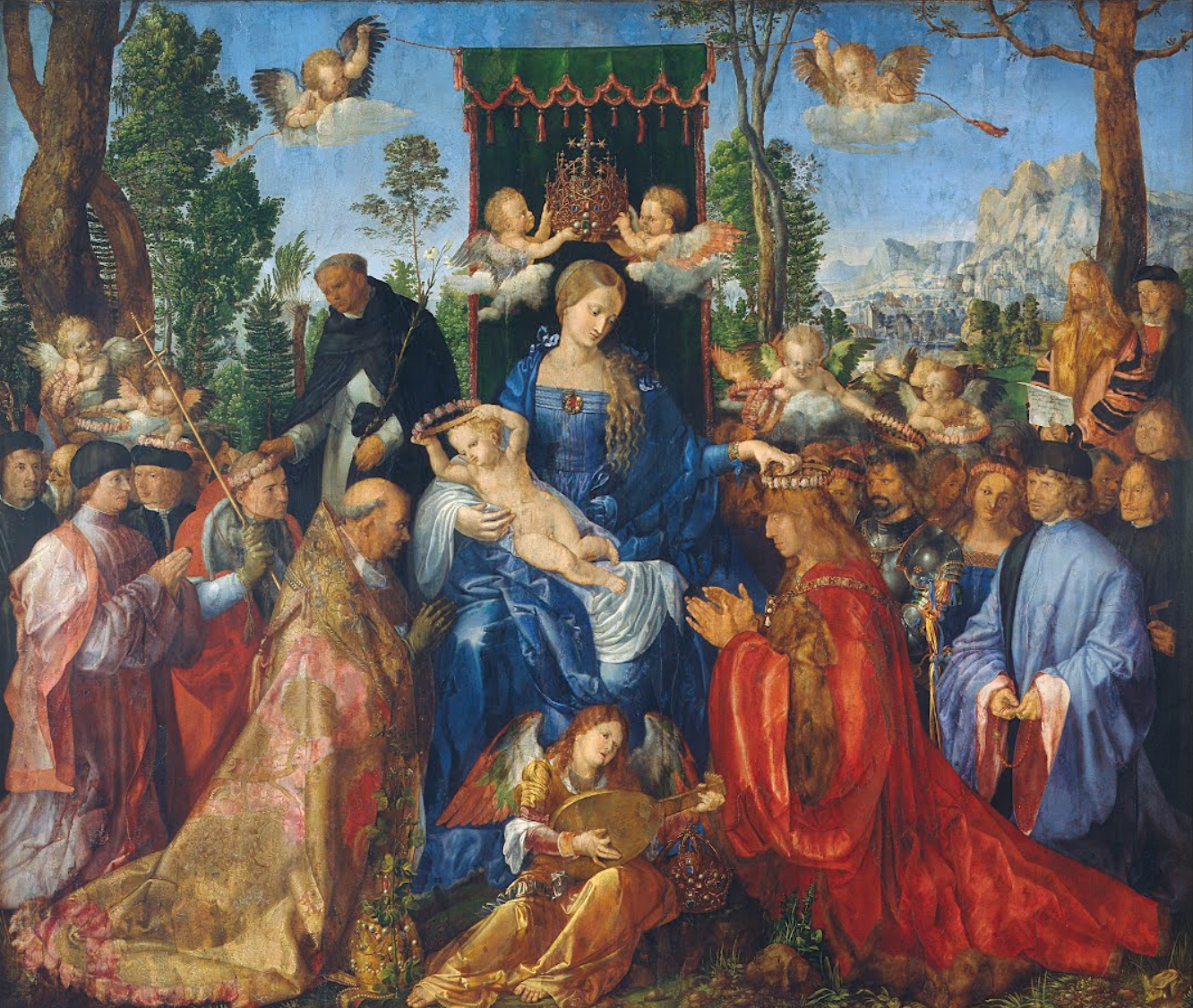
The painting was the Feast of the Rose Garlands . A lute-playing angel sits low in the centre, beneath the Virgin and Child. Kneeling figures spread their robes across the foreground; above them, small winged figures carry garlands through the blue air. At the far right, a long-haired man holds a white document towards us. The picture is busy with faces and fabrics, yet its broad blue centre remains easy to find. [2]
Dürer’s second Italian journey belongs to 1505–07. For the earlier journey, the customary dates 1494–95 sit beside the ALBERTINA’s 2019 chronology of 1495 and Margaret Doyle’s proposed span from autumn 1494 to spring 1496. [3] [4]
A letter to Pirckheimer could begin with business and end with teasing. Dürer asks for patience, offers greetings, complains about an errand and breaks into exuberant praise of his own work. Across the correspondence, confidence keeps company with dependence on other people. That restless voice gives his stay in Venice a particularly vivid human setting. [1]
At a Glance
- First journey Mid-1490s; chronology and itinerary remain debated [3] [4] [5] [6]
- Documented Venetian stay 1505–1507 [3]
Contents
- The earlier crossing
- Images and dress
- A household between cities
- Buying, judging and sending
- Admiration and rivalry
- The paintings before the viewer
- Blue paper and unfinished questions
- Frequently Asked Questions
The earlier crossing
In his letter of 7 February 1506, Dürer said that something which had delighted him eleven years earlier no longer pleased him. He did not name it. The recollection is suggestive, but the missing noun matters: it gives us no complete itinerary, duration of stay or account of what he studied on that earlier occasion. [1]
Three Innsbruck watercolours in the ALBERTINA carry current dates around 1495. The small north view, 3056, measures 12.7 by 18.7 centimetres. A shared 2012 catalogue discussion associates the Wappenturm’s scaffolded roof with 1496–97, identifies an undeveloped tower outline in the cloudless courtyard, and considers separate painting campaigns. It leaves their execution place unsettled. Architectural information and the completion of the painted sheets therefore need not share one date. [5] [7]
Across the north view, red roofs make a series of sharp accents above the grey-green water. Some towers have broad, square bodies; others rise into narrow points. Reflections run downwards in broken bands. The left half contains a particularly dense cluster of buildings, while the right opens into pale walls and roofs. Above this narrow inhabited strip, the blue-grey sky fills much of the paper. [5]
The two courtyard views turn in opposing directions within the same castle complex: 3058, with clouds, looks north; 3057, without clouds, south. [5] [7]
In the clouded view, a row of dark arches supports an upper storey patterned with timber diagonals. At the right, a slender turret extends towards the clouds; little windows puncture the walls beneath it. The other view gives the pointed arch of a gateway a central position. A projecting window rises above it, while the tall turret stands near the left edge. Low roofs slope into both foregrounds. Between the buildings, the broad patches of bare ground have only slight changes of colour and a few small marks. The difference between the sheets is immediately visible in the space above the rooflines: mottled cloud in one, a nearly unbroken light field in the other.
At Arco, the Louvre’s square sheet, dated about 1495, combines brown penwork, watercolour and black-ink reinforcements. Hélène Grollemund interprets its mixed viewpoints as evidence against completion wholly before the motif. [8]
The rock rises in great vertical faces, striped with grey, brown and green. Its fortress is a thin, broken line against the sky. Below, round tree crowns gather beside little blocks of houses. A planted field lies at an angle near the lower right, its repeated rows set against the rough, exposed foreground bank. The eye can follow a pale path around the cultivated slope and then return to the dark clefts beneath the castle. Small repeated marks and broad areas of colour keep changing places as one looks from the fields to the cliff.
The broader Trento from the North is Bremen’s KL10. The Germanisches Nationalmuseum’s analysis distinguishes carbon ink in the place-name from iron-gall ink in the AD monogram. An identical watermark occurs in an Innsbruck document of 1500; the project gives paper-use ranges of 1496–1504 with a four-year tolerance, or 1498–1502 with a two-year tolerance. Those ranges cannot establish an exact painting date. The project also discusses delayed studio completion; its sky-pigment analysis remained pending in the published entry. [6]
Here the river spreads into a wide, light foreground. A dark belt of trees separates much of the water from the city, with pale buildings breaking above it. The mountains become lighter as they recede towards the middle of the valley. Beside Arco’s abrupt upward mass, this view offers a long, open interval between the nearer water and the distant peaks. [8]
Images and dress
Dürer’s 1494 Bacchanal with Silenus copies Mantegna; copying could have occurred in Nuremberg, and tracing remains technically unproved. It establishes no meeting with Mantegna. [7]
In the drawing, a broad belly occupies the centre above a bowed head. Bent backs, elbows and knees interrupt the outlines of neighbouring bodies. At the left, one figure turns his back to us and clasps his hands behind him; at the right, another throws an arm upwards while his legs pull in different directions. Between the figures, small patches of untouched paper remain visible. The cluster is easier to untangle if one follows a single limb before returning to the whole.
The 1495 Venetian Woman and its costume reverse share sheet 3064. Jutta Zander-Seidel cautions against identifying the wearer through Vecellio’s 1590 dress book; her status as bride or courtesan remains unresolved. [7]
On the front, curls break the outline of the woman’s profile. A pendant hangs over the pleated bodice, and a long strand of beads drops beside her arm. Dense curved strokes gather in the lifted cloth at her side; below, a much lighter floral pattern spreads almost to the ground. The small back view above her shoulder has far fewer marks. On the reverse, the head disappears beyond the upper edge, leaving arms, skirt and a glimpse of footwear. A shoe is drawn separately near the lower left. The detached shoe sits much lower than the hem, with a wide empty interval between them.
The letters bring another kind of detail into view. Their closing greetings repeatedly reach beyond Pirckheimer to friends and members of the household. In September Dürer explained his haste by listing the other people he had already written to that night, including his wife and father-in-law. A messenger was about to leave. The artist whose pictures hold our attention also had to divide his time among people expecting news, reassurance or a reply. [1]
A household between cities
Venice’s German merchants had their commercial and social centre at the Fondaco dei Tedeschi and their religious centre at San Bartolomeo. They commissioned Dürer’s altarpiece for the church. [9]
In January Dürer described the payment for his German picture as 110 Rhenish gulden; in April he called it 85 ducats. The two statements belong to letters written at different stages, rather than a complete account of costs and receipts. He wanted Pirckheimer to be patient about a debt, and the picture supplied a reason to expect repayment. As his estimate of the work’s duration changed, so did his account of the money it would leave him. [1]
The January letter then becomes unexpectedly domestic. Dürer lists money left with his mother, sums she had received for art, payments from other people and a remittance sent through Sebastian Imhof. Rent still had to be paid. He also sets down money given to Agnes and money she had taken at Frankfurt. If necessary, a relative would help until he returned. The numbers make his absence feel less like an escape from business than an extension of it across several places. [1]
Agnes helped sell his work and took prints to fairs, as Doyle’s account explains. [4]
The correspondence gives that work an immediate setting. In April Dürer asked that his mother be ready to sell at the forthcoming fair and said he was arranging for Agnes to be home by then. In August he asked Pirckheimer to lend his mother ten florins if she needed them; in September he said that neither she nor his wife required a loan. These instructions change as messages and money move. Reading them in sequence restores the activity of the people at home to the account of the travelling artist. [1]
There was also his brother to consider. Dürer wanted his mother to ask Wolgemut whether he could provide the young man with work. He regretted not bringing him to Venice, where he thought employment and learning the language could have gone together. The complaint leads into a frank account of supporting several people. His own prospects and the family’s immediate needs keep meeting in the same letter. [1]
Buying, judging and sending
Pirckheimer’s commissions gave Dürer another kind of work. The sapphire ring discussed in March took two days of searching with a hired companion among German and Italian goldsmiths. Dürer eventually obtained one from a man who was wearing it. He reported enthusiastic valuations, but also admitted that he depended on other people’s judgement. Earlier, an amethyst had proved disappointing; friends helped arrange its return, with a dish of fish smoothing the transaction. [1]
This is an engagingly uncertain account of expertise. Dürer could be confident about his own painting and anxious about whether a gem was worth its price. He sent Pirckheimer information as well as an object: what he had paid, who had advised him, what someone else had offered. Those details allowed a judgement to continue at the receiving end. The ring’s value was being negotiated through a network of people whose assurances did not always agree. [1]
Delivery created a separate worry. In April he still wanted to know whether the sapphire had arrived. He traced it through Hans Imhof in Augsburg and a messenger, recalled the sealed packet and asked that the messenger be questioned. For all the friendship in the correspondence, an unanswered letter could leave an expensive object suspended between cities. The impatient questions are part of the practical effort by which things actually travelled. [1]
Books, paper and carpets brought their own frustrations. In August Dürer reported a printer’s inability to supply news of recently published Greek books. He asked what paper Pirckheimer wanted, since he knew none in Venice finer than that available at home. He and Anton Kolb searched for carpets, but the available ones were long and narrow; Pirckheimer apparently wanted square ones. By October Dürer had ordered two and intended to pack them with his linen. [1]
The paper enquiry is a useful moment in an account of artistic travel. Here Dürer judges an ordinary purchasable material against what he knows from Nuremberg. Being in Venice did not make every local commodity preferable. His requests for clarification also show how difficult a distant commission could be: a buyer needed to know the desired kind, shape or quality before choosing from what was available. [1]
Admiration and rivalry
On 7 February Dürer told Pirckheimer that Giovanni Bellini had praised him publicly, visited him and asked to buy a painting. In the same letter he enjoyed the company of knowledgeable Italians, musicians and judges of art. He also complained that painters copied his work while disparaging it. The letter contains friendship, competition and a generous assessment of an older painter within a few lines. [1]
The Bellini encounter is particularly clear because Dürer tells it himself. The familiar story about a special brush for painting hair belongs to a later account by Camerarius, rather than this letter. [1]
In April he reported three summonses before the magistrates and a payment to the painters’ school. In September he announced that the altarpiece had silenced people who considered him an accomplished engraver but an inadequate colourist. He said that the Doge and Patriarch had seen it. Such claims tell us how urgently he wanted recognition as a painter; they also preserve the pleasure with which he described success to someone who knew him well. [1]
His humour gives that self-portrait another dimension. The September letter turns Pirckheimer’s memory and learning into an absurd calculation of how long a speech would take. In October, Dürer includes himself in the joke: both men become delighted when praise persuades them they are important, although the admirer may be a flatterer. A few pages away from his proudest declarations, he can recognise how eagerly he listens to approval. [1]
The celebrated October line, “Here I am a gentleman, at home only a parasite,” comes from Conway’s translation. Its setting is teasing, affectionate and restless. Dürer has been discussing purchases, departure and the cold that awaits him north of the Alps. The sentence is powerful evidence of how he felt, but its sharpness belongs to a particular exchange between friends; it cannot speak for every encounter in either city. [1]
The paintings before the viewer
The Prague panel is dated 1506, painted on poplar and measures 162 by 192 centimetres. Olga Kotková relates its Venetian stimulus to established German rosary imagery. She also stresses its altered surface: the pope’s repainted face makes identification uncertain, and original passages must be distinguished from later additions. The document-bearer at the right is Dürer himself, identifying the author within the devotional gathering. [2]
Look first at the two kneeling figures near the front. Gold-patterned cloth spreads across the left; a red robe occupies the right. Between them the angel holds the lute diagonally, its rounded body crossing his lap. Above, the Child stretches towards one side while the Virgin extends a hand towards the other. Small round garlands repeat across heads and hands. A dark green hanging stands behind the Virgin’s head, with a narrow red fringe against the sky. The pale mountains visible to the right contrast with the heavy tree trunk at the edge. [2]
In his September letter Dürer imagined the picture itself wishing Pirckheimer would come to see it. The joke puts the absent friend in the position we occupy now, facing the painting and testing the artist’s praise of its colour. It also recalls an important limit of correspondence: even an exuberant description cannot deliver the experience of the thing being described. [1]
Prague began a new conservation programme at the end of August 2026, estimated to take up to five years. The painting’s appearance therefore remains a subject of active investigation. [10]
Christ among the Doctors , dated 1506, measures 64.3 by 80.3 centimetres. Its inscription claims five days’ execution, without necessarily including preparation. Borobia discusses two candidates for the unnamed additional picture in Dürer’s September letter: this work and the Madonna of the Siskin . The letter of 23 September supplies no title. [9]
Here there is almost no open interval between the people. Books enter from the bottom edge, hands overlap in front of Christ’s chest, and heads fill the upper corners. The large beard on the right falls in pale strands against a warm robe. At the left, fingers lie across a closed book; farther back, another book is held open close to a face. A white cap beside Christ makes a hard light shape among the surrounding darker colours. [9]
The treatment of faces also demands critical attention. Caroline Kaye argues that concentrating on formal sources can leave the painting’s anti-Jewish implications unexamined. Its caricatured Jewish teachers belong to a Christian representation of religious disagreement; their features cannot be accepted as neutral evidence of character or as a description of a community. Admiration for the picture’s invention need not repeat its judgement of the people it depicts. [11]
Blue paper and unfinished questions
The 1506 Hand with Book (3103) corresponds to the upper-left scholar; Duke Albert inventoried it with 3104. Heads 3099 (angel) and 3106 (Christ) shared another sheet: the cut split the angel’s shoulder, part of which remains with Christ’s head. [7]
In the hand study, the book slopes sharply up towards the left. Its upper edge is a narrow pale strip; below the thumb, page edges form a broad band of closely spaced lines. A fingernail is enclosed by an oval, with shorter curved strokes running away from it. On the two heads, the curls make larger loops beside the cheeks and smaller, crowded waves above the forehead. The angel’s neck is more upright; Christ’s head leans to one side. Both faces have light strokes extending well beyond the brightest points, across cheek and throat. [7]
Venetian carta azzurra was coloured during manufacture. Dürer’s later northern sheets, including the Praying Hands of 1508, use prepared coloured surfaces. On either surface, the blue provides a middle value between dark marks and white heightening. A prepared ground is an applied layer of colour. The distinction affects the support beneath the marks, even when the overall blue appears similar. Gnann and Metzger’s 2025 exhibition also proposes a workshop-archive and showpiece function for highly finished sheets, giving their preservation and display greater weight than the familiar category of preparation alone. Metzger advanced that emphasis in 2019. Such a proposal opens a question about function; it does not establish that every finished passage was added after a painting, or remove the drawings’ observable relationships to painted figures. [12] [3] [4]
Dürer was still making plans in October. He wanted to ride to Bologna, spend eight or ten days learning perspective from an unnamed man, return to Venice and then travel home. In August he had also contemplated going to Rome if the king came to Italy. These are plans expressed in letters, leaving both their fulfilment and the identity of the Bologna teacher to other evidence. [1]
Borobia discusses a Roman journey as a disputed hypothesis prompted by Fecit Romae on later copies of the Doctors. A copy’s wording cannot establish the artist’s whereabouts. [9]
In 1507, after his return to Nuremberg, Dürer painted the Prado’s Adam and Eve . Their original commission is undocumented. Eve’s inscription names him as German and gives 1507; its reference to the Virgin’s childbirth does not supply a Christmas execution date. [13]
The two pale bodies stand in tall, dark fields. Adam tilts his head and carries one arm away from his side; Eve holds an arm out towards the tree. Small leaves interrupt the long contours near their hips. Their feet stand at different angles on the light earth, and the fruit draws attention towards their raised hands. Compared with the crowd of heads and books, these panels offer much more darkness around each figure. [13]
The letters make the return north feel full of things still to be done: portraits promised, purchases packed, money needed for the road. They also leave room for an artist willing to become a pupil again. That combination is central to Dürer’s experience of Italy. He could seek admiration for a finished painting, complain about the work it had cost him, and plan to learn something new before going home. [1]
Frequently Asked Questions
Further reading
A historical edition for following the primary texts. Its translation and editorial commentary belong to the nineteenth century.
Literary Remains of Albrecht Dürer. William Martin Conway; manuscript transcripts and notes by Lina Eckenstein. Cambridge: Cambridge University Press, 1889.
Read the Venice letters alongside this article’s account of Dürer’s Italian journeys. Read the digitised edition.
Artworks directory
These 187 records include individual works, reverse sides, detail views, paired panels and reconstructed arrangements. Three additional catalogue images repeat works already listed. Related views are not counted as separate originals; qualified attributions and published dating are retained.
Discussion
Look again at the images and ideas explored in Dürer in Italy. These editorial prompts invite your observations.
Reader Insights
Which detail or idea in Dürer in Italy most changed your reading, and why?
How does the discussion of “The earlier crossing” affect your understanding?
What comparison would you bring to the discussion of “Blue paper and unfinished questions”?
Join the Conversation
Share a detail, comparison or question about Dürer in Italy below.
References
- Albrecht Dürer , Venice letters, in William Martin Conway, Literary Remains of Albrecht Dürer , Cambridge University Press, 1889, pp. 47–58, with Camerarius’s later account at pp. 138–139; translation by Conway, with manuscript transcripts and notes by Lina Eckenstein. English translation of German; editorial commentary in English. View source .
- Olga Kotková , “Růžencová slavnost,” O 1552, National Gallery Prague, 2007 catalogue entry. Czech. View source .
- ALBERTINA , Albrecht Dürer , exhibition dossier, 2019, chronology and demonstration-sheet discussion. German. View source .
- Margaret Doyle, National Gallery of Art, Washington, brochure for the 2013 ALBERTINA loan exhibition, pp. 5–8 and 17–20 (English; descriptive citation). View source.
- Christof Metzger , catalogue entries in Kaiser Maximilian I. und die Kunst der Dürerzeit (2012), pp. 140–141, and current ALBERTINA records: 3056, 3057, 3058. German. View source 1 . View source 2 . View source 3 .
- Germanisches Nationalmuseum , “Trient von Norden, Bremen, KH KL10”, Dürer Tintenanalyse , 2013. German and English. View source .
- ALBERTINA , current records and Albrecht Dürer (2003) and Die großen Meister der Albertina (2008), entries by Heinz Widauer and Jutta Zander-Seidel: 3060, 3064 recto, 3064 verso, 3103, 3099, 3106. German; some introductory English summaries. View source 1 . View source 2 . View source 3 . View source 4 . View source 5 . View source 6 .
- Hélène Grollemund, 2013 commentary in the Musée du Louvre’s current collection record for the southern Tyrolean landscape, INV 18579 (Paris; French; descriptive citation). View source.
- Mar Borobia , “Jesús entre los doctores”, Museo Nacional Thyssen-Bornemisza, inv. 134. Spanish. View source .
- National Gallery Prague , “The Feast of the Rose Garlands through Five Centuries”, conservation programme. English. View source .
- Caroline Kaye , The Disputation: The Enduring Representations in William Holman Hunt’s “The Finding of the Saviour in the Temple,” 1860 , doctoral thesis, Manchester Metropolitan University, 2021, chapter 5, pp. 128–137, especially 131–135. English. View source .
- Achim Gnann and Christof Metzger , Leonardo–Dürer: Renaissance Master Drawings on Colored Ground , ALBERTINA, 2025 dossier, PDF pp. 10–11. English. View source .
- Pilar Silva Maroto, historical account in the Museo Nacional del Prado’s 2010–11 restoration display for Adam and Eve; current Eva record, P002178, inscription (English; Spanish; descriptive citation). View source 1. View source 2.
- S. R. Koehler, A Chronological Catalogue of the Engravings, Dry-Points and Etchings of Albert Dürer, as Exhibited at the Grolier Club (New York: Grolier Club, 1897), nos. 16 and 71, pp. 17–18, 63. English. View source.
- Charles Ephrussi, Albert Dürer et ses dessins (Paris: A. Quantin, 1882), selected pp.2,14–16,20,78–80,107,109,120,153,178,188,298,302; index pp.399,403,405–406,409–410; additional selected pp. 86, 111–112, 152, 158 (footnote 1) and 202. Original French edition. View source.
- Campbell Dodgson, Catalogue of Early German and Flemish Woodcuts Preserved in the Department of Prints and Drawings in the British Museum, vol. 1 (London: British Museum, 1903). Original English edition Selected pp. 246, 260, 262, 272, 274, 288, 290, 294–296, 299–300, 302, 307. View source.
- Heinrich Wölfflin, Die Kunst Albrecht Dürers, second enlarged edition (Munich: F. Bruckmann, 1908), pp. 110, 298. Original German edition. View source.
- Burlington Fine Arts Club, Exhibition of Early German Art (London: Burlington Fine Arts Club, 1906). Original English catalogue P.24, no.38. View source.
- Moriz Thausing, Albert Dürer: His Life and Works, translated from German, edited by Fred. A. Eaton, vol. II (London: John Murray, 1882), pp. 16–18. Original English edition. View source.
- Joseph Heller, Das Leben und die Werke Albrecht Dürer's, vol. II, part 1 (Bamberg: C. F. Kunz, 1827), p. 118, no. 138; pp. 160–162, Florence entry 13; pp. 196–197, Munich entry 17; additional selected pp. 230–231, no. 6 and p. 260, entry e. Original German edition. View source.
- Johann Carl Sigmund Kiefhaber, ed., Nachrichten zur ältern und neuern Geschichte der freyen Reichsstadt Nürnberg: ein Beytrag zur Geschichte der Reichsstädte in Teutschland, vol.1 (Nuremberg: Lechner, 1803), first quarter, pp.6–9,14–16. Original German historical edition of correspondence and inventory. View source.
- Maud Cruttwell, Andrea Mantegna, London: George Bell and Sons, 1901, pp. 110–112. View source.
- Moriz Thausing, Dürer: Geschichte seines Lebens und seiner Kunst (Leipzig: E. A. Seemann, 1876). Original German edition Selected pp.303, 306, 308–309. View source.
- T. Sturge Moore, Albert Dürer (London: Duckworth and Co.; New York: Charles Scribner’s Sons, 1905), part III, portrait discussion and caption of the 1500 Munich self-portrait; additional selected Part III, II Portraits, subsection III, Hans Tucher paragraph. Original English edition. View source.
- Hans W. Singer, Drawings of Albrecht Dürer (London: G. Newnes; New York: C. Scribner’s Sons, 1906), p. 8; Little Owl (Schönbrunner and Meder no. 829). Original English edition. View source.
- Germanisches Nationalmuseum, Katalog der im Germanischen Museum befindlichen Gemälde (Nürnberg: Verlag des Germanischen Museums, 1893), pp.34–35, nos.206–209. Original German catalogue. View source.
- Joachim von Sandrart, L’Academia Todesca della Architectura, Scultura & Pittura: oder Teutsche Academie der Edlen Bau- Bild- und Mahlerey-Künste (Nuremberg, 1675), II, book 3, p. 224; facsimile and transcription. View source 1. View source 2.
- Albrecht Dürer and Benedictus Chelidonius, Epitome in Divae Parthenices Mariae Historiam ab Alberto Durero Norico per figuras digestam cum versibus annexis Chelidonii (Nuremberg: Albrecht Dürer, 1511); Vatican Library, Cicognara.IX.2022, scans 7–46, including all twenty designs, facing texts and final imprint. Latin. View source.
- Maryan W. Ainsworth, Salvator Mundi, in Dürer and Beyond: Central European Drawings, 1400–1700, Metropolitan Museum, 2012, catalogue 8, pp. 19–22 (English). View source.
- Friedrich Winkler, Die Zeichnungen Albrecht Dürers, II (Berlin: Deutscher Verein für Kunstwissenschaft, 1937), no. 357, pp. 73–74. German. View source.
- National Gallery of Art, Annual Report 1974 (Washington: National Gallery of Art, 1975), p. 23; title and copyright pages. English. View source.
- Albrecht Dürer, Records of Journeys to Venice and the Low Countries (Boston, 1913), translated Rudolph Tombo, diary pp. 31–32, 47–48, 59–60, 75, 83–87 (English). View source.
- Heinrich Weizsäcker, Catalog der Gemälde-Gallerie des Städelschen Kunstinstituts in Frankfurt am Main, Erste Abtheilung: Die Werke der älteren Meister vom vierzehnten bis zum achtzehnten Jahrhundert (Frankfurt am Main: Druckerei von August Osterrieth, 1900), nos. 83 and 85, pp. 91–98. Original German edition. View source.
- Hermann Knackfuß, Dürer, 12th edition (Bielefeld and Leipzig: Velhagen & Klasing, 1921), printed pp. 19–20, 24–26, 45–46, 58–60 and 138; plates 22, 30, 36 and 61. Original German edition. View source.
- Moriz Thausing, Albert Dürer: His Life and Works, translated from German, English edition edited by Fred. A. Eaton, vol. I (London: John Murray, 1882), pp. 119–120. Historical English edition. View source.
- The Metropolitan Museum of Art, Handbook of the Benjamin Altman Collection, with painting descriptions by Bryson Burroughs, other object descriptions by Durr Friedley and William M. Milliken, and introduction by Edward Robinson (New York: The Metropolitan Museum of Art; printed by The Gilliss Press, November 1914), no. 32, pp. 50–52; staff credits, pp. xiv–xv. Original English edition. View source.
- “Ein wiederaufgefundenes Gemälde von Albrecht Dürer”, Hamburgischer Correspondent, no. 473, Abend-Ausgabe (9 October 1900), p. 5, centre column (German). View source.
- Germanisches Nationalmuseum, Barbara Dürer (German and English). View source.
- Web Gallery of Art, Tucher–Rieter reverse (English). View source.
- National Gallery of Art, Portrait of a Clergyman (English). View source.
- Dürer Art, Portrait of a Man (English). View source.
- Hessen Kassel Heritage, Elsbeth Tucher (German). View source.
- Web Gallery of Art, Hans Tucher (English). View source.
- Germanisches Nationalmuseum, Emperor Maximilian I (German and English). View source.
- National Gallery of Art, Lot and His Daughters, reverse (English). View source.
- Bayerische Staatsgemäldesammlungen, Glim Lamentation (German). View source.
- Museo Nacional del Prado, Portrait of a Man (Spanish). View source.
- Bayerische Staatsgemäldesammlungen, Madonna of the Carnation (German). View source.
- Städel Museum, Job on the Dungheap (German). View source.
- Wallraf-Richartz-Museum, Piper and Drummer (German). View source.
- Italian Ministry of Culture / Uffizi, Head of Saint James (Italian). View source.
- Klassik Stiftung Weimar, Dresden Altarpiece (German). View source.
- Staatliche Museen zu Berlin, current collection entry for the portrait of a girl, object 870760 (German and English; descriptive citation). View source.
- Dresden State Art Museums / Roland Enke, Bernhard von Reesen (German). View source.
- Royal Collection Trust, Burkhard von Speyer (English). View source.
- Dresden State Art Museums, Seven Sorrows of the Virgin (English). View source.
- Bayerische Staatsgemäldesammlungen, Mater Dolorosa (German). View source.
- Bayerische Staatsgemäldesammlungen, Lucretia (German). View source.
- Städel Museum, Young Woman with Her Hair Down (English). View source.
- ALBERTINA, Portrait of a Young Man (German). View source.







