


 by
Tom Gurney
Tom Gurney BSc (Hons) is an art history expert with over 20 years experience
Published on October 22, 2026 / Updated on October 22, 2026
Email:
tomgurney1@gmail.com
/ Phone:
+44 7429 011000
Dürer in the Netherlands, 1520–1521: Introduction
When Albrecht Dürer prepared to leave Antwerp in the summer of 1521, getting his possessions home required its own small transport operation. He listed a great turtle shell, a shield made from fish skin, fish fins, long pipes and shields, and little barrels of lemons and capers. Other bales had already gone ahead to Nuremberg. Prints had travelled out with him; fabrics, unfamiliar natural specimens, household purchases and gifts now travelled back. The journey had become much larger than the pension business that helped bring him north. [1]
For almost a year, Dürer moved through the Low Countries as an artist with an established reputation and an unusually portable stock of work. He sold prints, gave them away, drew people who entertained him, inspected paintings, watched processions and pursued animals. His diary places the cost of firewood beside the splendour of an imperial coronation. The alternation is part of its attraction: behind the celebrated traveller stand three people needing rooms, meals, clean clothes and transport. [1]
Dürer travelled with his wife Agnes and their maid Susanna, leaving Nuremberg on 12 July 1520 and setting off home in July 1521. His written account and his drawing book had different afterlives. The original diary was lost, but an old copy preserved its text; leaves of the sketchbook became separated among collections. William Martin Conway described that distinction when publishing the diary in 1889. Today's reader can follow the traveller's words and examine surviving sheets, but cannot turn the pages of either book as he did. [2]
At a Glance
- Travellers Dürer, Agnes and Susanna [2]
- Journey July 1520 to July 1521 [2]
- Main written evidence Travel account preserved through copies [2]
Contents
- Prints on the river
- The guest at Antwerp
- Agnes and the travelling household
- A pension and an emperor
- Gold and silver from Mexico
- Portugal, Antwerp and a gift of Saint Jerome
- The whale that was no longer there
- Older paintings and living lions
- Luther, Erasmus and unfinished questions
- Leaving with more than an account book
- Frequently Asked Questions
Prints on the river
The departure entries establish a pattern that continued throughout the trip. At Bamberg, Dürer presented the bishop with a painted Virgin, a Life of the Virgin , an Apocalypse and engravings. In return came hospitality, letters of introduction and a pass that could spare the travellers tolls. As they descended the Main towards Frankfurt, he repeatedly noted showing that document and being allowed through. Art had already become a means of opening the road. [1]
The pass did not work everywhere. On the Rhine, officials demanded payment or undertakings that he would return with appropriate authorisation. At Boppard he certified under his seal that he carried no ordinary merchandise. The distinction mattered to a traveller whose luggage nevertheless contained images available for sale. Dürer's status as a favoured artist and his practical business as a print publisher occupied the same boat. [1]
People supplied wine and food along the way. Jacob Heller, the Frankfurt patron for whom he had once laboured over an altarpiece, sent wine to the inn. At Mainz, fellow artists and acquaintances furnished provisions for the boat. These acts were small, but they made an extended journey possible. The diary records a network maintained through gifts, introductions and remembered services, with money moving through it alongside affection and professional respect. [1] [2]
The travellers reached Antwerp in early August and lodged with Jobst Plankfelt. It became their base for excursions to Brussels, Aachen, Zeeland, Bruges, Ghent and Mechelen. Dürer's Netherlands extended across cities now divided between Belgium and the Netherlands, with the Rhine towns forming an essential part of the route. The diary's geography follows roads, rivers, employers, friends and opportunities to see things. [1]
Antwerp offered buyers as well as hosts. Sebald Fischer purchased batches of the Small Passion , large books and other prints. Elsewhere Dürer recorded smaller sales, single sheets and exchanges. The repeated titles describe a stock that could be selected for different recipients. An elaborate engraving might reward an influential intermediary; a book could go to a servant, a physician or another artist. These were individual impressions and volumes in circulation, often years after their designs had been made. [1]
The engraving now called Knight, Death and the Devil offers a precise example. The British Museum identifies the diary's simply named rider with this print and dates a recorded sale to 24 November 1520 and a gift to 11 February 1521. The same design could therefore move through different kinds of transaction. Marketable images remained useful as presents, and the choice of transaction helped define each relationship. [3] [4]
The luggage also connected Antwerp with Italy. Tommaso of Bologna, a pupil of the recently deceased Raphael, gave Dürer a ring; Dürer answered with engravings. Later he entrusted Tommaso with a set of prints for another painter in Rome, expecting Raphael's work in exchange. Tommaso painted Dürer's portrait to take back with him. The diary leaves the promised return shipment unresolved, but the arrangement shows why a travelling artist might want duplicates in his stock: they could bring other artists' images into his own collection. [1]
Dürer also used prints to obtain materials and services. He exchanged them for ultramarine, compensated people who helped him and traded for jewellery whose value he sometimes misjudged. His repeated valuations make the account unusually revealing, but they cannot be converted into a reliable modern price list. A present, a negotiated exchange and a cash sale might each assign a different value to an impression. [1]
The guest at Antwerp
One of the diary's fullest scenes describes the painters' banquet on St Oswald's Day. Dürer attended with Agnes and Susanna. As he approached the table, the company rose, and he registered the silver, fine food and elaborate courtesy. Wine arrived from Antwerp's magistrates, followed by another gift from the town carpenter. At the end of the evening his hosts escorted the party home by lantern light. [1]
It is an exceptionally vivid account of professional recognition. We hear it through the honoured guest, who carefully remembered the standing company and assurances of help. The gathering also shows painters acting together as a civic body, with wives present and town officials acknowledging the visitor. Dürer's reputation gained a social setting: people, tables, vessels, speeches and an illuminated walk back to the inn. [1]
His exchanges with Joachim Patinir were more workaday. Dürer paid in prints for the use of Patinir's apprentice and colours, drew his fellow artist and attended his wedding. Later he supplied St Christopher drawings for him. He also received a small painting of Lot and his Daughters by Patinir through Antwerp's civic secretary. Looking at other artists' work was accompanied by borrowing tools, lending help and acquiring pictures. [1]
Dürer visited Quentin Massys's house, met goldsmiths and glass painters, and made portraits across the city's international communities. The Genoese Bombelli family, the Fugger representatives and Portuguese agents recur in the account. Some names stand beside payments, others beside meals or presents. The sheer repetition of dining makes acquaintance look like something cultivated over time. A relationship could involve many meetings before it produced an image or a more substantial exchange. [1]
The grand public procession of Our Lady made another impression. Dürer watched guilds, clergy, musicians, merchants and armed companies pass his lodging, followed by sacred tableaux and spectacular constructed creatures. He described the duration and density of the display, then admitted that he could not set everything down. His interest encompassed costume, skilled fabrication and religious performance. The church, street and artists' workshop belonged to a continuous field of things to examine. [1]
Agnes and the travelling household
Agnes already had experience of the print trade, taking her husband's work to fairs in other cities. In the Netherlands she changed money, incurred household expenses, received gifts from portrait sitters and accompanied him to some of the dinners. During his autumn absence she and Susanna remained in Antwerp. When Dürer returned, he recorded their expenditure and the theft of Agnes's purse in the Church of Our Lady. It had contained money and keys; the purse itself also had a value. [5] [1]
A shopping list makes the rented household tangible. Agnes paid for a washtub, bellows, basin, slippers, cooking wood, stockings, two jugs and a parrot cage. Hospitality did not remove the need for ordinary domestic arrangements. The cage also links the shopping to another strand of the diary: one of the Portuguese gifts was a small green parrot for Agnes. [1]
On the Zeeland excursion Dürer bought her a fine Netherlandish headcloth at Bergen op Zoom. A surviving 1521 drawing in Berlin, Agnes Dürer in Netherlandish Dress , gives her adoption of local clothing a lasting place within the journey. Michael Roth's museum essay connects the drawing with the diary's purchase, while offering several possible purposes for the portrait, including personal commemoration. Its exact occasion remains open. [6]
These details give Agnes an active presence without requiring us to invent her private feelings. They also change the scale at which we understand the trip. A year abroad brought his household into unfamiliar routines alongside his public appearances. Susanna likewise appears as a named person receiving clothes, tips and gifts, participating in the practical life around the images. [1] [6]
A pension and an emperor
Dürer had a serious reason to seek access to the new ruler. Maximilian I, who died in 1519, had granted him an annual pension in 1515. Charles V's confirmation would protect that income. The renewal document specified 100 Rhenish florins a year, payable through Nuremberg's imperial contributions, together with arrears. Its bureaucratic precision matters: this was an existing claim that required recognition from the successor. [2]
In a letter to Georg Spalatin, which Conway dated to early 1520, Dürer complained that the Nuremberg council had stopped paying. He described the labour he had already spent in imperial service and worried about declining sight and steadiness of hand. This was his appeal to an influential friend, with an interest in making his need persuasive. It nevertheless puts a particular anxiety behind the journey: past work had earned a promise whose future value now depended on another ruler. [2]
In Brussels Dürer put letters of recommendation to use, arranged a petition and cultivated officials. Margaret of Austria, Charles's aunt and governor of the Netherlands, promised to speak for him. He presented prints to her and to people in her circle. Gifts helped carry his name and work through the court, although the diary does not allow every present to be reduced to a calculated payment for influence. [1]
At Aachen, where Charles was crowned on 23 October 1520, Dürer admired the ceremonial splendour. His attention also settled on the cathedral's stone columns and capitals, its relics and the building itself, which he sketched. The coronation sat among expenses for washing, paper, baths and purchases. Even at this great political event, the diary kept the small transactions in view. [1] [2]
Charles's confirmation was dated at Cologne on 4 November. Dürer recorded receiving the news on 12 November, after considerable labour. The document preserved in William Martin Conway's translation directs the Nuremberg council to pay the pension throughout the artist's life. A long-term purpose of the journey had been achieved. [2]
The next entries lead back to Antwerp. Dürer paid his host, sold a group of prints, and heard the report of a stranded whale that would send him off on another expedition. The grant had been secured, but the travel account continued for seven more months. Its pages fill that interval with actual work and encounters, allowing us to follow what kept him occupied without pretending that he set down a single explanation for staying. [1]
Gold and silver from Mexico
In Brussels in August 1520, Dürer saw objects sent to Charles from Mexico: a golden sun, silver moon, weapons, shields, clothing and domestic things. In Rudolph Tombo's translation, he admired the “subtle ingenuity of men in foreign lands”. Precious materials mattered, but so did their makers' skill. [1] [7]
Julie Jones traces their passage through Hernán Cortés's expedition. Motecuhzoma's emissaries offered gifts to discourage the Spaniards from advancing to Tenochtitlan; Cortés forwarded treasures to Spain for Charles. Diplomatic gifts entered an imperial project. [7]
Dürer's admiration was expressed at the court whose favour he sought. The objects' Indigenous makers remain unnamed in his account, and their original uses largely unexplained. His delight in their artistry belongs beside the unequal history that made the display available to him. [1] [7]
Portugal, Antwerp and a gift of Saint Jerome
The Portuguese connections brought distant objects into Dürer's daily life in a different way. Acquaintances whom he calls Rodrigo, Francisco and Brandão exchanged presents with him. He received sugar confections, cloth, coral, coconuts, porcelain and birds; he answered with paintings, prints and portraits, while remembering payments to the servants who delivered the gifts. The repeated errands make these exchanges feel like an established part of life at the inn. [1]
The names attached to the objects map several routes. Dürer described feathers and textiles as coming from Calicut and later recorded a parrot brought from Malacca. He bought a small monkey. The objects travelled along routes reaching far beyond the Americas. The Portuguese commercial presence in Antwerp connected him to goods moving through different parts of the world, although his short descriptions rarely establish an object's precise place of manufacture. [1]
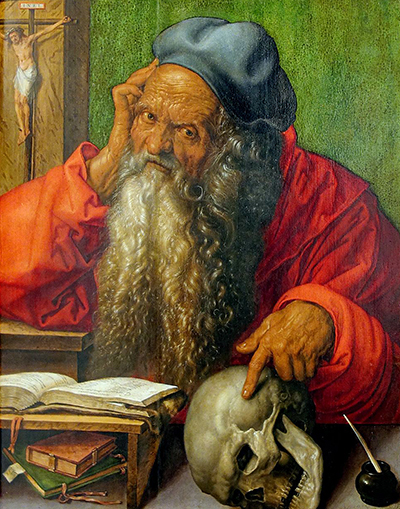
Dürer painted Jerome in oils and gave it to Rodrigo, who gave Susanna a ducat. Lisbon's museum identifies the recipient as Rui Fernandes de Almada and the picture as its Saint Jerome (1521), oil on oak, 59.5 by 48.5 centimetres. One hand supports the head; the other points diagonally towards the skull below. The open book meets the frame's edge. Compared with the whole room in the 1514 engraving, this saint seems almost within reach. The Almada family retained the painting until its purchase by Lisbon's Academy of Fine Arts in 1880. [1] [8]
Preparatory work makes that invention concrete. The ALBERTINA's arm and hand study explores an arrangement subsequently changed in the painting, while a separate study isolates the reading desk and books. Matthias Mende's object essays identify revisions to the forearm and to the lower corner of the composition. Dürer was doing sustained studio work during the journey, testing parts before resolving the image. [9]
The whale that was no longer there
In December 1520 Dürer went to Zeeland hoping to see a stranded whale near Zierikzee. Before setting out, he repeated reports of its extraordinary size and of the difficulty people expected in cutting it up. Those dimensions belonged to the story he had heard. He never obtained the direct encounter that might have tested them. [1]
The expedition instead produced one of the diary's most dramatic passages. At Arnemuiden, a collision and a broken rope left the vessel carrying Dürer and a few others drifting away from the shore in strong wind. Most of the crew had already landed. In his telling, the skipper panicked; Dürer urged him to consider what could be done. The remaining passengers helped raise a small sail, brought the boat back towards land and received assistance from the shore. [1]
The narrative allows him a composed role in the emergency, but it also preserves the physical vulnerability of travel. Elsewhere the group spent a freezing night at anchor without food or drink. When Dürer finally went towards Zierikzee, the tide had carried the whale away. The animal that had drawn him out remained absent from his book of observations. [1]
There were other things to see. Middelburg's buildings impressed him, and he commented on an altarpiece by Jan de Mabuse, praising the colouring more than the drawing. Portrait work continued during the excursion. The pursuit of one remarkable creature opened into a broader journey through towns, harbours and households. [1]
Illness later intruded more insistently. After Easter 1521 Dürer described fever, weakness, nausea and headache, adding that he had previously suffered an unfamiliar illness in Zeeland which still troubled him. Payments to doctors, apothecaries and a surgeon recur. The diary gives us symptoms and treatment expenses; it does not establish a modern diagnosis or prove that this episode caused his death seven years later. Rodrigo's gifts of sweetmeats during the illness offer a more securely documented continuation of their friendship. [1]
Older paintings and living lions
Dürer's April excursion to Bruges and Ghent combined hospitality with a concentrated encounter with Netherlandish art. Jan Provoost accompanied him to Bruges and lodged him at his house. Goldsmiths, painters and merchants welcomed the visitor, and a large company escorted him home with torches. As in Antwerp, professional regard became an event remembered through its meals and ceremonial courtesies. [1]
The viewing was substantial. Dürer recorded paintings by Rogier van der Weyden and Hugo van der Goes, works associated with Jan van Eyck, and Michelangelo's Madonna in the Church of Our Lady. Churches and collections offered a succession of things to inspect, with his hosts helping him gain access. He repeatedly remembered the people who opened paintings for him and the small sums he paid them. [1]
In Ghent the painters took him up the tower of St John's to survey the city. He then examined the Van Eyck altarpiece, praising its studied execution and selecting the Eve, Mary and God the Father for particular approval. His enthusiasm gives older Netherlandish painting an immediate presence in the trip. He encountered it as an artist scrutinising achievements that remained compelling. [1]
Afterwards he saw the lions and drew one in silverpoint. Berlin's Two Seated Lions , a sheet measuring 12.1 by 17.1 centimetres from the dispersed sketchbook, is usually connected with this visit. Its light prepared surface received the metal's fine marks. Hans Mielke suggested that the two poses show one animal. [1] [10]
Profile and forward gaze sit side by side, with long mane hairs falling towards broad, resting paws. On the reverse, a portrait made in Antwerp shares space with an Andernach landscape added on the homeward route. The sheet carries several stages of a journey on its two faces. [10]
Luther, Erasmus and unfinished questions
On the Friday before Whitsun 1521, news reached Dürer that Martin Luther had been carried off near Eisenach. Unsure whether Luther was alive, he wrote an extended lament. Its prayers and accusations interrupt the lists of expenditure. He praised Luther's interpretation of the Gospel, denounced abuses associated with the papacy and called upon Erasmus to defend Christian truth. [1]
This is the response to an alarming report, not reliable news of Luther's death. Nor does the address to Erasmus establish that Dürer sent him a separate letter. Within the diary, however, it makes the strength of his religious feeling unmistakable. The man who carefully recorded visits to relics and payments to confessors was also reading Luther and fiercely supporting reform. His experiences belong to an unsettled moment whose commitments should be described through the evidence rather than compressed into a single later label. [1]
Erasmus was already a real acquaintance. The diary records portraits and gifts, and an Antwerp dinner at which they were both present. Their encounter had an afterlife in Dürer's engraved portrait of 1526, though that later work also drew on Quentin Massys's medal. The travelled relationship and the eventual printed image had distinct histories. [1] [11]
Religious drawing continued during the stay. Dürer recorded three scenes of Christ carrying the Cross and two of Christ on the Mount of Olives on five half-sheets. Dana E. Cowen's study of the drawings conventionally grouped as the Oblong Passion argues that their wider format and restrained drama were shaped by Netherlandish art and reforming ideas. She proposes that they could function as independent drawings, questioning the familiar account of preparations for an abandoned print series. The group extended into 1524: the question of what to make from the journey remained open after the return. [1] [12]
The diary preserves another, briefer encounter with a young artist. Dürer bought a small illuminated image of the Saviour from Susanna, the daughter of the painter Gerard Horenbout. His surprise that a woman could paint so well makes the compliment revealing in more than one way. Like his admiration for distant makers, it shows an eye responsive to skill together with assumptions that shaped how he registered it. This Susanna was a different person from the maid travelling with his household. [1] [13]
Another direct exchange came near the end of the stay, when Lucas van Leyden entertained Dürer at Antwerp. Dürer drew him in silverpoint and exchanged eight florins' worth of his own prints for a set of Lucas's engravings. He was leaving with another printmaker's work as well as distributing his own. The encounter gives professional reciprocity a particularly clear material form. [1]
Leaving with more than an account book
Courtly recognition could still disappoint. On a visit to Margaret of Austria at Mechelen, Dürer offered a picture of the emperor which she disliked, and he took it away. She nevertheless showed him her collection. He admired small oil paintings and works by Van Eyck and Jacopo de' Barbari, and asked for Jacopo's little book. Margaret said that it had already been promised to her painter. [1]
These are memorable limits to the diary's repeated honours. Dürer could be celebrated by a guild and still fail to obtain a desired object or a patron's approval. In his final reckoning he complained of financial loss and singled out Margaret's lack of recompense. He also recorded borrowing 100 gold florins from Alexander Imhof, giving a sealed undertaking to repay him in Nuremberg. The loan makes a need for ready money tangible. His broader complaint still cannot supply a complete balance sheet for a year containing purchases, valuable gifts and a renewed lifetime pension. [1]
The last weeks continued to generate work. Christian II of Denmark summoned him for a portrait, and Dürer followed the king to Brussels, where he painted him in oils. Transport arrangements changed, more presents arrived, and more gratuities went out. The return began in July 1521 through Leuven, Maastricht, Aachen and Cologne, with the familiar succession of inns, meals and fares. [1]
The diary ends with the same mixture of work and practical arrangements that filled the year. Books of prints had secured hospitality and passed between artists; drawings followed dinners, visits and chances to see something new. In the final entries Dürer was still paying for rooms, packing and making portraits. He returned from a place where his existing images had found new viewers and where looking, making and exchange had become inseparable parts of daily life. [1]
Frequently Asked Questions
Further reading
A historical edition for following the primary texts. Its translation and editorial commentary belong to the nineteenth century.
Literary Remains of Albrecht Dürer. William Martin Conway; manuscript transcripts and notes by Lina Eckenstein. Cambridge: Cambridge University Press, 1889.
Read the Netherlands travel diary in a historical English edition. Read the digitised edition.
Artworks directory
These 187 records include individual works, reverse sides, detail views, paired panels and reconstructed arrangements. Three additional catalogue images repeat works already listed. Related views are not counted as separate originals; qualified attributions and published dating are retained.
Discussion
Look again at the images and ideas explored in Dürer in the Netherlands, 1520–1521. These editorial prompts invite your observations.
Reader Insights
Which detail or idea in Dürer in the Netherlands, 1520–1521 most changed your reading, and why?
How does the discussion of “Prints on the river” affect your understanding?
What comparison would you bring to the discussion of “Leaving with more than an account book”?
Join the Conversation
Share a detail, comparison or question about Dürer in the Netherlands, 1520–1521 below.
References
- Albrecht Dürer , Records of Journeys to Venice and the Low Countries , edited by Roger Fry, translated by Rudolph Tombo (Boston: Merrymount Press, 1913), diary, pp. 31–99; translator credited p. 99. English translation from German. View source .
- William Martin Conway, Literary Remains of Albrecht Dürer (Cambridge: Cambridge University Press, 1889), manuscript transcripts and notes by Lina Eckenstein, selected pp. 34–35, 37, 40–41, 47, 51–52, 65–71, 82–83, 89–93, 97, 107–108, 115, 122–123. English translation from German. View source.
- British Museum, Knight, Death and the Devil, 1868,0822.198, collection record; entry from Giulia Bartrum, a catalogue of Dürer and his artistic legacy (descriptive citation), with contributions by Günter Grass, Joseph Leo Koerner and Ute Kuhlemann (London: British Museum Press, 2002), cat. 126; exhibition 2002–2003. English. View source.
- S. R. Koehler, A Chronological Catalogue of the Engravings, Dry-Points and Etchings of Albert Dürer, as Exhibited at the Grolier Club (New York: Grolier Club, 1897), selected entries: 5 (p. 5), 14 (p. 14), 16–17 (pp. 17–18), 32–33 (pp. 32–35), 34 (pp. 37–38), 35 (p. 42), 38 (p. 44), 55 (p. 51), 65 (p. 55), 69–70 (pp. 58–61), 71 (p. 63), 89 (p. 77), 95 (p. 81). English. View source.
- Margaret Doyle , Albrecht Dürer: Master Drawings, Watercolors, and Prints from the Albertina , National Gallery of Art exhibition brochure (2013), PDF p. 7. English. View source .
- Michael Roth , Agnes Dürer in niederländischer Tracht , KdZ 36, Berlin collection record; essay from Dürers Mutter (2006), pp. 148–150, cat. 93. German. View source .
- Julie Jones , “Gold of the Indies”, Metropolitan Museum of Art (2002), “Aztec Mexico.” English. View source .
- Museu Nacional de Arte Antiga , São Jerónimo , 828 Pint, collection record; “S. Jerónimo”, museum essay, e-cultura. Portuguese. View source 1 . View source 2 .
- Matthias Mende, ALBERTINA records for preparatory arm and hand studies, inventory 3168, and the reading desk and books, inventory 3176 (descriptive citations); essays from a catalogue of Dürer’s work (descriptive citation), edited by Klaus Albrecht Schröder and Maria Luise Sternath (ALBERTINA, Vienna, 2003), cats. 180 and 179, pp. 503–510. German. View source 1. View source 2.
- Hans Mielke , Two Seated Lions , KdZ 33 verso, Berlin museum record; revised by Ursula Mielke in From Schongauer to Holbein: Master Drawings from Basel and Berlin (National Gallery of Art, 1999), cat. 73, pp. 171–172. English translation from German. View source 1 . View source 2 .
- Metropolitan Museum of Art , Erasmus of Rotterdam , 1526, 19.73.120, collection record. English. View source .
- Dana E. Cowen , Albrecht Dürer's “Oblong Passion”: The Impact of the Reformation and Netherlandish Art on the Artist's Late Drawings , PhD dissertation, Case Western Reserve University (2014), introduction, pp. 1–13. English. View source .
- Getty Research Institute , Horenbout, Susanna , ULAN 500099479, authority record. English. View source .
- Charles Ephrussi, Albert Dürer et ses dessins (Paris: A. Quantin, 1882), selected pp.2,14–16,20,78–80,107,109,120,153,178,188,298,302; index pp.399,403,405–406,409–410; additional selected pp. 86, 111–112, 152, 158 (footnote 1) and 202. Original French edition. View source.
- T. Sturge Moore, Albert Dürer (London: Duckworth and Co.; New York: Charles Scribner’s Sons, 1905), part III, portrait discussion and caption of the 1500 Munich self-portrait; additional selected Part III, II Portraits, subsection III, Hans Tucher paragraph. Original English edition. View source.
- National Gallery of Art, Annual Report 1974 (Washington: National Gallery of Art, 1975), p. 23; title and copyright pages. English. View source.
- Campbell Dodgson, Catalogue of Early German and Flemish Woodcuts Preserved in the Department of Prints and Drawings in the British Museum, vol. 1 (London: British Museum, 1903). Original English edition Selected pp. 246, 260, 262, 272, 274, 288, 290, 294–296, 299–300, 302, 307. Additional selected introduction p. 3. View source.
- Maud Cruttwell, Andrea Mantegna, London: George Bell and Sons, 1901, pp. 110–112. View source.
- Albrecht Dürer and Benedictus Chelidonius, Epitome in Divae Parthenices Mariae Historiam ab Alberto Durero Norico per figuras digestam cum versibus annexis Chelidonii (Nuremberg: Albrecht Dürer, 1511); Vatican Library, Cicognara.IX.2022, scans 7–46, including all twenty designs, facing texts and final imprint. Latin. View source.
- Hermann Knackfuß, Dürer, 12th edition (Bielefeld and Leipzig: Velhagen & Klasing, 1921), printed pp. 19–20, 24–26, 45–46, 58–60 and 138; plates 22, 30, 36 and 61. Original German edition. View source.
- Heinrich Wölfflin, Die Kunst Albrecht Dürers, second enlarged edition (Munich: F. Bruckmann, 1908), pp. 110, 298. Original German edition. View source.
- Joachim von Sandrart, L’Academia Todesca della Architectura, Scultura & Pittura: oder Teutsche Academie der Edlen Bau- Bild- und Mahlerey-Künste (Nuremberg, 1675), II, book 3, p. 224; facsimile and transcription. View source 1. View source 2.
- Moriz Thausing, Dürer: Geschichte seines Lebens und seiner Kunst (Leipzig: E. A. Seemann, 1876). Original German edition Selected pp.303, 306, 308–309. View source.
- S. R. Koehler, A Chronological Catalogue of the Engravings, Dry-Points and Etchings of Albert Dürer, as Exhibited at the Grolier Club (New York: Grolier Club, 1897), p. 5, cat. 5. English. View source.
- Burlington Fine Arts Club, Exhibition of Early German Art (London: Burlington Fine Arts Club, 1906). Original English catalogue P.24, no.38. View source.
- Germanisches Nationalmuseum, Katalog der im Germanischen Museum befindlichen Gemälde (Nürnberg: Verlag des Germanischen Museums, 1893), pp.34–35, nos.206–209. Original German catalogue. View source.
- Moriz Thausing, Albert Dürer: His Life and Works, translated from German, edited by Fred. A. Eaton, vol. II (London: John Murray, 1882), pp. 16–18. Original English edition. View source.
- Moriz Thausing, Albert Dürer: His Life and Works, translated from German, English edition edited by Fred. A. Eaton, vol. I (London: John Murray, 1882), pp. 119–120. Historical English edition. View source.
- Heinrich Weizsäcker, Catalog der Gemälde-Gallerie des Städelschen Kunstinstituts in Frankfurt am Main, Erste Abtheilung: Die Werke der älteren Meister vom vierzehnten bis zum achtzehnten Jahrhundert (Frankfurt am Main: Druckerei von August Osterrieth, 1900), nos. 83 and 85, pp. 91–98. Original German edition. View source.
- Joseph Heller, Das Leben und die Werke Albrecht Dürer's, vol. II, part 1 (Bamberg: C. F. Kunz, 1827), p. 118, no. 138; pp. 160–162, Florence entry 13; pp. 196–197, Munich entry 17; additional selected pp. 230–231, no. 6 and p. 260, entry e. Original German edition. View source.
- Hans W. Singer, Drawings of Albrecht Dürer (London: G. Newnes; New York: C. Scribner’s Sons, 1906), p. 8; Little Owl (Schönbrunner and Meder no. 829). Original English edition. View source.
- “Ein wiederaufgefundenes Gemälde von Albrecht Dürer”, Hamburgischer Correspondent, no. 473, Abend-Ausgabe (9 October 1900), p. 5, centre column (German). View source.
- Stijn Alsteens and Freyda Spira, with Maryan W. Ainsworth, Dirk H. Breiding, George R. Goldner, Guido Messling, Marjorie Shelley and Joshua P. Waterman, Dürer and Beyond: Central European Drawings in The Metropolitan Museum of Art, 1400–1700 (New York: Metropolitan Museum of Art; New Haven and London: Yale University Press, 2012), p. 15, fig. 2, Three Studies of a Left Hand, ALBERTINA 26327. English. View source.
- Johann Carl Sigmund Kiefhaber, ed., Nachrichten zur ältern und neuern Geschichte der freyen Reichsstadt Nürnberg: ein Beytrag zur Geschichte der Reichsstädte in Teutschland, vol.1 (Nuremberg: Lechner, 1803), first quarter, pp.6–9,14–16. Original German historical edition of correspondence and inventory. View source.
- Friedrich Winkler, Die Zeichnungen Albrecht Dürers, II (Berlin: Deutscher Verein für Kunstwissenschaft, 1937), no. 357, pp. 73–74. German. View source.
- The Metropolitan Museum of Art, Handbook of the Benjamin Altman Collection, with painting descriptions by Bryson Burroughs, other object descriptions by Durr Friedley and William M. Milliken, and introduction by Edward Robinson (New York: The Metropolitan Museum of Art; printed by The Gilliss Press, November 1914), no. 32, pp. 50–52; staff credits, pp. xiv–xv. Original English edition. View source.
- Germanisches Nationalmuseum, Barbara Dürer (German and English). View source.
- Web Gallery of Art, Tucher–Rieter reverse (English). View source.
- National Gallery of Art, Portrait of a Clergyman, object 1952.2.17 (English). Associated catalogue: John Oliver Hand, with the assistance of Sally E. Mansfield, an illustrated collection catalogue of late medieval and early modern German painting (descriptive citation) (Washington: National Gallery of Art, with Cambridge University Press, 1993), pp. 61–66. View source.
- Dürer Art, Portrait of a Man (English). View source.
- Hessen Kassel Heritage, Elsbeth Tucher (German). View source.
- Web Gallery of Art, Hans Tucher (English). View source.
- Germanisches Nationalmuseum, Emperor Maximilian I (German and English). View source.
- National Gallery of Art, Lot and His Daughters, reverse (English). View source.
- Bayerische Staatsgemäldesammlungen, Glim Lamentation (German). View source.
- Museo Nacional del Prado, Portrait of a Man (Spanish). View source.
- Bayerische Staatsgemäldesammlungen, Madonna of the Carnation (German). View source.
- Städel Museum, Job on the Dungheap (German). View source.
- Wallraf-Richartz-Museum, Piper and Drummer (German). View source.
- Italian Ministry of Culture / Uffizi, Head of Saint James (Italian). View source.
- Klassik Stiftung Weimar, Dresden Altarpiece (German). View source.
- Staatliche Museen zu Berlin, (entry description) collection record for painting 557I (1507), object 870760 (German and English). View source.
- Dresden State Art Museums / Roland Enke, Bernhard von Reesen (German). View source.
- Royal Collection Trust, Burkhard von Speyer (English). View source.
- Dresden State Art Museums, Seven Sorrows of the Virgin (English). View source.
- Bayerische Staatsgemäldesammlungen, Mater Dolorosa (German). View source.
- Bayerische Staatsgemäldesammlungen, Lucretia (German). View source.
- Städel Museum, Young Woman with Her Hair Down (English). View source.
- ALBERTINA, Portrait of a Young Man (German). Embedded essay credited to Eva Michel, no. 48, p. 98, fig. 48, in Sabine Haag, Christiane Lange, Christof Metzger and Karl Schütz (eds.), Dürer – Cranach – Holbein. Die Entdeckung des Menschen: Das deutsche Porträt um 1500 (Munich: Hirmer, 2011), inv. 3122. View source.







