


 by
Tom Gurney
Tom Gurney BSc (Hons) is an art history expert with over 20 years experience
Published on October 22, 2026 / Updated on October 22, 2026
Email:
tomgurney1@gmail.com
/ Phone:
+44 7429 011000
Dürer’s Small Passion: Introduction
Albrecht Dürer’s Small Passion puts a remarkably extensive Christian history into a compact woodcut book. Published in Nuremberg in 1511, it opens with the sorrowing Christ, then moves from Adam and Eve to the Last Judgement through thirty-six illustrated scenes. Forest, bedchamber, dining room, courtroom and burial place succeed one another within small rectangular frames. The surviving 1511 volume in Munich’s Bayerische Staatsbibliothek allows us to follow those changes as pages of a book, with poetry, margins and a final publishing statement still present. [7] [9]
The designs belong to about 1508–11; several bear the dates 1509 or 1510. The publication year therefore describes the completed book, rather than the making of every block. This is the woodcut Small Passion , distinct from Dürer’s Engraved Passion on copper. “Small” distinguishes its format from the Large Passion . Its narrative reaches well beyond the arrest, trial and execution that the word Passion might first suggest. [10] [11] [12]
At a Glance
- Book publication Nuremberg, 1511 [7]
- Designs Title image and thirty-six narrative woodcuts [7]
- Narrative range Adam and Eve to the Last Judgement [7]
Contents
- Opening the book
- Eden, a room and a city
- The long passage through judgement
- Cross, burial and the returning Christ
- Lines, blocks and books for sale
- The images outlive their first edition
- Frequently Asked Questions
Opening the book
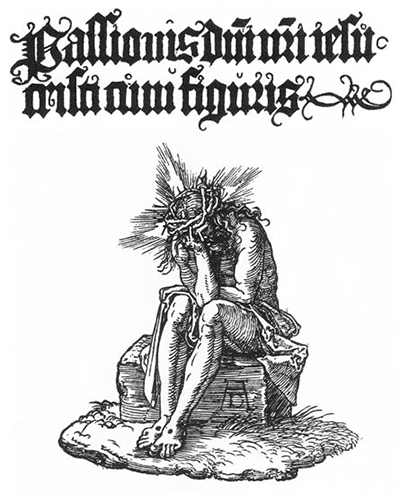
The title Christ sits on a block, head bowed into one hand, with bare legs and a thorny crown. Rays surround his face; empty paper leaves him without companions, architecture or crowds. [7] [13]
Beneath him, four Latin lines address the person looking. In paraphrase, Christ identifies humanity’s sins as the cause of his suffering and asks the reader to cease tormenting him through new offences. The voice makes a demand upon conduct, rather than simply announcing the contents. Above the image, the title names both the maker of the pictures and the monk whose poems accompany them: Albrecht Dürer and Benedictus Chelidonius. This is a religious book with a speaking image at its threshold, as well as an unusually visible declaration of artistic authorship. [7]
Bridwell Library describes the 1511 publication as a small quarto of thirty-eight leaves: title, thirty-six narrative illustrations and colophon. That gives thirty-seven woodcut designs. “Small quarto” is the library’s format description; the distinction between leaves and pictures matters whichever catalogue terminology a particular collection uses. [9]
Regensburg University Library identifies Hieronymus Höltzel as printer of Dürer’s four religious woodcut books of 1511. Dürer designed and published this cycle; Chelidonius supplied Latin poetry already used with Hans Wechtlin’s woodcuts. The verses were not all newly written for these images. Text faces a full-page illustration across an opening. This arrangement invites movement between verbal and visual accounts; its Latin also cautions against assigning the book a uniformly unlettered audience. Looking, reading and turning pages offered different ways of attending to the same story. [14]
The Munich copy makes that physical arrangement visible. The poem for the Fall occupies the back of the title leaf, opposite the illustration. Its heading identifies a heroic poem; other headings identify elegies and different verse forms. The text has its own succession of shapes and lengths. Wide margins surround both print and poem, while handwritten additions in this particular copy show that its present pages include more than the original printed programme. Those additions belong to this volume’s subsequent use; they cannot identify the behaviour of every early reader. [7] [14]
Selected sheets from the Small Passion
Eden, a room and a city
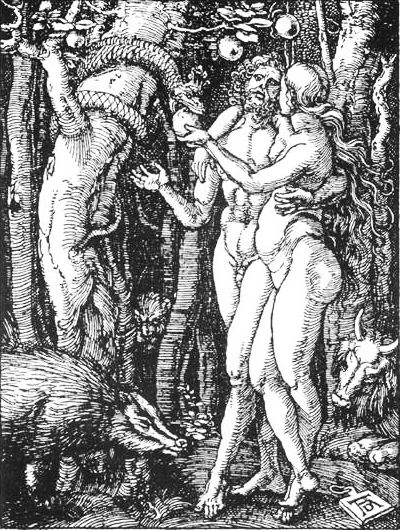
The first narrative pair establishes the world from which redemption becomes necessary. In the Fall , a thick trunk rises at the left and foliage fills the upper edge. Adam and Eve stand towards the right, sharply lighter than the surrounding woods. Animals occupy the lower corners. The serpent’s curved body, the reaching arm and the fruit occupy different heights, so that the compact composition can hold both the encounter and the environment in which it occurs. [7]
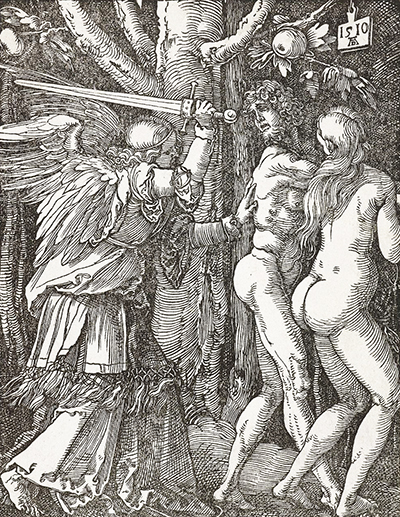
The Expulsion retains trees and fruit but introduces a sword almost spanning the picture. Its angel strides from the left; Adam and Eve turn towards the right. The overlapping legs make the exit crowded and uneven. Dürer has altered the whole arrangement while keeping enough of the woodland setting for the two scenes to be compared. The date 1510 appears on a small tablet high among the branches. [7]
The Annunciation replaces this forest with an interior. Gabriel enters at the left, Mary kneels at the right, and the dove occupies a bright diagonal between them. A curtain and canopy darken the space behind Mary. The next scene, the Nativity, introduces the infant beneath a rough shelter. Within a few pages the book moves from the first humans to the beginning of Christ’s earthly life, making the Fall part of the story the Passion will answer. [7]
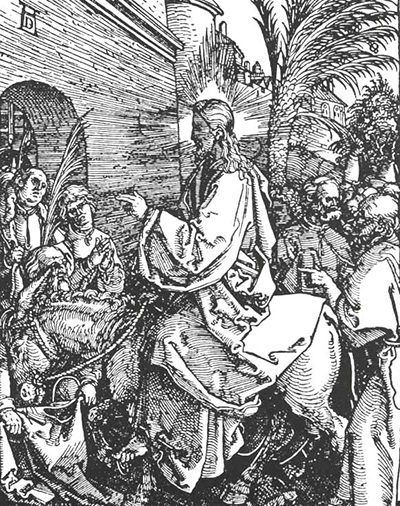
The Entry into Jerusalem brings a different sort of enclosure. A tall wall runs across the right background, broken by an arched gate. Christ sits on the donkey near the front, with a dense company following him and branches rising above their heads. A figure stoops towards the road. The wall’s long, nearly horizontal lines distinguish it from the clustered leaves and faces on the opposite side. This is a crowded image whose larger divisions remain easy to grasp. [7]
The cleansing of the Temple, the farewell to Mary, the Last Supper and the washing of the disciples’ feet lead towards the arrest. The Munich volume places the farewell after the Temple scene; the Pushkin catalogue lists it before the Entry. A particular bound copy and a modern sequence list should therefore be kept distinct. Both arrangements include the private separation alongside the public events in Jerusalem. [7] [10]
The farewell comes from the medieval Vita Christi devotional tradition, as the National Galleries of Scotland explains. Cole’s 1844 edition prints a Latin passage from the Meditations on the Life of Christ : Mary and Magdalene seek to keep Jesus from Jerusalem, while he explains that the time of redemption has arrived. This provides a fuller narrative setting for the kneeling mother in Dürer’s image. It is a devotional elaboration beyond the Gospel accounts, and it gives anticipation its own place before the suffering begins. [15] [16]
The supper and foot-washing bring the disciples into a shared interior. Cole’s accompanying biblical selections connect the meal with the announcement of betrayal, and the washing with Christ’s instruction that his followers serve one another. His English texts are nineteenth-century companions to the pictures, replacing the original Latin poems. Read as such, they help explain why these two episodes belong before the arrest: the company is established before it breaks apart. [16]
The long passage through judgement
The Agony in the Garden separates the praying Christ from the sleeping disciples; the Betrayal introduces an armed party. Thereafter, the series makes room for Annas, Caiaphas, mockery, Pilate and Herod before scourging, the crown of thorns, the presentation to the people and Pilate’s washing of his hands. These are distinct scenes in the 1511 volume. The reader encounters repeated changes of authority and setting before reaching the road to execution. [7]
Cole’s selected passages from John and Luke make those transfers unusually clear. Annas sends the prisoner to Caiaphas. Pilate, learning of Christ’s Galilean origin, sends him to Herod, who questions him and returns him. The biblical extracts give different explanations for the successive encounters; they are not merely multiple illustrations of the same trial. Cole combines passages from several Gospels, and his arrangement should be understood as an editorial account of those texts, rather than a transcript of Chelidonius’s poems. [16]
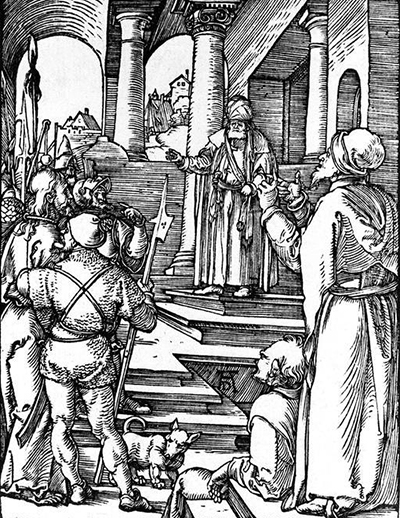
Dürer makes architecture an active part of Christ before Pilate . The governor stands at the top of a flight of stairs, beneath an arch and beside columns. Christ and his guards occupy the lower left. At the right, a tall standing figure raises a hand; a seated man below him looks across the scene. The diagonal of the stairs gives the eye a route towards Pilate, but the figures interrupt it at several points. Through the upper opening, roofs and a distant tower place the hearing within a larger town. [7]
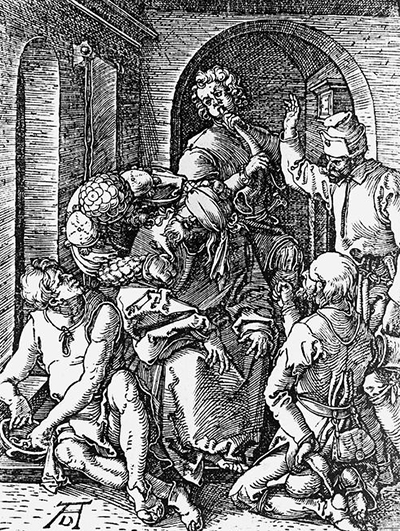
The blindfolded Mocking of Christ uses a lower, tighter room. Christ sits near the centre, with an upright figure immediately behind him and a kneeling tormentor at the front. Limbs point in different directions across the central group. The black spaces beneath the ceiling and within the doorway make the lighter garments and exposed faces particularly distinct. Dürer need not fill every recess with detail: a dark opening can establish depth more decisively than another row of objects. [7]
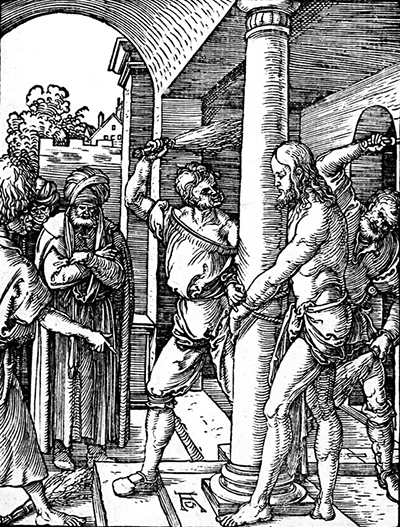
Scourging brings a column close to the front. Its rounded base and capital give a firm vertical against the executioners’ raised arms. Christ stands beside it, while an observer at the left occupies the boundary between the punishment and an open arch. Beyond that arch are trees and buildings. The far view remains visible even though the foreground figures take up most of the picture. The small format accommodates both a concentrated incident and a more distant world. [7]
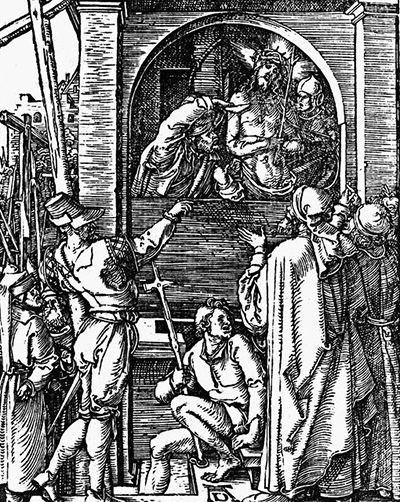
The crowning scene returns Christ to a seated position, surrounded by men using long implements above his head. In the Ecce Homo , he is displayed inside an elevated arch. Below, a man sits almost at the picture’s centre, while standing figures flank him and direct their gestures upwards. The opening is narrower than the group of spectators beneath it. After so many enclosed encounters, the presentation turns the prisoner towards a larger assembly without removing the architectural barrier between them. [7]
These settings help distinguish images that are easily confused when seen as small reproductions. The blindfold belongs to the mockery; the prominent column identifies scourging; the seated figure and implements distinguish the crowning; the elevated arched opening identifies the presentation. Pilate’s hand-washing has its own scene. Attending to those differences restores the particular actions that a loose label such as “Christ’s trial” can conceal. [7]
Cross, burial and the returning Christ
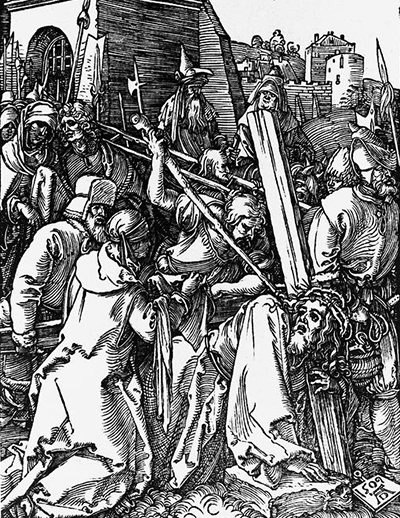
The Bearing of the Cross brings timber, weapons and people into the street. The long beam climbs through the right side of the image, almost parallel to the frame, while the crosspiece cuts across the men behind Christ. Veronica’s pale garment occupies much of the lower left. Roofs and an opening in the wall establish the city behind the tightly packed procession. The contrast between those broad boards and the many smaller curved lines keeps the cross visible within the crowd. [7]
Veronica’s separate image shows her between Peter, with his keys, and Paul, with his sword, displaying the face on her cloth. Shira Brisman reads this iconic pause, the burdened bearer in the Deposition, Christ’s finger near Magdalene’s forehead and the Ascension’s footprints through contact, bodily presence and absence. She relates these traces to printing’s transfer of an image. The reversed entrances in the Annunciation and appearance to Mary, and the movement from opening sufferer to final judge, extend that reading. It is an interpretation, rather than Dürer’s recorded explanation. [13]
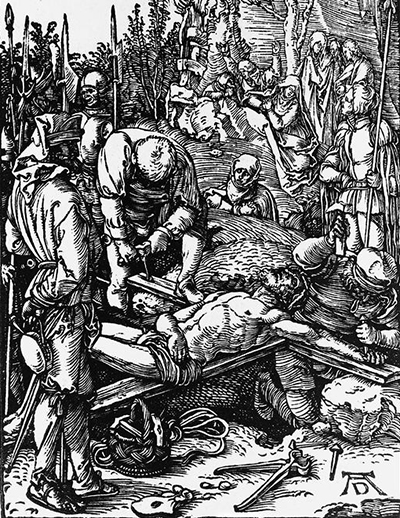
The Nailing to the Cross offers a markedly different construction. The timber lies across the ground, running out towards the lower right. One workman bends over an arm; another kneels at the opposite side, while a standing figure fills the left foreground. A rope, hammer and other implements lie close to the lower border. Upright weapons rise behind a bank of heads. The picture distinguishes the horizontal work below from the crowded company above, avoiding any need for an empty surrounding stage. [7]
Crucifixion, the descent into Limbo, Deposition, Lamentation and Entombment extend the account of Christ’s death. The Limbo image depicts his descent among the dead, a Christian tradition beyond a directly narrated Gospel episode. In Cole’s edition it is accompanied by the Apostles’ Creed. His burial selections name Joseph of Arimathea and Nicodemus and describe linen, spices and a nearby garden tomb. These different textual companions explain different parts of the sequence without making all its subjects equally biblical. [16]
The Resurrection does not end the book. Christ’s appearances to his mother, Magdalene, the companions at Emmaus and the apostles in the Thomas scene are followed by Ascension, Pentecost and Last Judgement. The whole last movement remains present in the 1511 volume: rising, appearing, departing and the descent of the Holy Spirit occupy successive designs before the final vision. [7]
The Pushkin Museum associates the appearance to Mary with the Golden Legend . Cole instead supplies an excerpt from Ludolph of Saxony’s Life of Christ . That passage explicitly acknowledges that the appearance is absent from the Gospel and defends it as a pious belief. The difference is useful: a devotional subject could circulate through more than one textual tradition. The citation printed by Cole names a Lyon edition of 1516; it does not prove that Dürer used that particular edition for a book published five years earlier. [10] [16]
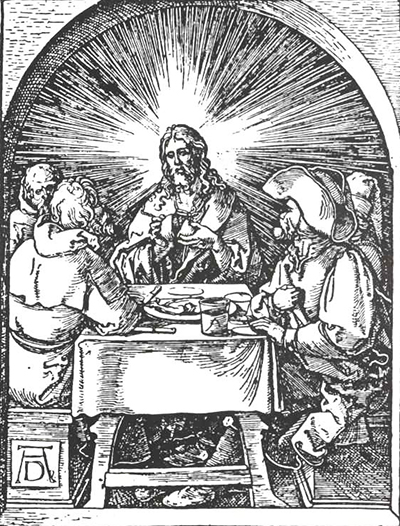
Magdalene’s encounter takes place outside. Christ’s spade crosses the sky behind his shoulder, and a winding route leads towards the distant tomb. Cole pairs the picture with John’s account of her mistaking Jesus for the gardener before recognising him when he calls her name. At Emmaus, his extract from Luke makes the breaking of bread the moment of recognition. These are different encounters, in different environments, with different explanations for the failure to recognise a familiar person. [16]
Dürer’s Emmaus table fills almost the entire lower width. A jug stands at the right; small vessels and a dish punctuate the tabletop. The companions sit either side of Christ, whose radiance spreads across the arch behind him. Hats, sleeves, bench supports and the fall of the tablecloth occupy distinct parts of the frame. Objects that would be incidental in a large painting become substantial shapes here. The viewer can move from the meal’s furnishings to the bright centre without losing the sense of one small room. [7]
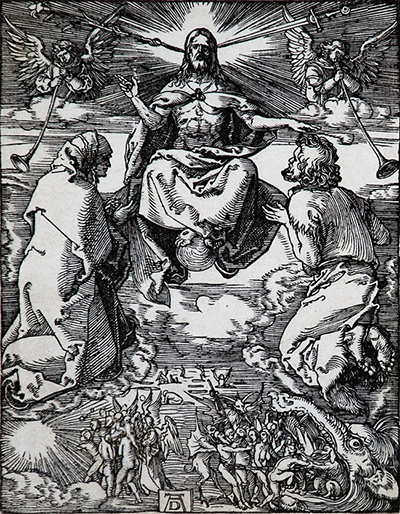
The Last Judgement divides its rectangle vertically. Christ, angels and the kneeling intercessors occupy the upper area; far smaller figures fill the ground below. Mary and John the Baptist flank the judge. At the lower right, the mouth of hell receives the condemned. Cole prints Matthew’s account of the Son of Man gathering and separating the nations beside this design. His selection makes the subject’s finality explicit: the book extends from human origins to a judgement of humanity. [17] [16]
Lines, blocks and books for sale
Woodcut transfers ink from a block’s raised surface; cutting removes the areas intended to remain white. Engraving instead holds ink in lines cut into metal. Lippmann’s historical handbook describes the burin pushing those furrows into copper. His explanation helps keep Dürer’s two small Passion cycles materially distinct, even when their subjects overlap. A familiar composition or a similar size cannot establish the printing method. [18] [19]
The Small Passion repeatedly changes the distribution of black and white. Closely packed strokes make the forest dark; longer parallel marks build the Jerusalem wall; radiating lines organise the space above the Emmaus table. Large light passages remain available for robes and architectural openings. Viewed across the whole cycle, the prints do not maintain one uniform density. Dürer adapts the marks to a setting and then changes the arrangement again on the next page. [7]
Designing the image, carving its block and printing a sheet are separate operations. Dürer’s authorship does not prove that he cut every block himself. Cole was already arguing in 1844 for a division of labour, reporting John Thompson’s comparison of different cutting styles. His confidence that he could identify at least four cutters belongs to that historical argument; it does not supply their names or settle the workshop’s organisation. The distinction remains useful without adopting Cole’s disparagement of the early cutting. [16]
The 1511 colophon adds a forceful publishing voice. It names Dürer as painter in Nuremberg and invokes a privilege from Emperor Maximilian against printing these images with substitute blocks or selling such impressions within the Empire. This is the book’s own assertion of protection, not a record of a particular prosecution. Its placement after the images and poems gives the reader another account of what the volume contains: labour and invention whose reproduction the publisher sought to control. Immediately before it, verses name Willibald Pirckheimer and Johann Cochlaeus alongside Chelidonius. The closing leaves preserve a literary exchange as well as a commercial claim. [7]
Dürer’s Netherlandish diary records the series as merchandise still in circulation years after publication. At Antwerp, Sebald Fischer bought sixteen small Passions for four florins. In the same transaction, Dürer lists thirty-two large books, six engraved Passions and other prints. Conway’s 1889 translation preserves the distinctions between products. This was a substantial mixed purchase, not a surviving universal price list. The entry demonstrates that Dürer could supply numerous copies of the small cycle alongside quite different publications; it does not reveal the profit on each book. [12]
The images outlive their first edition
The British Museum preserves thirty-five of the thirty-seven blocks. Its Entombment , about 1509–10, measures 129 × 99 × 25 millimetres: pearwood cut tangentially along the grain, according to its 1993 examination. The title disappears from later sixteenth-century impressions, suggesting damage or separation. Daniel Bissuccio’s Venice edition of 1612 supplied Italian text and an engraved title portrait based on Matthes Gebel’s Dürer medal. The farewell block separated after that edition and before the museum’s 1839 purchase from the Reverend P. E. Boissier. [20]
The Met’s Venetian Nailing to the Cross , printed in 1612, has a 12.6 × 9.7 centimetre image on a 20.5 × 14.7 centimetre sheet: a posthumous impression of Dürer’s design. [21]
Other artists carried the designs through new matrices. Scotland’s catalogue identifies copies by Marcantonio Raimondi in 1511 and Johann Mommard in 1587. Copying a composition, reprinting its original block and making a deceptive forgery describe different activities. In painting, Monica Alderotti identifies Dürer’s Emmaus woodcut as a source for Pontormo’s 1525 Supper at Emmaus , made for the Galluzzo Charterhouse guest quarters. Bridwell proposes that Antonio Tempesta’s Nailing illustration in the Medicea Arabic and Latin Gospels, Rome, 1591, paid homage to Dürer. The intention remains a proposal. [15] [22] [23]
Henry Cole’s 1844 edition made another kind of new object. His preface explains that the thirty-five museum blocks had broken borders and worm damage. With the trustees’ permission, stereotype casts were taken from them. The edition added new borders, filled gaps and employed Thurston Thompson to recut parts. Thompson also recreated the two missing subjects, the seated Christ and the farewell. These pages combine reproduction and intervention; their clear lines should not be mistaken for evidence that the original wood survived untouched. [16]
Cole describes the casting process in some detail. A plaster mould was taken from a woodcut, dried by baking and used to produce a metal cast. He believed the plaster’s slight contraction helped recover the fineness of lines that had thickened through wear. That is the editor’s explanation for the appearance he sought. It makes his edition a record of nineteenth-century restoration and publishing ambitions as well as a vehicle for Dürer’s compositions. Its impressions came from stereotype copies, supplemented by the two recut designs, rather than directly from all thirty-seven original blocks. [16]
His treatment of the text changes the experience again. English biblical extracts replace Chelidonius’s Latin poems. The farewell, Veronica, descent into Limbo and appearance to Mary move into an appendix, introduced as subjects lacking a directly applicable passage of Scripture. Cole retained all four pictures while separating their textual status from the rest. A reader of that edition therefore encounters a different sequence and a different boundary between biblical narration and devotional tradition. Even a reproduction devoted to recovering old designs can reorganise their argument. [16]
The preface also preserves a disagreement about how early prints should look. Cole thought the repaired casts compared favourably with early impressions, and reported a critic who might have accepted them as early had they appeared on old paper. His anecdote is not an authentication test. It reveals how a publisher could make newness seem like recovered antiquity. Paper and matrix history must be considered together when two sheets present apparently similar lines. [16]
The National Gallery of Victoria’s conservation research supplies a further distinction. Laid and chain lines preserve the structure of a papermaking mould; a watermark records an attached wire design. Cutting or trimming can leave only a fragment, or no mark. Watermarks are studied alongside catalogues, printing evidence and provenance; a recognisable motif alone cannot date a sheet. [24]
For an individual print, establish its edition, text, margins and matrix before comparing the lines. Then look closely at the images: their forests, rooms, stairs and streets keep rewarding attention. [16] [20] [18] [24]
Frequently Asked Questions
Artworks directory
These 187 records include individual works, reverse sides, detail views, paired panels and reconstructed arrangements. Three additional catalogue images repeat works already listed. Related views are not counted as separate originals; qualified attributions and published dating are retained.
Discussion
Look again at the images and ideas explored in Dürer’s Small Passion. These editorial prompts invite your observations.
Reader Insights
Which detail or idea in Dürer’s Small Passion most changed your reading, and why?
How does the discussion of “Opening the book” affect your understanding?
What comparison would you bring to the discussion of “The images outlive their first edition”?
Join the Conversation
Share a detail, comparison or question about Dürer’s Small Passion below.
References
- Charles Ephrussi, Albert Dürer et ses dessins (Paris: A. Quantin, 1882), selected pp. 2, 14–16, 20, 78–80, 86, 107, 109, 111–112, 120, 152, 153, 158 (footnote 1), 178, 188, 202, 298 and 302; index pp. 399, 403, 405–406 and 409–410. Original French edition. View source.
- S. R. Koehler, A Chronological Catalogue of the Engravings, Dry-Points and Etchings of Albert Dürer (New York: Grolier Club, 1897). Original English edition. Selected pp. 5, 14, 17–18, 32, 37, 42, 44, 50–51, 58, 60, 63, 81. View source.
- Heinrich Wölfflin, Die Kunst Albrecht Dürers, second enlarged edition (Munich: F. Bruckmann, 1908), pp. 110, 298. Original German edition. View source.
- Campbell Dodgson, Catalogue of Early German and Flemish Woodcuts Preserved in the Department of Prints and Drawings in the British Museum, vol. 1 (London: British Museum, 1903). Original English edition. Selected pp. 246, 260, 262, 272, 274, 288, 290, 294–296, 299–300, 302, 307. View source.
- Johann Carl Sigmund Kiefhaber, ed., Nachrichten zur ältern und neuern Geschichte der freyen Reichsstadt Nürnberg: ein Beytrag zur Geschichte der Reichsstädte in Teutschland, vol.1 (Nuremberg: Lechner, 1803), first quarter, pp.6–9,14–16. Original German historical edition of correspondence and inventory. View source.
- T. Sturge Moore, Albert Dürer (London: Duckworth and Co.; New York: Charles Scribner’s Sons, 1905), Part III, II Portraits, subsection III, discussion and caption of the 1500 Munich self-portrait and Hans Tucher paragraph. Original English edition. View source.
- Albrecht Dürer and Benedictus Chelidonius, Passio Christi (Nuremberg: Albrecht Dürer, 1511), Bayerische Staatsbibliothek, Rar. 113. Original Latin book; digitised title page 5, narrative woodcuts 7–77 (odd-numbered pages), selected verse pages 6, 10, 18, 22, 28, 32, 50, 54, 64, 68 and 78, and colophon 79. View source.
- Hermann Knackfuß, Dürer, 12th edition (Bielefeld and Leipzig: Velhagen & Klasing, 1921), printed pp. 19–20, 24–26, 45–46, 58–60 and 138; plates 22, 30, 36, 48 and 61. Original German edition. View source.
- Bridwell Library , “The Small Passion”. English. View source .
- Pushkin Museum , Small Passion , three-part catalogue, middle scenes, final scenes; Christ Appearing to His Mother . English translations. View source 1 . View source 2 . View source 3 . View source 4 .
- Benedictus Chelidonius, compiler, and Albrecht Dürer, Passio domini nostri Jesu, Nuremberg, 1511. Latin. Bayerische Staatsbibliothek, Rar. 49; digitised images 4–27, title, illustrations, verse pages and colophon. Catalogue and manifest. View source.
- Albrecht Dürer, Netherlandish diary, in William Martin Conway, with transcripts and notes by Lina Eckenstein, Literary Remains of Albrecht Dürer (Cambridge: Cambridge University Press, 1889), pp. 37–38, 97, 103–104, 134–135. English historical translation from German. View source.
- Shira Brisman , “A Touching Compassion: Dürer’s Haptic Theology”, Open Arts Journal 4 (2014–15), pp. 9–27. English. View source .
- Universitätsbibliothek Regensburg , “Die drei großen Bücher Dürers”. German . View source .
- National Galleries of Scotland , Christ Taking Leave of His Mother , P 2693. English. View source .
- Henry Cole, ed., The Passion of Our Lord Jesus Christ, pourtrayed by Albert Durer (London: Joseph Cundall; William Pickering; George Bell; Oxford: J. H. Parker; Cambridge: J. and J. J. Deighton, 1844; printed by Charles Whittingham at the Chiswick Press), preface, illustrated biblical extracts and appendix (PDF pages 14–29, 31–93, 96–103). English and Latin. View source.
- Rijksmuseum , Laatste Oordeel , RP-P-OB-1356. Dutch description; English metadata . View source .
- Suzanne Boorsch and Nadine M. Orenstein (1997), study of northern Renaissance printmaking (article description), The Metropolitan Museum of Art Bulletin 54, no. 4 (New York: The Metropolitan Museum of Art), pp. 3–4. English. View source.
- Friedrich Lippmann, Engraving and Etching, revised by Max Lehrs, translated by Martin Hardie (New York: Charles Scribner’s Sons, 1906), pp. 1–2. English historical translation. View source.
- British Museum, Entombment block, 1839,0608.3.44, Scientific Research (December 1993); curator’s commentary from Giulia Bartrum et al. (2002), exhibition catalogue on Dürer’s graphic work and reception (catalogue description) (London: British Museum Press). English. View source.
- Metropolitan Museum , Christ Nailed to the Cross , 1612, 1986.1180.78. English. View source .
- Monica Alderotti, Uffizi Galleries, catalogue entry for Pontormo’s 1525 meal scene (entry description). English translation. View source.
- Bridwell Library, Arabic and Latin Gospels, Rome, 1591, AER1214. English description; illustrated book (Arabic and Latin). View source.
- National Gallery of Victoria , “Watermarks in the NGV’s Collection of Prints by Albrecht Dürer”. English. View source .
- Burlington Fine Arts Club, Exhibition of Early German Art (London: Burlington Fine Arts Club, 1906). Original English catalogue. P.24, no.38. View source.
- Moriz Thausing, Albert Dürer: His Life and Works, translated from German, edited by Fred. A. Eaton, vol. II (London: John Murray, 1882), pp. 16–18. Original English edition. View source.
- Joseph Heller, Das Leben und die Werke Albrecht Dürer's, vol. II, part 1 (Bamberg: C. F. Kunz, 1827), p. 118, no. 138; pp. 160–162, Florence entry 13; pp. 196–197, Munich entry 17. Additional selected pp. 230–231, no. 6 and p. 260, entry e. Original German edition. View source.
- Maud Cruttwell, Andrea Mantegna, London: George Bell and Sons, 1901, pp. 110–112. View source.
- Moriz Thausing, Dürer: Geschichte seines Lebens und seiner Kunst (Leipzig: E. A. Seemann, 1876). Original German edition. Selected pp.303, 306, 308–309. View source.
- Hans W. Singer, Drawings of Albrecht Dürer (London: G. Newnes; New York: C. Scribner’s Sons, 1906), p. 8; Little Owl (Schönbrunner and Meder no. 829). Original English edition. View source.
- Germanisches Nationalmuseum, Katalog der im Germanischen Museum befindlichen Gemälde (Nürnberg: Verlag des Germanischen Museums, 1893), pp.34–35, nos.206–209. Original German catalogue. View source.
- Joachim von Sandrart, L’Academia Todesca della Architectura, Scultura & Pittura: oder Teutsche Academie der Edlen Bau- Bild- und Mahlerey-Künste (Nuremberg, 1675), II, book 3, p. 224. Original German edition; facsimile and transcription. View source.
- Heinrich Weizsäcker, Catalog der Gemälde-Gallerie des Städelschen Kunstinstituts in Frankfurt am Main, Erste Abtheilung: Die Werke der älteren Meister vom vierzehnten bis zum achtzehnten Jahrhundert (Frankfurt am Main: Druckerei von August Osterrieth, 1900), nos. 83 and 85, pp. 91–98. Original German edition. View source.
- Albrecht Dürer and Benedictus Chelidonius, Epitome in Divae Parthenices Mariae Historiam ab Alberto Durero Norico per figuras digestam cum versibus annexis Chelidonii (Nuremberg: Albrecht Dürer, 1511); Vatican Library, Cicognara.IX.2022, scans 7–46, including all twenty designs, facing texts and final imprint. Latin. View source.
- Stijn Alsteens and Freyda Spira, with Maryan W. Ainsworth, Dirk H. Breiding, George R. Goldner, Guido Messling, Marjorie Shelley and Joshua P. Waterman, Dürer and Beyond: Central European Drawings in The Metropolitan Museum of Art, 1400–1700 (New York: Metropolitan Museum of Art; New Haven and London: Yale University Press, 2012), p. 15, fig. 2, Three Studies of a Left Hand, ALBERTINA 26327. English. View source.
- Friedrich Winkler, Die Zeichnungen Albrecht Dürers, II (Berlin: Deutscher Verein für Kunstwissenschaft, 1937), no. 357, pp. 73–74. German. View source.
- National Gallery of Art, Annual Report 1974 (Washington: National Gallery of Art, 1975), p. 23; title and copyright pages. English. View source.
- Albrecht Dürer, letter of 23 September 1506, in Records of Journeys to Venice and the Low Countries, edited by Roger Fry, translated by Rudolph Tombo, Boston: Merrymount Press, 1913, pp. 22–24. English translation. View source.
- Moriz Thausing, Albert Dürer: His Life and Works, translated from German, English edition edited by Fred. A. Eaton, vol. I (London: John Murray, 1882), pp. 119–120. Historical English edition. View source.
- The Metropolitan Museum of Art, Handbook of the Benjamin Altman Collection, with painting descriptions by Bryson Burroughs, other object descriptions by Durr Friedley and William M. Milliken, and introduction by Edward Robinson (New York: The Metropolitan Museum of Art; printed by The Gilliss Press, November 1914), no. 32, pp. 50–52; staff credits, pp. xiv–xv. Original English edition. View source.
- “Ein wiederaufgefundenes Gemälde von Albrecht Dürer”, Hamburgischer Correspondent, no. 473, Abend-Ausgabe (9 October 1900), p. 5, centre column (German). View source.
- Germanisches Nationalmuseum, Barbara Dürer (German and English). View source.
- Web Gallery of Art, Tucher–Rieter reverse (English). View source.
- National Gallery of Art, Portrait of a Clergyman, object 1952.2.17 (English). Associated catalogue: John Oliver Hand, with the assistance of Sally E. Mansfield, an illustrated collection catalogue of late medieval and early modern German painting (descriptive citation) (Washington: National Gallery of Art, with Cambridge University Press, 1993), pp. 61–66. View source.
- Dürer Art, Portrait of a Man (English). View source.
- Hessen Kassel Heritage, Elsbeth Tucher (German). View source.
- Web Gallery of Art, Hans Tucher (English). View source.
- Germanisches Nationalmuseum, Emperor Maximilian I (German and English). View source.
- National Gallery of Art, Lot and His Daughters, reverse (English). View source.
- Bayerische Staatsgemäldesammlungen, Glim Lamentation (German). View source.
- Museo Nacional del Prado, Portrait of a Man (Spanish). View source.
- Bayerische Staatsgemäldesammlungen, Madonna of the Carnation (German). View source.
- Städel Museum, Job on the Dungheap (German). View source.
- Wallraf-Richartz-Museum, Piper and Drummer (German). View source.
- Italian Ministry of Culture / Uffizi, Head of Saint James (Italian). View source.
- Klassik Stiftung Weimar, Dresden Altarpiece (German). View source.
- Staatliche Museen zu Berlin, (entry description) collection record for painting 557I (1507), object 870760 (German and English). View source.
- Dresden State Art Museums / Roland Enke, Bernhard von Reesen (German). View source.
- Royal Collection Trust, Burkhard von Speyer (English). View source.
- Dresden State Art Museums, Seven Sorrows of the Virgin (English). View source.
- Bayerische Staatsgemäldesammlungen, Mater Dolorosa (German). View source.
- Bayerische Staatsgemäldesammlungen, Lucretia (German). View source.
- Städel Museum, Young Woman with Her Hair Down (English). View source.
- ALBERTINA, Portrait of a Young Man, inv.3122 (German). Eva Michel, cat.48, p.98, fig.48, in Dürer, Cranach, Holbein: Die Entdeckung des Menschen: Das deutsche Porträt um 1500, edited Sabine Haag, Christiane Lange, Christof Metzger and Karl Schütz (Munich: Hirmer, 2011). View source.







